About Me

My photo
Montreal, Quebec, Canada
I am a Montreal-based actor, writer and comedian. When U.S. President John F. Kennedy was shot, I was three days old. I cried all day. My favourite books of all time are Moby Dick by Herman Melville, The Last Temptation by Nikos Kazantzakis and The Ewoks Fun Time Activity Book by Chirpa and Pamploo. I am a member of The Vestibules, On The Spot Improv and The Best Buy Battery Club. Except for the Battery Club, I've been at all this stuff for over 20 years. Enjoy my blog.
Showing posts with label John Wayne. Show all posts

Friday, April 1, 2011

The Best Movies of All Time by Genre

One question that I have always had a hard time answering is "What's the best movie of all time?".  Picking just one out of all the great cinematic achievements in the history of film is a task too daunting to even consider.

I loved it when The American Film Institute came out with a list of The Greatest Films of All Time ranked by Genre. Great idea. Once you break films down by genres it really takes the task of making the selections of the Best Movies of All Time right down to size.

In that spirit, here is my humble list of the The Best Movies of All Time by genre...


Best Western
Young Guns 
(1988, d: Christopher Cain)


There are a number of directors who are considered to be the cornerstone film makers of the Western genre. Their names are synonymous with the spirit of the genre itself. They have defined, explored, redefined and made the genre great. Among those auteurs are John Ford, Sam Peckinpah, Howard Hawkes, Sergio Leone, John Sturges, Anthony Mann, Clint Eastwood and, of course, the one name that no such list could be complete without, Christopher Cain, director of the Western that stood the genre on its head, Young Guns.

Young Guns is, without a doubt, a milestone. It was a film that was made at a time when Hollywood considered the Western a dead genre. The only other Westerns produced in the 1980's were Lawrence Kasdan's Silverado and Clint Eastwood's Pale Rider. They are two abysmal films that mark the Western at its absolute lowest level of complete creative and artistic bankruptcy.

Young Guns saved the genre and paved the way for the only two Oscar winning Western movies (the vastly inferior Dance With Wolves and Clint Eastwood's much overrated Unforgiven).

Cain's 1988 Western is about a group of characters rather than the traditional single lone hero previously quintessential to the genre. It improves upon a vision first put on the screen by John Sturges in The Magnificent Seven. That, in turn, was a film which was itself based on Akira Kurosawa's Seven Samurai. There is direct link between Kurosawa and Young Guns. The often made favorable comparisons to Kurosawa is something that director Cain earns beautifully.

Cain shows great knowledge and insight into the genre, single-handedly creating a vision of the Western as one of heroes vs villains. Young Guns is a Western film that takes place in the unique setting of vast empty deserts, open plains and small frontier towns.

Cain certainly knows good solid actors when he sees them. Midway through Young Guns, the brilliant Lou Diamond Phillips performs one of the finest film monologues I have ever seen. Cain's innovative direction raises the performances of Emilio Estevez, Charlie Sheen and Kiefer Sutherland to the level of performances made by John Wayne, Roy Rogers and Gary Cooper.

Young Guns is a Western that will be remembered and cherished for generations to come.


Best Chick Flick
300
(2007, dir: Zack Synder)


300 does not make it to the top of Chick Flick genre (as it has unfortunately become known) just on the strength of Gerard Butler and his 299 companions' incredible abs. The abs may help but that visual treat is not what is at the heart of 300's appeal to its target female audience.

Like many of the classic so-called "Chick Flicks", 300 is a period piece. 300 is also filled with many scenes of great emotional warmth and humour. As sensitive as Gerald Butler's delicate portrayal of the tender yet powerful King Leonidas is, let's face it, this is a movie that is really about the incredible woman in Leonidas's life, Queen Gorgo of Sparta.

Lena Headey (previously seen on the thankfully short lived TV series Terminator:The Sarah Connor Chronicles) is perfectly cast as Gorgo.  The relatively unknown English actress turned heads in Hollywood when she beat out Julianne Moore, Rene Zellewegar and Sandra Bullock for the coveted role. Once landing the part, Headley wisely lobbied to expand the role of Queen Gorgo from her one scene in the original (graphic) novel on which the movie is based to making her the centerpiece of the film version of 300.

300 follows the story of Gorgo as she must contend with taking over Leonidas' role as leader of Sparta while her husband is away dealing with foreign difficulties. The film follows the trial and tribulations of Gorgo's challenge to live and work as an essentially single mother in a world that was very much -at the time- almost completely male dominated. Gorgo has one particularly clever solution to the problem of one her husband's former rivals when he becomes a little too overly amorous. I'm not going to give anything away but let's just say it involves the very clever use of a seemingly innocent looking dagger.

The secondary story of 300 follows Leonidas as he deals with a competing group of Persians while visiting the nearby resort town of Thermopylae. The King employs a unique approach to conflict resolution management that marks one of the weaker and less significant parts of this otherwise great Chick Flick.


Best Historical Epic
More American Graffiti
(1979 dir: Bill L. Norton)
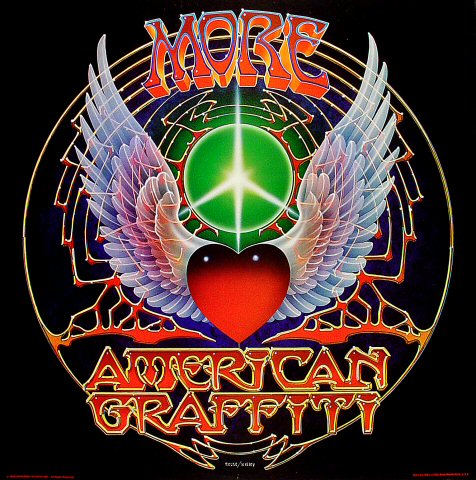


Many readers out there may be shocked that movies like Ben Hur, Lawrence of Arabia and Gandhi did not make into the number one spot in this category.

Let's make no mistake about it: William Wyler, David Lean and Sir Richard Attenborough are all fine filmmakers. There is one truth, however, about their work that few film critics or film academics ever point out : all of their movies are really long and dull.

In More American Graffiti, writer and director Bill L. Norton takes a mere 110 minutes to cover the tumultuous events that marked the social and political changes of the 1960's. The film depicts the Haight Ashbury drug scene, political campus activism , the birth of the woman's movement, psychedelia and the war in Vietnam.

C'mon, really, David Lean, do you actually need three and a half hours to tell the sweepingly epic story of an Arab revolt during World War I ? Is it necessary to devote roughly the same amount of  screen time to the story of guy who wins a chariot race, there, Willam Wyler? Here's an idea for your, Sir Richard: Indian Independence in 90 minutes or less.

Look, I'm just cutting out the niceties and saying what everyone is thinking.

More American Grafiti is, sadly, the lesser known sequel to George Lucas' first hit film, American Graffiti. It is a sequel that follows, among other things, the story of the Vietnam War. The beloved character of Toad from the original film has a far more interesting story and character development in this film as we follow his exploits during a war that defined an era.

More American Graffiti has scenes of Vietnam (some of which were shot by Lucas himself) that are amongst those of the very best films about the war: Apocalypse Now, The Deer Hunter, First Blood and Platoon.


Best Action Movie
On Deadly Ground
(1994, dir: Steven Seagal)


Long before being unfairly harassed by the FBI, Steven Seagal was one of the biggest box office action movie stars in the entire world. Unfortunately, thanks to the US government's baseless and unfair investigations, Seagal has now been force to retreat to making a modest living in the field of direct-to-DVD home entertainment.

In the heyday of Seagal's massive commercial success, he made one little film called On Deadly Ground. It was a time when Seagal's career was following the arc that a younger Clint Eastwood's career followed two decades earlier. Indeed, Seagal followed the inevitable evolution of his career from major motion picture star to major motion picture director. This great 1994 film marked the man's directorial debut.

On Deadly Ground is not your typical action movie fare. Not by a long shot. To be sure, though, the film does have some absolutely stunning and impeccably directed action scenes. Seagal proves himself to be not unlike James Cameron and Hal Needham in his mastery of both film technique and emotional substance. 

With extremely subtle and almost subversive direction, Seagal is able to work an environmentalist sub-text into the film. On the surface, On Deadly Ground may seem like a standard action film about a greedy oil company CEO (Michael Caine in his most overlooked yet arguably best performance) attempting to drill for oil on land owned by the Inuit. On another level, though, the film has almost undetectable undertones of messages about corporate greed, aboriginal rights and (though it took me multiple viewings to catch it) pro-environmental protection statements. When it comes to On Deadly Ground, I am grateful for the three years I spent studying film theory and criticism at Concordia University.

On Deadly Ground ends with Seagal making that one elusive thing in film that all fine actors seek: a career-defining speech. Take a look at Seagal's closing monologue and see if you can pick up on some of its more nuanced meanings....


Best Science Fiction Film
Master and Commander: The Far Side of The World
(2003, dir: Peter Weir)


Master and Commander is the best science fiction adventure flick to ever hit the big screen.  Director Peter Weir creates an exciting sense of adventure, exploration, and character development in a film that follows the captain and crew of a legendary ship of an organization known as the British Navy. In the film, the ship and its crew plunge headlong towards the vast deep reaches of the far side of the world.

It must be pointed out, though, that some elements of Master and Commander: The Far Side of The World are derivative of other films in the SF genre. Most notable among said films is, of course, the Star Trek movies.  Captain Jack Aubrey is clearly Captain James T. Kirk in different dress. Aubrey's ship, The HMS Surprise is a vessel not unlike The USS Enterprise. The character of Dr. Stephen Maturin is a wry combination of the friendship and loyalty displayed in both the characters of Mr. Spock and Dr. "Bones" McCoy. Even Russell Crowe’s wonderful interpretation of the character of Aubrey owes much to the ground breaking performances of William Shatner.

Such similarities are not necessarily bad, however. If you are creating surrealist art, is it wrong to be influenced by Rene Magritte? If you’re studying early childhood development, is it wrong to owe a debt of gratitude to Jean Piaget?  Is there anything wrong with a vaccine researcher building on the work of Jonas E. Salk?

Greatness stands on the shoulders of giants.

Master and Commander: The Far Side of The World is loosely based on Patrick O’Brian’s landmark series of books. O’Brian is often mentioned in the same breath as Arthur C. Clarke, Edgar Rice Burroughs and Orson Scott Card as the master and commander of the literary SF genre in his own right.

Master and Commander: The Far Side of The World has some amazing battle scenes. They are scenes that are reminiscent of the classic battles in Starship Troopers and the original Buck Rogers motion picture, which are generally considered the greatest science fiction battles scenes ever. 

The sequences that deal with the turbulent weather the HMS Surprise encounters on its voyages are, according to meteorological experts, the most accurate on-screen depictions of what great storms in the middle of vast bodies of water would most likely look like.

The evil nemeses of the film are The French. The French are a wonderful creation.  The concept of an alien race that speaks a different language, has a different culture and even different cuisine is just plain brilliant. Weir definitely gets a lot of mileage out the villainous French. 

Master and Commander also achieves at least one moment of true science fiction. It happens during a part of the story when the ship, somewhere in the South Pacific quadrant of the system, discovers a largely uncharted world known as the Galapagos Islands.  The lizards, birds, bugs and other fantastical creatures encountered during the scenes that take place in this strange Galapagos land contain the film's finest special effects. Using a combination of stop motion animation, CGI, and animatronic prosthesis, the visual FX team manages to bring to life creatures that look, act and move like real animals.

Many bloggers, internet commentators and critics have complained that much of the writing in Master and Commander: The Far Side of The World relies too heavily on pseudo scientific techno-babble.  Jargon like “mainsail”, “topsail”, “flying gib” and “masthead” are thrown around a great deal in the film. Such terminology is indeed hard to follow at times, if, in fact, that dialogue means anything at all. Nonehtheless, the so-called techno-babble jargon does invent a sense of verisimilitude towards an imagined reality that is central to the success of the movie.

Other critics, bloggers and internet commentators  have challenged the scientific accuracy of Master and Commander: The Far Side of the World as well.  One of the main bones of contention is the questionable notion that ships of the size, mass and weight of those depicted on screen would be at all able to achieve buoyancy on water. Another source of skepticism involves the far fetched manner in which the ships seem to be propelled by wind through the use of a technology know as "sails".

Oh c'mon, guys, that kinda nitpicking is beside the point. When dealing with a movie as entertaining as Master and Commander: The Far Side of the World,  why get bogged down on stuff like that? Does anyone question the scientific accuracy of the Flux Capacitor or the Death Star?

It’s just a movie. Chill.


Some other honourable mentions for the Best Movies Ever by genre include...


Best Horror Movie
Monster's Ball
(2001, dir: Marc Foresteter)


Best Romantic Comedy 
The Love God?
(1969, dir: Nat Hiken)

Best Musical
Sister Act 2
(1992, dir: Emile Ardolino) 

Best Superhero Movie 
Fearless Frank
(1967, dir: Philip Kaufman)

Best Sequel 
Godfather III
(1990, dir: Francis Ford Coppola)

Best Movie Based on a TV Show
M*A*S*H
(1970, dir: Robert Altman)

Best Documentary
Zelig
(1983, dir: Woody Allen)

Best War Movie
The Green Berets
(1968, dir: Ray Kellogg, John Wayne, Mervyn LeRoy)

Best Christmas Movie
Beneath The Planet of the Apes
(1970, dir: Ted Post)


The movie is even more exciting than the cover of the Blu-ray disc would have you believe


So there you have it folks. I'd be very surprised if any readers of this blog had any disagreements or issues with my choices. It's certainly a pretty hard list to argue with, that's for sure.

Until next time, gang, have a great first day of April!

Tuesday, November 30, 2010

The Article That All The In-Flight Magazines Rejected

The 10 Greatest Airline Disaster Movies of All Time


10. Zero Hour! (1954)
On a long transcontinental flight, the crew of a passenger airliner is incapacitated by food poisoning. The only person on board who can land the plane is burnt out veteran combat pilot suffering from post traumatic stress disorder.

Sound familiar? And kinda funny too?

That's probably because the plot of Zero Hour! was lifted entirely by the makers of the great parody film, Airplane! Many of the shots, costumes and even types of actors are almost exactly the same as in Airplane! Even some of the dialogue is verbatim.  The producers of the Airplane! actually optioned the rights to Zero Hour! to avoid any legal complications.

But enough about Airplane! for now. Let's talk Zero Hour!.

Once you get past the temptation to utter the words, "and don't call me Shirley" after every line of dialogue, Zero Hour! is actually not a bad B-movie airline disaster thriller. It was written by Canadian author Arthur Hailey (based on his teleplay), whose later novel Airport would lead to a slew of airline disaster movies in the 70's (but more on that later). 

In Zero Hour!, Ted Stryker (even some of the character names are the same) must not only get over to his traumatic World War II flying memories but he must also land the plane in question before any of the afflicted passengers and crew die of food  poisoning, including his own son (the premises do differ somewhat). Adding to the tension, Stryker (played by Dana Andrews, an odd casting choice for a leading man) has his estranged wife (played by the equally oddly cast Linda Darnell) right in the cockpit with him. Just to keep things hopping, Hailey decided to throw in the plane losing altitude over a mountain range and Stryker's former adversarial air force CO is, coincidentally,  turning up as the guy assigned to talking him down (that role, incidentally, is played by the perfectly cast Sterling Hayden of Dr.Strangelove fame -boy, I wish they woulda got him to reprise that role in Airplane!).

The last 15 minutes of Zero Hour! is text book "keep raising the stakes" screenwriting. Despite the stiffness that seems to inhabit many Hollywood films of the 1950's, the climatic plane landing scene is actually quite exciting.

In a rarity for Hollywood, the film retains the Canadian setting from Hailey's original teleplay. Stryker is a former RCAF pilot and the flight in question is a Winnipeg-Vancouver run. However, nobody in the cast sounds at all Canadian (funny how they can get away with that the other way around, eh?).

Here's an interesting factoid that may win you a trivial pursuit game one day, the teleplay version of Zero Hour! was Canada's first live dramatic television broadcast . It starred a young James Doohan in the role of Stryker.


9.  Skyjacked (1972)

Charlton Heston seemed to spend the 70's alternating between starring in dystopian sci-fi films and starring in big budget disaster films. Skyjacked just manages to squeak its way into the latter category.

In Skyjacked, Heston plays the pilot of a commercial flight hijacked by a crazed Vietnam veteran (combat trauma often played a key role in these stories) played by James Brolin. Brolin demands that the plane be flown to the Soviet Union. I guess "Take this plane to Cuba" was, even then, just a little too done.

Chuck plays to his strengths in this one: the self-righteous, egotistical, slightly morally ambiguous yet strong hero. Brolin, looking much like his son Josh does today, plays the classic early 70's archly unreal psychotic. The guy could just as easily be pulled out of any episode of Hawaii Five-0 or The Mod Squad.

The crazed vet just back from 'Nam was often the norm for the manner in which Hollywood dealt with the war in Vietnam at the time: subtle implications about the high cost of the conflict without  ever making any direct criticisms.

Skyjacked features a great deal of in-air tension, a taunt climatic style talk-down landing sequence that actually happens half way through the movie and a budding young romance between Laurie Partridge and 70's TV Spider-Man.

Best of all, though  is the opening sequence in which Heston freely lights up a pipe: not just on board the plane but in the cockpit during take-off.


8.Die Hard II (1990)

There's an episode of The Simpsons were the first Presidential primaries of the year are held in Springfield. For some reason, all the candidates end up in Homer's living room appealing for his vote. Included among them is politician turned actor turned politician turned actor again turned AIG reverse mortgage spokesman, Fred Thompson. Thompson (who was actually trying to run for President at the time) and all the other candidates are ordered out of the house by Homer. Thompson stays behind. Says Homer to Thompson, "That means you too." to which Thompson replies, "But I was in Die Hard".  Homer stares down Thompson saying,  "Two! TWO!".

That pretty much sums it up: Die Hard II is not Die Hard. Though it is a much better movie than the two more Die Hard movies that would follow in the seventeen years to come. It is a pretty entertaining movie to watch, despite the ever escalating levels of violence and mayhem.

More importantly, though, Die Hard II belongs in this genre. The Die Hard sequel is probably the most action packed of the all the airline disaster films. True, 80% of the action does take place on the ground but the main thrust of the story is all about preventing several planes from crashing.

Die Hard II features a great fight between Bruce Willis, John Amos (J.J. Walker's dad turned evil) and the head honcho bad guy William Sadler (in one of the most underrated villain performances of all time) that takes place entirely on the wing of plane during take off. It's a solid climatic scene for such and action-packed movie, even if does require you to shut off your brain.

Die Hard II: Die Harder also wins The Most Idiotic Movie Title of All Time award hands down.


7.  The High and The Mighty (1954)

No. This is not the story of Arnold Schwarzenegger in the 70's.

Sorry. Couldn't resist.

The High and The Mighty is one of the earliest airline disaster films. Commercial air travel was just beginning to be accessible to most of the population in the 50's. Naturally, then, so was the fear of airline disasters. That's one reason why this movie was such a huge hit back in '54.

John Wayne brings his artificial cowboy machismo to the cockpit in this story of a Honolulu-San Fransisco flight gone bad. As with so many of these films, Wayne's co-pilot character has got a back story filled with emotional trauma. He lost his family in -you guessed it- a plane crash some years back. Spencer Tracy was originally cast in the part but backed out at the last minute. Wayne, one of the producers of the movie, jumped into Tracy's role days before shooting started. Let's just say that Spencer Tracy and John Wayne are, well, very different actors.

Long story short: an engine burns out while the plane is flying over the middle of the pacific ocean. John Wayne overcomes his emotional trauma filled back story to take over flying the plane and (SPOILER ALERT) manages to land the plane safely . The burnt-out pilot in question is played by Robert Stack , who would later become better known as that guy in Airplane! who takes off one pair of sunglasses to reveal another pair underneath.

An "all star cast" (by film historian standards, anyway) makes up most of the 17 passengers on this flight (different times in the airline industry indeed). Almost all of them have a back story told  in the full tedium of 1950's exposition. Each story is somehow impacted and in true old Hollywood style resolved during or after  the disaster. In one of the more interesting stories, a passenger shoots  at another passenger,  using a gun that he easily brought onto the aircraft in his suit pocket.  Such an act of weapons smuggling could be easily be imitated today without any possible risks or consequences.

The High and The Mighty is an incredibly fun film to watch for both its historical curiosity and its undeniable entertainment value.


6.  Flight of the Phoenix 1965

Not to be confused with the mediocre 2004 remake.

In Flight of the Phoenix, the disaster opens the movie. Like many disaster movies, the film is about the sheer determination to survive in the face of certain death. Jimmy Stewart plays a washed up pilot (anyone seeing some common themes here?) reduced to flying around oil company employees in North Africa. Stewart ends up crashing one such plane right in middle of the Sahara desert. The chances of rescue are slim and the chances of survival are next to nil.

The survivors of the crash are a mix of British, American and Europeans, all from varied classes and social backgrounds. Included among them is a German aviation engineer. He hatches a plan to fly the stranded survivors out of the desert. Only his plan is not to repair the very badly damaged plane but to build an entirely new plane out the old plane's salvageable parts. It's a plan that will challenge the energy, remaining food and water supplies and, ultimately, the spirits of the survivors.

The Flight of the Phoenix features an incredible ensemble cast of male stars and character actors (sorry, it's 1965, no women flying around the desert working for oil companies here) of the era: Stewart, George Kennedy, Ernest Borgnine, Peter Finch, Richard Attenborough, Ian Bannen and Hardy Kruger. The Flight of the Phoenix adheres to my Kennedy-Borgnine Axiom of Entertaining Movies: any film featuring both actors is a good one.

This movie is real old school man's man stuff all the way. The only woman in the picture appears briefly in a mirage. The Flight of the Phoenix was directed by Robert Aldrich a director of similar machismo fare like Kiss Me Deadly, The Dirty Dozen (the Kennedy-Borgnine Axiom applies) and,one of the greatest macho conflict movies of all time, Whatever Happened to Baby Jane?

Stewart spends the entire movie basically playing the angry, cynical  and disillusioned pre-Clarence The Angel George Bailey. That said, Jimmy is really very good in this film. Most of the other guys fill the various levels of testosterone needed to propel the hard edges of the story, with the exception of the intentionally Pansy-waisted Richard Attenborough (his part was played by Miranda Otto in the remake).  Elleston Trevor's novel is given a fine screen treatment here.

One major subtext issue is completely side stepped in Flight of the Phoenix. Namely that of all these foreigners flying around the desert in order to maintain a controlling interest in the region's oil. There's a great scene where a bunch of Bedouins make camp near the wrecked plane. The encounter is far from a joyous opportunity for rescue. Rather the first words on almost every body's lips are "Arabs! They'll kill us!". Aldrich never really gets into why that is.

Things were still quaint in 1965. Nobody was being forced to look at the bigger picture of the whole middle east oil situation just yet.


5.  Airport '75 (1974)

Charlton Heston weighs in with his second appearance on this list. The sequel to the massively successful Airport (more on that one later), Airport '75 was actually released in 1974 by the forward thinking studio execs at Universal.

Zero Hour!'s Dana Andrews also makes a second appearance on this list as the small aircraft pilot who suffers a massive heart attack while flying. Rather than just crashing, Andrews ends up ramming his plane into the cockpit of a 747 that had the misfortune of flying by right at that moment. The 747 is left with one big gaping hole. Co-pilot Roy Thinnes and navigator Erik Estrada are sucked out of the newly ventilated cockpit and pilot Efhrem Zimbalast Jr. is left incapacitated.

That just leaves, egads, the stewardess to fly the plane. Karen Black plays the pre-flight attendant era stewardess in question.  Fortunately, Black's experienced pilot/aviation expert beau is back on the ground as the movie's on-call hero.  That is the role played, naturally, by Heston.

In 1974, it was so inconceivable that Karen Black could land a plane all by herself, that the only possible solution had to be lowering Heston on a tether into the hole in the cockpit from a helicopter flying above the disabled plane.  Seems like a perfectly practical plan to me.

All that so we can get the requisite nail-biting climatic plane landing scene with Chuck at the helm.

Airport '75 boasts a classic 70's all star cast: Efrem Zimbalast Jr., Erik Estrada, Linda Blair, Dana Andrews, "comedian" Sid Caesar (that's how he's billed in the trailer though the guy does absolutely nothing funny, intentional or not, during the whole movie), Helen Reddy, and reprising his role from the first Airport movie, George Kennedy (also making his second appearance on the list but, sorry, no Borgnine this time around). 

Karen Black is the only member of the cast that is actually emotionally invested in the material. Roy Thinnes comes in as a close second but his part is tiny and he's killed off way too early in the movie. 

To be fair, though, Heston does totally nail the line "Climb, baby, climb!".


4.  Air Crew (1980)

The Russian film Air Crew (Ekipazh is its Russian title) has the distinction of being the only non-Hollywood movie on this list. Foreign disaster movies in general are pretty rare. The USSR makes its first entry into the "catastrophe movie" (as it is called on a Russian movie fan site) genre with a fascinating and riveting film.

About the first hour of the movie (referred to as Part 1 on the DVD) follows the personal and professional lives of the flight crew of the title. Part 1 is practically indistinguishable from any foreign film of the era revolving around personal and social drama . Close-ups are rare so as not to create too much emotional involvement. Much of the action is covered in extended austere long shots.

In "Part II", Tarkovsky becomes Emmerich as our cast of characters gets into action. It really feels like a whole different movie. The editing is more quickly paced and there many more emotionally engaging close-ups.

The air crew is assigned to an Aeroflot airliner sent on a rescue mission to the remote Russian city (aren't they all?) of Bidri. I suppose a disaster that takes place during a commercial flight may well have been deemed "too bourgeois" by the state owned studio, Mosfilm. The city of Bidri has been besieged by an earthquake which has caused a volcano to erupt in turn creating rapidly spreading fires all over the city. Did I mention that a runaway or two got damaged  along the way? Such ramped up, pull-out-all-the-stops action was rare even in Hollywood at the time. Keep in mind that Michael Bay was still directing Donny Osmond videos in 1980. Speaking of which, the special effects in Air Crew do get a little Gerry Anderson at times but in my book, that ain't a bad thing.

The air crew's mission is to fly the Bidri survivors out before an impending avalanche covers the only surviving runway.  Given the size of the Soviet Air Force in 1980, you'd think they could scrounge up an aircraft better suited to the job than a passenger airliner but is better if you not ask so many questions, comrade.

In another seemingly staunchly anti-Hollywood move, the action of the disaster does not have any direct relation or impact on the character's stories. There's none of these "Do I rescue my ex-wife or my young girlfriend?" moral dilemmas that Chuck Heston is routinely faced with in these kinds of movies.

Air Crew also does something that I have never seen any disaster flick do: it follows the stories of the survivors many years after the "catastrophe".  Fascinatingly, the pre and post disaster story arc is at best only indirectly impacted by the disaster itself. It's like the disaster is just this one extraordinary event in the middle of otherwise normal lives. There's a subtle message to the proletariat buried in there somewhere.

Air Crew features some really good performances by Georgiy Zhzhonov, Leonid Filatov and Aleksandra Ivanes: an early 80's Soviet all star cast...probably.

My favourite line in the film is when an old babushka type lady, watching the wild fires encroach on the runway, turns to the pilot and co-pilot (who have still not yet boarded the plane) and says, "You're men. Do something.".

The following scene (only the beginning of Part II of the film, BTW) is in Russian with no subtitles. However, the more keen viewers among you may just be able to keep up with what's happening.


3.  Air Force One (1997)

A rousing and exciting picture that proudly displays the determination of the American spirit. With the help of a Benedict Arnold in the US Secret Service, Russian terrorists take control of the greatest plane in the world belonging to the greatest country in the world: Air Force One. It is a crisis that would be the true moral test of any great President. In this movie, the President Marshall is no exception.

The Commander-in-Chief splendidly rises to the challenge, refusing to negotiate with the terrorists, taking them on entirely on his own instead, at great risk to both himself and his family. Air Force One is suspenseful and thrilling while still upholding all of the values and courage of those who fight to defend freedom.

The movie is only flawed by the left wing tendencies of its European Socialist Director, Wolgang Peterson. Peterson previously made the three hour Nazi apologist epic, Das Boot. The German director here once again adopts a classic liberal progressivist stance by taking the side of America's enemies. The dialogue of Ivan Korshunov, the lead Russian terrorist, actually attempts to explain and even justify the man's immoral  actions. Many of the familiar old and tired "blame America first" arguments are predictably invoked. The actor who plays Korshunov, Gary Oldman, backs up Peterson's unwarranted and ungrateful bashing of his adopted country all the way. He actually plays the part with a great sensitivity and humanity. It is interesting to note that Oldman, a veteran of London's hard left theatre scene, has, in other movies, endowed similarly vile characters with inappropriate humanity, among them the punk rock anarchist Sid Vicious, the radical homosexual agenda pushing playwright Joe Orton and the amoral evil spawn of the undead, Dracula.

Fortunately, Peterson has the good sense to finally set everything right in the end. President Marshall (played by Harrison Ford, surely this generation's reincarnation of The Duke himself, John Wayne) finally asserts the ultimate superiority of America when he utters the famous line, "Get off my plane!" just before dispatching Odman's "nice guy" villain to the fires of Hell.

God bless Air Force One.


2.  Airport (1970)

Airport is the movie that really built the airline disaster genre. It spawned three sequels and gave rise to an entire big budget disaster genre of the 70's. It also established the many-stories-in-one approach that has been a standard in the disaster genre right up till The Day After Tomorrow. Unlike many of its predecessors, airline and other wise, Airport is a tightly written and directed, entertaining, if somewhat old fashioned, movie.

Airport's also got that all star cast thing happening: Dean Martin, Burt Lancaster, Helen Hayes, Jacqueline Bisset and making his third appearance on this list, perennial disaster fave George Kennedy (but again, no Borgnine). The disaster this time around is nice and simple: a desperate man trying to blow up a plane for insurance fraud purposes. Fortunately, pilot Dean Martin (and, no, the disaster does not involve Dean hitting the cocktails in the cockpit) is able to intervene at the last minute but not before the bomb goes off. The explosion tears a hole in the aircraft's fuselage. Martin is now faced with having to land a disabled plane in the middle of a blizzard in a -you guessed it- climatic landing scene. It's a disaster that is just big enough to create credible tension without going overboard in the ol' believability department.

Raising the stakes is a sub-plot involving Kennedy's efforts to get a snowed in aircraft off of the only available runway without damaging it and before Martin's plane has to come in for its emergency landing. To this day, I can not attempt to drive a car out of a snowbank without thinking about Kennedy chomping down on his cigar as he full throttles that aircraft in an all or nothing bid to clear the runway.

In a nice nod to the corporate aviation culture, Boeing is thanked, in actual dialogue, for making aircraft  reliable enough to withstand everything that the plot of Airport could throw at them.

Airport is based on the novel by Zero Hour! writer, Arthur Hailey. As such, the plot is filled with a soap opera in the skies involving infidelity, financial corruption, divorce and, in a ground-breaking move for mainstream Hollywood in 1970, the spectre of a potential abortion.

The passengers in Airport board the plane without going through a metal detector or any other kind of security screening. In fact, security personal are not even anywhere to be seen. My favourite line in this oh so wonderfully dated movie comes during a scene where Burt Lancaster and his airline staff are presented with evidence that a passenger on one of their flights may be carrying a bomb. Says Lancaster, dumbfounded and straight-faced, "A bomb? Why would anybody want to bring a bomb onto an airplane?".


1.  Airplane (1980)

Airline disaster genre purists will no doubt balk at my placing a comedy in the number one spot on this list. So my apologies to all one of you.

Airplane! is probably the best parody movie ever made. Like Airport and disaster movies, it spawned an entire genre. A genre that is still with us today in the form of four Scary Movie films and endless array of Date, Disaster and Superhero Movie movies.

But don't hold that against it.

Aside from still being able to make me laugh to this day, many of the movies on this list are either parodied or otherwise represented in Airplane!. Elmer Bernstein's brilliant score is very much a parody of the Airport's' classic Alfred Newman score. There's the singing to the little sick girl scene from Airport '75.  There's thunderstorm from Skyjacked. Then there's the sets, wardrobe, make up, lighting, cinematography, plot, dialogue and exclamation mark in the title from Zero Hour! Even Robert Stack from the cast of The High and The Mighty makes a career-defining appearance in Airplane!

One of the things I love about Airplane!, other than the great "and don't call me Shirley dialogue" and the gag a second pacing, is that the movie just takes its plot seriously enough that it is still somewhat engaging (even  amongst all the extremely fun silliness).

I remember watching Airplane! for this first time and during the climatic plane landing parody that ends the movie, I recall actually get caught up in not just the comedy but the drama of the moment. Quite a feat that.

Apparently, the biggest battle directors David Zucker, Jerry Zucker and Jim Abrams had with the studio was over including an all-star-cast style dramatic actors like Stack, Lloyd Bridges, Peter Graves and Leslie Nielson (interestingly, Charlton Heston and George Kennedy both passed on starring in Airplane!) instead of established comedic actors. That kind of casting had not yet been done at the time and no one in Hollywood could get their heads around it (including the movie's casting director!).

One studio the director/writer team took the film to wanted to cast Dom DeLuise, Don Knotts and Harvey Korman in Airplane!.

Now that would have been a disaster movie.