About Me

My photo
Montreal, Quebec, Canada
I am a Montreal-based actor, writer and comedian. When U.S. President John F. Kennedy was shot, I was three days old. I cried all day. My favourite books of all time are Moby Dick by Herman Melville, The Last Temptation by Nikos Kazantzakis and The Ewoks Fun Time Activity Book by Chirpa and Pamploo. I am a member of The Vestibules, On The Spot Improv and The Best Buy Battery Club. Except for the Battery Club, I've been at all this stuff for over 20 years. Enjoy my blog.

Friday, April 22, 2011

10 of My Fave Easter Flicks

Lucas will eventually get around to this version...


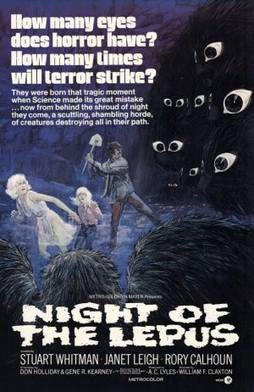
10. Night of The Lepus (1972)


Giant killer rabbits terrorize rural America. Yep. That's your basic premise of Night of the Lepus.

Originally, titled Rabbits, the studio got spooked that audiences would find the premise of a horror movie about giant killer rabbits silly.

Really?

The movie was retitled Night of the Lepus so as to keep the true nature of the monsters mysterious. The studio must have been banking on the assumption that horror movie audiences did not have even the most rudimentary grasp of Latin or scientific terminology.

Another key studio marketing strategy relied on hoping  that anyone who saw the film would never speak to anybody about the movie ever.

Night of the Lepus is Deforest Kelley's only non-Star Trek role between the cancellation of landmark cult SF series in 1969 and the actor's death in 1999.  And the poor guys doesn't even get top billing.  Whether that's sad or not depends on which camp you fall into regarding opinions on Night of the Lepus.

There are three basic attitudes towards the low-budget 1972 movie: "Night of the Lepus is an awful horrible movie.", "Oh, man, that's so bad it's hilarious!" and "What is Night of the Lepus?".  Whatever your viewpoint, one thing is for sure. When you are dealing with a movie that attempts to make giant bunnies terrifying, you cannot fault director AC Lyles for not taking risks.

Night of the Lepus is a favourite of the MST 3000 and Riff  Trax crowd. My personal feelings about are closer to theirs.

I never associated Night of the Lepus with Easter until a few years ago when the now defunct cable network Drive-In Classics, ran it on Easter Sunday.  Now it joins the ranks of biblical movies, chocolate rabbits and bonnets.

This is how they sold the movie:


And this is what the movie actually was...


9. Willie Wonka and The Chocolate Factory (1972)


Easter is about chocolate. Some might say it is about the Resurrection of Our Lord and Savior Jesus Christ. Perhaps those are people who have never tasted chocolate.  Some of my strongest memories of Easter involve not only chocolate but also of massive amounts of over indulgence in chocolate.

Aside from being a great musical with lots cool looking watered-down-for-mainstream-America type hippie images, Willy Wonka does speak to issue of excess consumption. It does, in fact, speak very strongly to many of the more negative personality traits, like overindulgence that children have an unfortunate tendency to develop early in life.

I'm really glad I did not see this movie till I was like 12. Younger than that, I would have been haunted by nightmares of those freaky Umpa Lumpas ironically punishing me every time I'd overindulge for years to come. That's what happens when you mix a Catholic upbringing with exposure to massive amounts of TV and movies.

The messages of the Willy Wonka and The Chocolate Factory aside, I'm still trying to devise a way to construct a a pool filled with chocolate that will one day occupy the middle of my living room.


8. The Greatest Story Ever Told (1965)


It's part of a long lost world now but back in the day every TV station (all five of 'em) would program pretty much every Hollywood biblical epic ever made every Easter. By the age of 13,  I could have written a PHD thesis on the religious epic genre.

I have never really embraced religion in any form (even surrounded by it as I was in those days) yet I always loved watching those movies on TV. Part of it is, I'm sure, that they were associated with the end of all those bleak and long lasting Montreal winters. They were also associated with the onslaught of more chocolate than any child should eat in a lifetime.

I also remember almost always watching those movies on days off from school.  I don't think the nuns teaching religion in my Catholic elementary school could have come up with any better associations to make with the good book.

In the days of five channels, no VCR's and not much cable TV, your TV choices were limited anyway (especially in the years where the super nice spring weather hadn't quite hit yet by Easter).

I always liked The Greatest Story Ever Told. One reason why was on account of its all star cast approach to the New Testament. In the early 70's when this movie first aired on TV, it was a casting approach that was that was still in vogue in the days of blockbuster Hollywood disaster film. In my mind: crucifixion, skyscraper on fire, same deal.

The Greatest Story Ever Told boasted a cast that was very much on my TV watching filled childhood radar.  It included The Invisible Man as Herod, Kojak as Pontius Pilate, Cornelius as Matthew, Blofeld as Satan (hello typecasting!), Illya Kuryakin as Judas, Commander Koenig as Caiaphas and, best of all, the The Omega Man as John The Baptist.  There was an earlier biblical movie called The King of Kings that starred Captain Pike as Jesus. If they coulda just got him in there then The Greatest Story Ever Told would had have an absolute perfect all star cast.

Actually, the only guy I didn't know in the cast was the actor playing Jesus.  I had no idea at the time but that part was played by Max Von Sydow. My ignorance of the great Swedish actor no doubt stemmed from the fact that CFCF 12 in Montreal was not running Ingmar Bergman's greatest film all that much in the early to mid 70's.

The role was Von Sydow's first English language film. It also marked the earliest signs of a bizarre career arc for Von Sydow that would include Persona, Strange Brew, Hour of the Wolf, Flash Gordon, The Exorcist and Conan The Barbarian.

And just imagine Von Sydow in this one....


7. The 10 Commandments (1956)


Okay, technically, this is a Passover movie. For some reason, though, it would always air around the same time as all the Easter movies.

Not sure what that's about....

This Easter Saturday, in fact, ABC will once again air the 55 year-old four and half-hour Moses movie in prime time, just as they have been doing for at least 40 years now. It must still get killer ratings.

The story of Moses is probably the biggest common denominator of the Judeo-Christian tradition. Chuck Heston as Moses trades in "Damn Dirty Apes" for "Damn Dirty Egyptians".  Actually, when you think about it, there are some interesting story arc similarities between the character of Taylor in Planet of the Apes and that of Moses in The 10 Commandments. Both arrive in a strange land in a vessel while they are in a nascent state, both are unjustly imprisoned and enslaved, both are treated very differently when the revelation of their true identity comes to light and both escape from an unjust and oppressive society.  However, Moses leads all of the Israelites out of slavery and Taylor merely escapes the apes with the nearest chick he can find, leaving all of his fellow still-imprisoned humans behind. So I guess you could say that one is a little more selfish than the other.

I have very strong memories of every part of this movie yet I can not possibly imagine being able to sit through the whole thing at a young age. I must have seen it in sections on different Easters. With movies in general back then you had to wait through alot of talking without the benefit of a fast forward button before you got see any exciting stuff.  That principal is true to the extreme in Cecil B. DeMille's Biblical classic. I think it's like two hours before we get to see Moses turn his staff into a snake. Then it's like another two hours before we get to see the parting of the Red Sea. Then it's like still another yet another hour at least before we see my  personal fave moment of the film. It's the scene where God, masterfully played by animated fire and an actor with the deepest voice working in Hollywood at the time, burns the Decalogue into solid rock.

The scene that follows, though, is a bit of a downer. It's the scene where Moses comes down from Mount Sinai and presents The Ten Commandments to the his people. Of course, in Moses' absence, the Israelites have taken to dancing around, laughing and worshiping golden calves.

I saw this scene again recently and the only thing that stood out in my mind when watching it again after so many years was "Who does this guy think he is?!".  I mean, here you've got all these people blowing off a little steam after 40 years of wandering in the desert. Seriously, watch the scene. All they are doing is dancing and laughing. And, well, yes, somebody made the extremely gauche choice of putting a Golden Calf in the middle of the party. That still doesn't make up for Moses acting like such a buzz kill.

Heston's Moses comes off as an arrogant, judgmental, self-righteous bossy-boots. A bunch of people are just having a little fun and then the ol' wet blanket shows up. He immediately starts yelling at everybody. Man, I could not believe the kind of accusatory loaded hyperbole that start coming out the guy's mouth: "Thou shalt be punished, thou are heathens, thou shalt feel the wrath of the Lord Thy God" and stuff like that. I'm not a Ten Commandments geek so I can't quote the film verbatim of the top of my head. Anyway, you get the idea.

Whoa, whoa. Turn it down a notch, pal, they were just doing a bit of incredibly tame 1950's dancing.  As if that weren't enough, Moses then goes and enlists God himself to literally reign down fire and brimstone on the crowd. The whole thing is kinda the biblical equivalent of the grumpy old man downstairs calling the cops to break up your "loud" party at 9 PM.

My tempting a fate of burning in a blasphemer's Hell for all of eternity aside, I think the problem with that scene is that it just has not aged well. For one thing, Heston and his over-the-top hammy melodramatic performance actually achieves the unthinkable: makes Moses too angry, too distant and, yes, too unlikeable as a character. The other problem is that, for a modern audience, the Israelites are really not doing anything that bad. The sexual carrying on is only implied subtly (really frakkin' subtly implied) and, even so, we don't really look at that kinda thing in same light in 2011. In order for that scene to work for a modern audience you'd have to bring Moses down about 20 notches from Heston to like, say a Kevin Spacey or maybe a Jeff Goldblum. In today's era of cinema violence and torture porn, the party would have to be totally sick and disgusting. Like the sinners would have to be like raping puppies while mainlining crystal meth crack cocaine made from the severed arms of dead babies. Then you'd get a 2011 audience on board with Moses. 

Or you could go a totally different way...


6. Excalibur (1981)
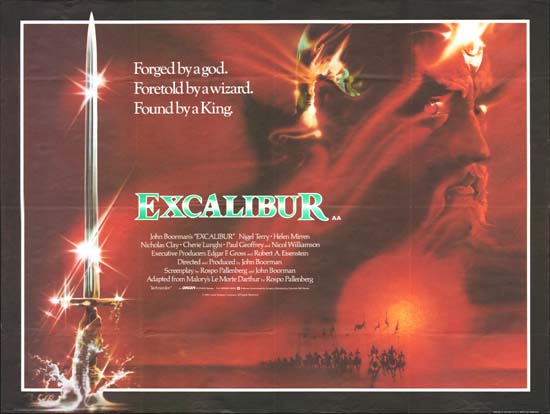


Many of you may be wondering what the Easter connection is to the film Excalibur, John Boorman's wonderfully lyrical and majestic 1981 take on Sir Thomas Malory's Morte d'Arthur or (for those of you non-medieval literature geeks out there) The Legend of King Arthur and The Knights of the Round Table.  The connection is pretty simple: the film was released in April of 1981 and I saw it for the first time right around Easter.

Too personal a connection to count, you say?

Okay. Well, part of the story of Excalibur follows the Quest for the Holy Grail. Jesus drank from the Holy Grail at the last supper. That was was when again? Oh, yeah, two days before he rose from the dead on Easter Sunday.

Too contrived to count, you say?

Man, there's just no pleasing you, is there?

Whatever the connection, Excalibur is one of my favourite movies ever, Easter or not. It is also one of the most wonderfully mythological films in ever.

There are many great elements that contribute to Excalibur's success, not the least of which is the film's incredible cinematography by the late great Geoffrey Unsworth. Unsworth gives Excalibur its lush forest greens, dramatic red fires and bleak winter greys. Many of the those colours can also be caught in the amazingly shiny and reflective armour that the knights wear and as well in the equally shiny and reflective mystical sword of the title (shooting all that silver must have presented Mr.Unsworth with a few challenges too). Unsworth's cinematography defines the visual mythology of Arthrur's mystical world with aplomb.

Excalibur is also aided by Boorman's meticulous direction. On the DVD commentary track, Boorman describes how the film was shot over a period of months from winter to summer. The film had to be meticulously scheduled so as to keep up with changes in Irish seasons (Excalibur was shot entirely on location in Ireland).  All that scheduling work paid off. The seasons almost become another character in the film. There is one scene in the film, for instance, that captures spring incredibly. It is a scene that happens right after Arthur wields Excalibur as king for the first time. He and his knights ride through the country side amidst budding trees and flowers while Carl Orff's incredible Carmina Burana plays. There is an amazing tracking shot of Arthur as he rides under some budding trees while the wonderful white pink buds fall all around him.  To borrow from Shakespeare, a thousand words could not capture the essence of spring as well.

Excalibur also benefits from a great cast that includes a young Helen Mirren, early film appearances by Gabriel Byrne and Patrick Stewart, and, making his film debut, a very young Liam Nesson.

Excalibur is one of those films that I've decided to cave in on and, yes, replace my DVD with a new Blu-ray disc. It is so incredibly visual a movie that it was practically made for that awesome format.

I plan on watching the Excalibur Blu-ray every spring.


5.Watership Down (1978)


The UK release poster

I know that it's no Hop but Watership Down is still up there amongst the greatest of bunny. It represents a type of film that is almost as rare as a Belgian Hare in southwestern Luxembourg: the dramatic animated feature film that is not Japanese and does not involve superheroes.

The film is based on Richard Adam's 1972 bestseller of the same name. The story follows a small young rabbit named Fiver. Fiver has been getting disturbing visions that the rabbitts' warren will be destroyed (I can't possibly imagine how that could come about in the late 20th century). Fiver and his brother Hazel attempt to convince the other rabbits that they must leave the warren immediately. However, the reigning political body of the warren can not be convinced to do such a thing just on the basis of "visions".

It doesn't seem like that hard a case to make to me. You'd think that someone at some point would say, "Wait a second here. We live a world of sentient intelligent talking rabbits and you're skeptical about 'visions'?  I mean, c'mon, think about it. Our entire culture and society is clearly the basis of an allegorical cautionary tale. How could you miss that?".

Alas, nobody says that.

So Fiver and Hazels leave the warren on their own. Watership Down is not a feel good "little cute animals endearingly survive a great adventure" Disney type movie. Nor are the bunnies wise cracking carrot chomping lovable scoundrels that can easily outwit hapless hunters.

This is real life, silly.

All bets are off. Anything can happen to the rabbits of Watership Down. Killing animals dramatically is most certainly not off the table in this story. While not as powerful as Adams's original novel,  Waterhsip Down is still an amazing animated feature.  It is an all too unique compelling and very serious animated film about talking animals.


The US DVD release takes kind of a different approach.

In the U.K., Watership Down is a little more culturally entrenched. There are follow-up books, a TV series and even merchandising. On this side of the pond, Watership Down is now largely forgotten in the mainstream. While it has produced some great movies, I just wish that the Pixar-Disney CGI juggernaut of fast-paced kids' movies filled with clever one-liners and/or musical numbers didn't so completely dominate the family film genre.

Just imagine if all the incredible animation resources available today could be put behind making another film like Waterhsip Down.


4. Ben Hur (1959)


Knock. Knock.
Who’s there?
Ben Hur
Ben Hur who?
Ben Hur for four hours watching this movie.

Sorry. This blog was temporarily taken over by a six year old boy.  A six year old boy from 1959.

For people my age, particularly guys my age, the first association with Charlton Heston is not with guns, right wing politics or that ambush interview in Michael Moore’s Bowling for Columbine. No, for us, Charlton Heston’s most famous line is not “From my cool dead hands!”, but rather“Take your stinkin’ paws off me you damn dirty apes!” (or, for those of us who like to be a bit more arcane, “Soylent Green is people!”). Heston’s right wing gun politics would not really be known publicly for at least another 10-15 years. In those days, unless your name was Jane Fonda, nobody talked about or even cared about actor’s political viewpoints.

The Charlton Heston of the late 60’s and early 70’s was the star of such neato cool sci-fi movies as Planet of the Apes, Beneath the Planet of the Apes, The Omega Man and Soylent Green. If you were an 8-12 year old boy in that era, Heston was definitely on your radar. Throw in an Airport ’75 and an Earthquake! and it made for Chuck being a pretty friggin’ cool dude (just an aside but it's unthinkable today that you'd see an action sf blockbuster with a love-handled male star in his 50's playing the lead).

Like any good Heston fanboy of the era, I made it my business to get know as much as I could about Chuck’s other movies. Ben Hur was a no-brainer. All it took was two free hours on consecutive afternoons in April. Anyway you slice it, four hours of Roman era biblical history and not a gorilla soldier, mutant vampire or futuristic riot in sight is a lot to ask of a nine year-old kid (or, I think, anybody watching the movie past the year 1965). 

Seeing Chuck as an action adventure hero, as I did then, the film's now famous chariot race did not disappoint. Even today, the chariot race in Ben Hur is one of the greatest sequences of pure cinema that anyone has ever shot. Another standout was the attack on the slave ship, parts of which still come off as pretty hard-edged, even by today’s standards.

Back in the day, I think I would have liked the scene better if Ben Hur were racing chariots against Dr.Zauis and General Urko but, hey, you can't have everything.


3. Jesus de Montreal (1989)

Quebec cinema is an amazing thing. There is a rich and colourful history of cinema here in this fascinating little cultural niche that is totally unique in North America.

Quebecois cinema has  its own distinct industry, its own blockbuster hits each year and its own star system. All of this for a population of just seven million or so people. That would be like an entire film industry that caters exclusively to the population of New York City.

It’s a feat that English Canadian cinema had only managed to replicate in the tiniest of ways. And as long as English Canada remains 10% of Hollywood’s domestic market, I doubt it will ever get there. Were the official language of The United States French then the situation would most likely be reversed. Also if that were true, we’d living in a mind-bogglingly different world that would have to be subject of a series of no less than seven alternate history novels.

But I digress.

Quebecois cinema also boasts its own collection of great auteurs. Among those is Denys Arcand  (Mr.Arcand’s unsuccessful attempts at wading into the waters of English language cinema notwithstanding). Arcand also has the distinction of being the very first director mentioned in this blog that I used to run into while working out at the Westmount YMCA.

Arcand's highly acclaimed 1989 film, Jesus de Montreal, is one of this best. It is a film that, among other things, beautifully captures not just the look but also the feel of my beloved hometown.

Jesus de Montreal follows the story of a struggling up and coming Montreal actor who takes on the role of Jesus. However, he is not playing Jesus in a major movie or even on stage; instead he is playing Jesus in an outdoor staging of the Stations of the Cross, an annual event held near the giant cross on top of Mount Royal in Montreal. This actor, however, makes the production his own by enlisting the help of his avant-guard theatre pals. One of these guys is played by the legendary Quebec/Canadian actor/writer/director Robert Lepage.

Turns out that Stations of the Cross on the mountain becomes one of the city’s hottest shows. I think you really have to have lived in Montreal a long time and know the culture pretty well to really appreciate some of Jesus de Montreal's satirical humour.  The scene that features well known and somewhat flamboyant Montreal entertainment critic Francine Grimaldi (playing herself in the film, natch) going on the radio and saying, “The show to see this year is the Stations of The Cross on the mountain” is particularly sublime.

The film becomes an art imitates life examination of spirituality in a secular society. The Catholic Church has a particularly notorious history of social and political repression here in Quebec. There are few places in the world that have seen as quick and complete a rejection of religion in the space of one generation as has been seen in La Belle Province. I have friends who were very well educated in the Quebec private school system, people with University degrees who seriously have said stuff  like, "The stations of the cross. What channel is that?" or "The Ten Commandments? Is that a thing from the bible?".The number of practicing Catholics in Quebec has been decimated over the last 50 years or so.

If the Christian Right in the US had any idea that such politically endorsed socialist secularization was happening on the same continent as them, they’d have invaded Quebec years ago.

Jesus de Montreal is a particularly prescient examination of the spiritual void left in such a society. Arcand does out rightly advocate religion any more than he out rightly advocates secularization. Like many great artists, Arcand skillfully lays the ideas out and leaves them open to interpretation. Perhaps his most succinct visual achievement on this front is when we see a woman who was previously seen singing hymns in a brightly lit ornate church. Later in the film she can be  seen doing the exact same thing as a busker deep in the fluorescent lit bowels of a Montreal Metro station. As the Jesuit priest who taught me film criticism would say, "It's all there.".

For the curious, the latter scene was shot in Place St. Henri Metro station. It's a station I walk through regularly to teach my improv classes at The Montreal School of Performing Arts. I think of that scene in Jesus de Montreal each and every time I do so.


2. Monty Python's Life of Brian (1980)

"He's not the messiah, he's a very naughty boy."


 For me, Monty Python and the Holy Grail is at the very top of the Python cannon (and one of the best comedy films ever made to boot). Running a close second in great Python achievements is Life of Brian. Holy Grail is, on the whole, a funnier film. However, not that that really matters, but as a story Holy Grail is a bit disjointed. Life of Brian holds together much more strongly as a story and is, I suspect, more appealing to non-Python fans (though my experience with Monty Python is that you either love it or it leaves you cold –rarely is there a middle ground).

Life of Brian was controversial in its day, though not as much as you might think. The satirical British film was more often than not dismissed by religious officials rather than condemned.  That’s the double edged sword of using comedy as social, political and religious satire. Through humour, you can land a critical point about, in this case, organized religion in way that you just can't an intensely serious argument. The downside is that it is very easy for those who are the subject of your humorous criticism to merely dismiss your point as silly jokes made just for laughs.  Look at current example of The Daily Show with Jon Stewart. Stewart is one of the few media figures that can, in one succinct hilarious line, completely negate a week’s worth of repetitive Republican talking points. However, people like Bill O’Reilly of Fox News is quick to categorize Daily Show as being “just for yucks”  and made for an audience of “stoned slackers”.

The exact same thing played with Life of Brian during its initial release. Many religious officials, particularly those in Britain (where oddly, the movie was more controversial than in the bible belt of the US –evidence that Americans are just not into British pop culture, no matter what) dismissed Life of Brian as “sophomoric” and “silly”.

And well religious officials should do so. Life of Brian (as many of the Pythons have pointed out over the years) is not a satire of Jesus Christ, the Messiah, but it is, instead, a satire of Christianity and organized religion in general. And in the case of organized religion, you better dismiss it, pal, ‘cause this is a movie that satirically nails your ass to the wall.

Any time Jesus is depicted on screen or referred to in Life of Brian (which is not much, really), it is done in a totally non-satirical and reverential manner. The scene that depicts the Sermon on the Mount, for instance, opens with a shot of Christ that could easily be right of Cecil B. DeMille. The satire starts when the camera pans over to a bunch of classic Pythonesque dimwits way far away from the mount, mishearing and misinterpreting the sermon in the dumbest and most asinine ways possible. It’s quite a funny scene and it in no way makes Jesus Christ as the object of satire.

There is another scene in Brian that is both a searing ironically satirical indictment of organized religion and just plain frikkin’ hilarious in its own right. It goes something like this:


Brilliant, hilarious, and organized religion’s Kryptonite. It also makes a point that few secular criticisms of religion ever make. Brian's followers are so dying to follow something or someone to point of absurdly funny obsessiveness.  The point being that people, for whatever reason, want and need religion. It's an idea that is rarely pointed out. Bill Maher, for instance, spends almost all of his film Religuous dismissing and talking down to religion but never once gets into why it exists in the first place. Monty Python in Life of Brian, on the the other hand, nails the idea a few really funny lines.


Of course, there are also many moments of just plain straight ahead funny comedy for comedy's sake too. Like this scene:


Life of Brian also has a much more satisfying ending than the Holy Grail. Holy Grail ends on a conceptually hilarious yet emotionally disappointing note.

The first time I saw Life of Brian, I found the concept of closing the movie with people being crucified singing a Disneyesque happy song to most incredibly brilliant thing I’d ever seen in my whole entire life. Not to mention that it appealed to my angry discontented anti-social 16 year old sensibilities no end.

When you think about it, isn’t people singing “Always look on the bright side of life” (or “death” as the lyrics change to later), while being crucified kinda really in essence what the concept of the resurrection is all about in the first place?

It’s just not the way The Church has been telling us to interpret The Crucifixion for the last 2011 years. That point, of course, brings up back to the real object of satire in Monty Python's Life of Brian.


1. The Last Temptation of Christ (1988)


Like the story of Christ himself, The Last Temptation is a movie that, in its time, was dismissed, condemned and unjustly persecuted. In reality, The Last Temptation of Christ is a deeply spiritual and reverential film. In fact, the film never even purports to be scripture. It is also one of Martin Scorsese’s most over-looked and underrated films.

I remember when this film came out. There were protests everywhere it played. The screening I went to had private security. Every one's bags were searched. Some fanatic in Toronto (and elsewhere I’m sure) threw a bottle of black ink on the screen of a cinema running the film so as to keep them from showing it for a whole 24 hours.
The film had a great opening weekend, though, that I'm sure the cinema in question covered the cost of a new screen in no time. All the publicity the protesters were getting was undoubtedly driving the high grosses at the box office.

Before we get into the subject matter of The Last Temptation of Christ, the controversy and the real meaning of the film, let's get into some background, shall we?


I was raised Catholic.  I don't practice anymore. I am not religious. I have a hard time buying into the concept of the God described in the Bible. Don't get me wrong. The Bible has a lot of great moral lessons and messages in it but it's not exactly consistent on that front.

God in the Bible, particularly in the Old Testament, is described by and large as well, kind of a jerk, really. He likes to test his followers faith by inflicting horrific suffering on them or by asking them to kill their firstborn son, just to see if they'll actually do it. God always seems ready to reign down stuff like droughts, floods and plagues on anyone that does not follow his rules. His rules include stuff like not worshiping other gods, honouring the day of the week He's set aside for himself, always capitalizing pronouns that refer to Him, and absolutely no using His name in vein. Man, that's one insecure all powerful being. He sounds more like an abusive parent than an all knowing deity to me.

Um, have you ever thought about seeking out a good therapist, Christianity?

At the same time, though, I can not completely rule out the existence of a powerful force in the universe that we don’t understand. I just do not at all agree with the way that traditional religion, particularly the Christian one, has defined it. Some would call that atheism, some agnosticism, some spirituality, some blasphemy, and some new age mumbo jumbo.

I call it what I believe.

Nonetheless, when you are brought up with Christian (and Catholic in particular) the story of Jesus and the Bible in general has a way of sticking with you. If nothing else, Jesus still represents a powerful mythology. Christian mythology is a major major corner stone of our society and culture, including pop culture. Many of my liberal open-minded friends like to say stuff like, “Yes. Christianity is important. Just as all the religions of the world are important.”

Um......actually...no....

How many epic fantasy movies have you seen that have powerful underlying Hindu allegories?

Have you ever seen a horror movie where they call in an Imam to deal with a case of demonic possession?

How many movies about the Buddhist Festival of Vesak are released around the holiday season each year?

Our culture, pop and otherwise, is a Judeo-Christian society, baby, with one big emphasis on the Christ, even for the secular.

It's because Christianity matters that The Last Temptation of Christ matters.

The film is my personal favorite Jesus movie. It’s about a billion times more real and emotionally powerful than any of the old school Hollywood fare like The Greatest Story Ever Told or King of Kings. Jesus in those films comes of as this perfect yet ultimately dull non-character carefully designed not to offend anyone.

The Last Temptation of Christ is also a much better Jesus movie than the preferred cinematic treatment of the Son of God of the more religious. Mel Gibson’s 2004 film The Passion of The Christ. That's the current film that seems to be the most popular with Christians these days. I still do not understand why The Passion of The Christ remains popular and praised while The Last Temptation of Christ remains condemned and obscure.

I had many more issues with The Passion than just the alleged antisemitism that got all the media attention. To be sure, the case of the presence of antisemitism in the film can certainly be made (particularly the shots of the scowling Pharisees that kinda look like something right out of a Nazi propaganda movie).

Antisemitism is just one issue in The Passion though. Satan, for instance, is played by a lithe woman with flowing unmistakably feminine movements but at the same time as an unmistakably masculine voice.  Kinda homophobic, no? Homophobia, BTW, being Mel's other big agenda. 

Then there’s the violence. The scenes of Christ being beaten by a particularly sadistic Roman guard puts The Passion up there with Hostel and Saw as one of the best torture porn movies ever made. If any of those horror films had the same level of brutal violence that The Passion has, the same people that love Gibson’s Jesus movie would be screaming.

By far the very worst thing in the Passion of the Christ, though, is that Jim Caviezel speaks Aramaic with an absolutely atrocious American accent.

Many of the criticisms of The Last Temptation of Christ is that it was fiction and from the Bible. That depicting Jesus a man who struggled with temptation just like anyone else was was an unacceptable interpretation of scripture. At the same time, The Passion of  The Christ is not based exclusively on scripture. Much of the more violent elements of the film are derived from meditations by German nun Anne Catherine Emmerich written in the 17th and 18th century. That's not exactly scripture either.

So I just wanna get this straight. Alternate interpretations of scripture are bad when they depict Jesus as having human temptations but are okay when they are antisemitic, homophobic and gruesomely violent?

The biggest bone of contentions with Last Temptation seemed to be with a sequence that saw Jesus coming down off the cross to get married and have children with Mary Magdalene. Jesus does not seem to have inherited his dad’s ability to perform immaculate conceptions so that, of course,means that Jesus would have had to have sex in order to father a child. But, and this is part most of the condemnation skips, this all happens in a vision from Satan...the most evil being in the universe.  Like, really, how much more evil can you get than attempting to manipulate the Son of God out of his destined role of Messiah by tricking him with visions of sins of the flesh? Would you also object to showing Darth Vader in Star Wars destroying a planet full of innocent people in order to demonstrate how evil he is?

That may well have been the argument Nikos Kazantzakis, author of the brilliant and superior novel on which the film is based, made as well.  He may well have brought it up when the Greek Orthodox Church ex-communicated him. I'm pretty sure that Kazantzakis would have left out the Darth Vader reference, though.

My biggest issue with the those who protest, condemned, dismissed and ultimately called for the censorship of The Last Temptation of Christ is that they didn't even seem to have seen the film. I remember seeing the stories on TV and reading the interviews with the protesters in the papers at the time. It was patently obvious that very few of them had actually seen the movie. They had been told to hate it by the religious establishment and the media.

Imagine if a bunch of atheists showed up outside churches to protest Christianity. Imagine if they threw black ink on the Bible and it turned out that they had never even read the good book in the first place. How exactly would that go over?

I understand that The Last Temptation of Christ may offend some people's beliefs. At the same time, some of the Christian beliefs, particularly those towards homosexuality and sex in general, while we're at it, offend me. So let's call it even.

That's what tolerance is all about, Charlie Brown.


What I love about The Last Temptation of Christ is that if present spirituality is a struggle. Jesus was the Son of God but was also human (kinda a tough premise to get your head around, really). He had human weaknesses. He was subject to temptation. What human out there, with nails hammered through their hands and feet, hanging from a cross, vision blurred on account of all the blood in the eyes from the crown of thorns on their head, dying a slow painful, horrific death, would not at least momentarily reconsider this whole messiah plan?

Scorcese’s direction is dead on when it comes to conveying the emotional and spiritual challenges Christ must face in a remarkable reboot of a classic story.

That kinda stuff don’t come easy.

I can identify with that.


Happy Easter!

Good luck with those eggs everybody....

The reboot everyone is waiting for...


Wednesday, April 20, 2011

Back in the New York Groove


I visited New York City for the first time in December 1980. Regular readers of this blog may remember the story. 

In the 31 years that followed, I have had the opportunity of returning to the Big Apple many times. Sometimes it's been for shows, sometimes for meetings, sometimes for romantic liaisons, sometimes for a short vacation, sometimes for long vacation and always, no matter what the real reason for the visit, it has always most definitely been for fun.

And NYC is very fun...especially when you don't actually live there.

The purpose of my my most recent pilgrimage to The City That Never Sleeps (I'm gonna run out of synonyms for New York City before this blog is done, I know it) was photography.

No. Not my photography, silly. Sure I planned to take a few snapshots here but, no, this trip was a photographic expedition for the wonderful love of my life and uber-talented photographer extraordinaire, who is known is this blog as IS.

I was along for the ride this time around: on hand to help lug equipment, provide psychological security (about the only kind I can provide, really) and get lost whenever I might start to get in the way.

It turned out to be the one of the best New York excursion in recent memory.

Here are some random highlights...or all the stuff I could come up with some good lines for...


April 13 


4:50 PM
Driving into Manhattan. Hey did you know that the George Washington bridge has an upper and lower level that take you onto different parts of the island? Did you also know that it's possible to miss both of them and get completely lost?

6:05 PM
While walking to shoot a fog-filled Central Park with IS,  I noticed these signs posted everywhere that said "Do no honk. $350 fine.". This is a new municipal initiative that earns the City of New York an estimated $29,516 every 12 minutes.

9:02 PM
Return to the hotel. The hotel has got really nice TV service: HD and tons of cable and movie channels to chose from. TV service rarely turns up in hotel reviews but it should.

Anyway, I turn right to Fox News. See, I only ever see Fox News in short out-of-context clips on The Daily Show, The Colbert Report and every program on MSNBC. So whenever I'm in the US, I watch as much of it I can so that I can get a "fair and balanced" perspective.

When I was studying Communications as Concordia University, I took a couple of courses in propaganda. After 20 minutes, I came to the conclusion that the producers at Fox News must have taken the same classes.

April 14 

1:25 PM
Iron Man and Spider-Man were making a personal appearance together in Times Square. They had a staff of people stopping tourists from taking pictures that was roughly the size of the Roman Fifth Legion. See, the idea was that you had to pay to take pictures of or with the two hugely popular superheroes. Though, I'm not sure what kind of a profit margin Mr.Parker and Mr. Stark would have after paying the salaries of the aforementioned huge staff whose only job was to stop people from taking photos in the first place. Kind of a meta situation, really.

And while I'm over-thinking it, you know, I can see Pete needing the extra cash but this appearance had to be purely a 100% ego trip thing for Tony.

This they let me take a picture of.


3:15 PM
Went to the east side of Central Park to photograph the 107th Infantry Memorial. The 107th Infantry were from New York and fought in World War I. It's rare, for some reason,  that you see The Great War commemorated in the US. I try and document every one I stumble across.

There were a group of German tourists also enthusiastically taking pictures of the monument while I was there. Amazing what a difference 93 years and the completion of reparations payments can make, huh?

The artist was one of these guys.


Barry Julien holding unknown award.
5:45 PM 
 Remarkably, the very popular late night political/social satire show, The Colbert Report, has three ex-Montrealers on its writing staff. There's Eric Drysdale (who I don't know so well but have met a couple of times at Just For Laughs), there's former writer for The Onion, Dan Guterman who I know pretty well from back in his local stand-up comedy days and another guy I got to know almost as well during my comedy club appearances with The Vestibules and On The Spot Improv. He is the show's Emmy Award winning head writer,  Barry Julien. All three guys are very funny and totally deserve to be there.


Thanks to Barry, I got tickets to the April 14 taping of The Colbert Report.

It's actually quite a modest little studio.

I gave  myself more than enough time to take the subway from Columbus Circle (where I was doing some shopping at the time) to the 50th street station, near the Colbert studio in the Manhattan neighbourhood known as Clinton. However, I ran into my usual NYC subway mishap. I got on an express train by accident. No trip to New York would be complete without that particular public transit mix-up.

Fortunately, the express train only took me two stops too far. So I managed to get off and get back on the non-express train back in the other direction. That took me to the 50th St. subway, no problem. However, it left me with only 15 minutes to walk eight blocks and have dinner. I stopped at a corner grocery store and bought a ham sandwich. I rushed down to the studio while shoving the sandwich into my face.

Next time I should try eating it .


7:34 P.M
After an almost 90 minute wait, the taping is about to begin (being part of a live studio audience takes a lot of patience, in case you didn't know).

Before the live taping of each edition of The Colbert Report, Stephen Colbert comes out to do a Q&A  with the studio audience, "out of character". "Please tell me you know he's doing character.", says the warm-up comedian before introducing the show's host. It is a wry reminder of Mr. Colbert's notorious appearance at the White House Correspondents Association Dinner in 2006  for then President Bush.

Mr. Colbert takes the stage to wild applause and cheers. He begins the Q&A.

Mr.Colbert is man after my own heart. To the best of my knowledge, he is the most smarty-pansted comedian working in TV today (just for the record, elementary school teasing aside, I consider the term "smarty-pantesed" to be a compliment). Mr.Cobert (and his writer's) humour is always very smart and very crafty. If The Daily Show (Colbert's sister political satire show) can be accused of occasionally leaning on Frat Boy type humour amidst its political comedy, then The Colbert Report can equally be accused of leaning on Chess Club humour in the same manner.

Stephen Colbert is also one of the few late comedy hosts that, like me, comes from a sketch and improv background (the sketch and improv part, that is, not the late night comedy host part) rather than a stand-up comedy one. While some of the very funniest people I know are stand-up comedians, stand-up is comedy discipline that has a very different vibe than sketch and improv comedy.  Sketch and improv comedy is closer to theatre than stand-up is (he said unbiasedly). That difference in approach makes for a unique and fresh TV host in the person of Stephen Colbert.

Back to the Q & A.

I'm dying to ask Mr. Colbert if his killer version of Rebbecca Black's otherwise forgettable pop song "Friday" will ever be available on iTunes.

Seriously. I'm dying to download it.

However, Mr.Colbert seems to favoring the ladies tonight so I don't get the chance to ask my question. During one of his answers to a question I don't recall, Mr.Colbert manages to somehow work in that the first Peter Jackson blog on the making of the upcoming Hobbit film was posted that day. He talks about how seeing the photos of the sets for the new Tolkien screen epic have made his day. Then I had a sudden revelation. Watching the The Colbert Report regularly, I pretty much could tell that Mr.Colbert was a geek. It's pretty obvious. However, watching him live at the taping, seeing everything he had done and talked about  up to that point, thinking about his "Tolkien Off" with James Franco the week before and watching him steer and unrelated conversation to The Hobbitt.  I come to the conclusion that the guy not just a geek but that he is a Major Geek.

We have more in common than I thought.

This is the second time I've been to a Colbert Report taping. The one thing that you never can see watching the show at home is how good Mr.Colbert is at connecting with the studio audience, talking to them, getting their energy up and generally working the room.  It makes a huge difference towards the live audience's energy in the studio and, ultimately, to the show that you see on the air each night.

8:07 PM
They have to stop tape for Mr.Colbert's third line flub of the night. He turns to the studio audience and says, "We'll just to pick that up again, fix it in post, and no one will ever know that I screwed up...as long as none of you blog about it.".

Ooops.

I'm amazed that the man can stumble in the middle of a show and still have an audience cheering and applauding for him. If ever you are watching The Colbert Report and you hear sudden huge laughs followed by an applause break in an unlikely place then there's a good chance that is where Mr.Colbert fumbled during the live taping. The studio audience is so supportive that they go nuts when Mr.Colbert finally gets the line right.It's an extraordinary thing to be able to have an audience that behind you, even when you're totally messing up.  Not an easy skill to acquire and it sure don't happen over night.

It reminds me of a story I once heard about Picasso. Pablo was on the beach one day and he was approached by this woman who was a huge admirer. She asked him to draw something for her. He took out a piece of paper, did a quick drawing and handed it to her. The woman said, "But it only took you five minutes to do this".  Picasso replied "No, my dear, it took me my whole life to do that."  Same deal with Colbert and his ability to keep an audience totally behind him, no matter what: he's been working at his whole life.

By the way, Mr. Colbert, feel free to quote me on the part where I favourably compare you to Pablo Picasso.

Mr. Colbert would probably be the first to point out that Yoda is a Tolkien ripp-off


8:39 PM
I start walking back to the hotel after the taping. It's  pretty much on the other side of midtown Manhattan. During the walk, I notice that there seem to be way less stores that sell CD's, DVD's, Blu-Ray's and books around town.

Must be a lot of early technology adapters living in the city.

April 15

6:02 AM 
Head out to the Brooklyn Bridge for a sunrise shoot with IS. Walking to the 59th street subway, I come to the conclusion that the homeless people in Manhattan are like moose when you're camping: you only see them in the very early quiet hours of the morning.

3:43 PM
Visit the house in Greenwich Village that stood in for Carrie Bradshaw's impossibly inexpensive upper west side apartment building in Sex and The City.  It is in a very nice location on a picturesque quiet street. It  also seems to have a ton of people showing up to photograph it at any given time of the day. The day I was there, I was the oldest and most male person among them. 


Note the "No Trespassing" sign. I wonder if they get a lot of visitors?


The Jedi shtick never really worked in these shots.

6:06 PM 
6 degrees Celsius, 20th floor rooftop terrace bar. Ideal location for late afternoon drinks, isn't it?

It is also the best vantage point for IS to get some outstanding Empire State Building shots.  The terrace we were on had a bunch of outdoor space heaters (I can hear my dad on that one now, "What are you? Trying to heat all of New York City?").  They didn't really keep us warm enough. In a back-up effort to keep all of the clientele warm, there were these hooded fleece robes that you could put on over your clothes.

With all of the Friday Happy Hour businessmen wearing the robes over their shirts and ties, I couldn't help but think that we had stumbled into some kind of Hogwart's Reunion.

11:37 PM
While watching Fox news back at the hotel, I caught myself thinking "You know Bill O'Reilly is actually pretty reasonable". I knew then it was time to start watching something else. I flipped over to Sy-Fy. They were running a marathon of the original V miniseries. I realize that I had forgotten how good the original was and how less good the remake was. I made a mental note to seek out the miniseries' again. Coming soon to a blog near you....

April 16


7:08 AM
After seeing it on TV and in movies for years, I finally finally got a chance to go running in Central Park. I was on the lookout for Nazi war criminal dentists for the rest of the day.


11: 37 AM 
58th st. and 5th ave: I am the only person in a huge throng of people that recognizes Peter Jacobson. Woah. I thought New Yorkers were supposed to be hip.


Coming soon to a Geek Night near you.
1:17 PM
No trip to NYC would be complete without a visit to the one of the city's largest electronic stores, J&R Electronics in lower Manhattan. While there, I stumble across the DVD of the 1945 movie serial The Royal Mounted Rides Again. I had previously believed the serial to be unavailable. Not to mention the super bonus score, that it was on sale too. I have now have the complete set of every Mountie adventure movie serial ever made.

I resolve to finally move ahead with long planned live Mountie Action Adventure Cliffhanger improv show.


2:54 PM
IS and I have our only Classic New York Moment this trip.  The NY subway Saturday schedule had been changed on account of construction and maintenance work. Long story short: some trains aren't running at all while others are running as express trains only that will take you about 2-3 boroughs away from where you want to go. It's all very confusing for us non-New Yorkers.


You can just make out "upstairs" in the 14th street subway station.

After we've been staring at an NY transit map for a particularly long time in the middle of the 14th Street Subway Station, an NY MTA employee walks by us.

The conversation goes like this:

MTA Guy:  Lost?
TB & IS:  Yeah.
MTA Guy:  Go upstairs (indicating to a subway platform above us).
IS: Can we get the A train up there?
MTA Guy:  Go upstairs.
IS:  Is it the express train or the-
MTA:  Go upstairs.
IS:  Will it take us to-
MTA Guy:  Go upstairs.
IS:  Yeah, okay, but I just want to know if-
MTA Guy:  Hey, did you hear what I just said? Go upstairs.
IS:  But-
MTA Guy:  Go upstairs.
TB:  What if we went upstairs? Would that help?

The MTA Guy glares at us as we go upstairs.

That, for me, is the quintessential New Yorker stereotype; they are nice enough to take the time out to stop to and help you out but they will do so with as much of a dick about it as possible.

For the record, the train we wanted was, in fact, upstairs.


9:30 PM
A torrential rainstorm and record high 40 MPH winds in midtown Manhattan make for an interesting 11th Anniversary night on the town for IS and I.


April 17

8:17 AM
Sitting in the Starbucks at 55th and Lexington. As I type away at my laptop, I realize that I will never finish this blog before I leave. In fact, I'm now writing this two days after I got back home and I'm still not finished.

I've come to the conclusion that blogging and short fun filled trips to NYC don't mix.


All times referenced in this blog are approximate and, more than likely, completely made up.

Monday, April 11, 2011

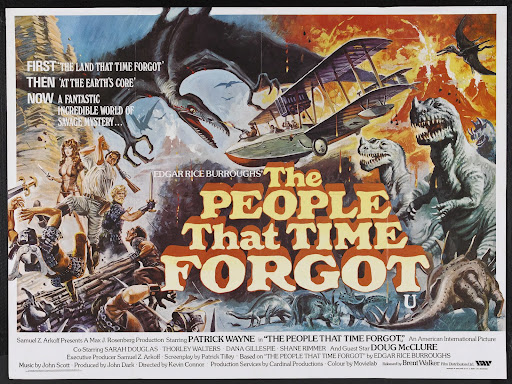
Biplane vs. Pterodactyl! My Weekly Goofy Movie Clip


This week's clip is a very cool yet at the same time pretty goofy scene from the 1977 film, The People That Time Forgot, sequel to 1975's The Land That Time Forgot. Both are based on the novels of the same name by Edgar Rice Burroughs.

The first is a classic dinosaur adventure movie from my youth. The second, not so much, except, of course, for this "awesome" opening scene...


As you can no doubt tell from the state-of-the-art visual effects, this film was released in the same year as the original Star Wars.

That's Patrick Wayne, John Wayne's son, piloting the biplane. The Duke lived just long enough to see his son's work in this classic film.


Check back here for more Goofy Movie Clips each week.

Same Bat Time.

Same Bat Blog

Friday, April 8, 2011

TV's Shameless Anti-Heroes

The cable networks are at it again. Yep, there is now one more more ground breaking TV series featuring featuring characters that can best be described as anti-heroes. These shows seem almost counter intuitive in their appeal. They've been with us for almost a decade now and I doubt there is any going back for the medium now. 
Let's get a little more specific.

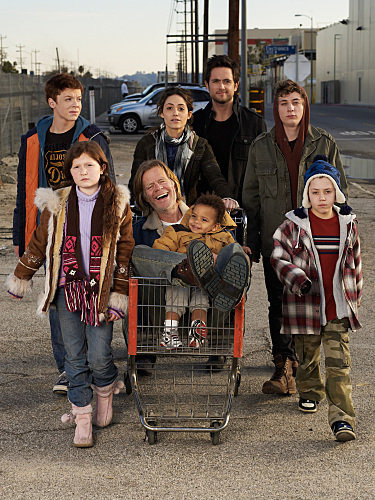
The Showtime series Shameless recently recently wrapped it's run on The Movie Network in Canada. By the time episode 12 rolled around I was a huge, if somewhat initially reluctant, fan. Based on the British series of the same name, Shameless is a show that is unapologetic towards (or, shameless, if you wanna get all clever about it)about alcoholics, criminals, nymphomaniacs, irresponsible parents, bullies, cheaters, assholes, con artists and other generally morally reprehensible people.

This is where the counter intuitive part comes in.

On Shameless, all of the above manage to come off not only as sympathetic characters but also has just plain likable people. The audience is oddly yet quickly and easily lured into both the humour and the drama of the lives of people who might otherwise be dismissed as lowlifes.

Contradictions like that are becoming commonplace on the TV landscape of the 21st century. This is most especially true in the land of cable TV series.  The anti-hero is an age old literary concept and this is not the first time that we've seen a pop culture fascination with the idea. 

Back in 70's, for instance, actors like Clint Eastwood, Jack Nicholson and Gene Hackman were typically playing characters that helped bring the concept back into vogue.  However, the protagonists of current and recent shows like Shameless, Mad Men, The Shield, Big Love, Nurse Jackie,  Damages, Dexter, The Wire, Battlestar Galactica, Deadwood, Boardwalk Empire, Weeds, In Treatment, Californication, and Breaking Bad are taking the anti-hero to a whole new level and on a much wider scale too.

From the time of my earliest memories of TV up to as recently as the mid to late 90's, it was unthinkable that you'd ever see a time when some of the best and most popular shows on TV would lead characters that were mob bosses, drug dealers, serial killers, alcoholics, polygamists and corrupt cops.  Even in the early naissance of the trend, when HBO first started running series like OZ and The Sopranos, such shows were the exception in TV and not the rule (yes, even on cable at the time).

Make no mistake, the cable networks and their struggle to pull audiences away from the bigger over-the-air networks are squarely behind the small screen revolution. If you're looking for edgy TV,  look no further than HBO, Showtime, AMC, FX, USA and similar networks that, sadly, have little or no availability in Canada. These rogue players in the TV industry operate, not unlike the anti-heroes that populate their programming, outside the constraining traditional rules and regulations that the Big Four (five if you count CW) US Broadcast networks. Networks like ABC, CBS, NBC, Fox and (to be nice) The CW are stuck with the pesky little detail of broadcasting on public airwaves. If that's your address then you've got all kinds restrictions imposed both from within and without of the network structure.

Those networks are most definitely paying  the price for those restrictions. Feeling the bite of their ever dwindling audiences, the broadcast networks are attempting to catch up with all those dark shows.  Fox, for instance, recently hired Shawn Ryan, creator of the outstanding series that unflinchingly portrayed police brutality and corruption, The Shield. Ryan's new series for Fox, The Chicago Code, is about the notorious corruption that apparently exists at every level in the city of Chicago. Unlike The Shield, however, the lead characters of The Chicago Code are honest and uncorrupted but are surrounded by horrible backstabbing people. It's an entertaining show but it's hardly even on the same level of The Shield. (I will say this, though, Jennifer Beals sure looks great at 47). 

Fox ran into similar problems when they attempted to mold 24's Jack Bauer into an anti-hero. The fact that the character of the maverick CIA Counter Terrorism agent and his use of extreme, anti-heroic methods like torture were demonized by the left and lionized by the right is clear evidence that said attempt failed spectacularly. 

ABC's Lost also attempted go the anti-hero route, particularity with the character of Sayed Jarrah, a former Iraqi torturer during Saddam Hussein's reign.  It wasn't long, though, before it seemed like the number one priority in Lost's writers room was to redeem Jarrah as often as possible. 

Once again, it's those darn pesky Standard and Practices Departments that every broadcast network must have that get in the way of makin' some good TV (not like I'm talking from any kind of personal experiences I may have had in the TV biz or anything like that).

In the case of Shameless, we are not dealing with anything so dramatically important as police corruption, counter terrorism or people lost on an island. The show follows the story of a majorly dysfunctional working class family living in Chicago's South side (a neighborhood, BTW, that has a notorious history of crime and gang violence). The lead character is Frank Gallagher, a father of five kids who makes no attempt to support them, has no job, lives off of fraudulent disability claims and is, in his own words, a raging alcoholic. Frank's wife took off more than a year ago, leaving six kids to, in essence, raise themselves. The kids are often seen pooling their money from after school jobs in order to cover silly little indulgences like the electricity bill and taxes.

As I watched the first episode of Shameless, I remember thinking "Oh, man, no way am I ever going to get into this". My initial impression was that this was just going to be yet another cable series trying to be edgy with dumb sex jokes, scatological references, mean spirited humour and totally unlikeable characters. It was not long, however, before Shameless' mysterious charms took hold. There is something incredibly engaging about a world that is so completely disordered that it throws its moral compass out the window. It's an incredible feat that a typical episode of Shameless can have you rooting for the criminal and siding with the completely irresponsible alcoholic.

It is a feat that rests squarely on the shoulders of the show's creators, writers, directors and an incredible cast. In particular the performances of Emmy Rossum (as the family's oldest and, oddly, most responsible member), Justin Chatwin (her mysterious love interest), Emma Kenney (who nails some of the best lines ever written for a 10 year old ) and one of the finest actors working today, William H. Macy.  

Shameless is worth watching just for Macy alone.

There are many really good actors out there who could play the role of the show's patriarchal drunk but there are very few that could make that guy as likable as Macy does.


That type of appeal is what's kinda really at the heart of Shameless. It's an approach that is only successfully achieved through humour. Shameless has plenty of humour. Dark humour. Humour so dark, in fact, that it often covertly slips into drama. The series has an uncanny ability to cross in and out of the territories of comedy and drama without ever having to show its passport.

I'm sure the British series that Shameless is based on did all this stuff first but their TV has always been something of a different animal. I am currently in the process of seeking out the UK hit (which is now in its ninth season!).

There was another acclaimed and high rated series out there in cable land that I was ready to turn off during the first episode as well. 

It's called Dexter. 

My initial opinion of a series with a serial killer protagonist was that it would never work. That opinion was backed up by the first episode which, for me, fell directly into the category  of "This is pretty frakin' sick, man.". I gave the show a second chance with the next episode. Turns out, that's all it took. Five seasons and who knows how many dismembered corpses later, and I'm all like "Yay! Serial killer! Go!".

Dexter is not your typical serial killer, however. How dull a show would that be? No. Dexter is a serial killer who only kills other serial killer. Ya just gotta love that concept for it meta-ness alone. It's a concept that seals the deal on the success of Dexter as an unlikely protagonist and anti-hero. Another huge factor in the success of the show is the performance of Michael C. Hall in the title role. Like William H. Macy in Shameless, Hall proves that all actors who use their middle initial in their name are good actors. He also rises to the challenge of making a character who, lets face it, kills people almost every episode, very sympathetic. The amount of cliffhangers in the series that feature Dexter almost being exposed is incredible. It speaks to Hall's ability to win over an audience. 

Another key to Dexter's success is that the show has some of the very best thriller writing currently seen on TV.

If the bad guys are good then the good guys are bad. 

Nowhere is this more true than in FX's ground-breaking police thriller, The Shield. The gritty series was created by Shawn Ryan a producer who cut his teeth on the Buffy The Vampire Slayer spin-off Angel (pun intended!).  As previously mentioned, Ryan created and currently produces Fox's The Chicago Code, a series that, while not quite as edgy as The Shield, is probably making the guy much more money.

In the Shield, Michael Chiklis plays corrupt LA cop Vince Mackey. Sandwiched between his dad roles in The Commish and No Ordinary Family, Chiklis took home his first Emmy award for bringing Mackey to life. 

And why the hell not? The guy's amazing. 

Chikilis lost weight and put on muscle for the role as a means of completely reinventing  his nice TV dad image into that of a majorly bad ass cop. Unlike Shameless' Frank Galagher or Dexter, the character of Mackey does not have quite so many redeeming or sympathetic qualities. He's a cop that is hard edged and downright rotten to the core. 

Chiklis, however, subtly and sparingly creates sympathy for the man.  In the case of The Shield that is a particularly difficult job. In the first episode of the series, Mackey shoots a fellow cop point blank in the head (he was informing the FBI about Mackey's habit of cleverly pocketing drug dealer money after big busts). The arc of one entire season revolved around Mackey and his elite squad of (also corrupt) cops trying to pull off a major heist from a group of seriously ruthless Armenian mobsters.  
Joe Friday and Steve McGarrett must be turning over in their fictional graves.

The writers do suggest a reason for Mackey's corruption that is not totally selfish. He has an autistic son which, in the American health care and social support system, is something that can get a tad pricey on a cop's salary. A direct line is never drawn between the two in any of the scripts. In a rare moment of restraint for American TV, the audience is allowed to make that connection all on their own.  While I have great sympathy for anybody who may be in such a situation, I'm pretty sure that shooting people in the head is still bad.

Anti-heroes do not reside exclusively in the world of cops and killers. Nor for that matter are they strictly the denizens of contemporary culture. Case in point is AMC's sublime Mad Men. 

I was first attracted to Mad Men by the time period in which the series takes place. That time period being the early 1960's, the world I was born into.  It soon became apparent, however, that there was much more to the show than just that. Nonetheless, they do capture the period amazingly. The sets, costumes and look of the show is beautifully faithful to the era as is the writing and the performances. It's the best replication of the time that I have ever laid eyes on.


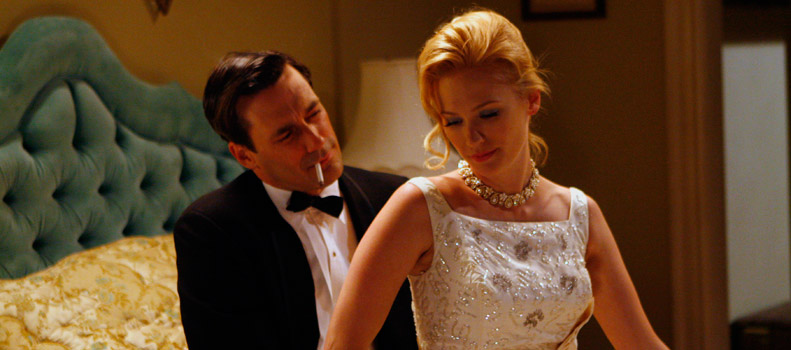
The common denominator between Mad Men and the other shows in this blog are in the characters, particularly that of the anti-heroic male lead of the show, Don Draper. Don Draper is an alcoholic (though a billion times more subtle about it than the guy on Shameless) and is emotionally cold and distant from just about everybody in his life. He also has a chronic case of serial infidelity (a trait that is only very very slightly offset by his incredible taste in women). Draper is expertly brought to life by the amazing Jon Hamm. Hamm endows Draper with a quiet and largely concealed humanity. Hamm's Draper is yet another guy that we really shouldn't like but yet do anyway. 

The other thing that impresses me no end about Jon Hamm is that he pursued a career as an actor without changing his last name.

One of the characters on the show that Draper is particularly cold to is his wife, Betty Draper. She too has plenty of problems of her own (besides her terrible husband). She is emotionally repressed, controlling, close-minded and pretty darn cold and distant herself. Betty Draper is nicely underplayed by the Grace Kellyesque January Jones. Mrs.Draper (no Ms yet in those days) is the polar opposite of the TV mom's of the era from shows like Leave it to Beaver and Father Knows Best. Her approach to parenting is almost that of an anti-June Cleaver.


But Betty Draper is far from TV's only or most intriguing female anti-hero.

That honour goes the high powered New York attorney Patty Hewes on the FX series, Damages. 

Hewes is played by Glenn Close in what is possibly the single best role of her career. Hewes runs one of the biggest and most prestigious law firms in NYC. In Close's hands, Hewes is powerful, direct, ruthless, firm, supremely confident and almost always in control of everything that goes on around here. Hewes is one of those strong woman who is very successful in male dominated field type of characters. In this case, though, the male dominated field often consists of hired assassins, extortion, corruption and, every once in a while, cold blooded murder. A strong woman, yes, but you'd no more want your daughter adopting Hewes as a role model than you would want your son looking up to Tony Soprano.

Thanks to Close and a solid writer's room, you really do feel for Hewes, even and especially in, her darker moments. Technically, Hewes is really more of the antagonist of the story to Ellen Parsons, the protagonist. Parsons is the up and coming young lawyer, played by Rose Byrne, who often finds herself on the wrong side of Hewes. Part of the brilliance of Damages is that the line between good and bad people is frequently and routinely blurred. 

All this is just the tip of iceberg. 

There are many more anti-heroes and shows that I have not touched on. There's Bryan Cranston nailing the role of a high school science teacher turned crystal meth dealer on Breaking Bad.  There's the dense and complexly plotted The Wire where the cops and the drug dealers are merely different sides of the same coin. There's the David Mamet-on-horseback Western, Deadwood. And, while we're on genre revisionism, there's also Battlestar Galactica, the ground-breaking science fiction series that saw evil alien clones bent on destroying humanity slowly, over the arc of the series, become just like humanity. The list goes on and on but my blog does not.

With these shows and their anti-heroes, TV has shifted from it's reassurance and predictability of the past. About the only thing reassuring and predictable in this new wave of American anti-hero shows is that you know they are going to go to some really dark places and, quite possibly, leave you there.

The other thing these shows have significantly changed is the amount the ease and speed with which one can  shut down anybody attempting to make that tired old trite observation that "there is nothing good on TV these days. It's all crap."  


You've come a long way, baby.

Friday, April 1, 2011

The Best Movies of All Time by Genre

One question that I have always had a hard time answering is "What's the best movie of all time?".  Picking just one out of all the great cinematic achievements in the history of film is a task too daunting to even consider.

I loved it when The American Film Institute came out with a list of The Greatest Films of All Time ranked by Genre. Great idea. Once you break films down by genres it really takes the task of making the selections of the Best Movies of All Time right down to size.

In that spirit, here is my humble list of the The Best Movies of All Time by genre...


Best Western
Young Guns 
(1988, d: Christopher Cain)


There are a number of directors who are considered to be the cornerstone film makers of the Western genre. Their names are synonymous with the spirit of the genre itself. They have defined, explored, redefined and made the genre great. Among those auteurs are John Ford, Sam Peckinpah, Howard Hawkes, Sergio Leone, John Sturges, Anthony Mann, Clint Eastwood and, of course, the one name that no such list could be complete without, Christopher Cain, director of the Western that stood the genre on its head, Young Guns.

Young Guns is, without a doubt, a milestone. It was a film that was made at a time when Hollywood considered the Western a dead genre. The only other Westerns produced in the 1980's were Lawrence Kasdan's Silverado and Clint Eastwood's Pale Rider. They are two abysmal films that mark the Western at its absolute lowest level of complete creative and artistic bankruptcy.

Young Guns saved the genre and paved the way for the only two Oscar winning Western movies (the vastly inferior Dance With Wolves and Clint Eastwood's much overrated Unforgiven).

Cain's 1988 Western is about a group of characters rather than the traditional single lone hero previously quintessential to the genre. It improves upon a vision first put on the screen by John Sturges in The Magnificent Seven. That, in turn, was a film which was itself based on Akira Kurosawa's Seven Samurai. There is direct link between Kurosawa and Young Guns. The often made favorable comparisons to Kurosawa is something that director Cain earns beautifully.

Cain shows great knowledge and insight into the genre, single-handedly creating a vision of the Western as one of heroes vs villains. Young Guns is a Western film that takes place in the unique setting of vast empty deserts, open plains and small frontier towns.

Cain certainly knows good solid actors when he sees them. Midway through Young Guns, the brilliant Lou Diamond Phillips performs one of the finest film monologues I have ever seen. Cain's innovative direction raises the performances of Emilio Estevez, Charlie Sheen and Kiefer Sutherland to the level of performances made by John Wayne, Roy Rogers and Gary Cooper.

Young Guns is a Western that will be remembered and cherished for generations to come.


Best Chick Flick
300
(2007, dir: Zack Synder)


300 does not make it to the top of Chick Flick genre (as it has unfortunately become known) just on the strength of Gerard Butler and his 299 companions' incredible abs. The abs may help but that visual treat is not what is at the heart of 300's appeal to its target female audience.

Like many of the classic so-called "Chick Flicks", 300 is a period piece. 300 is also filled with many scenes of great emotional warmth and humour. As sensitive as Gerald Butler's delicate portrayal of the tender yet powerful King Leonidas is, let's face it, this is a movie that is really about the incredible woman in Leonidas's life, Queen Gorgo of Sparta.

Lena Headey (previously seen on the thankfully short lived TV series Terminator:The Sarah Connor Chronicles) is perfectly cast as Gorgo.  The relatively unknown English actress turned heads in Hollywood when she beat out Julianne Moore, Rene Zellewegar and Sandra Bullock for the coveted role. Once landing the part, Headley wisely lobbied to expand the role of Queen Gorgo from her one scene in the original (graphic) novel on which the movie is based to making her the centerpiece of the film version of 300.

300 follows the story of Gorgo as she must contend with taking over Leonidas' role as leader of Sparta while her husband is away dealing with foreign difficulties. The film follows the trial and tribulations of Gorgo's challenge to live and work as an essentially single mother in a world that was very much -at the time- almost completely male dominated. Gorgo has one particularly clever solution to the problem of one her husband's former rivals when he becomes a little too overly amorous. I'm not going to give anything away but let's just say it involves the very clever use of a seemingly innocent looking dagger.

The secondary story of 300 follows Leonidas as he deals with a competing group of Persians while visiting the nearby resort town of Thermopylae. The King employs a unique approach to conflict resolution management that marks one of the weaker and less significant parts of this otherwise great Chick Flick.


Best Historical Epic
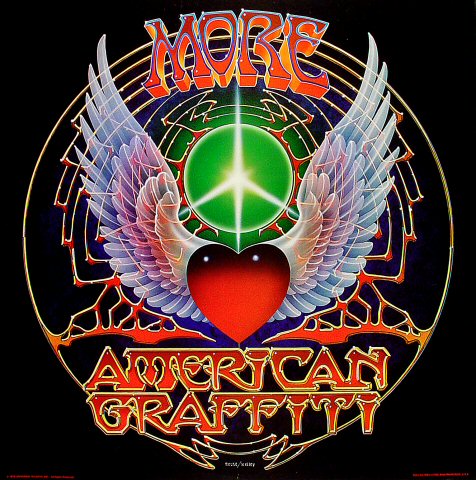
More American Graffiti
(1979 dir: Bill L. Norton)


Many readers out there may be shocked that movies like Ben Hur, Lawrence of Arabia and Gandhi did not make into the number one spot in this category.

Let's make no mistake about it: William Wyler, David Lean and Sir Richard Attenborough are all fine filmmakers. There is one truth, however, about their work that few film critics or film academics ever point out : all of their movies are really long and dull.

In More American Graffiti, writer and director Bill L. Norton takes a mere 110 minutes to cover the tumultuous events that marked the social and political changes of the 1960's. The film depicts the Haight Ashbury drug scene, political campus activism , the birth of the woman's movement, psychedelia and the war in Vietnam.

C'mon, really, David Lean, do you actually need three and a half hours to tell the sweepingly epic story of an Arab revolt during World War I ? Is it necessary to devote roughly the same amount of  screen time to the story of guy who wins a chariot race, there, Willam Wyler? Here's an idea for your, Sir Richard: Indian Independence in 90 minutes or less.

Look, I'm just cutting out the niceties and saying what everyone is thinking.

More American Grafiti is, sadly, the lesser known sequel to George Lucas' first hit film, American Graffiti. It is a sequel that follows, among other things, the story of the Vietnam War. The beloved character of Toad from the original film has a far more interesting story and character development in this film as we follow his exploits during a war that defined an era.

More American Graffiti has scenes of Vietnam (some of which were shot by Lucas himself) that are amongst those of the very best films about the war: Apocalypse Now, The Deer Hunter, First Blood and Platoon.


Best Action Movie
On Deadly Ground
(1994, dir: Steven Seagal)


Long before being unfairly harassed by the FBI, Steven Seagal was one of the biggest box office action movie stars in the entire world. Unfortunately, thanks to the US government's baseless and unfair investigations, Seagal has now been force to retreat to making a modest living in the field of direct-to-DVD home entertainment.

In the heyday of Seagal's massive commercial success, he made one little film called On Deadly Ground. It was a time when Seagal's career was following the arc that a younger Clint Eastwood's career followed two decades earlier. Indeed, Seagal followed the inevitable evolution of his career from major motion picture star to major motion picture director. This great 1994 film marked the man's directorial debut.

On Deadly Ground is not your typical action movie fare. Not by a long shot. To be sure, though, the film does have some absolutely stunning and impeccably directed action scenes. Seagal proves himself to be not unlike James Cameron and Hal Needham in his mastery of both film technique and emotional substance. 

With extremely subtle and almost subversive direction, Seagal is able to work an environmentalist sub-text into the film. On the surface, On Deadly Ground may seem like a standard action film about a greedy oil company CEO (Michael Caine in his most overlooked yet arguably best performance) attempting to drill for oil on land owned by the Inuit. On another level, though, the film has almost undetectable undertones of messages about corporate greed, aboriginal rights and (though it took me multiple viewings to catch it) pro-environmental protection statements. When it comes to On Deadly Ground, I am grateful for the three years I spent studying film theory and criticism at Concordia University.

On Deadly Ground ends with Seagal making that one elusive thing in film that all fine actors seek: a career-defining speech. Take a look at Seagal's closing monologue and see if you can pick up on some of its more nuanced meanings....


Best Science Fiction Film
Master and Commander: The Far Side of The World
(2003, dir: Peter Weir)


Master and Commander is the best science fiction adventure flick to ever hit the big screen.  Director Peter Weir creates an exciting sense of adventure, exploration, and character development in a film that follows the captain and crew of a legendary ship of an organization known as the British Navy. In the film, the ship and its crew plunge headlong towards the vast deep reaches of the far side of the world.

It must be pointed out, though, that some elements of Master and Commander: The Far Side of The World are derivative of other films in the SF genre. Most notable among said films is, of course, the Star Trek movies.  Captain Jack Aubrey is clearly Captain James T. Kirk in different dress. Aubrey's ship, The HMS Surprise is a vessel not unlike The USS Enterprise. The character of Dr. Stephen Maturin is a wry combination of the friendship and loyalty displayed in both the characters of Mr. Spock and Dr. "Bones" McCoy. Even Russell Crowe’s wonderful interpretation of the character of Aubrey owes much to the ground breaking performances of William Shatner.

Such similarities are not necessarily bad, however. If you are creating surrealist art, is it wrong to be influenced by Rene Magritte? If you’re studying early childhood development, is it wrong to owe a debt of gratitude to Jean Piaget?  Is there anything wrong with a vaccine researcher building on the work of Jonas E. Salk?

Greatness stands on the shoulders of giants.

Master and Commander: The Far Side of The World is loosely based on Patrick O’Brian’s landmark series of books. O’Brian is often mentioned in the same breath as Arthur C. Clarke, Edgar Rice Burroughs and Orson Scott Card as the master and commander of the literary SF genre in his own right.

Master and Commander: The Far Side of The World has some amazing battle scenes. They are scenes that are reminiscent of the classic battles in Starship Troopers and the original Buck Rogers motion picture, which are generally considered the greatest science fiction battles scenes ever. 

The sequences that deal with the turbulent weather the HMS Surprise encounters on its voyages are, according to meteorological experts, the most accurate on-screen depictions of what great storms in the middle of vast bodies of water would most likely look like.

The evil nemeses of the film are The French. The French are a wonderful creation.  The concept of an alien race that speaks a different language, has a different culture and even different cuisine is just plain brilliant. Weir definitely gets a lot of mileage out the villainous French. 

Master and Commander also achieves at least one moment of true science fiction. It happens during a part of the story when the ship, somewhere in the South Pacific quadrant of the system, discovers a largely uncharted world known as the Galapagos Islands.  The lizards, birds, bugs and other fantastical creatures encountered during the scenes that take place in this strange Galapagos land contain the film's finest special effects. Using a combination of stop motion animation, CGI, and animatronic prosthesis, the visual FX team manages to bring to life creatures that look, act and move like real animals.

Many bloggers, internet commentators and critics have complained that much of the writing in Master and Commander: The Far Side of The World relies too heavily on pseudo scientific techno-babble.  Jargon like “mainsail”, “topsail”, “flying gib” and “masthead” are thrown around a great deal in the film. Such terminology is indeed hard to follow at times, if, in fact, that dialogue means anything at all. Nonehtheless, the so-called techno-babble jargon does invent a sense of verisimilitude towards an imagined reality that is central to the success of the movie.

Other critics, bloggers and internet commentators  have challenged the scientific accuracy of Master and Commander: The Far Side of the World as well.  One of the main bones of contention is the questionable notion that ships of the size, mass and weight of those depicted on screen would be at all able to achieve buoyancy on water. Another source of skepticism involves the far fetched manner in which the ships seem to be propelled by wind through the use of a technology know as "sails".

Oh c'mon, guys, that kinda nitpicking is beside the point. When dealing with a movie as entertaining as Master and Commander: The Far Side of the World,  why get bogged down on stuff like that? Does anyone question the scientific accuracy of the Flux Capacitor or the Death Star?

It’s just a movie. Chill.


Some other honourable mentions for the Best Movies Ever by genre include...


Best Horror Movie
Monster's Ball
(2001, dir: Marc Foresteter)


Best Romantic Comedy 
The Love God?
(1969, dir: Nat Hiken)

Best Musical
Sister Act 2
(1992, dir: Emile Ardolino) 

Best Superhero Movie 
Fearless Frank
(1967, dir: Philip Kaufman)

Best Sequel 
Godfather III
(1990, dir: Francis Ford Coppola)

Best Movie Based on a TV Show
M*A*S*H
(1970, dir: Robert Altman)

Best Documentary
Zelig
(1983, dir: Woody Allen)

Best War Movie
The Green Berets
(1968, dir: Ray Kellogg, John Wayne, Mervyn LeRoy)

Best Christmas Movie
Beneath The Planet of the Apes
(1970, dir: Ted Post)


The movie is even more exciting than the cover of the Blu-ray disc would have you believe


So there you have it folks. I'd be very surprised if any readers of this blog had any disagreements or issues with my choices. It's certainly a pretty hard list to argue with, that's for sure.

Until next time, gang, have a great first day of April!