 |
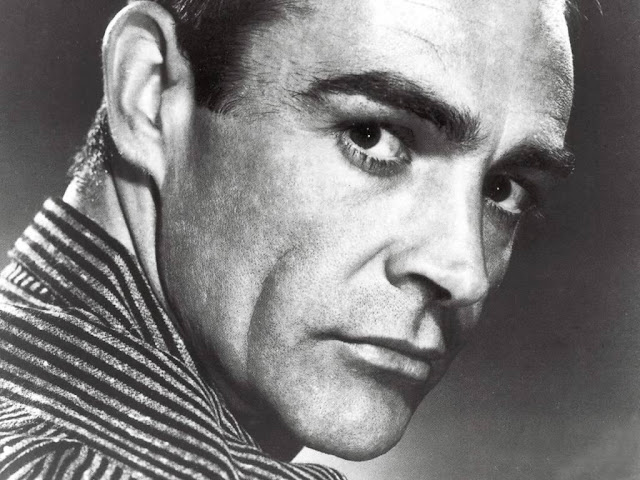
| Sir Thomas Sean Connery looks back at that which might have been. |
Anybody who has ever parused into the depths of IMDB.com or the plethora of internet trivia pages, knows there are a lot of famous roles that were not originally going to be played by the actors that made them famous. There are a lot of stars in cinema history that at one time or another have been offered famous, popular or iconic roles and, for one reason or another, turned them down.
It's fun (or in some cases horrifying) to think about these movie-might-have-been's: Ronald Reagan as Rick Blaine in Casablanca, WC Fields as The Wizard in the The Wizard of Oz, Nicolas Cage as Superman, Tom Selleck as Indiana Jones, Dustin Hoffman as Rick Deckard in Blade Runner, Dom de la Luise and Harvey Korman in Airplane!, Christopher Walken as Han Solo, Marlon Brando in The Exorcist...the list goes on and on. It's not uncommon for a role and the film it belongs to to transmography radically several times over during the process known in the industry as "development hell".
In many cases, the original casting choices are ones that could have significantly changed the role, the movie or both. Poke around in the depths of alternating casting lore long enough and there is one name that reappears more than any other: Sean Connery.
Once you take a good look at the amount of times it has happened, it is not uncommon for big movie stars to pass on roles that become legendary in the hands of other actors. However, in Connery's case, it sometimes feels like the original James Bond Academy Award Winning Sexiest Man Alive has turned down just about every role he was ever offered.. Few movie stars can match Connery's seemingly pathological commitment to passing over famous, iconic, financially successful, career defining and just plain juicy roles. The guy a legend in that department.
Here are 10 examples for Sir Thomas Sean Connery's incredible knack for the phrase: "Hmmm....no, guys, I think I'll pass this time, thanks."
Tarzan
in
Tarzan, The Magnificent
 |
| Tarzan and the Plastic Jungle of the Bandanna People |
In 1959, the Tarzan movie franchise, which had been dumbing down Edgar Rice Burroughs' jungle pulp adventure hero since the early 30's, got something of a reboot. The same series of ape man movies had been a viable Hollywood franchise since 1932. 27 years on, a new producer, Sy Wientraub, had taken control of the series. He felt it was time to shake the Lord of the Jungle up a bit. The resulting movie, Tarzan's Greatest Adventure is one the best Tarzan movie ever made (with kudos also going to the 1999 Disney version and the 1984 film, Greystoke). For the first time in cinema history, the character's childlike "me Tarzan, you Jane" broken pidgin English was dropped in favour of making Tarzan as articulate and intelligent as he was in the pages of Burroughs' original novels.
Muscle man turned B-movie actor Gordon Scott was cast as Tarzan. The evil treasure hunting bad guy was effectively played by Anthony Quayle. In the part of one of Quayle's henchman was a young up and coming Scottish actor by the name of Sean Connery. Producer Weintraub was so impressed with the young Connery that he reportedly offered him the role of Tarzan in the next movie in the the series, Tarzan The Magnificent. Connery is quoted as responding to Weintraub's offer with, "two fellows took an option on me for some spy picture and are exercising it. But I'll be in yours next.". On account of that "spy picture" thing, Connery's Tarzan was never to be. By the time Tarzan Goes to India (next film in the series after Tarzan The Magnificent) got off the ground, so had a series of movies featuring a spy named Bond, James Bond. James Bond was a massive hit and it arguably remains Connery's most famous role to this day.

Not all trivia sites are in agreement on the Tarzan role, however. Some say Connery was was offered a role in Tarzan Goes to India but not the title role. Given Connery's Mr.Universe physique, undeniable charm and sex appeal at that time, Tarzan seems a much more likely role for a hot young actor than that of just another baddie. Either way, it is a moot point. Connery was out of Weintraub's price range by that time anyway. There probably wasn't enough money in all of Hollywood to convince Connery to don that loin cloth by that stage in his career.
At the height of Bondmania in the mid-60's, Tarzan's Greatest Adventure was re-released into theatres. The film's second run was an obvious attempt to cash in on Connery's presence in the movie . The movie poster for the re-release featured a new (SPOILER ALERT) slug line: "Tarzan Kills James Bond!".
_01.jpg) |
| Connery in the Tarzan role he did actually play, along with fellow bad guy Anthony Quayle |
King of the Moon
in
The Adventures of Baron Munchhausen
After co-directing one of the greatest comedies ever made, Monty Python and the Holy Grail (1974), ex-Pythoner and budding auteur, Terry Gilliam, went on to create a series of increasingly audacious cult movies. Time Bandits (1981) was followed by the highly praised Brazil (1985). Gilliam then followed that up with his biggest and most sprawling production to date, The Adventures of Baron Munchhausen (1988).
Sean Connery had previously worked with Terry Gilliam in the aforementioned Time Bandits. In that film, a sheltered British kid and a bunch of dwarfs quirkily
The Adventures of Baron Munchhausen is an epic fantasy adventure set in the 18th century...on acid...or to be more historically accurate but still as cliched...on opium. Among about a million and one other visually stunning stream of consciousness adventures, the eponymous Baron sails to the moon. Once there he encounters, naturally, the King of the Moon.
Apparently stipulating that he only play Kings in any future Gilliam movie, Connery was cast as the lunar monarch. Gilliam has a reputation for retooling and rewriting his scripts that puts the like George Lucas and Orson Welles to shame. The Munchhausen script at the time that Connery signed on and the one that ended up being the shooting script were two very different animals. Somewhere in there, the King of the Moon, a substantial role in the first draft, ended up being reduced to little more than cameo role in the final draft. Connery reportedly felt that the part had become too small and so he dropped out of the project.
Gilliam's path at that point was clear: recast the part with the only actor who is as close to Sean Connery as you can get: Robin Williams.
 |
| Robin Williams or Sean Connery? Who can tell? |
The Player
in
Rosencrantz and Guildenstern Are Dead
Speaking of Terry Gilliam, the screenplay for Gilliam's most famous film, Brazil ,was co-written by British playwright Tom Stoppard. Stoppard wrote (or co-wrote) a number of screenplays including Shakespeare in Love and an uncredited rewrite of all of the dialogue in Star Wars Episode III: Revenge of the Sith.
As a playwright, however, Rosencrantz and Guildenstern Are Dead remains Stoppard's best known work. Rosencrantz and Guildenstern Are Dead is actually a play within a play. It follows the "off stage" story of two minor characters from William Shakespeare's Hamlet.
Rosencrantz and Guidenstern Are Dead premiered on stage at the Edinburgh Fringe Festival in 1966. However, it was not until 1990 that Stoppard finally got to make the film version of one of the most wonderfully absurdist meta pieces of theatre ever. Stoppard both adapted his play to the screen and directed the film. Rosencrantz was played by Gary Oldman and Tim Roth was cast as Guildenstern. The role of the Player King is smaller than that of the two leads, yet thematically intrinsic to the play. For that part Stoppard cast, you guessed it, Sean Connery.
I have played the part of the Player King on stage in both Rosencrantz and Guildenstern Are Dead and Hamlet. For the life of me, I can not fathom why any actor would want to turn down so juicy a part. Nonetheless, Connery did just that.
There are conflicting explanations as to why Mr.Connery did so. I remember reading the press on the movie when it came out. The story that I read then was that Connery was forced to drop out for health reasons. The actor had throat surgery in 1989, reportedly to remove benign nodules from his vocal chords. His voice, the story said, had not yet sufficiently recovered from the surgery to take on such a role.
Current Internet commentators, on the other hand, seem convinced that Connery dumped the part in favour of the much better paying and higher profile gig as the Scottish-brogued Russian submarine Captain in The Hunt For Red October. Throat surgery seems a more likely explanation to me. Watch Connery's films and you'll notice that his now trademark and often imitated vocal raspyness only starts turning up in his performances from 1990 or so onward.
 |
The role of the Player King
finally went to the second greatest
Connery doppelganger after Robin Williams,
Richard Dreyfus. |
Thomas Crown
in
The Thomas Crown Affair
In 1968, box office superstar Steve McQueen, was cast against type in director Norman Jewison's The Thomas Crown Affair. McQueen's character, the titular role, is a millionaire businessman (yep, just a mere millionaire, it was the 44 years ago, after all).
This particular member of the 1968 1% also robbed banks, just for the fun of it. The role of the suave, sophisticated debonair playboy millionaire was a bit of departure for McQueen. His most famous roles up to that point tended to be cops, cowboys, foot soldiers, street hustlers and other more down to earth every man type characters. Nobody saw McQueen as a "suit". The star had a great deal of trouble convincing the studio to let him play one too.
Some of the resistance to McQueen playing the role of Thomas Crown came from screenwriter Alan Trustman.
Why? Well, in a 2011 interview with the New York Daily News, Trustman explains, " I wrote it for Sean Connery.....when they cast Steve McQueen, I objected violently and claimed that he could not deliver the dialogue."
Connery had already turned them down by that point so Trustman and the studio execs finally relented. The screenwriter did an extensive rewrite of the role, tailoring it to McQueen's personality.
Connery has since said that he regretted not taking the part. Personally, I'm not convinced that it would have worked. Thomas Crown dresses well, has expensive tastes and seduces the woman who is investigating him. A variation on James Bond, in other words.
Perhaps the best known scene in The Thomas Crown Affair is the one in which McQueen and co-star Faye Dunaway, not so subtly flirt with each other while playing chess. Let's just say that there' plenty of Bishop stroking and leave it at that. I shudder to think what kind of a grinning smirkfest a 1968 Sean Connery would have turned that scene into. Trustman also seemed to have a strong sense of what Connery's Thomas Crown might have been like. " It would have been very different and I'm not sure it would have been better.", he said.
Interestingly, when Die Hard and Predator director John McTiernan remade the movie in 1999, he too cast the James Bond of the day, Pierce Brosnan, in the title role. The Thomas Crown Affair had come full circle. Said Trustman of the remake, "Brosnan played it as if he were Sean Connery.".
James Bond
in
On Her Majesty's Secret Service,
Live and Let Die
and
Moonraker
 |
| Early marketing campaigns attempted to capitalize on the idea of a Connery-less Bond movie |
Sean Connery had a complex, love-hate relationship with James Bond. Sure, it brought him international super-stardom, yet in the success of the popular role lurked that which can be both an actor's blessing and curse: typecasting. Connery would not successfully break the Bond mold until years after he left the series. Even so, it took till to the late 80's and early 90's before Mr. Connery really ditched the 007 association once and for all.
It's hard to believe that, as early as 1977, Connery was considering playing Bond again. The projects in question were non-official rogue 007 films spawned by a complicated legal loophole that opened the door to the question of who really owned the rights to the story of the fifth Bond movie, Thunderball . Such legal machinations would finally result in Connery reprising the role of Bond in Never Say Never Again in 1983 (it and the 1967 spoof, Casino Royale, remain the only two "unofficial"James Bond movies).
Even before that, though, Connery had his fair share of flirtations with 007 movies that would not come to pass. After Thunderball, the producers of the Bond franchise wanted to follow up that massive hit with On Her Majesty's Secret Service. Based, of course, on the Ian Fleming Bond novel of the same name, that's the movie where James Bond famously (SPOILER ALERT) gets married and his wife famously (SPOILER ALERT) gets killed. There was just one problem with the plan. The film features a hidden bad guy fortress in the Swiss alps which, of course, endows the story with both a ski and bob sled chase. In order to meet the studio's desired release date for the next Bond movie, On Her Majesty's Secret Service would have had to shoot in summer. That made shooting ski chases in the Swiss alps a little problematic. So instead the producers moved ahead with You Only Live Twice, the Fleming book in which Bond (SPOILER ALERT) supposedly famously dies. Midway through shooting You Only Twice in Japan, Connery decided that he was leaving the franchise. So On Her Majesty Secret Service, a fan favourite of the series, which contained one of the most powerful scenes in all of Bond-dom, the death of 007's wife, would, alas, be done without Connery.
Even after all that, Connery was not still quite done with the role yet. After the box office disappointment of the Connery-less On Her Majesty's Secret Service and the thorough critical trouncing of new 007 George Lazenby, the producers and the studio were quite eager to see Connery back in Bond action. They finally struck a deal with Connery to return to the role just one more time. He was paid the then astronomical fee of one million dollars. Connery donated all of it to charity.
In the late 60's with the Apollo 11 moon landing and the public's general fascination with space, Ian Fleming's Moonraker (the closest the literary Bond ever got to outer space) was considered as the next film. Gerry Anderson, famous for his super successful puppet action adventure shows Thunderbirds and Captain Scarlet, was hired to get to work on a space oriented Bond story. For reasons that remain uncertain, Moonraker was ditched in favour of Diamonds Are Forever in which, of course, Connery would star. A satellite in the service of the evil Blofeld and stunningly silly desert moon buggy chase are all that remained of the space angle (and of Anderson's contributions? Who knows?). The franchise would return to Moonraker in 1979, in the wake of the success of Star Wars and the new Hollywood sci-fi blockbuster craze of the time.
Diamonds are Forever went on to become the number one grossing movie of 1971. That is particularly impressive box office success when you take into account that the movie was released in December. Now the studio was more eager then ever for another Connery Bond. Overtures were made. Overtures to the reported tune of 5.4 million bucks. It was an unheard of offer back in the day but the studio really really really wanted Connery in that next James Bond movie. The next film slated for the series was Live and Let Die. As pop culture history tells us , despite the incredible offer, Sean Connery did not appear in Live and Let Die. The producers and the studio, no doubt reluctantly, settled for Roger Moore, the former star of the British TV series, The Saint, as James Bond.
Probably for the best. As Roger Moore took on the Bond mantle, the series would go on to defy itself in its rise to all the new levels of super silly-billy-ness.
 |
Imagine what the German release poster for
Moonraker with Connery as Bond would have looked like... |
Nigel Powers
in
Austin Powers in Goldmember
In early 2001, it was being widely reported in the entertainment news media that Sean Connery and his Goldfinger co-star Honor Blackman (you know, the P-word named woman) had just signed on the play the parents of Mike Myer's mega popular super spy parody character, Austin Powers. The news didn't come as that much of a surprise. Ever since the first film in the Austin Powers series, everybody was kinda expecting something like this, sooner or later.
In said first film, Austin Powers: International Man of Mystery, it was clear that Meyers was doing a James Bond parody. In fact, it was a little too clear, if you ask me. Myers' 60's Bond parody concept was very predominant in the media and popular consciousness. It's all anybody was focusing on. There was little or no mention of all the other lesser known 60's spy films and pop culture that Myers was satirizing even more than he was poking fun at Bond. Myers was, in fact, also going after many of Bond's imitators and the super spy pop culture fad of the 1960s in general. That first Powers movie had everything from character names lifted directly from Dean Martin's Matt Helm spy comedy movies to references to the Flinstones' "J.Bondrock" parody. Alas, almost all such references flew right by most critics and commentators.
For better or worse, the Bond references were the most obvious ones to spot. The climatic Austin Powers scenes in the first film feature some shot for shot recreations of similar scenes the climatic battle in the James Bond movie, You Only Live Twice. Dr.Evil looks almost exactly the same as Donald Pleasance in the role Ernst Starvro Blofeld, the Bond arch villain character (though Dr.Evil was named after the arch nemesis of Captain Action, a popular action figure line at the time). Then, of courses, there's Powers' comically hairy chest that is most certainly a nod to every time Mr.Connery took off his shirt in a Bond movie.
 |
| Never Say Never Again: about as close as we'll ever see of an aging Connery in a spy role. |
When Myers decided to introduce the silly super spy Powers' dad, Connery was a natural choice. Sir Sean had even already blazed the trail for the role when he played the dad of a character he partly influenced, in Stephen Spielberg's Indiana Jones and The Last Crusade.
The early 2001 news reports of Connery in the role never came to fruition. There is scarce information on why exactly Connery never joined the cast. My best guess is that by 2002, Connery was starting to take the prospect of life after retirement a lot more seriously and was getting a lot more picky (even by his standards!) about the roles he wanted to play.
The role of Nigel Powers, Austin's dad, instead went to Michael Caine. At first glance, Caine may seem like a lesser second choice for the part in that there is no real thematic connection to Powers or to the spy movie genre. However, Austin Powers' iconic glasses are exactly the same type of glasses that Caine wore when he played British spy Harry Palmer in another series of 60's spy movies (produced by the same guys that produced Bond). In fact, the Palmer character was part of the inspiration for Austin Powers.
See what I mean? Another reference everybody missed.
Sybok
in
Star Trek V: The Final Frontier
It's gotta be every fanboy's dream crossover: Captain Kirk vs Zed, The Exterminator (you'll get that one later, trust me)...okay...well maybe just this fanboy's.
In Star Trek V: The Final Frontier, William Shatner signed on not just to once again play the Captain of the USS Enterprise but to also direct the fifth film in the then seemingly unstoppable Star Trek movie franchise. In a move that was highly contentious amongst Trek fans, Star Trek V introduced the character of a renegade Vulcan named Sybok. As the story unfolds, Sybok also turns out to be Spock's long lost, never even spoken of before brother (but let's not dwell on that which cannot be undone).
Shatner's first choice for the role of Sybok was Sean Connery. Shatner (who is -believe it or not- the same age as Connery) believed that Connery could bring just the right amount of gravitas, humour and power to the role, not to mention a lot of international name brand recognition. So much so that the movie probably would have been released in some countries under the banner "Sean Connery in Star Trek V".
The choice was not just Shatner's pipe dream, either. Negotiations with Connery had begun, but before the deal could be finalized, this guy named George Lucas came along and offered Connery the role of the father of some archaeologist from the 1930's. I dunno. Sounds kinda dull, Sean. You sure want to give up Star Trek for that?
Connery and Shatner in the same movie. My mind boggles at the possibilities. All the film would have needed then was Charlton Heston as the powerful alien entity who pretends to be God (you know, it really is kind of a bizarre plot for a Trek movie). Then Star Trek V would have realized the dream team movie cast of my childhood.
No matter, though. Sadly, even with Connery's presence, charisma and popularity, nothing could of have saved that major misfire of a Star Trek movie, either creatively or at the box office.
 |
| Okay, this one, more people will get. |
John Hammond
in
Jurassic Park
Michael
Crichton , the renowned novelist, screenwriter, director and M.D., was good friends with Sean Connery. The two first met when Crichton directed Connery in his 1979 film, The Great Train Robbery. They hit it off and remained friends for years. Connery once said of Chrichton, "He’s got a very big influence on my life.".
Though, apparently almost no influence at all when it comes to roles Sean accepted. Aside from The Great Train Robbery, Connery only ever appeared in one Crichton related project, the 1993 film adaptation of Crichton's novel, Rising Sun (which was neither directed nor adapted for the screen by Crichton).
There could have been one other notable exception: Jurassic Park. For the role of John Hammond, the Scottish billionaire who masterminded the idea of an amusement park populated by cloned dinosaurs, Crichton suggested that director Steven Spielberg cast his old pal, Sean Connery.
Like everything else listed in this post, it was not be. According to an interview with Chricton I remember seeing on Charlie Rose back in the day, their friendship did not run quite
that deep. Connery wanted more money than the studio was willing to cough up, according to Crichton.
The studio execs probably felt that the success or failure of Jurassic Park did not rely on Mr. Connery's presence in the film. They were already shelling out the big bucks for the real stars of the movie, the dinosaurs (and the ground breaking visual effects that would bring them to life on the screen).
Sir Richard Attenborough got the part of Hammond. Attenborough played the part as a naive benevolent happy-go-lucky grandfatherly figure who, although well intentioned, was horribly misguided. The characterization is almost a total opposite of Chrichton's Hammond in the original novel. There, Hammond knows exactly what he's doing and is well aware of the potential dangers (and massive profits) of his undertaking. He darkly uses the term "collateral damage" when people start getting eaten by the giant reptilian Frankenstein monsters Hammond helped create.
Connery tends to play most of his characters as people who, while often facing great conflicts, are essentially happy. It is doubtful that any sense of darkness to the character would have played into Connery's acting choices nor would they have been tolerated by the studio execs who seriously gunning for a big summer blockbuster.
Almost cast as Dr. Grant, the role that ultimately went to Sam Neil, was Harrison Ford. Yeesh, with Connery and Ford under Spielberg's direction, the whole affair might have felt a little too Indiana Jones and the Last Jurassic Crusade.
Morpheus
in
The Matrix
 |
| Um...no...I'm not doing the doppelganger bit again. |
As I start looking down this list of roles that Mr. Connery turned down, one overwhelming thought comes to mind:
"What the hell was this guy thinking?". The list that contains some of the most interesting, iconic, juicy and lucrative roles of the last 50 or so years.
Well, here's one more for you, Sir Sean; you could have easily doubled his 1990's asking price price of 10 million dollars a picture by starring in The Matrix.
Connery has stated in a couple of different interviews that we was approached to star in The Matrix. Many believe that he was offered the role of Morpheus, the cooler-than-thou leather clad mentor in The Matrix. In addition to making an absolute ton of money, The Matrix redefined the SF action movie genre for the next 10 years and beyond. Better yet, Connery, as far as critical reaction goes, would have the added advantage of being the guy in the movie that wasn't Keanu Reeves.
Yes, according to most sources, Connery was initially offered the part that went Laurence Fishbourne (and single handedly rejuvenated his career). However, here is some speculation out there in Internet land that Connery was, in fact, offered the role of the Key Keeper in the sequel, Matrix Reloaded.
.jpg)
If that's true, it makes even less sense than turning down Morpheus. That decision is at least conceivably understandable. The first Matrix film is so intensely a visual and visceral experience that God knows how the thing ever would have come across in mere written word script form. Turning down the sequel to one of the biggest hits of the decade is much more perplexing. The movie was out there. It was successful. More than likely, they could have afforded Sir Sean. The part of the Key Keeper is relatively small in terms of a time commitment yet at the same time potentially very profitable. Given all that, I'm more inclined to believe that Connery turned down the seemingly risky Morpheus role in the original rather than the sure thing role of the Key Keeper in the sequel.
Morpheus would have worked for Connery too. The action tough guy mentor role is one that he had mastered at that stage in his career, having already played the part in such films as The Untouchables and Highlander.
However, turning down The Matrix is a mere drop in the bucket next to...
Gandalf
in
The Lord of the Rings
Connery is on record as saying, "I didn't understand it" in refrence to the roles he passed on in both The Matrix and in The Lord of the Rings (just check out the extras on The League of Extraordinary Gentlemen DVD ). In another interview Connery sold the Lord of the Rings non-comprehension explanation even harder. "I had never read Tolkien, and I didn't understand the script when they sent it to me. Bobbits? Hobbits?", he said.
You might have wanted to take a second look at Tolkien and those Bobbits Mr. Connery. Based on the cut of the gross deal that Sir Ian Mckellan got for playing the role of Gandalf in the Lord of the Rings trilogy, Connery would have stood to make an estimated $253 million from the role. Good thing the guy was already a multi-millionaire when he passed on that one.
Not understanding the script is one reason for passing on the one of the biggest film trilogies of all time Another, and slightly more understandable, reason why Sir Sean turned down director Peter Jackson's offer was the prospect of the grueling 18 month shooting schedule that would take place on the other side of the world. Connery was in his late 60's at the time and all that wouldn't have exactly been easy for him..
Now, legendary horror movie actor Christopher Lee was ten years older than Connery and yet that didn't stop him from taking the part of the evil Saruman in the same project. Let's face it, though, Saruman isn't as big a role and, with all due respect, Mr. Lee was probably a lot more in need of 253 million bucks than Connery was.
J.R.R. Tolkien's creation of the wizard Gandalf is one of the most recognizable characters in all of fantasy fiction (that was true even before the movies). The Lord of the Rings: Return of the King is the only film ever in the SF/Fantasy/Horror genre to win an Oscar for Best Picture. Yep, Sean, you seriously missed the boat on this baby.
Mr. Connery, however, may have been leery of "weird" SF and Fantasly scripts sent his way since, say, the mid 70's. Also on the League of Extraordinary Gentlemen DVD extras, Connery says that he did The League of Extraordinary Gentlemen because, "I'm the guy who did Zardoz, after all." That may be a very telling comment in light of his rejections of both The Matrix and Lord of the Rings.
For the uninitiated, Zardoz is a 1975 science fiction film directed by John Boorman (Excalibur, Deliverance) starring Sean Connery. It is a very trippy 70's sci-fi parable that pretends to more dense and cryptic than in fact it actually is. In other words, it's pretentious.
As if that weren't enough, Connery plays a guy named Zed, The Exterminator (see, I told you that reference would make sense later) who spends almost the entire film in a bright red diaper that looks like it may very well have been the inspiration for Borat's infamous one piece male swimsuit. Or, as Mike Myers referred to Sean's unique Zardoz wardrobe at Connery's induction into the American Film Institutes's Hall of Fame, a "nutsack". It's kinda like he got to play Tarzan 16 years after he was first offered the part.
When you take Zardoz into account, it's no wonder that, whenever Connery saw an offbeat "cerebral" SF or Fantasy script like The Matrix and Lord of the Rings, he ran as fast as he could in the opposite direction.
Don't get me wrong, Zardoz is a fascinating curiosity in both the genre and in Connery's career. Nonetheless, go watch it and see if you can't blame the guy.
 |
| The role that many feel Sean Connery should have turned down. |
These are but a few examples of the Connery Roles That Never Were. The list goes on: Daddy Warbucks in Annie, Captain Von Trapp in The Sound of Music and, most recently, reprising the role of Dr. Henry Jones, Sr. in Indiana Jones and The Kingdom of the Crystal Skull, to name a few.
Sir Thomas Sean Connery is now quite adamantly retired from movies. The likes of George Lucas and Stephen Spielberg have famously attempted to lure him out of his luxury New York City apartment and back on to the big screen, but to no avail. Except for a couple of voice gigs, no one has succeeded in that endeavor.
I guess Sean Connery has decided to take his notorious reputation for turning down roles to its ultimate logical conclusion.
 |
| No, this one's just for fun. |


_01.jpg)


.jpg)


