About Me

My photo
Montreal, Quebec, Canada
I am a Montreal-based actor, writer and comedian. When U.S. President John F. Kennedy was shot, I was three days old. I cried all day. My favourite books of all time are Moby Dick by Herman Melville, The Last Temptation by Nikos Kazantzakis and The Ewoks Fun Time Activity Book by Chirpa and Pamploo. I am a member of The Vestibules, On The Spot Improv and The Best Buy Battery Club. Except for the Battery Club, I've been at all this stuff for over 20 years. Enjoy my blog.

Friday, February 4, 2011

The Superbowl and The Sum of All My Fears

Not to fear, all my geeky readers of this blog, this post isn't really that much about the Superbowl. Mainly it will involve action movies, Tom Clancy and on set film business anecdotes as they relate to the biggest football game of the year.

The Super Bowl is this Sunday. It will feature That Team There playing against That Other Team There. If  that doesn't reassure you of this post's minimal Super Bowl coverage, I don't know what will.

I hope The U.S. Department of Homeland Security watches a lot of movies. If so, they will have operable intelligence that the Super Bowl is quite the popular potential target for terrorists and/or psychos. It's a scenario that very much predates 9-11.  Super Bowl attack paranoia goes at least as far back as 1976:
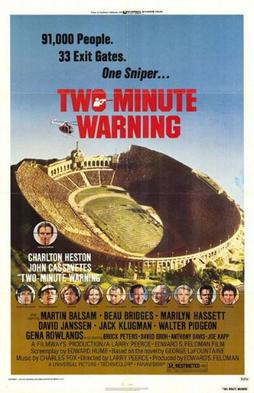


A psycho sniper at the Super Bowl that only Charlton Heston and John Cassavetes can stop?  Suddenly I'm a lot more interested in football. 

I know. I know. It's actually referred to as Championship Sunday in the movie. More than likely the producers could not afford the rights to the name Super Bowl. That NFL legal licensing team was on the ball even back then.  I wouldn't be surprised if this post is pulled for legal reasons because I did not title it The Big Football Game at the Beginning of February and The Sum of All My Fears.


A year later, Hollywood upped the stakes with this classic John Frankenheimer thriller
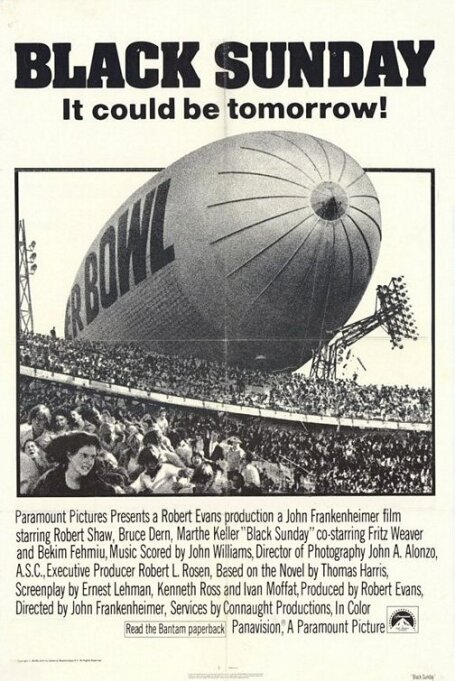


In Black Sunday, terrorists plan to bomb the Super Bowl (they had the rights to the name this time around) using the Goodyear blimp as the delivery system.  And, yes, actual terrorists do figure in the plot. Palestinians in this case. Just to back up the point, the hero of the movie is a tough Mossad agent played by Robert Shaw. Though, really, the Goodyear company should know better than to hire a bitter psycho Vietnam veteran played by Bruce Dern to pilot their blimp.

Back in 1977, such scenarios seemed quaintly far fetched.

Why is it that I'm only interested in football when it involves the threat of mayhem and destruction being reigned down on the sport's biggest game? Oh, yeah, right. High school Gym class.

Best selling political thriller author Tom Clancy brought the Super Bowl attack premise to its ultimate logical conclusion with this 1991 entry into his popular Jack Ryan series of books:
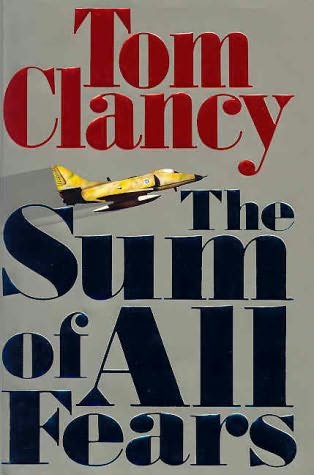


Yep. Part of the plot of Clancy's The Sum of All Fears involves terrorists setting off a nuclear bomb at -you guessed it- the Super Bowl.

Hollywood decided to wait until 2001 to announce plans to film The Sum of All Fears. It was kinda odd timing given that three other of Clancy's books about CIA operative Jack Ryan,  The Hunt For Red October, Patriot Games and Clear and Present Danger, had already been filmed featuring the 007-like switch-up casting of Alec Baldwin and Harrison Ford as Ryan.

In The Sum of All Fears, the much younger than his predecessors Ben Affleck was cast as Ryan. James Earl Jones suddenly became Morgan Freeman.  In fact, there was no real indication if there was or was not supposed to be continuity between this newest Ryan adventure and the previous two. The Sum of All Fear has got to be the most secretive reboot of all time.


At this point,  you may be wondering where the acenecdotes about the movie biz that I promised earlier fits in to all this.  It's coming, trust me.

The Sum of All Fears was one of the first big Hollywood blockbusters to shoot in Montreal.  That meant that a great deal of Montreal actors would probably get quite a lot of smaller speaking roles (with various variations on the term "smaller").

That included yours truly.

The Sum of All Fears was one of the weirder auditions I've been on. I went in for some other movie or TV show entirely.  I don't remember the title even. These were the old glory days of the Montreal film and TV production boom. It was not uncommon to lose track of auditions, especially once I was done with them. In recession laden 2011, however, it's hard to forget something you do only two or three times a year.  Anyway, while I was auditioning for whatever, I was asked if I'd like to read one line for The Sum of All Fears.

Yes, it's true. Actors audition, sometime multiple times, for roles of one line or sometimes even less. This is especially true for Montreal-based actors.

They put me on tape saying my one line, "Mr.President". I said it while handing a video cassette box over to an unseen presumably off-camera President of the United States. I had no idea of the context of the scene in the story but I'm pretty sure that the prop in question was not actually supposed to be a video cassette case in the actual movie.

Auditions had already been held for The Sum of All Fears and all the parts had been cast some time ago. I even knew some actors who had already worked on the film by then. I had never auditioned in the first place. That I got to read for it at all was a total bonus.

Like many auditions back in the day, I put it out of my mind and went on with my life. A few weeks later, I was in Toronto working on the editing of "The Font Doctor", a short film written, performed and directed by The Vestibules. I picked up a phone message from my agent. The director of the movie, in the words of the casting director, "really loved" the way I said "Mr. President".

I had been offered a part in The Sum of All Fears.

Before the role was a done deal, they wanted to know if I could drive a manual transmission vehicle. If so, the gig was mine. Many years ago, I had an acting teacher whose advice when it came to any question regarding potential work was "always say yes". Can you sing? Yes. Can you dance? Yes. Can you speak German with a Scottish Accent? Yes. Can you drive a manual transmission? Yes. Thinking foremost of that advice and not wanting to lose a role of any size in a major Hollywood movie, I , of course, said "Yes."

As you may have guessed, I could not drive a manual transmission vehicle then (or now even). I decided that I'd take a crash course (no pun intended) and learn how to drive standard before my shoot date. In my experience, roles ivolving driving in movies usually meant going about four feet and then stopping and getting out. I was sure I could master that much in a short period of time.

There was one small problem. From the time when I got back to Montreal to when my shoot day was scheduled was only about one week. So as soon as I got home, I went to the driving school down the street. I told them I had to learn to drive a car with standard transmission in one week. The woman behind the counter asked me why it had to be done in such a short period of time. I said it's because I needed to know how to drive standard so that I could act in a movie with Ben Affleck. She looked at me blankly for a beat then said ,"No one will believe that. I'll tell the instructors you are going to Europe for business in a week.". Then she got on the phone to find any available driving instructors who could fit the lessons into their schedule in the next week.

I ended up landing four different lessons with four different instructors. I also ended up paying a nice and hefty "rush" fee on top of the cost of the lessons (still, though, at Hollywood pay scales, I'd be coming out way ahead).

At the time, I was writing and recording radio sketches with The Vestibules during the day and then doing shows with On The Spot Improv at night. So each evening that week, I'd finish with The 'Bules, shove a sandwich in my face on the bus, do an hour of manual driving lessons (at various weird locations all over the city, beggars can't be choosers) and then go do a show with Spot that night.

I think I wrecked many a clutch during that week. My fourth lesson was canceled by the instructor at the last minute. I would have to make do with just three lessons. I was still a little shaky on my abilities to drive a  vehicle with a manual transmission.

My shoot day finally arrived. I was lucky that first day. Production was behind schedule and they didn't get to my scene at all that day. I got paid to sit around in my trailer for twelve hours and then go home. It was a nice way to relax and build up my manual transmission skills confidence.  I kept coming back to "Hey, I'm only gonna have to drive for like three feet. I probably won't even have to shift gears." It was a night shoot so I managed to get some sleep in as well. Nice work if you can get it.

On the second day (we still call 'em days even when they're nights), they were ready to shoot my scene right when at the beginning of the day. Normally, that's a rare treat for a bit player in a big movie. This time around, not so much.

At this point, I should point what my role was. I did not get the role of a Pentagon official handing the President a video cassette box. No. Instead I got the role of a National Guard driver.

See, in the movie (SPOILER ALERT), there is this convoluted Chechnyian terrorist plot to set off a nuclear bomb at the Super Bowl (which is again, for legal reasons, referred to as The Big Football Game or something equally lame). Of course, CIA analyst turned super agent Jack Ryan somehow figures out the plot. However, he is not in time to stop the bomb from exploding. Nice going, Ryan. James Bond would never have let that happen. So in my scene, Ryan is rushing to a makeshift aid station set up near the blast site.  Destruction and mayhem are everywhere.

I'm the National Guard driver that drives Ryan on to the site. I have one line. I say, "Oh, great. Now it's snowing too." to which Ryan says, "It's not snow. It's ash from the blast" (my guess is that this scene was added last minute over concerns that audiences might misinterpret the ash as snow-it being late January in Maryland in the story and all).

It seems I had, out of nowhere, suddenly landed myself a dialogue scene with  Ben Affleck. Score...sort of.

We were shooting out at the Armed Forces base airport in St.Jean Sur Richelieu (about half an hour out of Montreal). I walked on set and saw the whole thing in its entirety for the first time. By set, I mean two airplane hangers and a massive tarmac. There were two huge tents. One was for make-up for the extras so that they could all be made up to have simulated radiation burns and other injuries. The second was the hospital tent in the movie that they were going to shoot in. There was also a bunch of cars and trucks, military and otherwise. There were even actual soldiers from the US Army, presumably playing themselves (hello, typecasting).

Right next to the crane (OMG, a crane shot!), there was this very large truck. It had a great deal of expensive camera and lighting gear attached to it.

That was the truck that I was going to have to drive. Gulp.

Just then, the director, an extremely nice man named Phil Alden Robinson introduced himself to me. He explained that that day was the biggest and most complicated day of the entire shoot. The biggest day of the entire shoot of an action thriller involving a nuclear explosion. Did I mention that it would be best for the shoot and my career that I not fuck anything up and ruin a shot with all this other incredibly expensive stuff going?


I was then introduced to Mr. Affleck. We headed over to truck. I'm was about to do a scene in the middle  of a big budget Hollywood blockbuster driving a truck I didn't  know how to drive while playing a scene with Ben Affleck.

Piece of cake.

I got into the truck so we could rehearse the scene. I took a look at the gears. My mouth hung open in amazement.

The truck had an automatic transmission.

So when they told me I had to know how to drive standard, they were just kidding I guess. Can I have the last week of my life back now, please?

Immediately, my confidence level shot up about ten fold. However, I still have to drive a huge truck with lots of expensive equipment hanging off it. I ran the scene with Mr. Affleck a couple of times while doing some rehearsal driving. Other than almost running down some extras who were walking where they should not have been walking, everything went fine. Mr. Afflect disappeared back to his trailer. We continued to run the mechanics of the driving and the scene several times with his stand-in.

During that time, I was constantly told by the assistant director to drive much faster. Meanwhile the Steadicam operator, not unpredictably, kept asking me to make it all nice and smooth. I'm not sure where the director was in any of this.

The scene required, as I predicted, a short drive. I do my lines with Mr.Affleck while driving, drive a few more feet then stop. Mr.Affleck gets out of the truck and the Steadicam follows him out, the operator seamlessly walks onto a platform on the crane as it rises up and we see Mr. Affleck continuing to cross the tarmac in, to use Mr. Robinson's words, "the most complicated shot of the picture".

The whole scene is almost second nature to me by the time that we are ready to shoot. As we prepare, the stand-in is suddenly gone and I'm sitting next to Ben Affleck once again. We rehearse the scene once. We now are ready to shoot. There is a long delay. Mr. Affleck goes away someplace again. The assistant director comes over to me. He asks me if I can get out of the truck for a moment. They need to run the scene with one their guys, for some technical reason.  So I get out and watch them run the scene with a member of the crew driving the truck. It goes nice and fast.

Suddenly, Mr. Affleck is back. He gets into the truck. The crew member gets out of the truck. I figure they will be calling me back any moment. Then I suddenly notice that the wardrobe and hair people are hovering around the crew member.

They are putting a national guard uniform on the guy and giving him a military style haircut similar to mine.

Years earlier, I played the lead role in a wonderful play by Christoper Durang titled The Actor's Nightmare. It's about an actor who suddenly finds himself in a production of Hamlet but has not rehearsed the part and doesn't know any of the lines. As an improv veteran of many years, that scenario was never my version of The Actor's Nightmare.

That moment on set that night was my Actor's Nightmare. My Sum of All Fears.

Now nobody had said a word to me at that point. So I decided, "Fuck it. I'll play dumb".

As they were getting ready to roll, I walked over to the truck to get in. The assistant director came running over and said, "Um, we're gonna do the shot with one of our guys. It's a big rig and it needs to move fast.".  Thanks for the update, pal. Then I asked him what was going on with my lines. He said he didn't know.  I was quickly ushered away.

Later Mr. Robinson, the director, came over to me and apologized. He said that with all that equipment on the truck, it was an insurance issue. And they just suddenly realized this before rolling? To this day, I'm still not sure if I buy that explanation.

Though the director did tell me that Mr. Affleck and I would record our lines at the end of the shoot.  The shot in the scene is of the back of our heads so they could just dub the lines in later.

I was still not at all happy. As it turned out, the branch president of ACTRA, the actor's union, also had a small part in the film and was shooting that day.  "Ha! Little do they realize that the union branch president is on set today. They have not heard the end of this!", I thought.

I marched over to his trailer and explained what had happened. He very calmly and casually said, "Yeah.They can do that. As long as they're paying you.". I walked away singing Billy Bragg's "There is Power in a Union" to myself.

Just then the second assistant director came up to me and told me that they would not be using me in the shot tonight but that I would be recording me with Mr. Affleck at the end of the night. Boy, are those second assistant director's ever in the loop or what?

The end of the night came and me an' Ben (he wasn't Mr.Affleck anymore) recorded our two lines in the truck while it wasn't moving. About a thousand people stood around being completely quiet until we were finished.

I went home thinking that ,well, at least my voice would get to be in a major motion picture. And I did make something like 2500 bucks for two days work.

My date on set was in April of 2001. I think the film wrapped some time in June (they had been shooting since February).  I don't think I need not get into the events that followed in September. The original word that I was getting through my agent was that in the aftermath of 9-11, the movie would be shelved permanently and never released.  What had once been a far fetched Tom Clancy plot was now hitting way too close to home.

About a month later, Collateral Damage, an Arnold Schwarzenegger movie about a firefighter tracking down a terrorist that had killed his family, was a huge hit. Add to that all those stories of  how movies like Independence Day were flying off the video store shelves (which, it was later learned, was based on a report from one New York area Blockbuster -so all those post 9-11 pundits were actually analyzing the behavior of one movie geek).

Early in 2002, I began seeing this in the theatres:


The Sum of All Fear opened in May 2002. I went to see it.

Most of the scenes depicting the attack were cut way down or were right out completely. Gone were the tents full of survivors with radiation burns. Only one short scene about the aftermath of the blast stayed in the movie on account of its importance to the plot. Also gone also was me, the damned truck, the crew member standing in for me and even the dialogue Ben and me recorded. Less than a year after 9-11, not showing the horrific aftermath of a nuclear attack on U.S. soil was understandable. A big drag for me but understandable.

When The Sum of All Fears came out on DVD, my scene was nowhere to be seen even in the deleted scenes. The movie was never a big enough hit to warrant a super duper two disc collector's edition DVD or Blu-ray. I doubt that footage will ever be unearthed. No. It will forever remain one of the great lost scenes of cinema history.

Every year I could care less about the Super Bowl except for one thing. It reminds of that day on the set of The Sum of All Fears. Showbiz is totally and utterly unpredictable.

Much to my surprise, a couple of years ago, I got suddenly $400 royalty cheque for The Sum of All Fears. I started singing "There is Power in a Union" with a different meaning this time.

Those royalty cheques keep coming in every year. And I'm not even in the movie!

Imagine what  kind of cheques Ben Affleck must be getting.

Tuesday, January 25, 2011

Some of The Weirdest Animated Shows Ever Made For Kids


Almost all animated shows for kids, really, are kinda weird. They often involving talking ducks, people that can fly, robots, sponges with jobs, pink pony unicorns, cavemen who have pet dinosaurs and ton of other weirdo stuff that is usually the exclusive domain of the insane and/or the stoned.

Some animated shows aimed directly at kids are little more strange than others, though. As a kid, we will watch just about anything that is put in front of us. Many premises and ideas that hold a significant "WTF?" factor to anyone over the age of 13,  just fly by us at face value.

As adults, we look back on these shows and start to realize that "Hey, this whole show is kinda whacked.".

Sometimes, it's the premises of these cartoons that are bizarre. Other times, the premise is relatively normal but the execution is strange.  Or in some cartoons, the source material is just plain an odd or inappropriate choice for a kids show. Whatever the case, I have always found these animated oddities intriguing, fascinating and very entertaining.

Here are some of the weirdest animated shows ever made for kids...


"Softness in eyes, Iron in his thighs"...um, what's going on there?

Speaking as someone who has written for a great deal of kids shows, I would love to try and get those lyrics by the Standards and Practices department of any of the major children's networks today. And let's not even get into the whole centaur sidekick thing.

Most of the weirdness in this early 60's animated take on Greek mythology can only be seen by modern adult eyes. This is particularly true if those eyes have had a strong classical education.

Nevermind that this reboot of ancient stories for five year-olds mixes up characters from about five different myths and legends. Nevermind that almost all of the well established Heracles (See? I'm getting all smarty-pants and using his original Greek name) stories are not even referred to in any episode of The Mighty Hercules that I've ever seen. No. The weirdest aspect of this particular adaptation is that Hercules does not have "the strength of ten ordinary men" until he puts on his magic ring.

A magic ring? Hercules?

Hello Greek Mythology Meets Tolkien Meets The Green Lantern with some Wagner thrown in for good measure!

The Mighty Hercules featured Canadian broadcaster Jimmy Tapp as the voice of the lead character for the first 13 episodes. His delivery is a tad dry, I gotta say.

The Mighty Hercules was also responsible for great deal of difficulties I had in my Classics classes in university.

"Professor, how does Tewt figure in The Twelve Labours?"


"Anywhere and everywhere the savage forces of General Warhawk threaten the peace-loving people of the world...". K, you gotta be wary of any show that positions Rambo as the pacifist.

As you may have observed, the show was actually titled Rambo and The Forces of Freedom. What did they? Have Reagan's speechwriter on loan?

I remember the controversy in the media when this show first came on the air. Sylvester Stallone, displaying a lot of good sense and PR savvy, publicly distanced himself from the series when it premiered in the fall of '86. Stallone stated that the R-rated (14+ at the time in Quebec) Rambo films were never intended for children. That's in spite of the simplistic writing, I guess. He added that even though he objected to the cartoon, there was little he could do about it. He didn't own the rights to the character and had no control over what the studio did with him.

He said the same thing about Rocky V.

Here's a fun fact that will most likely never win you a Trivial Pursuit game: an action figure from this series makes a brief appearance in The Vestibules "Action Figure Theatre" video.


Moby Dick as a cute and heroic white whale...I know...I know...Captain Ahab must be rolling over in his watery grave.

If you're gonna go with a Melvillian animated series, ya gotta at least make it a Coyote-Road Runner style chase show. You know, something with a title like say "Ahab 'n Moby" (today's cartoon: "Round Perdition's Flame!").

While we're on the subject of potential Melville inspired cartoons, the name Billy Budd has got that Stan Lee style character alteration thing happening. Could make for an interesting superhero: "Fighting the never ending battle against evil in 19th century navies everywhere!"

Or how about the zany adventures of Bartelby The Silly Scrivener?

Okay. I'll stop now.


The Mighty Mightor was my favourite shows when I was like five or so. The mild mannered cave dweller turned Super Cro-Magnon angle must of been lost on me at the time. I don't even remember that the show took place in the stone age.

The Mighty Mightor is to the best of my knowledge the only prehistoric superhero ever. Yes. Yes. I know. There's Captain Caveman. However, the good Captain spent most of his time hanging out in the 1970's with babes who wore high heels in the jungle.

Creationists would no doubt laud the Flintstones-like accuracy of the depiction of humans and dinosaurs existing at the same time. I'm not convinced. Mightor's powers are clearly pagan in origin.

More contemporary audiences will recognize Mightor as the judge from the classic Adult Swim series, Harvey Birdman: Attorney at Law.

Anybody remember this?


Yep, in the 60's there was a cartoon series of The Beatles. You will find only the tiniest references to it in any of the official Apple histories of The Beatles. 10 hours of The Anthology and I think it's alluded to briefly once. Even then it's only mentioned in the context of how the movie Yellow Submarine came about (same producer, believe it or not). It has never been released on VHS or DVD and I wouldn't hold your breath for the Blu-ray treatment any time soon either .

The show premiered on ABC in 1965. Not surprising, really. Beatleamania was still going strong then. The Fab Four skewed to a pretty young audience in those days. What is surprising is that the series ran all the way until 1969. That's well into the band's-hippie-freaks-who-do-lots-of-drugs phase. Once the trippy days of the mid 60's start kickin' in, incorporating the wacky Saturday morning cartoon  romps of those crazy mop tops into songs off of , say, Revolver, well....starts to get a little challenging...


Oh, those crazy primitive cultures.

Speaking of which...

Robert E. Howard, it ain't.


Every era has its fair share of flash-in-the-pan pop superstars who were absolutely massive for a relatively short period of time. When looking back, however, they serve to only illustrate the silliness of the era. The 60's had Bobby Sherman, the 70's had David Cassidy, the 80's had Boy George and the 90's had this guy:


I have seen this intro may times and the theme song is currently on my iPod. Honestly, though, I'm still not clear on what exactly Hammerman's back story is.

At least the action figures were easier to understand.


Cows that ride horses. My brain hurts now.

In the wake of the success of The Transformers and GI Joe movies, Universal Pictures optioned all of Hasbro's toy and game products. Incredibly, there are currently in development Monopoly, Operation and Battleship movies, with, quite possibly, more to come.

The people who made this show were way ahead of the curve:


I don't think there's a kid that grew up watching English Canadian TV in the last 50 years or so that does not know...


Setting aside the notion of astro-glenns for a moment, the premise of Rocket Robin Hood is not so weird. As Saturday morning cartoons go, Robin Hood in the future is pretty much par for the course.

However, it's the execution of the premise that is truly strange. First off, there was that theme song that was repeated at every single commercial break. Then there was those odd little character explanation vignettes that ran in almost every episode. One featured Friar Tuck taking one bite out of three different types of food then throwing the rest of the food away. This bizarre eating ritual was repeated in the exact same order at least twice. He even managed to take one bite out of a bunch of grapes; a feat that still defies me to this day. The vignette also clearly illustrates Friar Tuck's ability to beat off the bad guys with his stomach (a greatly under-rated fighting technique, BTW).

The limited budget animation was a major contributor to some of the more bizarre elements of Rocket Robin Hood (actually that an animated English Canadian TV series got made at all in the days before the Cancon rules and tax credits is in itself bizarre). Sure, there was the obvious re-using of stock action sequences and the Bergmanesque close-ups of the eyes for large chunks of dialogue. Those are standard. But Rocket Robin Hood blazed new trails in this particular area.

For instance, there is one episode where Rocket Robin Hood has to get to some treasure or something by going through different levels of some kind of fortress or something (hey, it's been awhile). On each level, he encounters different bad guys he has to get past. Each set of bad guys looks exactly like all the different bad guys from, oh, say, every other episode of the series. Pretty much the entire plot consisted of our hero just beating up the aforementioned wide variety of meanies. Rocket Robin Hood wasn't so great in the writing department either.

Speaking of bad guys and limited animation, all of The Sheriff of N.O.T.T.'s guards look exactly the same in every singe way. Anybody ever wonder where George Lucas got the idea for an all clone army?

Then there were the Rocket Robin Hood episodes that were obviously inter-cut with footage from the 60's Spider-Man series (also Canadian made).  Or was it the Spider-Man footage that was cut into Rocket Robin Hood?

No one is really sure.


But, by far, the all time weirdest animated show ever made for Saturday or any other mornings has gotta be:


"...or whatever the need requires!" Woah, woah, careful there, guys, you don't want to write yourself into a corner.

Airing in the 1967-68 Saturday morning TV season and never being big in syndicated reruns, Super President is a little before my time....and everybody else's too, I think.

You do have to hand to the people that created Super President, Depatie-Freleng (yes, Friz Freleng, one of the guys who animated Bugs Bunny and The Pink Panther was in on this one). Outside of editorial cartoons, the presidential superhero is a premise that has never been done before.

I'm not sure exactly how the Super President premise works. Was he elected as Super President? Or is Super President's secret identity that of the President of the United States? If so,  the name is kinda of a dead give away, no?

According to Wikipedia, President James Norcross got his super powers from a cosmic storm after he was elected. Only his chief of staff, Jerry Sayles, knows his true identity. I'm gonna go with a big "citation needed" on that one.  I mean, c'mon, all those Clark Kent like disappearances in times of crisis would absolutely kill the guy in the 24 hour news cycle.  Then there's the problem of ditching the Secret Service every time he has to get into costume. The mind boggles at the complications.

Not only I am an unclear on the premise but I'm pretty sure that everyone who worked on the show was equally unclear on it. All of the bad guys, for instance, seem to know that they can find Super President in The White House.

The writers probably came to the same conclusion I did: it's better not to think about it.

Like Bruce Wayne in Wayne manor, President James Norcross has a secret headquarters beneath the White House. From there, he can launch some kind of a two man super presidential flying underwater spaceship. Given the amount of secrecy and security surrounding The White House, how do we know that such a thing is not actually there?

As I mentioned earlier, Super President's sidekick (and supposedly the only guy who knows his secret identity) is Jerry, the President's chief of staff.  Everybody knows there is no better sidekick for a superhero then that of a balding middle-aged man in a 1960's business suit wearing horn rimmed glasses.

Just in case anyone one who owns the rights is reading this out there, Super President is prime for a TV/big-budget movie/graphic novel reboot.

We can only hope.


That's right, kids, remember to tune in next week...

Friday, January 21, 2011

Lenny Cohen an' Me

Leonard Cohen touches the audience's perfect body with his mind


Readers of my previous posts may be familiar with my Leonard Cohen fandom.  Up to now, though, I've never thought of myself as having much in common with the man. We're both Anglo Montrealers and we both share an introspective fascination with the darker sides of our nature. Other than that, we have different cultural and religious backgrounds, different career paths (some might say one of us is more successful than the other), are of different generations and a have made a few very different lifestyle choices.


It's fair to say that the vast majority of my live performance experience is in comedy.  Whether it be in improv, sketch, stand-up or even in theatre, I've dealt with many different types of audiences and I've seen more than my share of tough rooms. Dealing with crowds like that is often just a case of reading their mood, figuring out what they want, giving it to them on your own terms and then taking control of the show so you can move on.   It's something you pick up really easily after the first 10 years of  4 or 5 nights a week of live comedy performances (forgive my vague generalities on the subject but all will all become clear later on).

I've also done my fair share of dramatic performances but I've always thought that different rules apply. In my mind, that level of hyper awareness of the audience is only necessary when you're trying to get something as precarious as laughter out the audience.

I've been rethinking that assumption lately.


One of my Xmas gifts this year was the Blu-ray disc of Leonard Cohen Live at The Isle Wight 1970.

Just as a geeky side note: this is an excellent Blu-ray disc and a must for any Cohen fan. The HD picture quality is really good, even considering that the original materiel is a 40 year old 35 mm film. And, man, did those techs ever get a nice 5.1 HD sound out of what were most likely some very primitive 1970 recordings.  

K, back to my point.

Leonard Cohen Live at The Isle of Wight 1970 (you really gotta work on that title, boys) is not just a concert film, it also tells a story.  The Isle of Wight is, as one may guess, a small island off the southern coast of England. Back in the late 60' and early 70's, the little island was the site of a massive annual music festival.

The '69 festival featured acts like The Band and Bob Dylan (who actually played that fest and Woodstock back to back).  The '70 fest line-up followed the bigger and better formula of festival expansion. Booked for that year's fest was The Doors, The Who, The Moody Blues, Emerson Lake & Palmer, Donovan, Jethro Tull and Kris Kristofferson. Thrown in for good measure were the mellow folky acts of Joan Baez, Joni Mitchell and the unclassifiable talent of an up and coming Canadian poet and novelist turned musician by the name of Leonard Cohen.

It was a pretty rough festival that year. Attendance hit a record number of 600,000 people. Despite the fact that the ticket prices were the equivalent of about seven bucks Canadian for five nights of music featuring all the above acts and more, this festival had the same problem Woodstock had a year earlier. Many people showed up refusing to pay.  Back in the 60's, see, everyone thought music should be free, man, for like anyone who wants to hear it, man. It's not like musicians have to make a living or anything. That's Establishment sell-out thinking.

It was no Altamont but no Woodstock either. Fences were torn down. Scuffles bordered on riots. Even the better behaved members of the crowd made for a pretty restless audience. There is a clip on the Blu-ray disc of a festival organizer (who looked not unlike Spinal Tap's manager) scolding the crowd, calling them "pigs" for behaving badly at a festival that he had put a year of his life into organizing. Buddy, I get the frustration, but very few performers can pull that kinda shit off without years of experience  (and even then...). The effect of a speech like that on a borderline aggressive audience is akin to actions involving a bee's nest and a baseball bat.

Leonard Cohen was scheduled as the penultimate act, following Jimi Hendrix. And, really, even at the best of times, who the hell would ever want to have to follow Hendrix at a music festival in 1970?

Cohen was not necessarily a good fit for the peace, love and LSD crowd.  He would certainly not be considered an Establishment sell-out but, really, Leonard Cohen is, if anything, a product of the Beatnik generation. He is a tad mellow in comparison with Hendrix.His songs are, at best, only indirectly about drugs and youthful rebellion. For the uninitiated Cohen's unique vocal style is often an issue. As Cohen himself said at the Junos a few years back, "Only in Canada could I win an award for Best Male Vocalist".  At the risk of belaboring a point, add to that that Cohen was 35 in the "don't trust anyone over 30" era.

The festival atmosphere was not getting any better as Mr.Cohen's set approached. There had been incidents of fans storming the stage (event security was still a radical new concept in 1970), Kris Kristofferson had beer bottles thrown at him while being booed off the stage the night before and that night the stage had been set on fire...by Jimi Hendrix.

It was nearly 2 AM when Cohen finally took the stage. He did so to, what was for an audience of 600, 000 people, near silence.

Leonard Cohen's second album, Songs From a Room, was charting at no. 2 on the UK charts at the time.  All those people who bought his album were not there that night. Many of the songs did get recognition applause but they sound like maybe 200 people (out of over a half a million).

Ya gotta hand it to Lenny, though. Cohen did not seem phased in the the least.  You do not see him trying to pick up the energy or change his approach. He did not suddenly decide to do more upbeat songs (not that he had them anyway).  No. Cohen took his time with everything. There was perfect calm between each song, regardless of audience reaction. It was truly amazing to watch.

At the same time, Cohen was not oblivious to his surroundings. Not at all.  He very clearly had a sense of the mood of the crowd.

At one point during his set, someone comes from back stage and hands Cohen a note to read to the audience. My guess is that was some kind of crowd security related announcement or something of that nature. Whatever the case, it was an announcement the organizers felt important enough to hand to a performer in the middle of a set. Cohen then calmly took the piece of paper, read it and then looked up a the audience. In that classic earnest Leonard Cohen voice of his, he said "They have the island surrounded".

Broke the tension instantly.

It's certainly not uncommon for Lenny to make a subtle joke or two during his shows. That Leonard Cohen has no sense of humour, really, is a myth perpetrated by people who don't know his work all that well.  But it wasn't the humour that impressed me so much as his seemingly innate performer's intuition.

It's as if he just instinctively knew that that audience did not want to hear another announcement about "stop doing this" or "be careful about that" or "the neighbours have asked up to keep it down" or anything of that nature. Clearly, that crowd had enough of that.

God knows what the announcement really was but Cohen was able to use the moment to make a connection with the audience. And I doubt he was pandering. I'm sure that Cohen himself felt that the announcement was unnecessary; this crowd was going to do whatever the hell it wanted to anyway. 

Then Cohen sealed the deal. He said, "Someday we will own this land."  Huge cheers and applause. Suddenly it sounded like 600,000 people were there. Then he added "But we are not strong enough yet".  Less applause but that did not matter. He had just found an incredibly canny and subtle way to send a "so simmer down" message to the crowd. .

It worked. He had them in the palm of his hand

Each song after that seemed to get an ever increasing amount of attention and applause. He managed to make further connections throughout the show. For instance, he introduced this classic song as "A great song to make love to." (sexual appetite is certainly something Leonard Cohen had in common with the hippies):


Leonard Cohen closed his set that night with a song about suicide.  He ended on massive applause and cheers. He got an encore.

Cohen pulled off something that I've seen many great comics pull off.  In comedy terms, he "read the room".  He gave 'em what they wanted, connected with them and then used that connection to take control of the show. It was an incredible thing to watch.

I would never have imagined that an act as esoteric as Leonard Cohen who ever have to deal with a "tough room" nor that he would be able to do so in such a familiar manner. He managed to win over an massive and unruly audience who were in the mood for something very different than him.

The style and the manner were very different but the essence was something that I knew very well.

Turns out Lenny Cohen and me have more in common than I thought.

Friday, January 14, 2011

The Green Hornet and Other Great Pre-Superhero Superheroes


Sure, yeah, there's a big new blockbuster Green Hornet movie opening today. It may or may not be a huge hit and it may or may not forever connect the roles of The Green Hornet and Kato with the oddly cast duo of funny guy Seth Rogan, and pop singer Jay Chou.  Even so, The Green Hornet has a rich and varied history dating back to the 1930's. Among other things, the 30's was an era of early prototype superheroes who appeared in pulp magazines, radio shows, feature films, comic strips and movie serials.

So when it comes to The Green Hornet, forget Seth Rogan and Jay Chou, forget Van Williams and Bruce Lee of the 60's TV series and even forget Gordon Jones and Keye Luke of the 1940's movie serials (okay, okay, so nobody really remembered them anyway). Instead remember Al Hodge and Tokutaro Hayashi who originated the roles of the Green Hornet and Kato on radio in 1936.

The Green Hornet appeared two years before Superman burst on to the pop culture scene of the waning days of the Great Depression. The first appearance of the Man of Steel ushered in a new era of the superhero and the comic book (both are still very much with us today, mainly in the form of big Hollywood movies like The Green Hornet).

Before June 1938, though, there were a bunch of pre-supehero superheroes. While not strictly speaking by today's pop culture standards, superheroes, all of these characters disguised their identities, possessed a special skill set of extraordinary abilities and had a distinctive outfit that they would not be caught dead without when fighting evil.

As a side note, just so that everyone out there has a realistic idea of my age, all of these heroes are before my time. I've developed an appreciation for them either from my dad's stories about the beloved heroes of his youth or through a lifetime of an almost professional level of pop culture geekiness...or perhaps both.

In addition to The Green Hornet, here are some of  my personal faves, in no particular order.

The Phantom


The Phantom does what few men can do: pulls off wearing an all purple skin tight outfit.


The Phantom was created by legendary comic strip artist Lee Falk. The character first appeared as a daily newspaper comic strip in 1936 (before comic books, newspaper comic strips featured almost all of the most popular two dimensional characters or the era, both funny and serious).

The Phantom went on to appear in film, TV, comic books and video games over the years. Creator Lee Falk worked on the strip from 1936 till 1999, the year of his death. Wow. 63 years writing the same character. As a fellow professional writer, my hat goes off to you, Mr. Falk.

I also take my hat off to your great premise (I'm not really into wearing a hat today anyway). The Phantom is a multi-generational hero. I'm not talking about his appeal. I'm talking about the actual character. See, in the fictional African nation of Bengalla (don't ya just love 1930's writing?), there has always been a Phantom, dating all the way back to 1536. That's the year that Christopher Walker's father was killed by pirates off the coast of Bengalla. From then on, Walker swore an oath to dedicate his life to fighting evil. It is an oath passed down from generation to generation, all the way to Kit Walker, the current and 21st Phantom (all of The Phantoms have the first name of Kit in their true identities).

Thus The Phantom has become something of a a mythical legend in Bengalla. This being the 1930's, of course, the native African population can only come to the conclusion that this guy is immortal. After all, they cannot possibly conceive of the notion that different people might be able to wear the same costume.

And while we're in the business of taking 1930's comic characters too seriously, boy, it's a good thing none of the Walker kids over the years ever wanted to ditch the family business and pursue a career in the arts.  That would have been a great victory for evil, no?

Ironic detachment aside, The Phantom is still a very cool character. He got a mystical allure about him and is surrounded by all the pulp adventure props: pirates, jungles, swords, guns and a secret headquarters in cave (sound familiar, Mr. Wayne?). He fights evil in Africa (almost all of it perpetrated by white people-so there is some sense of historical perspective there). The Phantom relies on absolutely nothing more than his intense physical strength, his superior wits and the fear surrounding his mythical reputation as "the ghost who walks" and "the man that cannot die",  along with a trained wolf, horse and falcon and two semi-automatic side arms. But that's it. That's all he's got on his side.

The Phantom is an enduring, popular, if somewhat obscure, character.

There are a number of different comic book runs in many different countries around the world and the newspaper strip is still running. That in itself is stunning; not that the strip is still running but that there are still newspapers.

There is also a 1940 film serial of The Phantom, an unaired 1961 TV pilot (um, hello youtube?) , at least two TV cartoon versions, a coolly received 1996 film starring Billy Zane and a really lame-o 2008 TV miniseries/pilot shot here in Montreal (my apologies to all my actor pals that were in it-it's not you, guys, it's almost everything else).

In the wake of the current comic book superhero movie craze, there is a new film entitled Phantom: Legacy (no relation to the graphic novel) in development. Hopefully, it will make more of dent than this last big screen outing:


The Lone Ranger 


The Lone Ranger as he originally appeared on radio

"To the dump, to the dump, to the dump, the dump, the dump, dump, dump..." Sorry. Could not resist that one.

The Green Hornet's granddad  (more on that later), The Lone Ranger was the first cowboy superhero. A masked man with superior gun fighting and horse riding skills who was "riding the plains searching for truth and justice", the character of The Lone Ranger was created for radio in 1933. The masked man of the west was created by George Trendel and Fran Striker, the same duo that would later create The Green Hornet (but, again, more on that later). 

The use of the now-more-closely-associated-with-The-Lone-Ranger-than-Rossini William Tell Overture was largely on account of the fact that classical music was in the public domain and required no fees or royalty payments. The original premise of The Lone Ranger was so good that it could not possibly last. In the early radio shows, the character's true identity was never revealed nor did he have an origin story.  The audience was as in the dark about the mysterious masked man as the people he helped. Hence the now famous "Who was that masked man?" line.

But, as is the often the case today, Hollywood fucked it up. 

The release of the 1938 Republic studios serial added a back story that fans today would use the word "apocryphal" to describe.  For the record,  Republic Studios made some of the best theatrical serials ever (Spy Smasher, King of the Mounties, Manhunt in the African Jungle, to name a few) but this ain't one of 'em.  Not only did they add an origin story and give the character a secret identity but their version had six different Lone Rangers. 

Holy Tim Burton's thankfully never made take on Superman!   

Were there the equivalent of Comicon back then (Radiocon?), director William Whitney would have been booed off the stage.

With the popularity of Republic's version, the radio show producers had no choice but to incorporate some of the serial elements into the The Lone Ranger radio show and thus into the overall official masked man mythology.  So now it turns out that The Lone Ranger was-sigh-once a Texas Ranger (about a hundred years before Chuck Norris' Walker made the Rangers a household name) named Reid (Green Hornet connection alert), first name Dan or John, depending on the version.  Reid and five other Rangers were ambushed by the notorious outlaw Butch Cavendish. Reid, the only survivor of the attack, was found barely alive and nursed back to health by a Native American (though that's not exactly the terminology they used back in the day) named Tonto .  Tonto became The Lone Ranger's faithful companion. Tonto also became shorthand for "benevolent racial stereotype" for years to come.


The Lone Ranger reached icon status in the hands of actor Clayton Moore in the 1949-57 TV series. Aimed almost exclusively at a kid audience, the show made the masked man, his horse Silver, Tonto, and all their exploits into tired corny worn cliches. It all seemed pretty silly to anyone over the age of eight. 

The Lone Ranger did uphold some pretty high standards that you don't see much of in this age of the quasi-anti-hero movie superheroes like Wolverine and The Dark Knight. The Lone Ranger would only use his guns to shoot guns out of the bad guys's hands. He never shot to kill or even to wound.  He never smoked or drank.  He always used perfect grammar without the use of slang or colloquialisms. Al Swearengen, he ain't.

Many comic book versions, two Clayton Moore-Jay Silverheels feature films, two animated TV series (including an animated Lone Ranger-Brady Bunch crossover...I'm serious) and video games followed in the years to come. Most curious of all was a 2003 pilot for a WB Network teen oriented reboot starring Chad Michael Murray, of Dawson's Creek fame, as The Lone Ranger.

In 1981, there was a really bad Dino DeLaurentis produced film titled The Legend of the Lone Ranger. It starred the unknown (now and then) Klinton Spillsbury as the Lone Ranger. Spillsbury must have been pretty bad as all of his dialogue was redubbed by Stacey Keach. A pre-Twin Peaks Michael Horse played, what was by 1981, the racially problematic role of Tonto. 

I remember watching this movie once on VHS back while I was working in a video store in the 80's. As I recall, the film's only bright spot is its last line. After taking forever to foil an assassination attempt on then US President Ulysses S. Grant, The Lone Ranger triumphantly rides off into the sunset. President Grant, incidentally, is played marvellously by a slumming Jason Robards, who totally nails the immortal line "Who was that masked man?"


Zorro


Anyone else suddenly have the odd sensation of being in my dining room?


Zorro is one of the earliest masked heroes. He inspired both Batman and Indiana Jones. Spanish for Fox, Zorro is arguably the world's fist superhero. Not only does he hide his identity (not an absolutely essential superhero trait but you get my point) but he also possesses some extraordinary abilities: incredible swordsman skills, excellent horsemanship, stealth, guile, cunning and he can carve a pretty mean Z too. 

Zorro first appeared in 1919 in a story called The Curse of Capistrano in the pulp publication All Star Magazine. The story was written by a New York-based pulp writer named Johnson McCulley and was serialized over several issues. In 1920, all of the installments were released as a novel under the title of The Mark of Zorro. McCulley was no doubt unaware of the magnitude of his creation at the time. Zorro's true identity is revealed to everyone at the end of the story.

The husband and wife silent movie star team of Douglas Fairbanks and Mary Pickford has just founded a studio called United Artists in 1920. They came across the book and chose The Mark of Zorro as the first film for their new studio. The movie was such a huge hit that it prompted McCulley to completely ignore the ending of the first book and go on to write 60 more Zorro novels. Those books and the enduring popularity of Zorro prompted more feature films, movie serials, radio shows, TV series, cartoons, books, video games and comic book adaptations that still continue to this day.


Zorro is actually Don Diego de la Vega, a nobleman living in the small pueblo of Los Angeles in Spanish colonial California (the date is not mentioned in the original story but that places the action some time between 1781-1821).  In most versions Don Diego adopts the character a wimpy cowardly fop so as to avoid suspicion of his dual identity. It's an idea that Bob Kane openly lifted when creating Batman and his alter ego, Bruce Wayne (along, possibly, with the cowl, the cape and the general dark look of the character).

The ideological premise of Zorro is that a benevolent aristocracy must look out for the oppressed peasants. The peasants, of course,  inherently lack the ability to stand up for themselves. If that struggle means conflict with the established order and other aristocrats, so be it (but be sure and hide your own identity so as not to threaten your wealth and property). Not written by a Marxist, in other words. 

Quite the opposite, in fact. 

The whole premise smacks of an allegory to the American Revolution. Taking into account the historical context of Manifest Destiny, the coming Mexican-American war and the eventual assimilation of California into the USA, then Zorro, really, is the ultimate agent of ideological and cultural assimilation.

Adding to the assimilationist nature of the character is the presence of only Caucasian actors in the role. That did not change until a 1974 Mexican made film gave pop culture history its first ever actual Hispanic Zorro. Antonio Banderas continued to carry the ethnically accurate casting torch in the 1998 reboot  The Mask of Zorro and its 2005 follow-up The Legend of Zorro. Otherwise, it's been white American-sounding guys wielding the swords of justice all the way.

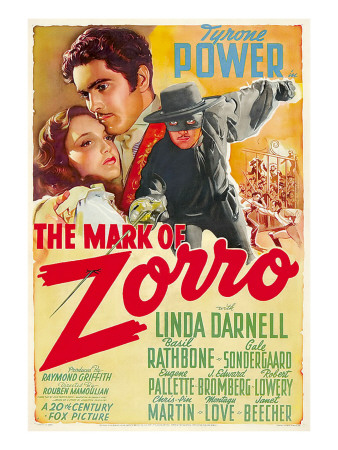
My endowing a pulp adventure character with ideological, historical and cultural interpretations aside, Zorro, when done well, is a really fun, cool guy to watch in action. He's also the only character on this list that has seen major mainstream popularity outside of the male youth and comic book geek audience.  Part of the mainstream appeal may be on account of the sexy masked Latin lover angle that is often played up to the hilt. It's the kinda thing that opens Zorro up to a much wider (ie: female) audience. Well, that and Tyrone Power's tight bullfighter pants.


After the era of Douglas Fairbanks and Tyrone Power (actually a white guy, for my younger readers), Zorro came to TV in the 50's. Much like the Lone Ranger series, the Disney TV show brought Zorro to a massive audience while at the same time systematically suckifying and borifying (those are real words, right?) the character. 

There's also the 1975 French Spaghetti Western take on Zorro starring Alain Delon, the really very homophobic Zorro The Gay Blade parody movie starring George Hamilton and Chilean novelist Isabelle Allende's wonderfully spiritual and culturally appropriate reinvention of the iconic character in her 2005 novel simply titled Zorro.


The best of all the Zorro's for me are the Republic theatrical movie serials. Usually  consisting of 12 or 15 fifteen minute episodes or chapters, these films were originally made to to be shown once a week in theatres. Each chapter, of course, ends in a cliffhanger designed to get audiences back in theatre the following week to see how the hero cheats death once again. The resolutions of those cliffhangers are some of the most obvious cheats in cinema history. In the days before TV, that cynical ploy kept kids coming back for more in massive numbers for over 20 years. 

Unlike the Lone Ranger, Republic Studios did the Zorro thing very well. They produced five Zorro serials in all: Zorro Rides Again, Zorro's Black Whip (actually about a female descendant of Zorro and the first ever woman serial hero-but that's a whole other blog), Son of Zorro, Ghost of Zorro (starring a pre-Lone Ranger Clayton Moore) and my personal favorite of  them all, Zorro's Fighting Legion.  Zorro's Fighting Legion used an idea only previously seen in McCulley's novels: a legion of Zorro's led by the one true Zorro carry on (K, so the Marxists do take over a bit there). It's also, like all the other serials Zorro or otherwise, all about the action; no politics, no romance, no character development, just lots and lots of fights and chases. 

The entire reason why Indiana Jones has a whip was 'cause Spielberg and Lucas wanted to rip-off all of Zorro's best whip-related stunts in Raiders of the Lost Ark. Take a look at this clip and see if anything seems familiar:


The Shadow


Definitely some lurking here.


"Who know what evil lurks in the hearts of men?"

"Who knows who will get that reference in 2011?"

"The Shadow knows!"

That's a slight embellishment of the classic opening of the long running Shadow radio series.  The Shadow premiered on radio in 1930 but had been appearing in the pulp publication Detective Story Magazine for quite some time before that. There is no individual writer who is credited with The Shadow's definitive creation.

Which is kind of appropriate to the nature of the character. 

The Shadow is a mysterious figure. In most versions, he wears a big black cloak, a black fedora, red scarf and/or a crimson lined cape (that he would often drape over the lover part of his face) along with a black trenchcoat or black business suit.  He possessed various mystical mental powers including hypnosis, the ability to influence other people's thoughts and, in a clever invention for the medium of radio, the power to "cloud men's minds so that he cannot see them".  It was great device for radio. It meant much maniacal laughter on The ("invisible") Shadow's part and much freaking out on the bad guys part. In addition to his incredible mental powers, The Shadow (like The Phantom) packed two semi-automatic hand guns. It seems weird to me that all these mystically themed heroes needed the help of not one but two guns. My best guess is that these characters were initially up against the more conventional and better selling cowboy stories in the pulp adventure magazine and comic strip marketplace. They probably needed some way to compete with all those two-gun kids.

In the pulp magazines, The Shadow had two different alter egos. Now that's crafty. For radio and all subsequent versions, it was simplified to one: Lamont Cranston.  The origin stories differ but it is generally accepted that Cranston "a wealthy young man about town" acquired his powers while traveling in "far east Asia" (a setting that opened the door to a great deal of -shall we say- dated ethnic portrayals). The origin story has been greatly embellished in subsequent adaptations (most notably in the 90's movie version) but that's about as far as it went on radio.

In the late 1930's, The Shadow was voiced by a hot up and coming nineteen year old actor named Orson Welles. Nobody is really sure what happened to the guy after The Shadow but, man, did he ever hold great promise. There were three feature film versions of The Shadow and one 15 chapter Columbia serial through the 30's and 40's. None of them really do the character any justice. There were also a comic strip and several comic books (all these guys got comic books once the Superman led boom kicked in). 

In 1973, DC Comics attempted to relaunch The Shadow. I remember buying the first issue and showing it to my dad (The Shadow was his era all the way). He looked at for a moment and simply hrumphed at it. Fans never change, do they?

In 1994, a pre-dumpy, pre-funny guy on 30 Rock Alec Baldwin played The Shadow in a big screen adaptation directed by Rusell "Highlander" Mulcahy. I remember watching it when it came out. I simply hrumphed at it. Fans never change, do they?

George Lucas openly admits that the "Jedi mind tricks" are lifted directly from The Shadow (and, BTW, in case you didn't realize it, nothing in Star Wars is original). If you listen to the radio shows, you can hear some "these aren't the droids we're looking for" type scenes when The Shadow uses his mental powers to influence "weaker minds". In fact, when the '94 film came out, some lunkhead critic actually accused The Shadow of ripping off Star Wars. 

"Who knows how that guy got his job?" 


The Green Hornet


The greatest actor to ever portray The Green Hornet


If your only frame of reference for The Green Hornet is the just released Seth Rogan movie, chances are you have not read this blog quite this far. This one's for all of you that have stuck with it.

So let's get the basic premise down. The Green Hornet is rich suave newspaper publisher Britt Reid. Reid is either the grand-nephew or the grandson of Dan (sometimes John) Reid, aka The Lone Ranger.  Not surprisingly The Green Hornet shared the same creators with The Lone Ranger. Hence the connection.  

By night Reid disguises himself as The Green Hornet to fight crime along side his Asian sidekick, Kato (you see benevolent racial stereotyping Ranger connection, kimo sabe?). Kato has over the years been Japanese, Chinese, Phlipino and Korean in origin, depending on the politics of the era. He drove The Hornet's cool car, The Black Beauty. The car was, of course, equipped with all kinds of cool gadgets. The Green Hornet also has a "sting" weapon that dispensed gas designed to knock out bad guys instead of shooting them. In the TV version, The Hornet Stinger (as they called it) became an ultrasonic sound wave weapon.

The Hornet's modus operandi is that he pretends to be a notorious criminal. With that ruse, he can easily gain entrance to many an evil lair, get info, even make the bad buys cut him in on their action (the proceeds of which go to funding his crime fighting) or make a deal with one set of bad guys that gets them to take out another set of bad guys. All the while, The Green Hornet's true motivations are safely hidden. To seal the deal and take suspicion of him, Reid makes sure that his paper takes an anti-Hornet editorial stance. It's a brilliant scheme really. 


The Green Hornet also has a great outfit: green tie, green trenchcoat, green fedora and a green mask. It was a every guy on a commuter train circa 1962 wearing all green and a mask kind of a look. But, hey, I've always loved heroes that put on a jacket and tie before they go out kick some evil ass.

In the age before Seth Rogan was born, The Green Hornet is probably best remembered for the short lived 1966-7 TV series. The series was produced by William Dozier, hot off producing the campy hit Batman TV show starring Adam West. Dozier was smart enough to know that the silly Batgags format was a beat you just couldn't hit twice. So The Green Hornet show played it straight. After the silliness of Batman, it seemed that audiences were just not ready for a straight superhero show in 1966.

If nothing else, The Green Hornet TV series introduced Bruce Lee to the world. It starred Van Williams as The Green Hornet and Bruce Lee, as, of course Kato. You gotta hand it to Lee for forever elevating Kato's sidekick nature out of the hackneyed Tonto territory into the serious ass-kicker territory of a martial arts master. Martial arts were not associated with Kato before Bruce Lee. Indeed, they were generally unknown to the mainstream world before Mr. Lee. The show is worth watching just to see Lee leave a bunch of Hollywood western bar fight type stunt men in the dust.  Even when Lee is just running to The Black Beauty, he displays incredible grace and agility.  Today, the show is often sold on Lee's merits alone:


Before TV, there were two Green Hornet movie serials: The Green Hornet (1940) and The Green Hornet Strikes Again (1941). The former starred  Gordon Jones in the title role and the latter Warren Hull. Both serials, though, used the voice of the radio Green Hornet, Al Hodge, whenever the mask was on. Both also starred a pre the-old-Chinese-guy-in-Gremlins and pre-Kung Fu, Keye Luke in the role of Kato. Luke was a great character actor and one of the few Asians working in Hollywood at the time. For obvious reasons, Kato was no longer referred to as Japanese by 1941. In these serials, he is referred to as Korean.

In later adaptations, Kato became Filipino then finally returned to Japanese again by the 1960's. As far as Hollywood casting went all Asians are interchangeable (we still see that today).

As with most serials based on comic strip, pulp or radio characters, The Green Hornet serials mainly plugged pre-existing established characters into an almost constant fight, chase, then cliffhanger formula.


As I mentioned earlier, The Green Hornet began as a radio show. The character was originally called The Hornet but was changed to The Green Hornet for copyright reasons.

Like The Lone Ranger, the radio show utilized cheaper public domain classical music. In this case, Flight of the Bumblebee by Nikolai Rimsky-Korsakov (Bee-Hornet, get it?). Probably the best version of the "theme" was used in the 60's TV show. It featured legendary jazz trumpeter Al Hirt playing an amazing version of the piece. Nothing on the show ever quite matched the excitement of that theme. It's a version that was famously used by Quentin Tarantino in Kill Bill, part 1.

The Green Hornet has also appeared in many different comic book adaptations beginning in 1940 and continuing right up to 2011.

A Green Hornet feature film had been in development for decades. Finally, with the current comic book movie craze, the movie was finally green lit (no pun intended but I'll take credit for it anyway). 

Michel Gondry, director of Eternal Sunshine of the Spotless Mind and The Science of Sleep was, oddly, chosen to direct The Hornet movie. Fans, though,  are probably even more miffed by the casting of Judd Apatow comedy star Seth Rogan in the title role and Asian pop star Jay Chou as Kato. Chou's Kato, thanks to events set in motion by Bruce Lee 45 years ago, seems to have broken out of the subservient sidekick role. In fact, in the trailers, it seems like he's the guy in charge. 


The trailers also suggest a decidedly comic tone to the movie. However, that may just be a ploy to put as many millions of asses in the seats as is possible opening weekend. That's all the time they've got before potential word gets out that the movie is not really a comedy and/or is not really very good. Either is possible. Personally, I'm wary of a movie whose release has been delayed twice already, only to finally come out in the studio's January garbage dump release season.


Wannna go Saturday?

Finally, I'd like to close on this fascinating low budget indie short film made in France in 2006. Out of all The Hornet's incarnations, I find this one the most intriguing.


Feel The Sting Everybody!

Friday, January 7, 2011

Just Unearthed From The Dark Misty Vaults of Time

This photo of me was recently unearthed. I had never seen it before. In fact, I've never seen a picture of me this young.


Good thing somebody accidentally caught me in the frame while they were trying to get a good shot of that lamp.

Just for the record the moniker on written on top never caught on. My brother's name is Kerry. Too much confusion ensued (though it was a great way of getting out of trouble) so it was dropped when I was very young.  I have never thought of  "Terry" as my name. I have had many a battle of wills with teachers over the years who insisted on calling me this thing that was not my name.

"Ter" was often used by my family but never really caught with the general public.


For the curious, this was written on the back of the photo.


No one is really sure how old the lamp was.

That would put the picture circa February of 1964. Pretty sure that's my mom's handwriting. I suspect that the note was written some years later unless she suffering from some kind of postpartum amnesia.

Research at the Terence Bowman Historical Institute continues....

Friday, December 31, 2010

An Offbeat Tribute to Those We Lost in 2010

Happy New Year's Eve everybody!

Here is my somewhat morbid, non-comprehensive offbeat musings on some of the talented people we lost in 2010...


Dennis Hopper (1936-2010)

When Dennis "Easy Rider, Apocalypse Now, Blue Velvet" Hopper died, a clip of him reciting "If" by Rudyard Kipling from the Johnny Cash Show turned up everywhere on the net.

This is the clip that comes right before that. It's the only time I've ever seen him sing. Hopper and Cash seem to connect almost a little too well. Seems like they've both been down that same substance abuse road


I remember renting this fascinating little curiosity on VHS in the 90's. The early HBO film, Witch Hunt, features a rare sympathetic lead role for Hopper. It is also most likely the only time Hopper ever even attempted to pull off the hard boiled gumshoe PI role.

Check out not just the premise of this one but also the name of the private eye.


Peter Graves (1926-2010)

Depending on your generational reference point, Peter Graves is either most famous as Mission: Impossible! team leader Jim Phelps, as the creepy yet humourous Captain Clarence Oveur in Airplane! or as that guy that seems to host of all those biography things on TV there.

Though, I'm pretty sure that almost no one knows him only as the star to the 1950's sci-fi film, The Red Planet Mars.

Long story short: radio transmissions are established with intelligent Utopian life on Mars. The message from Mars: worship God more. Think of the Jodie Foster movie Contact with a ton of 1950's cold war propaganda thrown in.


Irvin Kershner (1923-2010)


The Empire Strikes Back is undoubtedly the film that Kershner will always be best remembered for. You could maybe throw in Kershner bringing Sean Connery back to the role of James Bond after an twelve year absence in Never Say Never Again or Kershner filming Frank Miller's ambitious screenplay for Robocop 2 or the trippy 70's Faye Dunaway horror thriller, The Eyes of Laura Mars. Really, though, the name Kershner is synonymous with what is arguably the best Star Wars movie of the series.

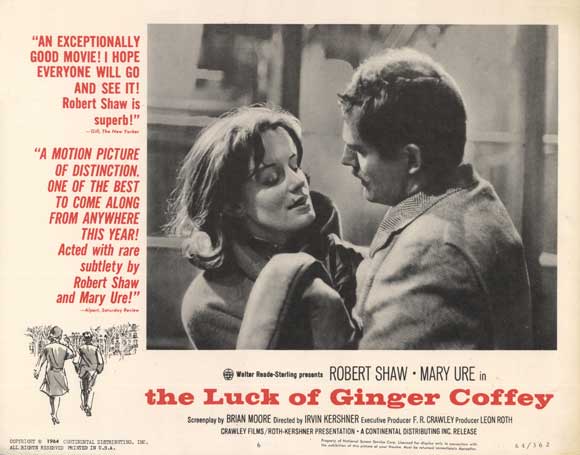
However, 16 years before introducing the world to AT-AT Walkers and Boba Fett, Kershner found his way to Montreal to direct a low budget Canadian movie entitled The Luck of Ginger Coffey . Robert Shaw plays an Irish journalist emigrating with his family to Montreal in 1964. Based on the novel of the same by Brian Moore, the film chronicles the struggles of adapting to a new life in a new country.

This movie is a must for any Montrealer. The film captures the many of the city's landmarks and neighbourhoods in all their 1964 black and white splendor. It is fascinating just on its historical terms alone. A bus ad in one scene plugs the still three years away Expo '67. There is also a cameo by what looks like a 17 year-old Don McGowan (there's a generationally specific Anlgo Montreal reference for ya).

Robert Shaw is, as always, great in the title role. The Luck of Ginger Coffey is a really good little film to boot.

It's easier to find the posters for this film on the web than it is to find the film itself.


The Luck of Ginger Coffey is also an extremely rare archeological find: an independent English Canadian film from the early 60's (there's no connection to the NFB or the CBC in this production and Canadian film tax credits were still years away).

I managed to catch this wonderfully obscure gem on on History Television a few years back but, alas did not manage to record it. There is a DVD edition available on Amazon UK but you'll need a multi-region player to watch it. If you are so inclined, it's worth the trouble.


Gary Coleman (1968-2010)

Forget "Whatch you talkin' about Willis?", Coleman's best role ever was as the boy genius Interstellar President Hieronymus Fox on the classic 70's sci-fi series Buck Rogers in The 25th Century.


Tony Curtis (1925-2010)

For those my age, the strongest association with Tony Curtis is not Some Like It Hot or The Defiant Ones or Spartacus or The Persuaders or even The Bad News Bears Go To Japan.  No, for us Boomer-Gen X Tweeners, Tony Curtis is Stony Curtis. In fact, as a child Curtis' guest appearance on The Flintstones created a great deal of confusion. I was under the impression that Stony Curtis was actually the man's real name. Stony and Tony sounded very similar and, after all, Stony did look and sound like the guy in movies like Boeing, Boeing.  As far as I was concerned, everyone kept getting Stony Curtis' name wrong when they called him Tony Curtis.

4 years of film and theatre school school managed to straighten that misconception out.

Here's Stony in at the pinnacle of his career...


Jackie Burroughs (1939-2010)

One of Canada's greatest actors, known for her roles in Road to Avonlea, A Winter Tan, The Grey Fox and the one of the greatest TV series ever (Canadian or otherwise), Slings and Arrows.  But for me and my pals in my sketch comedy troupe, The Vestibules, she will always be remembered as the women who stormed up to us out of nowhere at the 1990 Canadian Radio Awards reception in Toronto and declared "You guys are so fucking funny!".

We figured out who she was later...


J.D. Salinger (1919-2010)
Colbert never did land this guest
At the time of the brilliant reclusive writer's death, I posted a link to a brilliantly funny tribute to the man written by those really funny guys at www.theonion.com. Here is another great Salinger piece of theirs I recently turned up.


Cory Haim (1971-2010)

Another person on the list that I've actually met...well, kinda.  There was about 10 minutes in the mid-90's when SCTV legend Joe Flaherty was supposedly interested in directing a potential TV pilot for The Vestibules. The whole thing was set up by a local producer who had gotten lucky and managed to get a movie called Snowboard Academy into production. As a means of acquainting Flaherty with our work, Paul, Bernard and I drove up to Mont Blanc to do a show for the cast and crew of the film (which included Flaherty, Jim Varney, Brigette Neilson and Cory Haim). 

If having someone talking loudly and obnoxiously through your entire show constitutes meeting them then, yes, we met Corey Haim. 

On a serious note, at least his demise was not drug related which, based on his behavior that night years ago,  I was, at first, convinced was the case.


James MacArthur (1937-2010)

Book 'em Danno...sorry, James, couldn't resist...


The adopted son of Academy Award winning actress, Helen Hayes, James MacArthur was the last surviving principal cast member of the legendary 1960's/70's TV cop show Hawaii Five-0 (his part is played by Scott Caan in the current re-boot).

Before 5-0, MacArthur appeared in number of other film roles including a few Disney flicks. He was also something of teen heartthrob for super brief period of time.  That time included a bit of a not-unShatner-like music career. This is song charted at #94 in the US in 1963.

It's called The Ten Commandments of Love.


It's my understanding that several small towns in the US have this version of The Ten Commandments posted in their courthouses, particularly in the more male-dominated regions...


Frank Frazetta (1928-2010)

Frank Frazetta is universally recognized as one of the greatest fantasy painters that ever lived. He was largely famous for paintings like this one:


Frazetta was one of the few artists who had the ability to, with one painting, make both men and women insecure about their body image simultaneously.

A rare gift.

Frazetta is well known for his paintings of Conan The Cimmerian, John Carter Warlord of Mars, Kull, Tarzan and, of course, Woody Allen. Yes. Woody Allen.

Frazetta was also a movie poster artist and early in his career, this was one of his assignments:


Oddly, Woody never contacted Frank for the Annie Hall or Manhattan posters...


John Forsythe (1918-2010)


Hmmm...not a hat in sight...


And, finally, big shout out the to the late great John Forsythe, star of Charlie's Angels, Dynasty, The John Forsythe Show and the original guy who "had on a hat".

Happy New Year
All The Best for 2011!