

The other day I was checking out the extras on the Rise of the Planet of the Apes Blu-ray I got for Christmas this year. One of the special features focuses on the history of the Apes franchise.
A history of the The Planet of the Apes franchise? Really?
Given how much Fox, the owners of the rights to all things Apes, seems to want to find a new audience for the reboot and given how much the Apes franchise is either or unknown to or dismissed by just about anyone under the age of 40, I was kinda surprised they even went there.
And, in fact, they kinda didn't.
In one featurette, director Rupert Wyatt, screenwriters Rick Jaffa and Amanda Silver as well as actor Andy Sirkus all talk in very positive terms about the original Planet of the Apes. They all say that they are big fans of the movie. However, 99% of the focus of the featurette is on the original 1968 film. Little or no mention is made of the later films.
I found this particularly bizarre as Rise of the Planet of the Apes is, for all intents and purposes, a remake of the fourth film in the Apes series, Conquest of the Planet of the Apes (some say it is more a reboot of Conquest but, hey, let's split Ape hairs). The interviews imply that the writers somehow just came up with this idea of creating a back story for Planet of the Apes as a means of a rebooting the franchise. This is even more bizarre in light of the fact that Fox has had a Conquest remake/reboot in the works since almost right after the failure of the last reboot attempt, Tim Burton's 2001 "re-imagining" of the '68 film.
Also weird is that at one point Jaffa says that in one of the later films "reference" is made to an ape named Caesar who first defied his human masters and said "No". He adds that he thought it would be a great to actually see that moment on screen.
First of all: "reference"? Conquest of the Planet of the Apes is an entire movie devoted to Caesar's story. That's slightly more than just a "reference". Secondly, the moment Jaffa refers to has already been seen in said movie; it is not something new to the franchise as Jaffa seems to be suggesting. For the record, the only "reference" to the event in question is in the previous film in the series, Escape from the Planet of the Apes. Jaffa comments make me wonder if he has even seen these movies. Both he and all of the publicity I've seen about the movie says that Jaffa is big fan of the series.
There is more to this than just Apes fanboy nitpicking. It's like the featurette is purposely drawing attention away from connection between Rise of the Planet of the Apes and Conquest of the Planet of the Apes. What's the agenda here? Is just that they think most of the public at large only know the original film and not the sequels? Or do they not want to confuse potential new fans of the reboot? Or does Fox just simply feel that getting into the whole history of the Apes franchise will "turn the kids off"?

Another example of perplexing Blu-ray extras can be found on the Let Me In Blu-ray. Let Me In is the "not as bad as you might expect it to be" remake of the amazing Swedish teenage vampire movie, Let The Right One In. BTW, if you have not seen Let The Right One In, do so. It's one of the most engagingly creepy movies of all time.
Imagine Twilight directed by Ingmar Bergman.

Yes, it's true: the original Swedish film is also based on the same novel. However, the implication of the subsequent interviews with Reeves and the various producers of the film is that Let The Right On In is the only adaptation of the book that exists. Nowhere does anyone even bring up the original film.
As with Apes, this is kinda weird if you've seen both movies.
Let Me In is, in some scenes, a shot for shot remake of the Swedish film. The sets, costumes and cinematography are all variations on or recreations of elements of original movie. In. To be fair, there a few Americanizations here and there. Some scenes are ramped up big time, old-school Hollywood style. Overall, though, the Let Me In is a very close in mood, tone and look to Let The Right One In.
So, why then do they seem to be deliberately deceitful about the background of this film?

I know American audiences will not flock to European movies en mass, even when they involve trendy pop culture icons like vampires. Though, will it really turn off American viewers that much if they even know that the movie is in any was connected to a European film?
Sometimes the agendas of the DVD extras go another way. Take the Batman and Robin DVD...please (sorry, could not resist).
Of course, I'm talking about the 1997 movie that, in star George Clooney's words, "shut down the Batman franchise". Indeed, Batman and Robin is pretty much a universally reviled movie by both fans and non fans alike. Unlike the previous examples, the extras on this DVD are not so quite so deceptive in nature.
If fact, all of the interviews and commentary tracks on the Batman and Robin DVD are quite apologetic, often explaining where and how the problems with the film developed. Chris O' Donnell (Robin) says that the media "assault" for a movie like this can hurt a film in that it builds up false expectations. Director Joe Schumacher goes even further. He actually says, "I'm sorry" outright at one point.
So why point out that the movie that someone just bought or rented is really bad?
Well, in this case, I remember people talking about the apology on the DVD. Let's face it, it attracted a lot of attention to a DVD of a movie that has such a bad reputation that it might never have left the Zip.ca warehouse. Perhaps they were trying to draw people to the DVD that way?

My theory is that the DVD extras can achieve two goals.
One is the DVD's are, of course, sent to critics. Often the extra content of the DVD/Blu-ray turn up in reviews. Many websites feature reviews of not just the movie but also of the special features. And, in some cases, the DVD extras have doubled as promo material appearing in electronic press kits and the like. In other words, the extras are tool in the overall publicizing of the movie in the media.
The second goal DVD/Blu-ray extras can achieve is that they can (hopefully) generate good word of mouth publicity (which even now is still often the backbone of a movie's success). So if, for example, the word gets out that Let Me In is not a completely original movie then that can impact future DVD/Blu-ray sales.
Negatively, apparently.

These are just a few examples I noticed recently.
Anybody out there ever notice the DVD/Blu-ray extras that seem to have some kind of an agenda going on?
Feel free to weigh in below


 film arrives on
  this week, along with the rest of the original trilogy and the prequels. News of the new format release has once again brought
  into the center of a fan controversy concerning special editions vs. original editions and the issue of yet more obsessive tinkering. At the same time, though, this is also a good opportunity to look back at what Lucas’ landmark first Star Wars film did give us.
  fighting
  to
to  lecturing
  to the audio of the
  trailer set to scenes from
  , to name just a very few.
 (author of among others things,
  ) on Star Wars. We have all heard of concepts like the Hero’s Journey referenced in many an analysis of Star Wars, much of it often coming from Lucas himself. To be sure, there are a great many classic literary archetypes and themes to be found in Star Wars. But Star Wars is also very much an incredibly visual product of an incredibly visual medium. Its cinematic influences merit a great deal of consideration as well.
 serials of the 1930’s. Because the
  (like all serials of the time) were shown in theatres in weekly instalments, it was necessary to recap the story every “chapter”. The producers of the Gordon serials decided they wanted to stand out from the crowd and so shot the scrolling text crawl from a low an angle. The technique stood out so well that it made its way into a huge hit movie forty years later.
 , the popular film comedy duo of the 20’s, 30’s and 40’s are another Star Wars mash-up element. The duo was made up of thin British comic actor
  , and the plumper American comic actor
  . The juxtaposition of the two physical types is not unlike that of the droids
  and
and  in Star Wars. The relationship is similar as well. In addition to their physical comedy, Laurel and Hardy were also known for their verbal sparring. They would often bicker with each other while still maintaining an unspoken bond beneath the surface of their humourous squabbles. Hardy would often play the part of the pompous complainer, often blaming his own failures on the quieter and more intelligent Laurel. The scenes with C3PO and R2 wandering the desert of Tatooine reflect a very Laurel and Hardy type of dynamic (even if half of the droid duo never actually speaks words).
 ’s 1953 film
  . The movie has two bickering peasant characters that may remind most Star Wars fans of the two droids. The Hidden Fortress also contains many similar plot elements to Star Wars. The specific look of C3PO, however, is lifted from
 ’s silent SF classic,
 .
.
 movies bring in another mash-up to a quintessential part of Star Wars: the incredible ground-breaking space battle scenes. Elements of Hollywood veteran director
  ’ 1943 movie,
  turn up in one of the space battle scenes. Luke Skywalker and Han Solo take on the Imperial Tie Fighters just after the escaping the Death Star. Luke and Han man two gun turrets very much like the ones the
  airplane gunners man in Air Force. The two gunners in Air Force yell and cheer back and forth to each other across the airplane as they shoot down the enemy. The attacking
  make almost the exact same screeching sound that the
  make as they whip by the Millennium Falcon. Both battle scenes begin with the line “Here they come!”.
 sequence contains even more mash-up elements. The unforgettable climatic battle owes its influence to not one but at least two different World War II movies. Perhaps the biggest influence on the Death Star assault scenes is British director
  ’s 1954 movie
  . Inspired by real events, the story of The Dam Busters follows a group of
  pilots who must blow up a strategically important German dam. To do so, they use special bombs that bounce off the surface of the water. To blow up the dam, they must land that one extremely difficult “million to one shot” hit in just the exact right spot. It’s an assault that takes multiple attack runs by different planes, all of whom have got German fighters on their tail. Sound familiar? Even some of the
  pilot banter is lifted verbatim from The Dam Busters.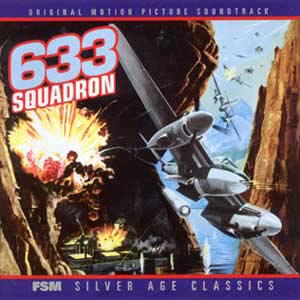
 ’s 1964 movie
  Squadron. The recently passed Cliff Robertson plays a squadron leader who commands an attack on a German
  fuel factory. The factory is located deep within a fjord in Nazi-occupied
  . The fjord is heavily armed with anti-aircraft guns. The shots of the anti-aircraft guns firing on the planes as they attempt to make their attack run into to the fjord are very similar to the shots of the laser cannons firing on the X-Wing Fighters as they attempt to make their attack run into the trenches of the death star.
 movies like
  the cantina in
  is classic wild west saloon transplanted to outer space, the diminutive
  physicality and movements bear a striking similarity those of the
  in
in  , the scene where Luke returns to his home to find his aunt and uncle slaughtered by stormtroopers is a lot like the aftermath of a similar attack in
 ’s
’s  , the medal ceremony at the end of the film is (rather creepily) reminiscent of
  ’s Nazi propaganda film
 is unmistakably costumed with a cowboy style vest and holster and the scene where Han fires first on Gredo is a lot like a scene in
 ’s
’s  However, there is no Special Edition of the Good The Bad and The Ugly in which
 does not fire first.