 |
| Excerpt from the short lived comic book based on the 60's animated series Moby Dick and The Mighty Mightor |
I've just spent the last couple of months revisiting one of my very first favourite TV shows ever. There seems to be a digital age mandate that every TV show that ever aired anywhere at anytime must be made available to everyone everywhere (whether it be via DVD, Blu-ray, streaming video or digital download). Thanks to that unofficial internet mandate, I have got see, for the first time in over 40 years, an old Saturday morning cartoon called Moby Dick and The Mighty Mightor.
Regular He-Had-on-a-Hatters may recall that I previously blogged about Moby Dick and The Mighty Mightor in a post of mine from around a year ago concerning
some of the weirdest cartoons ever made for kids.
As coincidence would have it, Moby Dick and the Mighty Mightor was released on DVD just months after I first blogged about the show. Thanks to some lucrative TV work over the summer, I was able to indulge in the so frivolous a thing as the complete series DVD set of a cartoon that I barely remembered from my early childhood.
Contrary to what the order of names in the title might suggest, the feature attraction of the 1967-69 animated series was a prehistoric superhero known as The Mighty Mightor, and not a cartoon version of Herman Melville's infamous white whale The show was produced by Hanna Barbera, the animation production company famous for creations such as Tom and Jerry, The Flintsontes, The Jetsons, Yogi Bear, Johnny Quest, The Super Friends, Josie and The Pussycats and, in perhaps their greatest contribution to ironic Gen X pop culture kitsch, Scooby Doo.
Until a few months ago, I had only vague memories of Moby Dick and The Mighty Mightor. That's understandable. I would have between 3 and 5 years old during its original run (possibly a bit of older if I caught it in reruns).
Looking at the show "again", made me realize that I
really didn't remember much about it at all. It was only seeing the opening titles on Youtube that even made me aware of the Mightor's prehistoric setting. I also had forgotten that Mightor's adventures were lumped in with the Moby Dick cartoons. I did remember that there was a Moby Dick cartoon but I never connected it with Mightor. I also remember somehow knowing that Moby was a pre-existing character from a book or something like that. More than likely, Classics Comics Illustrated had something to do with that knowledge.
Given how vague I was on Moby Dick and The Mighty Mightor, I sure as hell can't expect my readers to know anything about the show either.
Time for some background.
Moby Dick and the Mighty Mightor had the classic 60's Saturday morning cartoon structure. It was divided into three seven minute-ish cartoons: one about Mightor, followed by one about Moby Dick and then another with Mightor to close out what really was a pretty offbeat cartoon sandwich. Moby and Mightor were always shown in completely separate self-contained adventures. They never crossed-over. The belief behind this popular format at the time was that younger kids did not have the attention span for longer and more involved 25 minute stories (yep, 25 and not today's standard of 20 to 22 minutes-there were way less commercials back then).
I gotta say that, even after just having seen the entire series over a four month period, I still find the show's prehistoric superhero and happy albino whale premise just a tad on the bizarre side.
The Moby Dick segments could generously and humorously be described as a very loose adaptation of Herman Melville's classic American novel. Aside from potentially agitating Melville purists no end, the Moby Dick segments featured some of the most basic cartoon chases this side of the Road Runner. Two perpetually scuba diving kids named Tom and Tub seemed to be continually attacked and chased by any number of undersea creatures, mutants, mad scientists, aliens or all of the above. Inevitably, they were saved by a friendly yet somewhat scrappy heroic whale named Moby Dick. If one really wanted to got out on a limb, I suppose one could argue the "scrappy" part is somewhat true to Melville...but I guess one doesn't.
Any other tenuous connections to Melville end there. Moby is essentially a superhero whale in these cartoons . He is able to smash and destroy many a ship, submarine, or sea monster just by head butting 'em with enough force .Moby never dispenses with Tom and Tub's nemesis without having a bratty bullying smirk cross his face. Kinda creepy, if you ask me.
In one cartoon, Moby cements his cetacean superhero status when he is actually able to tie himself into a knot and then quickly snap himself undone in order to produce enough inertia to swim after the bad guys at record speed (marine biologists can confirm the complete scientific validity of this maneuver -look it up on Wikipedia).
Tom, Tub and Moby are accompanied by a seal named Scooby. Apparently two kids and a happy-go-lucky heroic whale just didn't provide enough cute for one cartoon. And yes, that's right. The seal's name is Scooby. However, unlike like his canine successor, this Scooby did not speak, let alone pronouncing every word as if it begins with the letter "R". Nor did this Scoob have a pothead level obsession with munchies and snacking.
One episode worth checking out features a Captain Nemo-esque submariner who escapes to a "mysterious island'. It's the closest thing you'll ever get to a Herman Melville-Jules Verne crossover.
You can take a look at a more typical Moby Dick episode by
clicking here.
As for The Mighty Mightor, this intro explains the show's premise more concisely and eloquently than I ever could:
"And Tog is
transferred into a fire breathing dragon"? What is he? A crosstown bus? Maybe the word you were looking for is "transformed"?
Sorry. Had to get that off my chest.
Superheroes and dinosaurs. It's a no brainer, really. Undoubtedly, every five year old boy in the world would be glued to the TV.
I know I was.
And, no, despite the prehistoric setting that features a dinosaur-human coexistence, I don't think the creators of this show were creationists. Back then seeing people and dinosaurs together was just plain everywhere in pop culture. It was in everything from The Flintstones to One Million Years BC. It represented a common misconception of the day. I doubt there was any kind of overwhelming creationist agenda in Hollywood then, except maybe for not wanting to offend some religious groups (and doing so was particularly bad for business back then, especially when it came to kids shows). Indeed, the human dinosaur co-existence convention goes back to the earliest silent films set in prehistoric times. No doubt those early movie producers felt that people fighting dinosaurs just plain made for more exciting stories, not to mention a more lucrative bottom line at the box office.
It wasn't until Steven Spielberg's Jurassic Park in the early 90's, that the human dinosaur co-existence misconception (among other dinosaur misconceptions) was finally put to rest in the popular consciousness. After that, the primitive man-thunder lizard connection was strictly the domain of the creationists.
A typical Mightor episode would revolve around some kind of attack or plot against mild mannered cave dweller Tor's village. Tor would then have to sneak away to transform into Mightor in order to defend the village. Usually, the chieftain's daughter, Sheera, was somehow directly or indirectly threatened as well. Sheera ,with her bold red hair and Bedrock original designer cave dress, was a cross between Wilma Flintstone and Raquel Welch in One Million Years BC. The anachronistic prehistoric babe next door, in other words.
This clip kinda gives you a good idea of what usually went down in Mightor's world.
Some of the comments below this clip on Youtube, for obvious reasons, degenerate into a heated creationist vs. evolution debate. Um, folks, did you notice that Mightor flies? That he has a wooden club that fires energy bolts? That he uses that same club to transform his physical being? That his sidekick is a fire breathing dragon? That his adventures often involve giants, rock monsters, insect people and vampires? That it's a
cartoon?
See, it's this thing called Fantasy, there, guys. Look into it.
On less contentious note, notice how Mightor has a sorta British sounding voice. He speaks in that "standard English" accent that was often taught in theatre schools in the pre-James Dean/Marlon Brando method acting era. It was the kind of voice that was de-riguer for any Saturday morning hero in those days.

Most annoying of all and not seen in the above clip is the character of Little Rok, Sheera's younger brother. Little Rok is a kid who has a major hero fixation on Mightor. He is always dressing up like Mightor and trying to take on the bad guys and monsters himself. Such ventures would, of course, would end up with Little Rok getting into trouble, leaving Mightor to come rescue him. Mightor truly is a superhero in that he has incredible patience towards this essentially really dumb kid. Mightor keeps rescuing Little Rok over and over again without complaint. Not only that, but doesn't even attempt to turn these incidents into some kind of teachable moment. You know, so that Little Rok could learn the valuable lesson that it's really not a good idea throw rocks at an Allosaurus. The 1970's era of preachy, hammer-over-the-head message-y Saturday morning cartoons was still, thankfully, a few years away.
It's very clear that Mightor was made by the same guys that made The Flintstones. Sheera, for instance, rides around on a mini mammoth that, as any good fan can tell, is clearly the Flintstones' vacuum cleaner. That guy sure worked a lot back then.
 |
| Alex Toth's Mightor designs |
Like many of Hanna-Barbera's 60's creations, Mightor was designed by the legendary comic book and animation illustrator, Alex Toth. Toth spent years in the comic book industry, drawing the early Green Lantern and Justice Society of America comics. By the time Mightor came around, Toth was lending talents to most of Hanna Barbera's action adventure shows like Jonny Quest, The Herculoids, Space Ghost, Birdman, and later, in a return to his roots, The Super Friends.
However, the Mightor design is not totally Toth's. Some of the credit has to go to Jack Kirby. Yes, Jack Kirby, the legendary Marvel Comics artist. In 1967, Hanna Barbera had made an animated series based on Stan Lee and Jack Kirby's classic creation, The Fantastic Four. As a follow-up, Hanna-Barbera had a series in development based on another popular Marvel character, The Mighty Thor. For some unfathomable reason, Marvel decided instead to go with a deal with with the bargain basement animation of production company known as Grantray Lawrence. They were hired to make animated versions of the rest of Marvel's major characters (except Spider-Man who had his own series elsewhere at the time). Grantray-Lawrence created animation for the Marvel characters so bad that it made Rocket Robin Hood look like Fantasia.
Why anyone would forfeit this...
...for this...
...is beyond me.
Not wanting to waste the time and money they'd already put into the development process, Hanna-Barbera turned The Mighty Thor into The Mighty Mightor . You can kinda see the similarities: the cape, the horned helmet and the hammer/club that helps the hero fly. Though, for my money, the Mightor's transformation seems closer to that of Billy Batson becoming Captain Marvel than it does to Dr. Donald Blake becoming Thor (keep up with me here, geeks).
 |
| Still waiting for this crossover... |
Personally, I just wanna see Kenneth Branagh's film version of the Mighty Mightor. Mightor could be played by a dark haired Chris Hemsworth type but he should definitely be voiced by Branagh himself, just to keep things consistent with the original series.
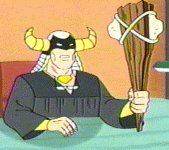
For now, though, I guess we'll just have to settle for Mightor's recurring role as Judge Hiram Mightor on the classic Adult Swim series, Harvey Birdman, Attorney at Law.
Finally, I want to leave you with the opening titles of the Moby Dick and the Mighty Mightor. Mightor does something that I have never seen any superhero do; he makes his enemy hit themselves.
Take a look at 0:21 to see what I mean...
Now I know where all those schoolyard bullies picked up that "Stop hitting yourself! Stop hitting yourself!" move.
Thanks a lot, Mighty Mightor.



 by
 is one of my all time favourite books. It is a dense novel that may seem daunting at first but, trust me, it is an extremely rewarding experience in the end.
 ,
 , the setting of the early parts of the novel, Melville's one time residence and the 19th century
 of the U.S. I have seen the
 and the
 , a chapel Melville attended regularly and that is described in detail in Moby Dick. I have been to these places not once but twice.
 , I duly arrived in New Bedford.

 , and his quest to track down and kill the great white whale that maimed him, has seen many screen adaptations.

 literary adaptations, the film was only very loosely based on Melville’s novel. For this film, Moby Dick was retitled

 (of the famous American acting clan that also gave us
 ,
 and
 ). In this version, Ahab has a fiancée and an evil brother. Yikes! I shudder to think of what horrors the "evil twin" of an already unstable guy like Ahab might be capable of.
 ,

 made his version of Moby Dick. It starred
 as Ahab and
 ’s
 as Ishmael.
 adapted Melville’s novel for the screen. As the story goes, Bradbury and the allegedly bullying Huston did not exactly hit if off. Huston apparently used little of Bradbury's contributions in the final film.
 in Disney’s 1954 adaptation of
 ’s
 , as the definitive version of
 ).
 as Ahab. Peck was to have had a much smaller part in the film, playing the
 . Reportedly under pressure from the studio, Huston reversed the casting, leaving Welles to play Father Mapple and Peck (the much bigger box office draw at the time) to play Ahab.
 . It featured actor
 playing Captain Ahab and just about everybody else in the book. Though I am still in the process of seeking this film out and have not yet seen it, it is, according to many Melvellians, the very best screen adaptation of Moby Dick.

 played a Melville-quoting Ahab (of sorts) in the second
 movie
 took on the role of a Captain that was somewhat different from
 on
 . Stewart played Ahab in a

 and
 franchises veteran Stewart,
 (otherwise known as the kid from
 .) plays Ismael. Perhaps they were motivated by the fact that the great white whale in this miniseries is mainly a product of that favorite
 movie effect of then and now:

 at the legendary obsessed one-legged captain and
 as
 -and-
 -character-name inspiring first officer, Starbuck.
 consensus seems to be that no one is sure exactly where and when this new TV miniseries will hit the airwaves. Nonetheless, I, for one, am very curious to see Hurt's Ahab.
 to the cast as Ahab's wife, Elizabeth, is cause for some concern. That and isn't Anderson just a tad young for a guy Hurt's age? I mean I know it's 1851 and all but still...
 's 1999 Melville-based novel,
 . I expect a film version starring Anderson by 2013.


 produced
 version aside,
 has got to be the most audaciously low brow adaptation of Melville ever attempted.
 . C
 . Moby Dick has been upgraded from sperm whale to super gigantic
 The guy from
 and
 is, of course, a perfect casting for the role of one of the most iconic literary figures of all time.
 catalog.
 ’s screenplay displays an unexpected reverence towards Melville. There are curious uses of lines or variations on lines from the novel. When the Ishmael character, Dr. Michelle Herman (played by Renee O’Connor,
 , one of Melville's earlier novels. Um...who exactly is the target audience for this movie again?
 character with an over-the-top gravitas suddenly juxtaposed with B-movie acting is like watching a
 mashup of
 and
 .
 . How about
 :The Curse of the Zombie Scrivener? Or perhaps
 vs.
 ?
 by
 and The Ewoks Fun Time Activity Book by
 and
 to follow...