About Me

My photo
Montreal, Quebec, Canada
I am a Montreal-based actor, writer and comedian. When U.S. President John F. Kennedy was shot, I was three days old. I cried all day. My favourite books of all time are Moby Dick by Herman Melville, The Last Temptation by Nikos Kazantzakis and The Ewoks Fun Time Activity Book by Chirpa and Pamploo. I am a member of The Vestibules, On The Spot Improv and The Best Buy Battery Club. Except for the Battery Club, I've been at all this stuff for over 20 years. Enjoy my blog.
Showing posts with label Rambo. Show all posts

Tuesday, May 24, 2011

So I Finally Watched The Rambo Movies...


You know, I gotta admit that the 80's was not exactly my favourite decade. I know saying that goes against the current ironclad Pop Culture 80's Retro Mandate but I'll take my chances.

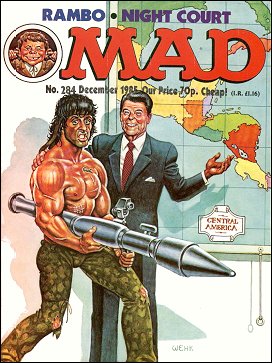
As a kid who was weaned on Mad Magazine jokes about Watergate and Vietnam, the sudden political shift towards the likes of Canada's very own Brian Mulroney, the U.K's Margaret Thatcher and The Greatest Single American That Ever Lived, Ronald Reagan, came as something of a shock to my system.

It wasn't just the politics either. The trickle-down cultural repercussions of the Reagan Era had a definite impact on the pop culture zeitgeist of the decade.

Being an even bigger Leftist Commie Pinko Canuck back then than I am now, I went and wrote a paper for my propaganda course at Concordia on propaganda in current popular culture. It focused on many pop culture phenomena that today are remembered as beloved icons of many people's childhoods. I'm not going to get all curmudgeonly and name names but the paper focused on what I, at the time felt, was a disturbing trend toward increasingly violent, simplistic and militaristic TV shows and movies, often aimed at kids.

One of the greatest examples of this trend, the Rambo movies, however, did not figure in my paper. The reason for that omission was simple. People who discuss and comment on movies that they have not seen were then, and are still, one of the banes of my existence. And I simply could not bring myself to watch any of those movies. 

I have not seen a single one of the Rambo movies in all the years that have passed since.


However, not too long ago, I saw an interesting little independent British movie called Son of Rambow (2007). 

Son of Rambow is the story of Will, a kid growing up in the UK circa 1982. Will is being brought up in an environment so religiously conservative that he is forbidden to watch TV or movies.  Nonetheless, the young boy of about 8 manages to see a bootleg copy of the First Blood (1982), the first film of the Rambo series. He instantly idolizes the character of John Rambo.

As is the case with many kids experiences with TV and movies, he personalizes the character in order to face the challenges and struggles in his own life, particularly the death of his father. 

The ideology of the movie is not on the boy's radar, nor does it really make an impact in his life. 

Will decides to write, direct and star in his own sequel to First Blood that mirrors, from a very juvenile perspective, issues he is dealing with during a particularly rough part of his childhood. 

My Concordia propaganda paper aside, the film nicely makes the case that kids personalities and behavior are not changed by TV and movies . Like everyone else, they react to movies based on their personal experiences and feelings. 
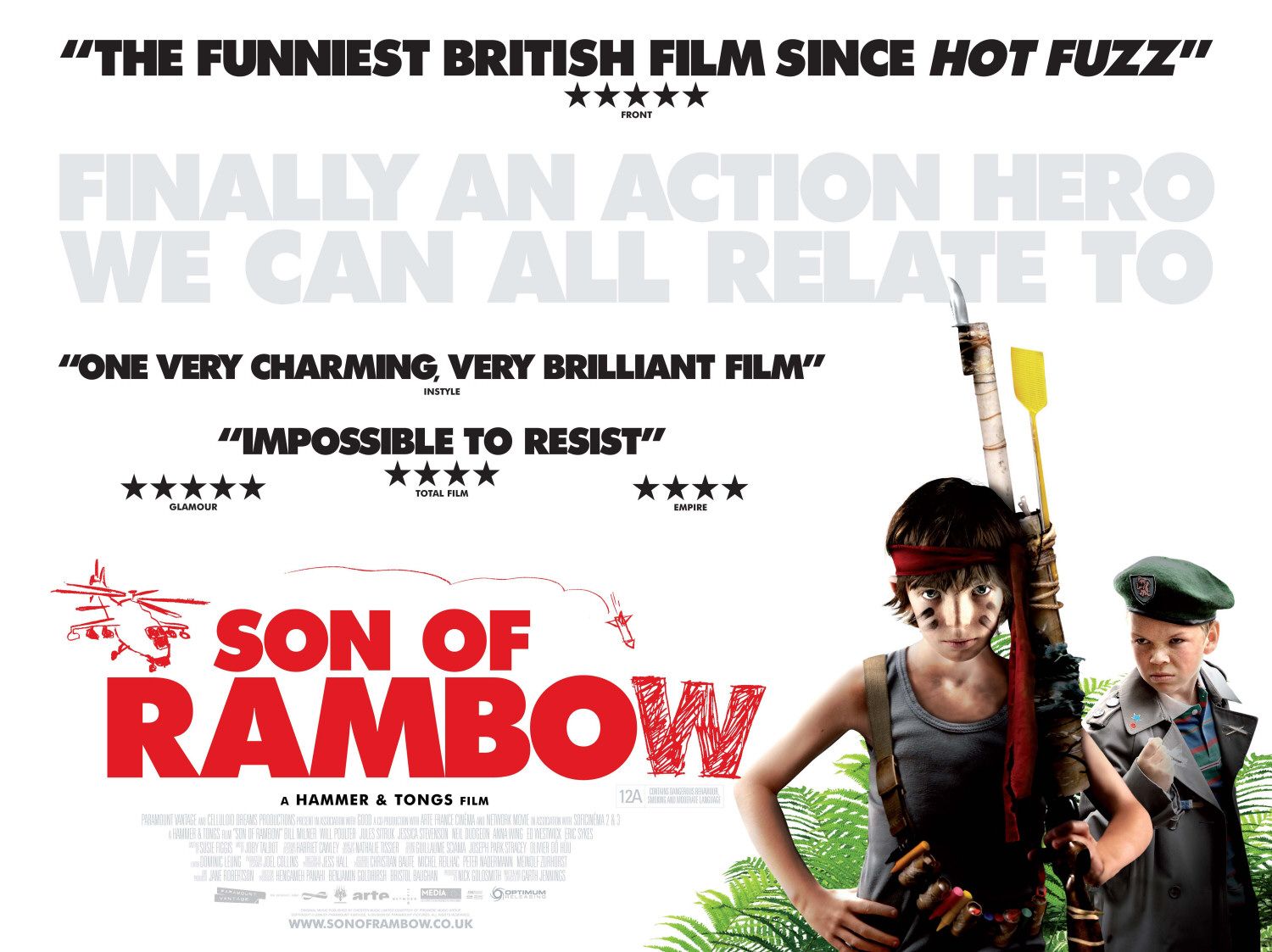


Son of Rambow was such an interesting little film that it made me reconsider the Rambo movies. I thought that maybe it's time I experienced what they were all about. Thanks to a marathon on the movie channel, Mpix, and a weekend to myself,  I was able to do just that. 

So in the spirit of the young hero of Son of Rambow, here then are my own personal thoughts and feelings on those quintessentially 80's pop culture zeitgeist action movies...


This poster kept me company while working in a video store in the 80's
First Blood is by far the most subtle movie of the series...and that's not really saying that much. It is a very basic story told on a relatively small scale. Decorated Vietnam War vet John Rambo is harassed by small town cops. He fights back, escapes to the woods and then proceeds to re-enact his own version of the Vietnam War.  In this conflict, however, the Vietnam vet, ironically, is cast as his former enemy,  the Viet Cong. The hapless cops are the Americans forces, attempting to fight an elusive, incredibly resourceful and determined enemy in an unfamiliar and inhospitable natural environment.  

Even from the first film, it is clear that the story of John Rambo is an American story told from a very American perspective. 

Or is it? 

The novel was first published in 1972.
I was amazed to learn that First Blood is based on a novel written by a Canadian, David Morell, and that the director of the movie, Ted Kotchef, is also Canadian.  Kotchef was, among other things, responsible for bringing two of Mordecai Richler's novels to the screen: The Apprenticeship of Duddy Kravitz and Joshua: Then and Now (both shot in Montreal). 

First Blood, in its initial stages of development, was a very different movie than the one that was realeased in 1982.

Stallone was far from the first choice for the role of Rambo. Al Pacino, Robert Deniro, Clint Eastwood and even Dustin Hoffman had all been approached for the role. They all turned it down.


The movie that inspired the original casting and choice of director
After that, the movie was to star country musician turned actor Kris Kristofferson as Rambo. That's not as weird a casting choice at it may sound. Kristofferson was a United States Army Ranger captain before getting into show biz. The rest of the cast was going to be Gene Hackman as the corrupt small town sheriff and Lee Marvin as Rambo's former commanding officer. The movie in that incarnation was reportedly going to be directed by Sam Peckinpah, director of such incredible Hollywood tomes on the nature of violence and masculine aggression as The Wild Bunch and Straw Dogs. Also, the original script followed the novel more closely in which (SPOILER ALERT) Rambo commits suicide at the end of the story.


I only dwell on these "mighta been" scenarios to make a point. First Blood represents a point of transition in the blockbuster Hollywood action movie. 

As I began watching the film and taking in its low key deliberately paced opening scenes, I was expecting one of those smaller scale 70's style action movies. Something like the original Walking Tall, for instance (not the silly Rock remake), which also follows the story of one man fighting corruption in a small town. Even 70's action movies like Death Wish and Dirty Harry, by today's standards, come off as subtle and thoughtful films that examine the issue of the use of violence to maintain law and order.


So as I watched the opening scenes following Stallone's quiet and reserved John Rambo and Brian Dennehy's unassuming yet stern small town sheriff, I started thinking that the film would go on to show how the conflict between the two characters intricately evolves, step by step, in an increasingly brutal and violent confrontation.


Silly me.


No more than 10 minutes into the movie, Stallone starts skillfully kicking the shit of out the one dimensionally corrupt and evil cops. Seemingly seconds after that, he has ran out of the police station and into the woods. Suddenly, we are into fast paced editing and action. The quiet Jerry Goldsmith score has quickly shifted to become one of Mr. Goldsmith's standard "Tunn-Tun-Ta-Ta-Tun-Tun-Tunnnn" action movie scores.  The movie proceeds to follow an A to B plot line from there on in. It's watchable and engagingly paced but certainly not a low key or subtle film.


That, in essence, is what First Blood represents: a shift from the mainstream Hollywood movies of the 70's to the mainstream Hollywood movies of the 80's.  One is quiet, deliberately paced and more nuanced with its themes while the other is faced paced, loud and generally pretty simplistic in its themes. 

It is not all surprising, then, that the script was rewritten so that at end of the movie, Rambo does not commit suicide.  And, of course, I'm not just talking about the commercial considerations of sequels here. One version of the story is a portrayal of the Vietnam Vet as a tragic symbol of all of the lives of young Americans that were both literally and figuratively destroyed by the war. The other version turns the Vietnam vet into the heroic underdog persecuted by an unjust society (in real life, BTW, there are equally valid arguments for both sides, IMO). 

Rambo certainly does not come off as a tragic figure, in true sense of the word. Instead, Rambo, the undisputed hero of the movie, runs around taking out cops (though never once killing anyone), driving trucks over blockades and blowing tons of stuff up, leaving a trail of unwarranted destruction in his path. 

No wonder that little British kid loved him so much.


Rambo's survival in the end of First Blood, for better or worse, opened some big time blockbuster floodgates...


“Boy, I saw RAMBO last night.  I know what to do the next time this happens.”  
Former US President Ronald Reagan, on US hostages in Lebanon
To borrow a phrase from Monty Python, Rambo: First Blood Part II (1985) is where things "started getting a bit silly".

Once again, we get a classic archetype of an American movie that is actually written and directed by Canadians. The director of the the second Rambo film, George P. Cosmatos was born in Italy and emigrated to  Canada later in life. The screenplay was co-written by some Canuck named or other named James Cameron. 


The original Rambo First Blood Part II

The film was an even bigger hit than First Blood. 


So much so, that I remember comedians doing bits about what Rambo II and Rambo III might be like (none of it funny, trust me). I remember thinking "Um...wouldn't that be Rambo III and IV? Does anyone even realize this movie is a sequel?". Nor did it seem to matter that the movie's plot of a Vietnam veteran returning to the 'Nam to rescue POW's allegedly still held captive in the country, had already been done. Two years earlier there was a film called Uncommon Valor (directed, interestingly, by First Blood director, Ted Kotcheff) that told pretty much the same story.


All of that is fitting, actually. Rambo First Blood Part II is movie does not hold up to much scrutiny. 

Nonetheless, here goes.


John Rambo is pulled off of the chain gang he was sentenced to after the events of First Blood. He is sent on a mission to rescue POW's reportedly still being held in Vietnam. In reality, whether or not this was ever actually true remains the subject of great debate and controversy in the US. 

The ill advised Rambo Saturday morning cartoon
Whatever. 

Doesn't matter in Rambo's world. 

Not only are the POW's still there but a weak US government, despite enlisting the help of Rambo, doesn't really want to rescue them. To top it off, the POW's are being held by Vietnamese soldiers who still wear the exact same uniforms they wore during the conflict 20 years earlier. More importantly, good ol' Charlie, it turns out, is in league with those darn Russkies just like everyone always knew they were.
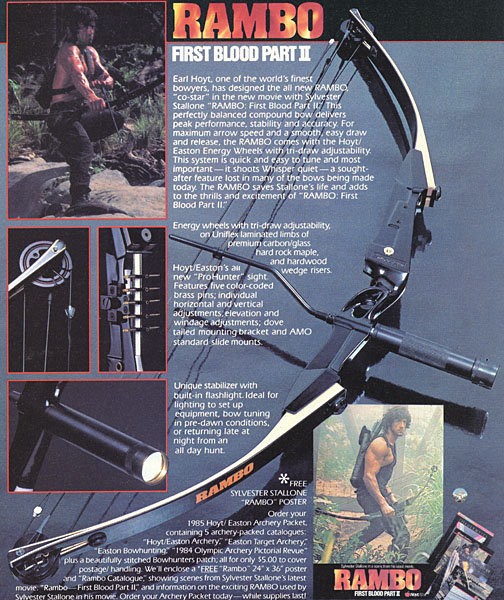

I remember seeing these posters in the Sporting Goods section of Canadian Tire

In this movie, Rambo has been upgraded from a highly skilled yet down-beaten underdog to a one man army superhero. The action is quick and violent. Rambo kills in this movie. A lot. He kills every which way he can. At one point, he blows an evil Vietnamese soldier literally to pieces with an exploding arrow.

Watching this film gave me a flashback to the Westerns I used to watch on TV as a very young kid. I don't remember much about the titles or actors or even plots of those Westerns. All I remember is that the cowboys were continually shooting and escaping from a bunch of Indians (that's what they called Native Americans in movies in those days). Whatever the odds may have been against them, the cowboys always got them injuns, no matter what.

Both those old Westerns and Rambo First Blood Part II are pretty much the same movie. Both take complex gray historical incidents and gloss them over into an overly simplistic shoot 'em up.


Freudian much?

The action in Rambo First Blood Part II is so big and over the top, that at times, it might almost come off as a comedy, or at the very least, tongue in cheek escapism. However, Stallone is determined to not let anything like that happen. The movie is very clearly a fantasy reboot of the Vietnam War, where in Rambo's words, "...we get to win this time". There is a great deal of heavy handed dialogue like "I just want this country to love us and much as we love it." . Stallone plays those lines with every bit of maudlin pathos he can muster. 

Then there's the ludicrous closing credits ballad by Frank Stallone (Sly's bro) featuring lyrics about a "time for healing". 

I'm not sure why the song never charted. 


Rambo First Blood Part II is a juxtaposition of escapist action and obvious messages that ultimately does the movie no favours.


This time around the All American Rambo III (1988) is directed by a Brit, Peter MacDonald.


In this movie, Rambo helps freedom fighters in their struggle against the Soviet occupation of Afghanistan. 

Man, that is so 23 years ago, isn't it?

This installment of the Rambo saga reminded a great deal of films like Mission To Moscow and Action in the North Atlantic. Both were Hollywood movies made during World War II that were, in order to promote war time alliances, very pro-Russian.  They were also movies that got the people who made them into a lot of trouble during the Cold War.


Rambo III's granddad
The approach in Rambo III is quite similar. Rambo arrives in Afghanistan (ostensibly to rescue his former commanding officer but, really, we all know it's just so that he can kill a bunch of Russians).  He is greeted by Afghan freedom fighters. These guys are portrayed in the classic Hollywood tradition of benevolent racial stereotyping. 

There is plenty of clunky expository dialogue explaining how the Afghans are a simple people who are not that different from Americans. They just want their freedom and they are willing to fight for it. 

Just like in the WWII propaganda movies promoting "our Russian friends", the Afghans even get a classically American colloquial endorsement from the hero of the movie. Rambo's Afghan guide tells Rambo that the Russians will never conquer his country. He says that many armies, going as far back as Alexander The Great and as recently as the British in the 1919, have tried but have never been successful. The guide asks Rambo if he knows what that means. Rambo replies, "It means you don't take any shit".


"Hello. Historical Irony Department. Can I help you?"


The movies were also known as Sylvester Stallone's Muscle Ego Project.


Rambo III is even more violent than Rambo First Blood Part 2.  However, watching the Rambo formula unfold for the third time, all the details of whose head got shot off by what kind of automatic weapon when kinda just blend into each other. 


The film ends with a title reading "Dedicated to all the people of Afghanistan".  There is a similar message about the Russians at the end Mission to Moscow. 


James Bond also fought the Russians in Afghanistan
The Afghan freedom fighters, historically know as the Mujaheddin, but never refereed to as such in the film,  later evolved into Al Quaeda and the Taliban. I'm sure there's a conspiracy theory out there somewhere that blames 9-11 on Rambo. Thankfully, there are no scenes featuring Rambo fighting side by side with a young and up-and-coming Mujaheddin named Osama bin Laden. That woulda been kinda hard to live down.

Ultimately, the Russians did finally manage to exact their revenge on Rambo. Shortly before the film's release, the Soviet Union announced that it would be  withdrawing all of its forces from Afghanistan.  The news was enough to cost Rambo III the number one spot in the box office grosses on opening weekend.


Darn Russkies...


Flash forward 20 years....
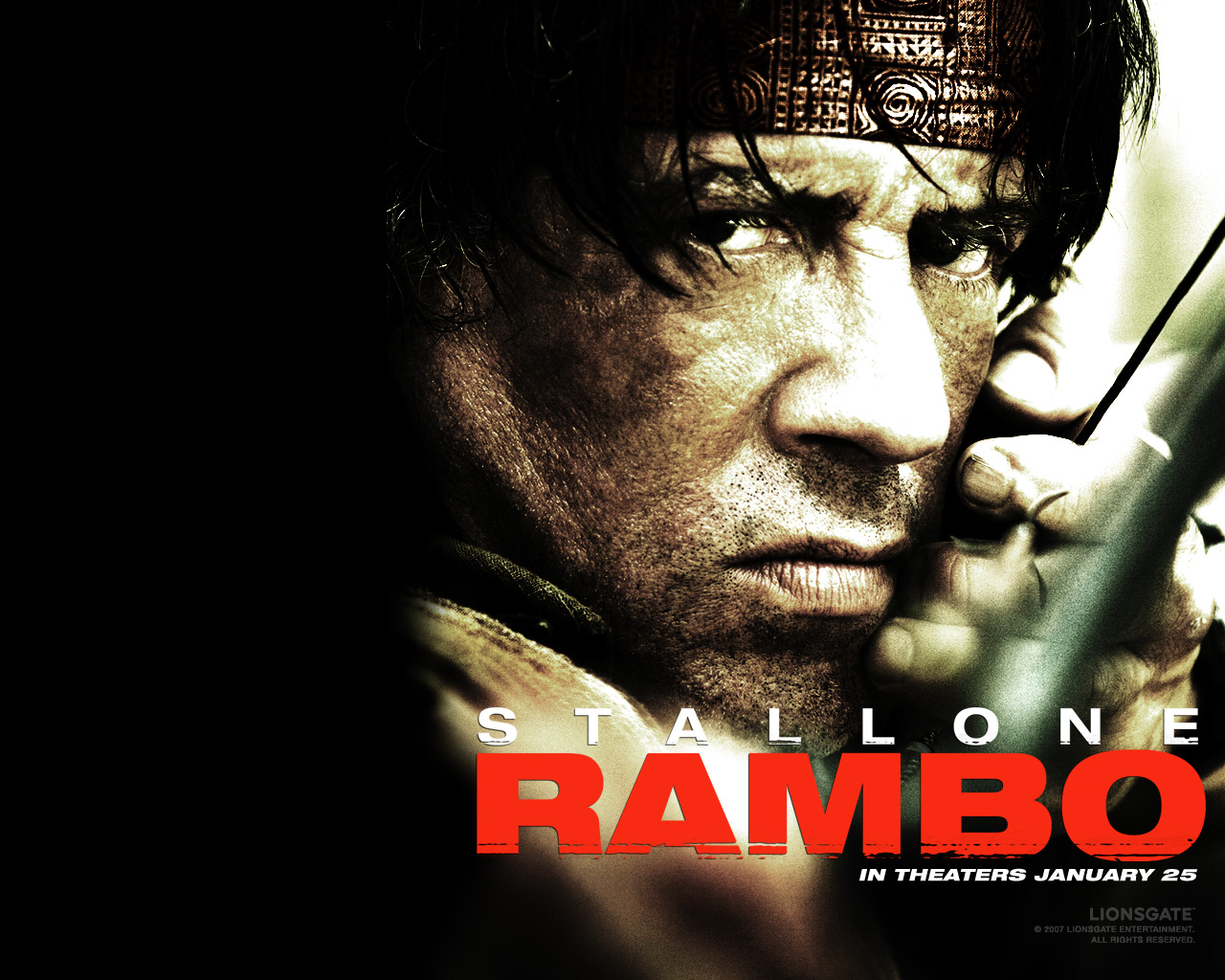


I remember seeing this poster next to the poster for the 2008 Indiana Jones movie and checking my calendar.

Sylvester Stallone, now 62 years old, feels a sudden need to reboot his career. He had done well two years earlier resurrecting Rocky after a sixteen year hiatus. So he decides to revisit the other big franchise of his career, Rambo.


Titled simply Rambo (known in some areas as John Rambo or Rambo IV or, my personal fave variation on the title, Rambo First Blood Part IV), this is the only movie in the franchise actually directed by Stallone himself.  No Canucks or Brits pretending to understand Yanks this time around.


This is by far the grittiest and most violent film of the bunch. The film has a very grainy look. The violence is much more plentiful and graphic. Stallone seems intent on steering away from the exaggerated hyper reality silliness of the first three movies.  For instance, flashback scenes from the previous films are quickly edited and shown in washed out sepia tones.


Julie Benz, Stallone's co-star in Rambo, was 10 when the first movie came out
Much to my surprise, Rambo's one man army does not in any way get involved in the War on Terror. I mean, really, what a great opportunity for John Rambo to return to Afghanistan and redeem himself for his inadvertent role in the founding of Al Quaeda. He could have single-handedly taken out the Taliban, Al Quaeda and Bin Laden himself (and beat Obama to it to boot).


However, Stallone wisely avoids such too close to home issues. He uses the opportunity of a Rambo revival, instead, to bring attention to the on going human rights violations in Burma. These violations have gotten little or no press ever. The situation is quite graphically depicted in the film.  When Rambo literally blows the Burmese bad guys away with a great big machine gun, it was the only time in the series where I found myself actually sort of on board with Rambo's actions.


Political activists have, believe it or not, praised Rambo for bringing awareness to the situation in Burma. I can't help but wonder how the activists really feel about such awareness being raised by such an incredibly violent film. Especially one that ends with a life long avowed pacifist pounding a dying Burmese soldier repeatedly in the head with a rock. 


Reportedly owning a copy of a DVD of Rambo in Burma is a crime for which you can be immediately imprisoned. Get caught selling a copy and you could be put to death.


You know, I'm not the biggest fan of these movies either, but, dude, c'mon...


Until the next sequel....or next blog post, whichever comes first....

Tuesday, January 25, 2011

Some of The Weirdest Animated Shows Ever Made For Kids


Almost all animated shows for kids, really, are kinda weird. They often involving talking ducks, people that can fly, robots, sponges with jobs, pink pony unicorns, cavemen who have pet dinosaurs and ton of other weirdo stuff that is usually the exclusive domain of the insane and/or the stoned.

Some animated shows aimed directly at kids are little more strange than others, though. As a kid, we will watch just about anything that is put in front of us. Many premises and ideas that hold a significant "WTF?" factor to anyone over the age of 13,  just fly by us at face value.

As adults, we look back on these shows and start to realize that "Hey, this whole show is kinda whacked.".

Sometimes, it's the premises of these cartoons that are bizarre. Other times, the premise is relatively normal but the execution is strange.  Or in some cartoons, the source material is just plain an odd or inappropriate choice for a kids show. Whatever the case, I have always found these animated oddities intriguing, fascinating and very entertaining.

Here are some of the weirdest animated shows ever made for kids...


"Softness in eyes, Iron in his thighs"...um, what's going on there?

Speaking as someone who has written for a great deal of kids shows, I would love to try and get those lyrics by the Standards and Practices department of any of the major children's networks today. And let's not even get into the whole centaur sidekick thing.

Most of the weirdness in this early 60's animated take on Greek mythology can only be seen by modern adult eyes. This is particularly true if those eyes have had a strong classical education.

Nevermind that this reboot of ancient stories for five year-olds mixes up characters from about five different myths and legends. Nevermind that almost all of the well established Heracles (See? I'm getting all smarty-pants and using his original Greek name) stories are not even referred to in any episode of The Mighty Hercules that I've ever seen. No. The weirdest aspect of this particular adaptation is that Hercules does not have "the strength of ten ordinary men" until he puts on his magic ring.

A magic ring? Hercules?

Hello Greek Mythology Meets Tolkien Meets The Green Lantern with some Wagner thrown in for good measure!

The Mighty Hercules featured Canadian broadcaster Jimmy Tapp as the voice of the lead character for the first 13 episodes. His delivery is a tad dry, I gotta say.

The Mighty Hercules was also responsible for great deal of difficulties I had in my Classics classes in university.

"Professor, how does Tewt figure in The Twelve Labours?"


"Anywhere and everywhere the savage forces of General Warhawk threaten the peace-loving people of the world...". K, you gotta be wary of any show that positions Rambo as the pacifist.

As you may have observed, the show was actually titled Rambo and The Forces of Freedom. What did they? Have Reagan's speechwriter on loan?

I remember the controversy in the media when this show first came on the air. Sylvester Stallone, displaying a lot of good sense and PR savvy, publicly distanced himself from the series when it premiered in the fall of '86. Stallone stated that the R-rated (14+ at the time in Quebec) Rambo films were never intended for children. That's in spite of the simplistic writing, I guess. He added that even though he objected to the cartoon, there was little he could do about it. He didn't own the rights to the character and had no control over what the studio did with him.

He said the same thing about Rocky V.

Here's a fun fact that will most likely never win you a Trivial Pursuit game: an action figure from this series makes a brief appearance in The Vestibules "Action Figure Theatre" video.


Moby Dick as a cute and heroic white whale...I know...I know...Captain Ahab must be rolling over in his watery grave.

If you're gonna go with a Melvillian animated series, ya gotta at least make it a Coyote-Road Runner style chase show. You know, something with a title like say "Ahab 'n Moby" (today's cartoon: "Round Perdition's Flame!").

While we're on the subject of potential Melville inspired cartoons, the name Billy Budd has got that Stan Lee style character alteration thing happening. Could make for an interesting superhero: "Fighting the never ending battle against evil in 19th century navies everywhere!"

Or how about the zany adventures of Bartelby The Silly Scrivener?

Okay. I'll stop now.


The Mighty Mightor was my favourite shows when I was like five or so. The mild mannered cave dweller turned Super Cro-Magnon angle must of been lost on me at the time. I don't even remember that the show took place in the stone age.

The Mighty Mightor is to the best of my knowledge the only prehistoric superhero ever. Yes. Yes. I know. There's Captain Caveman. However, the good Captain spent most of his time hanging out in the 1970's with babes who wore high heels in the jungle.

Creationists would no doubt laud the Flintstones-like accuracy of the depiction of humans and dinosaurs existing at the same time. I'm not convinced. Mightor's powers are clearly pagan in origin.

More contemporary audiences will recognize Mightor as the judge from the classic Adult Swim series, Harvey Birdman: Attorney at Law.

Anybody remember this?


Yep, in the 60's there was a cartoon series of The Beatles. You will find only the tiniest references to it in any of the official Apple histories of The Beatles. 10 hours of The Anthology and I think it's alluded to briefly once. Even then it's only mentioned in the context of how the movie Yellow Submarine came about (same producer, believe it or not). It has never been released on VHS or DVD and I wouldn't hold your breath for the Blu-ray treatment any time soon either .

The show premiered on ABC in 1965. Not surprising, really. Beatleamania was still going strong then. The Fab Four skewed to a pretty young audience in those days. What is surprising is that the series ran all the way until 1969. That's well into the band's-hippie-freaks-who-do-lots-of-drugs phase. Once the trippy days of the mid 60's start kickin' in, incorporating the wacky Saturday morning cartoon  romps of those crazy mop tops into songs off of , say, Revolver, well....starts to get a little challenging...


Oh, those crazy primitive cultures.

Speaking of which...

Robert E. Howard, it ain't.


Every era has its fair share of flash-in-the-pan pop superstars who were absolutely massive for a relatively short period of time. When looking back, however, they serve to only illustrate the silliness of the era. The 60's had Bobby Sherman, the 70's had David Cassidy, the 80's had Boy George and the 90's had this guy:


I have seen this intro may times and the theme song is currently on my iPod. Honestly, though, I'm still not clear on what exactly Hammerman's back story is.

At least the action figures were easier to understand.


Cows that ride horses. My brain hurts now.

In the wake of the success of The Transformers and GI Joe movies, Universal Pictures optioned all of Hasbro's toy and game products. Incredibly, there are currently in development Monopoly, Operation and Battleship movies, with, quite possibly, more to come.

The people who made this show were way ahead of the curve:


I don't think there's a kid that grew up watching English Canadian TV in the last 50 years or so that does not know...


Setting aside the notion of astro-glenns for a moment, the premise of Rocket Robin Hood is not so weird. As Saturday morning cartoons go, Robin Hood in the future is pretty much par for the course.

However, it's the execution of the premise that is truly strange. First off, there was that theme song that was repeated at every single commercial break. Then there was those odd little character explanation vignettes that ran in almost every episode. One featured Friar Tuck taking one bite out of three different types of food then throwing the rest of the food away. This bizarre eating ritual was repeated in the exact same order at least twice. He even managed to take one bite out of a bunch of grapes; a feat that still defies me to this day. The vignette also clearly illustrates Friar Tuck's ability to beat off the bad guys with his stomach (a greatly under-rated fighting technique, BTW).

The limited budget animation was a major contributor to some of the more bizarre elements of Rocket Robin Hood (actually that an animated English Canadian TV series got made at all in the days before the Cancon rules and tax credits is in itself bizarre). Sure, there was the obvious re-using of stock action sequences and the Bergmanesque close-ups of the eyes for large chunks of dialogue. Those are standard. But Rocket Robin Hood blazed new trails in this particular area.

For instance, there is one episode where Rocket Robin Hood has to get to some treasure or something by going through different levels of some kind of fortress or something (hey, it's been awhile). On each level, he encounters different bad guys he has to get past. Each set of bad guys looks exactly like all the different bad guys from, oh, say, every other episode of the series. Pretty much the entire plot consisted of our hero just beating up the aforementioned wide variety of meanies. Rocket Robin Hood wasn't so great in the writing department either.

Speaking of bad guys and limited animation, all of The Sheriff of N.O.T.T.'s guards look exactly the same in every singe way. Anybody ever wonder where George Lucas got the idea for an all clone army?

Then there were the Rocket Robin Hood episodes that were obviously inter-cut with footage from the 60's Spider-Man series (also Canadian made).  Or was it the Spider-Man footage that was cut into Rocket Robin Hood?

No one is really sure.


But, by far, the all time weirdest animated show ever made for Saturday or any other mornings has gotta be:


"...or whatever the need requires!" Woah, woah, careful there, guys, you don't want to write yourself into a corner.

Airing in the 1967-68 Saturday morning TV season and never being big in syndicated reruns, Super President is a little before my time....and everybody else's too, I think.

You do have to hand to the people that created Super President, Depatie-Freleng (yes, Friz Freleng, one of the guys who animated Bugs Bunny and The Pink Panther was in on this one). Outside of editorial cartoons, the presidential superhero is a premise that has never been done before.

I'm not sure exactly how the Super President premise works. Was he elected as Super President? Or is Super President's secret identity that of the President of the United States? If so,  the name is kinda of a dead give away, no?

According to Wikipedia, President James Norcross got his super powers from a cosmic storm after he was elected. Only his chief of staff, Jerry Sayles, knows his true identity. I'm gonna go with a big "citation needed" on that one.  I mean, c'mon, all those Clark Kent like disappearances in times of crisis would absolutely kill the guy in the 24 hour news cycle.  Then there's the problem of ditching the Secret Service every time he has to get into costume. The mind boggles at the complications.

Not only I am an unclear on the premise but I'm pretty sure that everyone who worked on the show was equally unclear on it. All of the bad guys, for instance, seem to know that they can find Super President in The White House.

The writers probably came to the same conclusion I did: it's better not to think about it.

Like Bruce Wayne in Wayne manor, President James Norcross has a secret headquarters beneath the White House. From there, he can launch some kind of a two man super presidential flying underwater spaceship. Given the amount of secrecy and security surrounding The White House, how do we know that such a thing is not actually there?

As I mentioned earlier, Super President's sidekick (and supposedly the only guy who knows his secret identity) is Jerry, the President's chief of staff.  Everybody knows there is no better sidekick for a superhero then that of a balding middle-aged man in a 1960's business suit wearing horn rimmed glasses.

Just in case anyone one who owns the rights is reading this out there, Super President is prime for a TV/big-budget movie/graphic novel reboot.

We can only hope.


That's right, kids, remember to tune in next week...