About Me

My photo
Montreal, Quebec, Canada
I am a Montreal-based actor, writer and comedian. When U.S. President John F. Kennedy was shot, I was three days old. I cried all day. My favourite books of all time are Moby Dick by Herman Melville, The Last Temptation by Nikos Kazantzakis and The Ewoks Fun Time Activity Book by Chirpa and Pamploo. I am a member of The Vestibules, On The Spot Improv and The Best Buy Battery Club. Except for the Battery Club, I've been at all this stuff for over 20 years. Enjoy my blog.
Showing posts with label The Beatles. Show all posts

Friday, May 4, 2012

The Avengers and The Movie Crossovers That Never Happened


The Avengers have arrived.

The long awaited big screen adaptation of the legendary Marvel Comics superhero team in is finally playing in theaters. There has never been a crossover movie quite like The Avengers; characters established in their own original movies, made with the express intention of later putting those characters together in one big movie. The hype surrounding the release of Iron Man, Iron Man 2, The Incredible Hulk, Thor and Captain America was not just about the opening of a big blockbuster movie in and of itself.  As much as anything else,  the hype was also about how each movie brought the world one set up closer to The Avengers.

Movie crossovers are nothing new: Frankenstein Meets The Wolf Man, King Kong vs Godzilla, Alien vs. Predator...the list goes on. Granted, putting Frankenstein and the Wolf Man in the same movie was as an after thought and not the reason why they made a Frankenstein and a Wolf Man movie in the first place but, still, you get the general idea.

It's all been done.

Or has it?

What about those crossover movies, some potential dreams comes true, some potential nightmares come true, that never quite made it into movies theaters?

 In the world of Hollywood Development Hell that is the movie business, many ideas, crossover and otherwise, are talked about. Few come to fruition.


Some of those ideas can run anywhere from the bizarre to the unfeasible or, in some cases, both.

Take, for instance, these examples...


The Beatles in The Lord of the Rings as Directed by Stanley Kubrick
Speaking as a huge fan of all three of the above, I am so glad this project never came to be.


Back in the day when Beatlemania was all the rage, The Beatles original old school show biz manager, Brian Epstein, signed a three picture deal for the The Fab Four with United Artists. A Hard Day's Night and Help! were the first two films of these deals.

By 1966, things had changed a bit since those two cinematic moptop romps were filmed. The Beatles had performed their last live show.  They started smoking those funny cigarettes Bob Dylan gave them. They were among the first people on the UK to drop acid. And, perhaps most significantly, the lads from Liverpool were replacing lyrics like "She loves you, yeah, yeah, yeah. She loves you, yeah, yeah, yeah" with lyrics like "No one I think is in my tree, I mean it must be high or low". 

The Era of Beatlemania had officially bitten the dust.

The boys themselves, now Zuckebergesque millionaires in their mid-20's, decided that they wanted to run their career a little differently from here on in. And they had the power to do pretty much whatever the hell they wanted. As anyone who has sat through the Star Wars prequels can tell you, that kind of creative control in not necessarily a good thing.

The Beatles were now, in part, defined by their own reactions against the earlier part of their career. They no longer had any taste for the incredible amount of handling they had undergone during their Beatlemania phase, for instance. Huge stadium shows were out. Rather than making live TV appearances, they made short films of their songs (early rock videos, really) to show on the Ed Sullivan Show and American Bandstand. And they sure weren't into making silly off-the-wall movies designed to sell soundtrack albums. Nonetheless, there was still a small matter of the contractual obligation they had for that pesky third Beatles movie. Well, if the lads were gonna do a film, they were gonna do it their way. Their, it turns out, lead to some -shall we say?- interesting ideas.

In the mid 60's, Italian film maker Sergio Leone had just created the genre that became known as the Spaghetti Western. The genre was typified by films of his like A Fistful of Dollars and The Good, The Bad and The Ugly. Yep, one of The Beatles movie ideas was that they would be the stars of a western; quite possibly a Leone-like Spaghetti Western. The movie may well have featured John, Paul, George and the aptly named Ringo sporting Clint Eastwood-like hair and beards while slinging their genre deconstructing six guns to the tune of an Ennio Morricone soundtrack perhaps peppered with a few psychedelic sounding Fab Four Country and Western songs.

The movie, oddly tittled A Talent For Loving, was actually scheduled to shoot in Spain. The reason for aborting the production was ostensibly on account of weather problems in that country. Though some might say it was the Hands of the Good Movie Gods intervening. If so, The Beatles would continue to keep those Hands pretty busy for some time to come.

The other idea the Beatles had was to do a film adaptation of JRR Tolkein's classic Fantasy  trilogy, The Lord of the Rings.  Back in the Sixties, The Lord of the Rings was seen as more of a mind blowing trippy hippie kinda book and not as much as the celebrated epitome of all geekdom that it is today. The lads were serious enough about the idea to approach the director of the SF classic 2001: A Space Odyssey, Stanley Kubrick. This made perfect sense because, aside from Kubrick being an accomplished A-list director at the time, 2001 was a movie that was very popular with the hippie crowd in 1968.

The Beatles. Tolkien. Kubrick. 1968. Did I mention the part about those funny Dylan cigarettes and being some of the first people in the UK to drop acid?

Stanley Kubrick's Lord of the Rings, Beatles-style, had already been cast too: George Harrison as Gandalf, Paul  McCartney as Frodo Baggins, Ringo Starr as Sam Wisegamgee and John Lennon as Gollum.

Hey, man, don't shoot the messenger.

According to most reliable Kubrick biographies, the legendary director did actually consider taking the job. Kubrick finally passed on the film, though, on the grounds that the books, even with his 2001 visual effects team on the job, were unfilmable. In the pre-Industrial Light and Magic and CGI era, Kubrick was right.

While a Kubrick LOTR would have been fascinating, God knows how much of Tolkien would have actually made it to the final cut. Just ask Antony Burgess, Stephen King and Vladimir Nabokov how Kubrick film adaptations worked out for them.

Not to mention that The Beatles are not actors. They would have been plugging their own personalities into pre-established Tolkien characters. So the movie would have ended up with a Maharishi-like Gandalf, a over-the-top cutesy Frodo, an angry anti-authoritarian Golum and a goofily downbeat Sam.

It's also rumoured that, after Kubrick turned the project down, British film maker John Boorman was approached. Boorman too would have been an "interesting" fit, having gone on to direct films like Deliverance, Excalibur and one of the trippiest SF exercises of all time, Zardoz.

According to Peter Jackson, it was Tolkien himself, by virtue of the fact that he was still alive at the time, who put the ultimate kibosh on the whole bizarre mash-up of a project.

The Beatles finally ended up getting their long desired hippy dippy adventure movie and got to honour their United Artists contract at the same time. The solution to both problems was the animated film, Yellow Submarine. The animated movie was appropriately psychedelic to the era. It also demanded very little of The Beatles, outside of writing some new songs and appearing in a short live action epilogue at the end of the film.

Another crossover that never happened...


Zeppelins, Dinosaurs, Vikings and Nazis
With a line up like that, how could you go wrong? 
Well, let's start with never making it...


While none of the above elements were established movie franchises per se, they were, and still are, elements that, even by themselves in just one film, can make for awesome movies.

Hot on the heels of the success of the original 1933 King Kong, producers and directors Ernest B. Schoedsack and Merian C. Cooper were approached by MGM studios to make a fantasy adventure movie so big that it would make King Kong look like a spider monkey. The movie in question was to have been titled War Eagles.

The basic elements of the movie would have gone something like this: explorers discover a lost valley. In this remote valley, descendants of Vikings lost centuries before continue to thrive. Also still existing in this valley: dinosaurs. Vikings and dinosaurs. Of course. De rigeur for any great adventure epic, really.

In addition to dinosaurs, there are also giant prehistoric eagles (the fossil records for which have yet to be discovered, I guess). Naturally, the Vikings ride these giant eagles majestically through the skies. Somewhere along the way, it being the eve of World War II and all, the Nazis attempt to invade the US of A. Their attack fleet is made up, naturally, of Zeppelins. Oh, yes, indeed, my friends, the climatic battle of War Eagles would have featured Vikings riding a top giant prehistoric eagles fighting off Nazi Zeppelins over the skyscrapers of Manhattan.

Total Geekasm.

For the 1930's, War Eagles have been positively Michael Bay in its scope (though probably better directed). The movie would have been in Technicolor, the same process for making colour movies (a rarity back then) used in The Wizard of OZ and Gone With The Wind. Willis O'Brien, the effects legend behind King Kong, was set to do the visual effects. The screenplay was written by Cyril Hume, who wrote many of the hit MGM Tarzan movies as well as the now classic 50's SF film, Forbidden Planet.

With a premise so rich and a team like that, it begs the question: how did this movie not get made?  Well, the answer had something to do with the real life version of World War II.

Producer Cooper was also very much the adventurer. He was a flier and subsequent POW during World War I.  Not unlike the Carl Denham character in King Kong, Cooper shot wildlife documentary footage in exotic locales like Africa and South America during the 20's. On the brink of  the US entry into World War II, Cooper left Hollywood to join the US Air Force, despite the fact he was already old enough to have been exempt from military service. When he left, War Eagles was put on hold. It was never picked up again. At the time of Cooper's departure, the film was pretty far into production too, as this excellent book tells us.

A novel , supposedly based on the unfilmed screenplay for War Eagles, came out many years later, though, I'm told, given War Eagles' history and pedigree, it is something of a let down. IMDB lists a 2012 version of War Eagles, with a similar plot to the original, as being "in development" but it cites no stars, director, writer, producer or studio attached to it.

Hey, Peter Jackson, you showed a great amount of admiration for King Kong in your 2005 remake. Maybe you could get to War Eagles after that Hobbit thing, k?


Star Trek Meets Eddie Murphy
The best idea in blockbuster movie crossovers since Richard Pryor met Superman.


Back in the mid 80's, riding high on the phenomenal success of the first Beverly Hills Cop movie, former Saturday Night Live star Eddie Murphy was just about the biggest comic on the planet. It seems that somebody got the idea of expanding Murphy's comedic range beyond that of just the planet.

Also not doing too badly in the mid 80's was the Star Trek franchise. The feature film series based the seminal SF TV series was hot off the one two punch of the hit movies, Star Trek II and III.  Leonard Nimoy, director and star of the upcoming Star Trek IV,  felt that, after all the emotionally wrenching death, destruction and resurrection in II and III, it was time for the Trek franchise to lighten up a bit. After all, where was the Star Trek movies answer to the show's classic comic relief episode, The Trouble With Tribbles?

Well, the answer certainly wasn't in the idea that came next.

Apparently some of the suits at Paramount Pictures got wind of the lighter direction idea for Trek. I guess they looked at some Beverly Hills Cop box office receipts and suddenly came up with a brilliant idea. Why not put Eddie Murphy in the next Star Trek movie? Unfortunately, their question was a rhetorical one.

Nimoy played the studio's little game and considered the idea. Murphy, reportedly a huge fan, leaped at even the very idea of appearing in a Star Trek movie. The wacky alien concept was bounced around but, in the end, it was decided that Murphy would be funniest if he were allowed to stay squarely in his mid 80's urban context. Thus the idea of a time travel story line was born.

According to Nimoy's book, I Am Spock, Nimoy met with Murphy in the ascending superstar's new sparsely furnished Hollywood Hills mansion. Nimoy writes that both parties,while remaining enthusiastic, expressed reservations over such a crossover and that both were well aware of its potential for failure.

The story goes that someone at the studio suddenly became aware of Superman III, which featured ground-breaking comedian turned movie star Richard Pryor in a central role. The combo of the very funny Pryor and the very established franchise of Superman was, well, poorly received by critics and fans alike. Superman III did okay at the box office yet still sent the franchise into a slump. Somebody at Paramount got appropriately scared of the idea of mixing franchises and of potentially killing both Murphy's and Trek's reputation simultaneously. Keep the two apart, though, and there was almost guaranteed success for each.

That ended up being the right call. Star Trek IV went on to become one the highest grossing Star Trek movies ever. Murphy's next two movies, The Golden Child and Coming to America, are still among the star's top ten highest money makers ever.

The time travel scenario did stay in the picture, though. The part Murphy was supposed to have played in Star Trek IV eventually morphed in the role of  20th century marine biologist Dr.Gillian Taylor, Kirk's love interest.

Imagine if Murphy had stuck with the part that far ; now that woulda been a crossover.


Which brings us to....


Batman vs. Superman
Wolfgang Petersen's Super Perfect Das Bat Force One starring Jude Law and Colin Ferell. 


Cast your mind back the time just after Joel Schmuacher and George Clooney "killed" the Batman franchise; the time when it was painfully obvious that Christopher Reeve would never play Superman again. Around that time, superhero movies were seeing something of a box office renaissance with the success of X-Men and the first Spider-Man movie. Hulk, Daredevil and Fantastic Four movies were also on the way. Not surprisingly, the idea of of reviving both the Superman and Batman franchises was very much one the minds of the people at DC Comics and Warner Studios. Reportedly, the predominant feeling was that bringing life back to Warner/DC's dormant flagship characters would best done sooner than later. Many different options on how to go about reviving Supes and Bats were explored.

What they settled on was Batman vs Superman.

Batman vs Superman...hmmm....well, the idea of getting those two guys together in a movie is a good one and one that is long overdue at that. However, the "vs" angle can be a bit problematic. Anyone who read World's Finest Comics (which regularly featured Superman-Batman team ups) when they were a kid knows that the two superheroes' alliance was generally an amiable one. Sure, in later Justice League and other comics, there was plenty of tension between The Gothamite and the Metropolitan. However, with the exception of Frank Miller's extremely gritty The Dark Knight Returns, relations between the two rarely broke down the "vs" level.

The battling superhero scenario has certainly been done in the comics. Plenty of times, in fact. It's a premise that can work, within certain limits. You can have The Thing vs The Hulk or The Hulk vs Wolverine and even the monumental Marvel-DC crossover of Superman vs Spider-Man seemed to make sense, but when comes to Superman and Batman, the whole "vs" concept just doesn't quite mesh.

Wolfgang doin' the directan' thang
Nonetheless, Batman vs Superman moved ahead. The studio got Wolfgang Petersen, director of such films as Das Boot, The Perfect Storm, Enemy Mine, The Neverending Story, Troy and Air Force One, on board to direct. Petersen stated publicly that he was very into the idea and loved the film versions of both characters that had appeared thus far. In fact, he still claims that he is interested in directing a Batman vs Superman movie some day.

Possible casting choices that hit the rumour mill at the time included Jude Law or Josh Hartnett as Superman and Colin Ferrell or actual eventual Batman, Christian Bale, as The Dark Knight himself. Apparently, Bale was also at one point considered for the role of Superman.

Wow. Imagine. Bale vs Bale. That, I woulda paid good money to see.

Like the Eddie Murphy meets Star Trek idea, however, Warner/DC got cold feet on the idea mixing franchises. Lighter heads prevailed. They decided that it would be better to revive each character separately. If Batman vs Superman bombed, both characters were screwed at box office. If only one or the other bombed, well, they always had Batman vs Superman in their back pocket to help boost the hypothetically less successful franchise.

In time, Warner/DC finally went with Christopher Nolan's Batman Begins. For the Kryptonian's resurrection, there was Bryan Singer's ostensible follow up to the Christopher Reeve Superman movies, Superman Returns. Batman Begins was a huge hit, as was its sequel, The Dark Night (and most likely that will also be the case for the upcoming The Dark Knight Rises). Superman Returns, on the other hand, did well financially but not so well with critics and fans. Whatever the case, there was never any talk of Bale's Batman duking it out with Brandon Routh's Superman.

In fact, now with The Avengers finally here, the DC superhero movie crossover project may well come full circle. Marvel Comics has just made a huge, bold and more than likely very successful move with a feature film version of their superhero team. Warner/DC have apparently been thinking about a potential movie featuring that company's biggest superhero group, The Justice League (also known for years on Saturday morning TV as the Super Friends) for some time. Now, it may well happen.

All Warner/DC needs to do now, is, after the 2013 Superman movie, Man of Steel, reboot Batman yet again (neither Nolan nor Bale are interested in seeing the Dark Knight join the league). Then they just need to tackle the small matter of making a Wonder Woman, Flash and Aquaman movie. And, well, popular or not, they've already established a movie Green Lantern, who could be ready to join the Justice League any time.


But, you know, after looking at the Development Hell process in detail in this post, it's possible that just about every project on this list may well come into being before we will ever see anything like a Justice League or a similarly ambitious crossover movie happen.

Tuesday, January 25, 2011

Some of The Weirdest Animated Shows Ever Made For Kids


Almost all animated shows for kids, really, are kinda weird. They often involving talking ducks, people that can fly, robots, sponges with jobs, pink pony unicorns, cavemen who have pet dinosaurs and ton of other weirdo stuff that is usually the exclusive domain of the insane and/or the stoned.

Some animated shows aimed directly at kids are little more strange than others, though. As a kid, we will watch just about anything that is put in front of us. Many premises and ideas that hold a significant "WTF?" factor to anyone over the age of 13,  just fly by us at face value.

As adults, we look back on these shows and start to realize that "Hey, this whole show is kinda whacked.".

Sometimes, it's the premises of these cartoons that are bizarre. Other times, the premise is relatively normal but the execution is strange.  Or in some cartoons, the source material is just plain an odd or inappropriate choice for a kids show. Whatever the case, I have always found these animated oddities intriguing, fascinating and very entertaining.

Here are some of the weirdest animated shows ever made for kids...


"Softness in eyes, Iron in his thighs"...um, what's going on there?

Speaking as someone who has written for a great deal of kids shows, I would love to try and get those lyrics by the Standards and Practices department of any of the major children's networks today. And let's not even get into the whole centaur sidekick thing.

Most of the weirdness in this early 60's animated take on Greek mythology can only be seen by modern adult eyes. This is particularly true if those eyes have had a strong classical education.

Nevermind that this reboot of ancient stories for five year-olds mixes up characters from about five different myths and legends. Nevermind that almost all of the well established Heracles (See? I'm getting all smarty-pants and using his original Greek name) stories are not even referred to in any episode of The Mighty Hercules that I've ever seen. No. The weirdest aspect of this particular adaptation is that Hercules does not have "the strength of ten ordinary men" until he puts on his magic ring.

A magic ring? Hercules?

Hello Greek Mythology Meets Tolkien Meets The Green Lantern with some Wagner thrown in for good measure!

The Mighty Hercules featured Canadian broadcaster Jimmy Tapp as the voice of the lead character for the first 13 episodes. His delivery is a tad dry, I gotta say.

The Mighty Hercules was also responsible for great deal of difficulties I had in my Classics classes in university.

"Professor, how does Tewt figure in The Twelve Labours?"


"Anywhere and everywhere the savage forces of General Warhawk threaten the peace-loving people of the world...". K, you gotta be wary of any show that positions Rambo as the pacifist.

As you may have observed, the show was actually titled Rambo and The Forces of Freedom. What did they? Have Reagan's speechwriter on loan?

I remember the controversy in the media when this show first came on the air. Sylvester Stallone, displaying a lot of good sense and PR savvy, publicly distanced himself from the series when it premiered in the fall of '86. Stallone stated that the R-rated (14+ at the time in Quebec) Rambo films were never intended for children. That's in spite of the simplistic writing, I guess. He added that even though he objected to the cartoon, there was little he could do about it. He didn't own the rights to the character and had no control over what the studio did with him.

He said the same thing about Rocky V.

Here's a fun fact that will most likely never win you a Trivial Pursuit game: an action figure from this series makes a brief appearance in The Vestibules "Action Figure Theatre" video.


Moby Dick as a cute and heroic white whale...I know...I know...Captain Ahab must be rolling over in his watery grave.

If you're gonna go with a Melvillian animated series, ya gotta at least make it a Coyote-Road Runner style chase show. You know, something with a title like say "Ahab 'n Moby" (today's cartoon: "Round Perdition's Flame!").

While we're on the subject of potential Melville inspired cartoons, the name Billy Budd has got that Stan Lee style character alteration thing happening. Could make for an interesting superhero: "Fighting the never ending battle against evil in 19th century navies everywhere!"

Or how about the zany adventures of Bartelby The Silly Scrivener?

Okay. I'll stop now.


The Mighty Mightor was my favourite shows when I was like five or so. The mild mannered cave dweller turned Super Cro-Magnon angle must of been lost on me at the time. I don't even remember that the show took place in the stone age.

The Mighty Mightor is to the best of my knowledge the only prehistoric superhero ever. Yes. Yes. I know. There's Captain Caveman. However, the good Captain spent most of his time hanging out in the 1970's with babes who wore high heels in the jungle.

Creationists would no doubt laud the Flintstones-like accuracy of the depiction of humans and dinosaurs existing at the same time. I'm not convinced. Mightor's powers are clearly pagan in origin.

More contemporary audiences will recognize Mightor as the judge from the classic Adult Swim series, Harvey Birdman: Attorney at Law.

Anybody remember this?


Yep, in the 60's there was a cartoon series of The Beatles. You will find only the tiniest references to it in any of the official Apple histories of The Beatles. 10 hours of The Anthology and I think it's alluded to briefly once. Even then it's only mentioned in the context of how the movie Yellow Submarine came about (same producer, believe it or not). It has never been released on VHS or DVD and I wouldn't hold your breath for the Blu-ray treatment any time soon either .

The show premiered on ABC in 1965. Not surprising, really. Beatleamania was still going strong then. The Fab Four skewed to a pretty young audience in those days. What is surprising is that the series ran all the way until 1969. That's well into the band's-hippie-freaks-who-do-lots-of-drugs phase. Once the trippy days of the mid 60's start kickin' in, incorporating the wacky Saturday morning cartoon  romps of those crazy mop tops into songs off of , say, Revolver, well....starts to get a little challenging...


Oh, those crazy primitive cultures.

Speaking of which...

Robert E. Howard, it ain't.


Every era has its fair share of flash-in-the-pan pop superstars who were absolutely massive for a relatively short period of time. When looking back, however, they serve to only illustrate the silliness of the era. The 60's had Bobby Sherman, the 70's had David Cassidy, the 80's had Boy George and the 90's had this guy:


I have seen this intro may times and the theme song is currently on my iPod. Honestly, though, I'm still not clear on what exactly Hammerman's back story is.

At least the action figures were easier to understand.


Cows that ride horses. My brain hurts now.

In the wake of the success of The Transformers and GI Joe movies, Universal Pictures optioned all of Hasbro's toy and game products. Incredibly, there are currently in development Monopoly, Operation and Battleship movies, with, quite possibly, more to come.

The people who made this show were way ahead of the curve:


I don't think there's a kid that grew up watching English Canadian TV in the last 50 years or so that does not know...


Setting aside the notion of astro-glenns for a moment, the premise of Rocket Robin Hood is not so weird. As Saturday morning cartoons go, Robin Hood in the future is pretty much par for the course.

However, it's the execution of the premise that is truly strange. First off, there was that theme song that was repeated at every single commercial break. Then there was those odd little character explanation vignettes that ran in almost every episode. One featured Friar Tuck taking one bite out of three different types of food then throwing the rest of the food away. This bizarre eating ritual was repeated in the exact same order at least twice. He even managed to take one bite out of a bunch of grapes; a feat that still defies me to this day. The vignette also clearly illustrates Friar Tuck's ability to beat off the bad guys with his stomach (a greatly under-rated fighting technique, BTW).

The limited budget animation was a major contributor to some of the more bizarre elements of Rocket Robin Hood (actually that an animated English Canadian TV series got made at all in the days before the Cancon rules and tax credits is in itself bizarre). Sure, there was the obvious re-using of stock action sequences and the Bergmanesque close-ups of the eyes for large chunks of dialogue. Those are standard. But Rocket Robin Hood blazed new trails in this particular area.

For instance, there is one episode where Rocket Robin Hood has to get to some treasure or something by going through different levels of some kind of fortress or something (hey, it's been awhile). On each level, he encounters different bad guys he has to get past. Each set of bad guys looks exactly like all the different bad guys from, oh, say, every other episode of the series. Pretty much the entire plot consisted of our hero just beating up the aforementioned wide variety of meanies. Rocket Robin Hood wasn't so great in the writing department either.

Speaking of bad guys and limited animation, all of The Sheriff of N.O.T.T.'s guards look exactly the same in every singe way. Anybody ever wonder where George Lucas got the idea for an all clone army?

Then there were the Rocket Robin Hood episodes that were obviously inter-cut with footage from the 60's Spider-Man series (also Canadian made).  Or was it the Spider-Man footage that was cut into Rocket Robin Hood?

No one is really sure.


But, by far, the all time weirdest animated show ever made for Saturday or any other mornings has gotta be:


"...or whatever the need requires!" Woah, woah, careful there, guys, you don't want to write yourself into a corner.

Airing in the 1967-68 Saturday morning TV season and never being big in syndicated reruns, Super President is a little before my time....and everybody else's too, I think.

You do have to hand to the people that created Super President, Depatie-Freleng (yes, Friz Freleng, one of the guys who animated Bugs Bunny and The Pink Panther was in on this one). Outside of editorial cartoons, the presidential superhero is a premise that has never been done before.

I'm not sure exactly how the Super President premise works. Was he elected as Super President? Or is Super President's secret identity that of the President of the United States? If so,  the name is kinda of a dead give away, no?

According to Wikipedia, President James Norcross got his super powers from a cosmic storm after he was elected. Only his chief of staff, Jerry Sayles, knows his true identity. I'm gonna go with a big "citation needed" on that one.  I mean, c'mon, all those Clark Kent like disappearances in times of crisis would absolutely kill the guy in the 24 hour news cycle.  Then there's the problem of ditching the Secret Service every time he has to get into costume. The mind boggles at the complications.

Not only I am an unclear on the premise but I'm pretty sure that everyone who worked on the show was equally unclear on it. All of the bad guys, for instance, seem to know that they can find Super President in The White House.

The writers probably came to the same conclusion I did: it's better not to think about it.

Like Bruce Wayne in Wayne manor, President James Norcross has a secret headquarters beneath the White House. From there, he can launch some kind of a two man super presidential flying underwater spaceship. Given the amount of secrecy and security surrounding The White House, how do we know that such a thing is not actually there?

As I mentioned earlier, Super President's sidekick (and supposedly the only guy who knows his secret identity) is Jerry, the President's chief of staff.  Everybody knows there is no better sidekick for a superhero then that of a balding middle-aged man in a 1960's business suit wearing horn rimmed glasses.

Just in case anyone one who owns the rights is reading this out there, Super President is prime for a TV/big-budget movie/graphic novel reboot.

We can only hope.


That's right, kids, remember to tune in next week...

Wednesday, December 8, 2010

John Lennon 1940-1980

John Lennon in the anti-war film How I Won The War


Rounding out the dark early December anniversaries is the shooting of John Lennon on December 8, 1980.

During my morning run today, my iPod shuffle eerily offered up Starting Over (Lennon's last hit single before his death), on this, the 30th anniversary of that fatal shooting in New York City. Needless to say, I found myself reflecting on the events of three decades ago today.

I remember it very well.

Earlier blogs have spoken about the role The Beatles have played in my life. I have even mentioned that I was at the memorial for John Lennon in Central Park in New York City on December 14, 1980.

I remember coming home from a rehearsal for a play that the Narroway Theatre Troupe (there are a tiny amount of you who will know that name) was putting on later that month (the one and only Christmas play I have ever involved with). I put on my clock radio to fall asleep to that night.

Suddenly the top 40 tunes of CKGM stopped and the DJ was talking about a famous musician who had just been shot. I was half awake. I didn't catch the name but, at that moment, I was pretty sure it was Keith Richards. I had just read Up and Down With the Rolling Stones and getting shot somehow seemed in keeping with Richards' lifestyle. Then the DJ repeated the name: John Lennon. I was suddenly completely awake. I was also stunned. I could not get my head around it : who the hell would want to kill John Lennon? How could the peace guy get shot?

I remember some yahoo on Facebook on last year's anniversary said "John Lennon said 'All you need is love' when all he really needed was Kevlar vest". Spoken like a true reactionary, pal. Lennon was advised many times by many people that he should have bodyguards. A really famous guy like Lennon hanging out in public in NYC unprotected was not a good idea, he was told. Lennon would not hear of such a thing. So, in a way, he did die for peace.

End of rant. Back to blog.

As fate would have it, I had asked my parents for a major b-day present that year: to go on a three day high school trip to New York City. Much to my surprise, they agreed. It would be my first time in the city. Our train tickets were for the Friday, as it turned out, after the Monday that Lennon was shot.

That would put me in NYC for the planned public Lennon memorial on December 14, 1980.

The trip was an incredible eye-opening blast. A seventeen year-old in NYC for the first time: need I say more?  Well, maybe...but let's save that for another blog.

On that Sunday, the last day of our trip, we were scheduled to visit The Metropolitan Museum of Art. An amazing museum, to be sure. I have been there many times since. At that particular moment in history, though, the MMA ran a distant second to a once-in-a-lifetime vigil for a slain rock legend.

The teachers supervising us did not see it that way.  They were not at all into the idea. At the time me and the other kids saw it as The Man denying us something we really wanted. When I think back on it now, though, taking their age into account, they were probably as probably as big or bigger fans of Lennon than we were. More likely, they were terrified of taking a bunch of teenage bumpkins from Canada into a Central Park crammed full of 250,000 New Yorkers. Any number of things could happen, none of them good. In 1980, NYC was closer to the city of Charles Bronson's Death Wish than to the Post Giuliani Times Square Disneyland it is today. And they'd already had one lost kid incident that trip.

After a few half-hearted arguments about the MMA being a very important cultural institute, they finally relented.

Attending the John Lennon memorial was a moving experience. People were crying all around me. Many aging boomers showed up with their old hippie protest signs and paraphernalia. I remember seeing one of those American flags with peace signs where the stars should be that some activist turned accountant had no doubt dug out of a trunk in his attic that morning.

Like the man says in the clip below, there was literally no noise in all of Central Park for ten minutes. The only sound was that of the helicopters overhead. Ironically, that sound conjured up images of Vietnam from Apocalypse Now in my head. I was standing next to the ABC News van and even they shut up (you can see the van in this clip but not me).


I really owe it to my parents and those teachers that I was even able to be there at all for such a moving moment in time.

The other side of the coin was that, frankly, that was the largest amount of people I have ever seen in one place at one time in my entire life. After the vigil, I fulfilled my teachers' worst fears. Caught up in the massive push of 250, 000 people all trying to leave Central Park at the same time, I quickly lost sight of my group. I remember making a majorly conscious effort to not panic. I found the roots of a massive tree, the highest elevated surface I could find. and stood on top of it. I did not move from that spot until a middle-aged history teacher on the verge of a simultaneous nervous breakdown and heart attack  found me.

He later told me, "We're lucky it was you. I'm not sure any of these other kids would have had the same common sense." . My apologies to any of the other students who were on that trip with me who may be reading this now but that is what the man said.

The next night I was back in Montreal in rehearsal for a show that opened the following weekend (it strikes me that I had a rather amazing well-rounded life back then -I can only hope that I was enjoying it to the fullest). When I told my fellow cast members that I had been at the Central Park Lennon memorial the day before, they just stared at me in disbelief.

December 1980 also marked the emergence of Lennon's Merry Xmas (War is Over) as a  new Christmas standard. It was a natural. It was Christmas time and the song was connected to a major news story. Besides which, many radio stations at the time went with an all Lennon/all Beatles 24 hour playlist for a week after Lennon's death. That's a lot of airtime to fill.

Before December 1980 Merry Xmas (War is Over) was rarely heard on the radio at all, even on the rock stations around the holidays. It was a single that never even charted in the US.  I'm guessing that an early 70's traditional folk standard turned Vietnam war protest song doubling as a yuletide tune would have been just a tad too contentious for the pre-1980 pop culture mainstream. Even Phil Spector's choir of angelic children could not get the song past that issue.

Every December since, Merry Xmas (War is Over) has gotten a ton of airplay. Today, it has been covered by Andy Williams, Jessica Simpson, Neil Diamond and Celine Dion. If that's not a sign of total mainstream acceptance, what is?

Among many many other things, John Lennon actually managed to be the last songwriter to introduce a new Christmas standard.

Let's go out on that one.


Friday, November 19, 2010

The Ten Best Things About The Year I Was Born

In addition to my entry into the world there were -believe it or not- many other wonderful things going on in 1963. I have compiled a list of the Ten Best Things About The Year I Was Born and how they relate to me and my life (Birthday Self Indulgence Alert! Birthday Self Indulgence Alert!). This list is undoubtedly going to stir up a storm of controversy and heated discussions amongst the massive Internet fanbase for both me and the year 1963. 

I stand by my choices.

10. The Great Escape


In March of 1944, 76 Allied POW's imprisoned in Stalag Luft III, through an amazing feat of ingenuity and determination, pulled off the largest escape from a prisoner of war camp in military history.  The movie's got nothing to do with those events. While based on the book by real life escape participant Paul Brickhill, The Great Escape embellishes the book, rewrites it, borrows incidents from other POW escapes and just plain makes shit up.

So what?

The Great Escape is a fun, exciting, really well shot and edited movie. Director John Sturges follows the formula of the success of his earlier hit film, The Magnificent Seven,  and casts an ensemble of up and coming as well as established man's men stars from the early 60's. The up and comers include a pre-Death Wish 5 Charles Bronson, a pre-the-voice-of-the-bad-guy-in-Monsters Inc. James Coburn, a pre-the-inspiration-for-Dr.Evil Donald Pleasance, a pre-"I'm starring in NCIS to boost my retirement fund" David McCallum, a pre-Polaroid-commercials James Garner and a pre-directing-me-in-a-really-tiny-part-in-a-major-motion-picture Sir Richard Attenborough.

Make no mistake, though,the real star of the film is a pre-Towering Inferno Steve McQueen. McQueen had so much clout at the time that the climatic motorcycle chase to the Swiss border was cooked up by McQueen and his stuntmen motocross buddies and not at all based on historical fact.

One real part of the true story the film does depict is exactly how the escapees dug an elaborate series of tunnels using only stuff they could find in their barracks or steal from unsuspecting guards. Many of the digging and building stuff montages are set to the incredibly rousing score by Hollywood music legend Elmer Bernstein. It's soundtrack full of upbeat catchy marches that suggests the whole extremely dangerous endeavour during one of history's most devastating wars was all one big wonderful romp.  To be fair, that's pretty much the whole movie: a fun romp through WWII.

I remember watching this movie on TV with my sister. At the time, I was six and she was seventeen. We were both really into Steve McQueen, but for completely different reasons.
 

9. Monkey Planet by Pierre Boulle

Apes and monkeys are both primates and both members of the simian suborder. However, the two are very different animals. In current casual English usage the words ape and monkey are often used interchangeably. The french language cuts right to the chase and has just one word for both apes and monkeys: singes.

In 1963, critically acclaimed author of Bridge on the River Kwai, Pierre Boule,  published his first science fiction novel, La Planete des Singes. The title could be translated into English as either Monkey Planet, Planet of the Monkeys, Ape Planet, or as the much more familiar title, Planet of the Apes.

The early English language editions of Boulle's unique novel about a French journalist embedded on a space mission who ends up stranded on a planet where apes are the the masters and humans the beasts went with the title Monkey Planet. Fortunately, for the biggest pre-Star Wars SF movie franchise of all time, when Hollywood adapted Boulle's novel to the big screen, they decided not to forgo Monkey Planet and go with the translation of the title that would actually appeal to audiences over the age of five.

I wouldn't be the first person to point out that Boulle's Monkey Planet bears more similarities to Jonathan Swift's Gulliver's Travels than it does to Franklin J. Shaffner's trippy yet moralizing ground breaking science fiction film. Monkey Planet is rife with arch absurdest social and political satire. Planet of the Apes is rife with "Take your damn paws of me you damn dirty apes!". 

Given the political situation of France and it's colonies in the early 60's (they were in the process of losing Algeria and had already lost Vietnam), Boulle's story of a planet where the simians have taken over comes off as something of a cautionary tale with just a tinge of implied underlying racism.

The character of Zira in the book is absolutely incredible. No film has matched Boulle's characterization of the incredibly emotionally grounded and powerful female ape. And did I mention that in the book Charlton Heston is French?

If you're not into reading, just watch the third Apes film, Escape From The Planet of the Apes. Substitute the lone French journalist on an ape planet for the talking apes on a human planet and you get the idea.

Other than an unused treatment for the second Apes film, Beneath The Planet of the Apes, Boulle's only contribution to the Apes franchise was cashing some General Ursus sized royalty cheques.


The cover of this early edition of Pierre Boulle's original novel reflects the satirical spirit of the book.


8. The Final Mercury Space Mission

On May 19, 1963, a rocket lifted off from Cape Canaveral. It was piloted by astronaut Gordon Cooper. 22 Earth orbits and one splash down later, the Mercury Space program was over. The significance of this final mission of NASA's first manned space program is not so much what it accomplished but what it lead to. The Mercury program was followed by NASA's Apollo program.

Hopefully, you don't need Tom Hanks and an HBO miniseries to tell you what incredible things the Apollo space program achieved.

Gordon Cooper, Alan Shepard, John Glenn and their fellow American astronauts were such an incredible part of the mythos of the early 60's. Nothing defined the uniqueness of the era better than those crew-cutted fearless men with their cool helmets who got to go into space.

One night my dad (an aerospace engineer) let us leave the all lights in the house on overnight so that the astronauts could see us and the rest of our city from space. Normally, we would be in serious trouble if we so much as left a room without the lights turning off. All night was unthinkable. These astronauts must have been a big deal indeed.

My father's extraordinary deviation from the Official Always Turn Off Every Light Policy was, in my opinion, Nasa's greatest achievement.


Gordon Cooper or GI Joe Astronaut?


7. Leonard Cohen Emerges

In 1963, The Favourite Game, Leonard Cohen's second novel was published.

It would be another five years before the young struggling anglo Montreal writer would shift his career focus from the publishing world to the much more stable and secure prospects of the music industry.

Admittedly I am more familiar with Cohen's music over his early literary aspirations. Nonetheless, it's fair to say that the career of an artist who would later have a profound impact on my life was well underway.

Cohen's words and music always had a way of nurturing the black emptiness of the soul without creating a bottomless abyss of hopelessness and despair from which there is no escape. There was always a light at the end of Cohen's emotional tunnels of pain. For every razor blade there was always faint music outside in the streets, for every deeply scarring relationship there was always some woman's beautiful golden hair and for every betrayal there was always a famous blue raincoat.

There's a few significant Cohen albums that got me through some pretty rough times in my turbulent thirties as well as more break-ups than I'd care to recall. 


Leonard Cohen touches your perfect body with his mind


My different musician friends alternately tell me that Cohen is either one of the most innovative song writers that ever lived or that, c'mon, he's just writing the same song over and over again. Whatever. All I know is that there are very few artists out there that have moved me as much as Leonard Cohen has.


6.Ring of Fire-Johnny Cash

Johnny Cash is the coolest guy ever. Period.

He dressed in all in black. He had this amazingly unique deep voice. He has this really cool way of slinging his guitar across his back when taking to the stage.

I've followed the late great Mr.Cash through every step of his career from the whimsical A Boy Named Sue right through to Cash's swan song single, his incredible cover of Trent Reznor's Hurt.

Johnny Cash could be both spiritual and existential simultaneously yet still somehow remaining folksy. The Man in Black certainly knew a thing or two about pain, depression and loneliness too. It mighta had something to do with the reported 100 pills a day he was popping by the mid-60's.

Musically Cash often walked his own line between folk, country, gospel and rock n'roll. He came out the legendary Sun Records studios of Memphis in the 1950's. His graduating class included Elvis Presley, Roy Orbison and Jerry Lee Lewis. Yet Cash stood apart from those legendary artists. His was a music all his own.

Ring of Fire spent 17 weeks at the number one spot on the country music charts in 1963. Coincidentally, it rose to number 17 on the Billboard Top 100. It was not originally recorded by Cash nor did he write it (the song writing credits go to Merle Kilgore and the love of Johnny's wife, June Carter). Nevertheless, once Cash touched Ring of Fire, it was forever his.

Over the years, Ring of Fire has been covered by such diverse artists as Eric Burdon and The Animals, Blondie, Stan Ridgway and Social Distortion. Though the ultimate accolade for Ring of Fire and Johnny Cash's amazing musical legacy is the inclusion of the song on Guitar Hero 5.


5. Akira Kurosawa's High and Low

Japanese director Akira Kurosawa is almost as legendary as the samurai he often portrays in his films. Seven Samurai, in particular is mandatory viewing in most film schools.  Kurosawa was also known for occasionally venturing into the contemporary noir thriller genre. His 1948 film, Stray Dog, is a standout in that department. For me, though, Kurosawa's best film is another such venture into the genre, 1963's High and Low.

Toshiro Mifune, long time Kurosawa collaborator and one of Japan's biggest stars at the time, plays a wealthy executive whose chauffeurs' son is kidnapped in botched attempt to abduct Mifune's son.  That does not stop the kidnappers from still demanding their ransom.

What follows is an incredibly riveting combination of intrigue, suspense and some classic Kurosawan moral and emotional dilemmas. The story takes many amazing twists and turns portraying both intense character development and an in depth police procedural drama. Kurosawa finally leads us (in some unforgettably noir scenes) into to the seamy underbelly of 1963 Tokyo.

At the risk of over-simplifying its title, the film seamlessly takes us from the High of the world of corporate executives and board rooms to the Low of the world of junkies and pushers.

Above all, High and Low is very entertaining film. It's one more masterpiece that helps cement Akira Kurosawa's place in history as Japan's greatest motion picture export.

Well, except maybe for Godzilla...


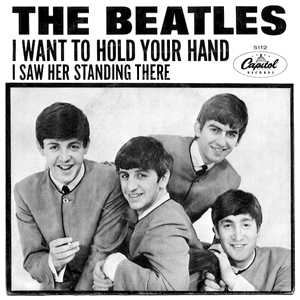
4. The Beatles- I Want to Hold Your Hand


The Beatles hit I Want to Hold Your Hand was recorded in the month before I was born. It was released in the UK 10 days after I was born. About a month after that, it was released in the US, just narrowly squeaking into 1963. In early 1964, the rookie Lennon-McCartney songwriting collaboration became the anthem of Beatlemania.

It's hard to believe today but back then The Beatles were strictly in the domain of kids mostly under 15. There is a wonderful trailer on the Help! DVD that says, "Hey, adults! You can go see Help! too". In early 60's mainstream media, The Beatles were seen the same way Justin Bieber is today (freakin' hell, that was a scary sentence to write).

My older siblings were all big Beatles fans. So like many kids in the generations to follow me, I grew up with The Beatles. As a preschooler I was more familiar with I Want to Hold Your Hand than I was with Old McDonald Had a Farm.

Like my brothers and my sister I saw the band evolve from the little cuties who sang I Want to Hold Your Hand to the long haired bearded "freaks" performing their final live appearance together on a rooftop in London.

I had a plastic army guy I named Sgt. Pepper. I sang Octopus' Garden in the elementary school variety show (not having had a single singing lesson at the time, it was most likely awful). I actually paid money to see the movie Caveman just because Ringo Starr was in it. I was at the memorial for John Lennon in Central Park on December 14, 1980.

I have lived through all the remixes, remasters, lost tapes, rarities, anthologies, circus shows, re-releases, compilations, rare live recordings, documentaries, photos and whatever the hell else they've come up with to keep repackaging the Fab Four over the years.

The Beatles are more than just band whose music I know and love. They are part of the landscape of my life.


3. Mad Men


Mad Men is, of course, not actually from 1963 but it is very much about 1963. Season 3, in particular, takes place entirely in 1963. Nothing really captures the look and feel of the early 1960's the way Mad Men does. The period detail and fashions are incredible.

Focusing on the professional and personal lives on Madison avenue advertising executives (Mad Men, get it?), the period series depicts a world where everything seems beautiful and perfect on the surface . Not far beneath that beautiful perfect surface of nice clothes, swank offices and smiling families lurks the darker worlds of alcoholism, serial infidelity, undiagnosed depression, paranoia, repressed homosexuality and socially sanctioned sexism, racism, and prejudice. The very different attitudes and social mores of 1963 are skewed through a subtle modern day prism.

Mad Men is often thin on dialogue but thick on subtext. It's a show that says more in its silences than most dramatic TV shows can say in 60 minutes of dialogue. Quite simply, Mad Men is the best show currently on TV.

Among other things, the Season 3 of Mad Men sees deals with the November 22, 1963 assassination of  President John F. Kennedy. The tragic event has a massive indirect impact on the various character's inner emotional lives. It is quite possibly the best episode of the series thus far.

Incidentally, Don and Betty Draper's third child, Gene, would be the same age I am today where he not a fictional character.

2. From Russia With Love

1963 saw the release of the second and, in my opinion, best James Bond movie of the entire franchise (though the 2006 Casino Royale does give it a run for its money). From Russia With Love is also the only Bond film that is actually an improvement on the original Ian Fleming novel.

From Russia With Love is one of the rare Bond movie outings that does involve some kind of an arch villain in a secret lair filled with cutting edge technology, intent on taking over and/or destroying the world.  No, the second Bond is your simple Cold War-era spy thriller.  It is a basic suspense chase story revolving around Bond, evil agents from SPECTRE and beautiful Russian intelligence operative in way over her head.

Connery is in fine form in From Russia With Love. He is as close to Fleming's Bond as he would ever get. By the next installment, Goldfinger, Connery's smirks and sense of self-parody would already begin to kick in. There would be no going back once Connery and the franchise caught the silly bug.

From Russia With Love features one of the greatest fight scenes ever filmed. Sean Connery and Robert Shaw (in a amazingly cold-blooded performance) take each other on in a tiny train compartment. The fight reportedly took two weeks to film. Director Terence Young (no relation) had the good sense to let the rickety rocking sounds of the interior of a speeding train score the scene. The end result is, even by today's standards, exciting and stunning.

The train fight is a scene that defines the essence of Bond. Beneath the nice suits with the thin ties, the first class meals, the gambling in exclusive men's clubs, the gorgeous women,t he fast cars, and the right wine with the right meal, it all comes down two guys in an enclosed space beating the shit out of each other in a kill or be killed bare-knuckled struggle to the death.

It would be another 43 years before a James Bond movie would ever take itself that seriously again.


1.The Birth of JFK Assassination Conspiracy Theories


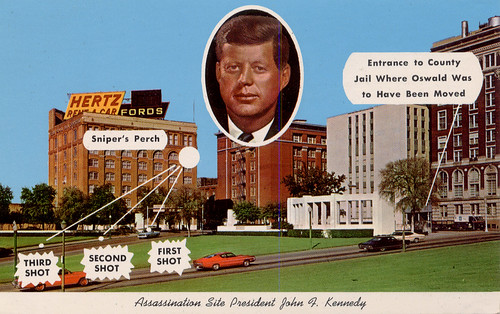
The assassination of President Kennedy in Dallas on November 22, 1963 is a dark moment in history. It really does not belong on any ten best list. That's why it's not on this one. It's the conspiracy theories borne out the fatal shooting that really fascinate me.

The Kennedy assassination was three days after my birth. For better or worse, it's a moment in time that has always and will always be linked to my arrival.  The Official History of the World as it was handed down to me by parents went like this: Great Depression, World War II, JFK is shot, you are born (technically, yes, I was born first but I was too young to grasp such subtleties).

If Oliver Stone is to be believed (and when it comes to conspiracies, why not?), the Kennedy assassination theories began on the actual day the President was shot. Though,  it was really not until Jack Ruby assassinated Lee Harvey Oswald, the alleged JFK assassin,  on the way to a Dallas courtroom  two days later that the conspiracy theories really took off.

Let's get one thing straight, I'm not going to use this blog to get into the whole conspiracy riff, okay?

I'm not going to talk about all the suspicious unanswered questions surrounding the shooting of the President. Questions like just why exactly why did Ruby shoot Oswald? Could Oswald really have made those three shots at that angle from the Texas School Book Depository? Why did the description of the murder weapon change while in the hands of the Dallas Police? Why was there witness intimidation going on during the investigation? What's with that guy with the umbrella in Zapruder film? Was he signaling somebody? Who did Oswald have contact with while he was living in the Soviet Union?

See? It's kinda addictive, isn't it?

Over the years I think I've heard 'em all. The major more legitimate theories have the conspiracy engineered by either the CIA, the KGB, the mafia, the Secret Service, Fidel Castro, the Israeli government, a secret multi-generational cabal that goes back to the assassination of President Lincoln, UFO's, the teamsters, or, according to a theory put forward by my sketch comedy troupe The Vestibules, British pop star Kiki Dee.

In a really odd way the Kennedy Assassination conspiracy theories are my own twisted connection to the world I was born into.

Or are they?