I am a Montreal-based actor, writer and comedian.
When U.S. President John F. Kennedy was shot, I was three days old. I cried all day.
My favourite books of all time are Moby Dick by Herman Melville, The Last Temptation by Nikos Kazantzakis and The Ewoks Fun Time Activity Book by Chirpa and Pamploo.
I am a member of The Vestibules, On The Spot Improv and The Best Buy Battery Club.
Except for the Battery Club, I've been at all this stuff for over 20 years.
Enjoy my blog.
Last night, as has been the case for the last 35 years, I watched the Oscars. For the first time, though, I found myself taking notes on the show. Here then are my random first impressions of the 83rd Annual Academy Awards.
7:48 PM: Turned on the preshow. These red carpet interviews are a dream come true if you love seeing your favourite stars being really awkward.
8:06 : I resolve not to have any "best dressed/worst dressed" coverage in this post. To paraphrase what my Mom used to always say, "You go to The Academy Awards to honour excellence in the field of motion picture arts and sciences, not for a fashion show.".
8:12: I briefly switch over to Fox. I discover that the network's counter-Oscar programming is, for reasons that I cannot fathom, all of their Sunday night animation show's Xmas episodes.
8:22 : Note to ABC: fire the guy controlling the audio levels between the show and the commercials.
8:27: Show is about to start. IS has just broken out the wine. I know it's gonna be fun show now, no matter what.
8:30: The opening film segment. The Oscars are still ripping off that old MTV Movie Awards bit all these years later…
8:43: Nice try on that tricky spin to keep a billion people interested in the Best Art Direction award there, Mr. Hanks.
8:47: Wally Pfister wins the Oscar for Best Cinematography for Inception. Note to self: when I win my Oscar, remember to make one more last minute check to see if I'm still wearing my glasses on my forehead before making my acceptance speech.
8:56: Only a 94 year-old, stoke-surviving Kirk Douglas could get away with holding up announcing the Best Supporting Actress Oscar....twice .
Here's Michael's dad when he was slightly younger...
8:58: Melissa Leo's acceptance speech proves that live television no longer uses the seven second delay. Man, would I have loved to see what Steve Martin, Chris Rock, Jon Stewart, Billy Crystal or even Bob Hope woulda done in response to that baby.
9:04: The Lost Thing from Australia wins Best Animated Short. The short “was produced over eight years from 2002 and features a mix of computer animated and hand-painted elements.” Note to the Music Director of the Academy: update the Best Animated Short walk-up music from that loud wacky Carl Stalling-style silly symphony stuff you insist on playing every year. Very few of the nominated short animated films these days feature Daffy Duck or Chilly Willy.
9:07: Toy Story 3 wins Best Animated Feature. Oh, man, that movie is gonna be impossible to rent for about a month now on account of all the six year-olds who will suddenly want to see it just because it won an Oscar.
9:26: I predict that the Canadian media today will not be able to shut up about the Quebec-made film Incendies not winning Best Foreign Language Film. You won't see quite as much of that in the French media who are considerably less needy for American attention than their English Canadian counterparts.
9:32: Christian Bale becomes the second Oscar-winning actor in history who has also played the role of Batman. There's hope for you yet, Mr.West.
9:44: Did that guy from Nine Inch Nails just win an Oscar?
9:57: The Wolfman wins for best make-up. It’s nice to see a technical award that just focuses on the actual technical achievement. Too often the Academy hands that Oscar over to a less deserving technical achievement that happens to be in a movie that is sweeping all the awards that night.
10:20: Hey, Coen Brothers, the camera is on you! Yes, now....look...yeah, that's right...over there...see...oh, darn...it's too late....
10:32: Robert Downey Jr and Jude Law officially become The Funniest Thing in The Whole Show (there wasn't really a lot of competition in that department). I'm sure I'm not the first person to float their names out there as contenders for next year's hosts.
If Downey can make jokes about his heroin bust then he can certainly handle all the bitchiness that the internet reviewers like to dish out on Oscar hosts.
10:55: The In Memoriam segment. Claude Chabrol and the guy who directed The Poseidon Adventure died?
11:07: Francis Ford Coppola directed some of the greatest American films ever made: The Godfather Trilogy, Apocalypse Now and The Conversation, to name a few. Eli Wallach is one of the greatest living method actors still working today. He has appeared in such classic films as The Misfits, The Good The Bad & The Ugly and The Magnificent Seven. Jean Luc Goddard reinvented filmmaking as part of the French New Wave movement of the 1960's. Among other things, his landmark film Au Bout du Souffle influenced mainstream Hollywood cinema throughout the 60's, 70's and beyond. Kevin Brownlow is a film maker and film historian responsible for documenting and preserving many of the greatest films of the silent era including the restoration of Abel Gance's lost 1927 epic, Napoleon. He also directed the excellent alternate history mocumentary It Happened Here.
Coppola, Wallach, Goddard and Brownlow are suitably honoured during a three hour broadcast with a 90 second film clip highlighting a previously held awards ceremony. The clip is reverently followed by three out of the four film legends briefly appearing live on stage, waving to the crowd without speaking. The audience slows down the the entire show by stopping to give them a standing ovation.
11:25: Jeff Bridges does not win the Oscar for Best Actor in True Grit, proving once and for all that he is no John Wayne.
11:34: In addition to launching a huge campaign amongst Academy voters for The King's Speech to win Best Picture, Harvey Weinstein apparently also lobbied to have The King's Speech dominate the montage of this year's nominated films.
11:36: The King's Speech wins Best Picture. Harvey Wienstein must have hired Karl Rove to advise him on how to snatch the Best Picture Oscar from the jaws of The Social Network.
Midnight: I frantically put together all my observations before hearing, seeing or being influenced by any other media comments or reviews. It's not easy.
And, oh yeah, I suppose I have to close by saying, yes, I am indeed a dummyhead...
A Midnight Clear is one of the most underrated war movies out there (and ditto that on Christmas movies too).
This indie 1992 movie features an all star Brat Pack of The 90's cast: Ethan Hawke, Gary Sinse, Kevin Dillion, Peter Berg and Arye Gross. They play an American Intelligence unit isolated in the Ardennes Forest during The Battle of The Bulge in World War II.
The Battle of the Bulge was a last ditch attempt by the Germans to turn the tide of the war back in their favour. It almost worked. The offensive was launched on December 16, 1944 with much of the bloodiest fighting taking place over Christmas and New Years.
In the midst of the fighting, the American soldiers are approached under a flag of truce by a lost German platoon. The war is pointless for them by now and they just want to surrender. Far removed from the fighting, the "enemies" find themselves celebrating Christmas together. Then tension mounts when the war once again reaches their doorstep and the two enemies are lead down a path from which there is no coming back.
A Midnight Clear is one of those films that doesn't hit you over the head with messages. The anti-war sentiments are there, to be sure, but they just lie there subtly, allowing the audience to come to their own conclusions. The same is true of the film's sympathetic and ambiguously heroic deception of these particular men who fought in World War II.
The film was made at a time when WWII was not in vogue in Hollywood. The war movie genre was still under the shadow of the lingering 80's obsession with movies about the Vietnam War. Even the box in the video store compared the movie to Platoon. It would be another six years before Spielberg and Saving Private Ryan would make WWII cool again.
A Midnight Clear is a lost gem, an underdog in the combat film genre, a great alternate Xmas flick and well worth seeking out.
9. The Apartment (1960)
The Apartment won the Oscar for Best Picture in 1960. It was one of those Best Pictures that actually deserved the honour. It was directed by Billy Wilder, legendary for directing one of the best film comedies of all time, Some Like it Hot. Wilder plays things a bit more dark and real this time around. He once again casts his Some Like it Hot favourite, Jack Lemmon, along with an unrecognizably young Shirley Maclaine and Fred MacMurray in what was probably his last non-family friendly role.
Set in the final week of the 1950's, The Apartment follows the story of a mid-level insurance company drone, played by Lemmon, trying to work his way up in the company. He has a unique strategy to achieving that goal. He lends out his apartment to four different managers so that they can use it as secret hideaway for all of their many extramarital affairs (and you thought Mad Men did it first). Chief among the managers is head honcho Fred MacMurray.
Things get a little complicated when Lemmon starts to hit it off with one MacMurray's main squeezes, played by Maclaine. Over Christmas and New Years, there's love, betrayal and attempted suicide. Yet Wilder manages to keep even the darkest moments both appealing and funny.
The Apartment features a performance from MacMurray that is so incredibly creepy you will never watch My Three Sons or Son of Flubber (yep, those stupid Robin Williams Disney things were remakes) the same way again.
The Apartment is a more realistic take on Christmas. Life goes on during the holidays; it's not like all your issues and conflicts just go on an extended Christmas break like the banks do.
8. Eyes Wide Shut (1999)
Stanley Kubrick is quite possibly the greatest film director who ever lived. His films have a visual language and meaning all their own. Kubrick is many things but he is not a panderer. Either you keep up with his audacious storytelling methods or you don't. It's that simple.
That may explain why Eyes Wide Shut still remains Kubrick's most maligned and misunderstood film. Some critics went so far as to say that Kubrick must not have finished editing it at the time of his death (he never lived to see the film released) or that he caved into studio pressure to tone down the extensive amount of orgy scenes. I don't think those critics understand Kubrick all that well. It's a much more complex film that they are giving the legendary director credit for.
And, oh yeah, it all takes place around Christmas.
Eyes Wide Shut is a story of sex and betrayal, both real and imagined. Kubrick does for Tom Cruise in Eyes Wide Shut what he did for Ryan O'Neal in Barry Lyndon: makes him look like a much better actor than he is. Cruise, after a confession from his wife Nicole Kidman (both real and movie version at the time), heads out into the streets of a backlot in London made to look exactly like New York City. He embarks on a a dream-like journey of sex, surreal experiences and well, more sex, really. He encounters an elite orgy of anonymous sex that reflects the inner world of his psyche run wild (See Stanley? I'm keepin' up). The orgy scenes are not about being shocking, sexy or caving or not caving into the studio censorship. Those scenes are much more oneiric in nature than any of those things.
And, oh yeah, they take place around Christmas.
One of the things I love about Eyes Wide Shut is how Kurbick (like the candles in Barry Lyndon) lights entire scenes with Chirstmas lights. I have never seen another movie that has used holiday lights as artfully and beautifully as Eyes Wide Shut.
And ya just gotta love any movie that ends (SPOILER ALERT) with Nicole Kidman standing in the middle of a crowded toy store on Christmas Eve saying the words, "We have to fuck."
I suggest that any of the maligners who may be reading this out there take another look at Eyes Wide Shut. I mean, who has ever really liked a Kubrick film on first viewing?
And, besides, Christmas is a time for forgiveness.
7. On Her Majesty's Secret Service (1969)
It was only after seeing this movie three times and reading the book that I realized it's a Christmas movie. It's as close as James Bond ever gets to anything yuletide. Well, aside from Sean Connery calling his attache case with a pop-out knife and exploding gas canisters in it, "A nasty Christmas present" in From Russia With Love. K....um...that was really geeky, wasn't it?
In this Bond outing, George Lazenby fills Sean Connery's shoes (for just one movie, as it would turn out). Lazenby is no Connery. In fact, he's barely even a Moore (and certainly not a Craig or even a Brosnan or a Nelson or Niven or....okay, I'll stop now). Though he does nail the last line of the movie, which in this case, is pretty damn important. Yep, this is the one were Bond gets married. Given that he is definitely not married in any other subsequent Bond movies, well, um, I think that's a spoiler alert.
In Lazenby's inexperienced hands, Bond comes off as a more vulnerable and less confident than any another 007 in cinema history (and I"m including Woody Allen's Bond from the 1967 comedy version of Casino Royale).
Back to the Xmas connection.
Ernest Stavro Blofeld, Bond's only multiple movie arch nemesis (played this time around by Telly Savalas -it wasn't just Bond they kept recasting), threatens to launch a major biological attack on the free world on Christmas Eve 1969, unless his demands are met.
James Bond spends Christmas Eve in a car chase on solid ice and in one of the greatest ski chases ever put on film. Bond launches an all-out assault with a group of mercenaries on Blofeld's remote complex high in the Swiss Alps on Christmas Day (again, you gotta be an eagle-eyed Bond fan to catch the references to the actual days).
At one point, Blofeld manages to capture Bond on Xmas eve. "Merry Christmas, 007" says Blofeld to Bond as 007 awakens. The first thing that comes into view as Bond's vision de-blurs in a POV shot, is Blofeld's Christmas tree.
Let's just pause on that for a second.
Blofeld is a guy who shoots his own henchmen in cold blood just to make a minor point and kills associates who bother him with lethally electrically wired chairs in the middle of bad guy board meetings. Just a movie before, Blofeld attempted to destroy most of the world with thermonuclear weapons. The man is the CEO and founder of an organization called the Special Executive for Counter-Intelligence, Terrorism, Revenge and Extortion. Yet, in the middle of planning and executing a massive complex plot to attack the free world with a horrific plague , he still takes time out to go and pick out a Christmas tree, transport it back to his remote complex in the Swiss alps and decorate it.
There is hope for the world after all.
6. Batman Returns (1992)
Outside of some wrapping paper I manage to track down every year, Batman makes a rare connection with the yuletide season in this movie. Batman Returns is the second and last Tim Burton directed Batman film and my personal fave of the 1989-97 caped crusader franchise.
Christmas is a back drop for the action in this story and it is a backdrop Burton takes full macabre advantage of. There are giant exploding presents, screaming women thrown off roofs into Christmas trees and lethal brightly colored candy cane weapons. In the back story for Danny Devito's wonderful take on The Penguin, the "freakish" baby is both born and abandoned by his wealthy parents at Christmas. Michael Keaton's acceptable Batman and Michelle Pfeiffer's incredible Catwoman (and I am not just talking about the costume) have a twisted mistletoe-inspired rooftop fight.
Few directors can utilize childhood imagery with such twisted juxtaposition to darkness the way Burton can. Yet somehow Burton is, at the same time, always able to somehow create a sense of security amongst the dark visions of evil elves and bat-infested Christmas trees.
That in itself is a Christmas miracle.
5. Kiss Kiss Bang Bang(2005)
Before Robert Downey Jr.'s being fired from Alley McBeal for a heroin bust and his big Iron Man renaissance, he kinda drifted around in a random array of under-the-radar roles. This is one of them.
Kiss Kiss Bang Bang is a great movie. The story follows Downey's small time NYC crook as he literally runs from the cops into an audition that just happens to be going on at the time. In the heat of the emotional moment of the chase, he actually lands a role in a Hollywood movie. Downey is then sent to LA where he is to prepare for the role of private eye by hanging out with a real private eye played by Val Kilmer (in a wonderful performance).
Downey finds himself in LA cruising around with Kilmer at Christmas time. Downey also manages to stumble across Michelle Monaghan as a struggling actress. Monaghan's role in Kiss Kiss Bang Bang is sure to satisfy anybody's sexy Santa's helper fetish. Kiss Kiss Bang Bang uses the classically surreal setting of Christmas in LA to maximum effect.
Also used to great effect are the legendary hard boiled detective writings of Raymond Chandler. His work is heavily referenced and integrated into the film. The movie is broken up in to chapters that borrow the plot, themes and titles of Chandler's The Lady in the Lake, The Little Sister, Farewell My Lovely, Trouble is My Business and The Simple Art of Murder. Though the movie does not take itself quite as seriously as any of those books. In fact, Kiss Kiss Bang Bang has a great deal of fun with the pulp detective fiction genre.
Kiss Kiss Bang Bang marks the directorial debut of Shane Black, the Hollywood screenwriter who gave us the first two Lethal Weapon movies, The Monster Squad, The Last Boy Scout, The Last Action Hero and The Long Kiss Goodbye. Four of his screenplays use the backdrop of Christmas in LA.
Xmas in LA is quite a popular setting for the non-Christmas Christmas movies, as our next selection undoubtedly demonstrates.
4. Die Hard (1987)
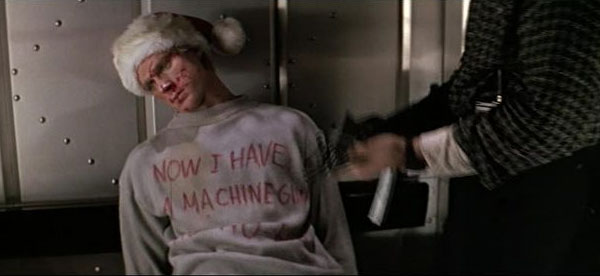
This scene is about as into the Christmas spirit as Die Hard gets
A perennial favourite on just about every alternative Christmas movie list out there, Die Hard is also a movie that forever redefined the action genre.
It's Christmas Eve in LA. New York cop John McClane (Bruce Willis) is town to try and patch things up with his ex-wife. In the middle of her company's Xmas party, heavily armed men storm the tower and take control of the company's massive skyscraper. McClane, who happens to be out of the room at the time, finds himself the lone hero who must.....okay, if you've read this far I really don't need to go on.
Die Hard is a massively entertaining piece of escapism. I say even though the screenplay displays some of the laziest writing I have ever seen. Everyone in the movie but the bad guys, Willis, his ex-wife and Urkel's friend's cop dad is unnecessarily stupid, arrogant and just plain unlikeable. It's as if the only way screenwriters Jeb Stuart and Steven E. De Sousa could make Willis a sympathetic character was by making everyone around him an asshole. Nonetheless, Die Hard is (even on the umpteenth viewing) full of great one-liners, exciting and genuinely suspenseful, despite the massive amounts of gratuitous violence.
Also Willis displays the most innovative use of Christmas packing tape I have ever seen. I'm still waiting for that one to turn up on Martha Stewart's show.
Die Hard 2 also takes place on Christmas Eve. Unfortunately, the story is set in Washington DC so there is tons of snow and winter tableau's everywhere. That automatically makes it too Christmassy for this list.
A screening of Die Hard around the crazily busy holiday season is a great way to unwind. Die Hard also nicely counteracts all the nice and happy yuletide images the media feeds us constantly throughout December.
A wonderful bit of Christmas movie-tie in marketing
3. Black Christmas
When I was a kid, they ran a trailer for Black Christmas during The Flinstones. It scared the hell out of me so much that my father, understandably, wrote a letter to the CRTC regarding the inappropriate airing of horror movie trailers during freakin' cartoons (some of those are his exact words). I think it was that negative memory and my perceived silliness of the premise that kept me away from Black Christmas for many years to come.
Until a few years ago, to be exact. One Christmas, IS, the wonderful love of my life, and I got not only to spend our first Christmas together but also to host all the yuletide festivities in our own home. It was almost midnight Christmas Eve and I was busy putting out and organizing the army of presents generated by two families. IS was watching TV at the time. Suddenly, the sounds of the Pope's midnight mass from The Vatican was replaced by low budget 70's horror atonal piano horror movie music and screaming with Silent Night echoing in the background. I found it both distracting and mood breaking. I looked up at IS and asked her why she was watching, of all things, Black Christmas now. She calmly responded, "This is my 'It's a Wonderful Life'".
I gained an immediate new-found respect for Black Christmas at that moment.
It has grown on me in the years since. It's a very well directed and well crafted horror thriller. Black Christmas pre-dates the holiday themed slasher movies trend begun by John Carpenter's Halloween by four years. It's also the first movie to use the much subsequently overused and quoted line, "The call is coming from inside the house!".
Black Christmas was directed by one of Canada's finest directors, the late Bob Clark. Clark also went on to direct the massive hit sex comedy, Porky's. Those two movies alone have made Clark a pariah among Canadian culture elitists who believe that this country's culture begins and ends with Pierre Burton and Farley Mowat. Even Clark's excellent Sherlock Holmes mystery, Murder by Decree, can't turn that perception around. It may also rub a lot of people the wrong way 'cause it has many a horrific murder set to the strains of holiday music (also one of the first horror films to use the ironic music juxtaposition device). That and both movies were made on Canadian Government Tax Credit programs.
Black Christmas is one of those horror movies that is actually a pretty good movie. Clark uses strategically placed silences, slow motion and accompanying slowed down sound effects and aforementioned juxtaposition of murder in the midst of tinsel and colourful blinking lights to create a film that is genuinely creepy, tense and scary. Black Christmas also features a great deal of that 70's "Hey, we can swear in movies now!" dialogue, including one scene in particular where the "C" word is thrown around so much that it would render the film virtually unreleasable in today's market. Oddly, the violence, though, is considered tame by today's standards.
Black Christmas stars a pre-Superman,pre-mental breakdown Margot Kidder, a pre-SCTV Andrea Martin, a post-Zeffereili's Romeo and Juliet Oliva Hussey and a post-2001, pre-2010 Keir Dullea (my guess is that they took advantage of the fact the he was in Toronto shooting the embarrassingly low budget Canadian Sci-Fi series, The Starlost, at the time) . Cementing its classic B-movie status is the appearance of John Saxon as the initially disbelieving cop turned last minute savior.
You can always count on some Canadian cable network running low on their seasonal Cancon to run Black Christmas at least once every December.
The recent "all 70's horror movies must be remade" craze gave us a 2006 version of Black Christmas (with Andrea Martin as the only returning cast member).
Avoid that one at all costs.
2. Joyeux Noel (2005)
One of the brutal realities of war is that war doesn't just stop because it's Christmas.
Or does it?
Joyeux Noel is an amazing trilingual (English, French and German, everybody speaks in their native tongue-none of this Hollywood "the entire world speaks English with an accent" silliness) film that explores just that idea. The story is based on a number of true incidents of unofficial spontaneous cease fires, yuletide and otherwise, that happened during World War I. They were more than just cease-fires. Soldiers from both sides would climb out of their horrible rat infested trenches and actually celebrate the holiday (or just hang out) together.
There is one particularly moving scene in Joyeux Noel. One of the German soldiers hears the Scottish troops over in their trenches playing Christmas Carols on the bagpipes (they often fought in very close quarters in that war) on Christmas Eve. Silent Night played on the bagpipes might not be most people's idea of easy listening music but it does inspire the German soldier in question. Turns out the guy was an opera signer in civilian life (yeah, it's a bit of a conceit but run with it). He makes the incredibly brave move of climbing out of the trenches singing the "O Come All Ye Faithful" . He stands right in the middle of "no man's land", just belting out the carol. It is this act of pacifistic bravery that inspires the other British, French and German troops to get out of their trenches as well.
In the case of the these impromptu cessation of hostilities, the festivities were often stopped not by the soldiers themselves but but by commanding officers as soon as they got wind of the activity. This is what happens in Joyeux Noel. All of the soldiers are severely punished for acting contrary to their job description.
The punishment the German troops receive is immediate reassignment to the Eastern Front. Yes, the Eastern Front was infamously awful in both World Wars. The film ends on a chilling line. As the German soldiers are being transported to the Eastern Front by train, one of them says, "I'm Jewish. I don't even care about Christmas".
1. Meet John Doe (1941)
Meet John Doe is the darker, more realistic version of It's a Wonderful Life. The two films are both directed by Frank Capra. Meet John Doe was released in 1941, five years before It's a Wonderful Life. Meet John Doe was a big hit in its initial release and has now faded into obscurity while the opposite is true of It's a Wonderful Life. The two films contain many of Capra's recurring themes but feature very different treatments of those themes and ideas.
Now let's talk about Meet John Doe on its own terms.
In 1941 before the US entry into WWII, the Great Depression was still dragging on. A newspaper columnist, played by the wonderfully underrated Barbara Stanwyck, is laid off. In response, she writes a letter to the editor under the name John Doe stating that Mr. Doe will jump off the roof of City Hall on Christmas Eve (still several months off) to protest the current state of the country's social and economic ills. The letter causes a sensation and Stanwyck is hired back. In a effort to keep sales up, the paper's editor concocts a plan to create an actual John Doe. They find a former baseball player played by Gary Cooper. Cooper is now homeless (or a "hobo" as was the term then) and agrees to pretend to be John Doe 'cause he needs the money to fix his bum arm that's keeping him out of the major leagues.
It's not long before John Doe creates a massive grass roots movement of common people. The movement is funded by the paper's owner and publisher played by Edward Arnold. Arnold's character is an early 1940's version of a media mogul, owning multiple newspapers and radio stations. Arnold is, of course, putting up the money to back John Doe in order to serve his own political ambitions. His jackbooted-motorcycle-riding private security force and lines like "What this country needs is an iron hand" betray Arnold's crytpo-fascist leanings. In 1941, fascism was on the march (to put it mildly) in Europe and Asia. The US was still predominantly isolationist and, really, no one was really sure whether fascism would catch on in America or not.
As soon as Cooper and Stanwcyk (who is both Cooper's speech writer and his love interest) clue in to Arnold's true ambition, they stand against him. Arnold, in turn, reveals to the media that he owns that John Doe is really a "fake". The exposure of the "fraud" is in an incredibly emotionally powerful scene set in a stadium full of Doe supporters.
Now thoroughly publicly discredited, Cooper decides that the only way to save the John Doe Society (as the movement is now called) is to follow through on the message of the original letter and jump off the roof of City Hall on Christmas Eve.
Highly regarded by film academics, directors and screenwriters, Meet John Doe is an otherwise forgotten film. You really gotta look to find a TV airing, even around Christmas. The DVD is put out by small time companies and usually has bad sound and not the greatest picture. It is still worth seeking out, especially at this time of the year and especially if you're starting to get a little tired of It's a Wonderful Life.
Take a look at this scene.
(and that's big WTF? on all that Dead Zone stuff)
There are no angels in Meet John Doe. God is often referred to there is no evidence of His divine intervention like in that other Capra Christmas classic. Edward Arnold is not Lionel Barrymore. He does not make speeches and judgments. He is not curmudgeonly. He is quieter, more scheming and a lot more powerful than Barrymore ever was (and I'm even counting when Barrymore is seen running the whole town in an alternate reality). Much much scarier, in other words. Gary Cooper is a bit more morally ambiguous than Jimmy Stewart. The bad guy is more powerful, we're not really sure if the good is really good and there is no tangible morally superior force in the universe. It's not the kind of movie you want to watch while wrapping your presents on Christmas Eve.
Meet John Doe ends on note of hope but not one of certainty. That's kind of what Christmas, and life, is really like.
Merry Christmas,
Happy Holidays,
Season's Greetings,
and Happy Whatever Else We're Supposed To Say Now,
All The Best for 2011!