About Me

My photo
Montreal, Quebec, Canada
I am a Montreal-based actor, writer and comedian. When U.S. President John F. Kennedy was shot, I was three days old. I cried all day. My favourite books of all time are Moby Dick by Herman Melville, The Last Temptation by Nikos Kazantzakis and The Ewoks Fun Time Activity Book by Chirpa and Pamploo. I am a member of The Vestibules, On The Spot Improv and The Best Buy Battery Club. Except for the Battery Club, I've been at all this stuff for over 20 years. Enjoy my blog.
Showing posts with label movies. Show all posts

Thursday, April 5, 2012

Five Great Movie Crucifixion Scenes*

*that aren't from movies about Jesus

The first still from Mel Gibson's upcoming Robocop reboot

After bunnies and chocolate eggs, the most prominent image of Easter is that of Jesus Christ crucified on the cross. It's an image that permeates more than just Easter. There are few other images in our Judeo Christian-based culture that are quite as resonantly iconic (well, if you leave out the Judeo part, anyway). The image of the 11th and 12th Stations of The Cross have been revisited by artists in many different mediums over the last twenty or so centuries.

Film makers are no exception. In the history of cinema, many directors have gone there and in many different ways. A good deal have gone to the literal representation of the crucifixion in biblical films like William Wyler with Ben Hur and George Stevens with The Greatest Story Ever Told while others have taken more controversial routes like Norman Jewison with  Jesus Christ Superstar,  Martin Scorsese with The Last Temptation of Christ and, more recently, Mel Gibson with The Passion of the Christ. Far more prevalent, though, are the allegorical Christ figures of movie history. Peruse through enough academic articles and serious-minded fan websites and you will find alleged Christ parallels in every cinematic icon from Rhett Butler to Luke Skywalker.  Many times the perceived savior allusion is more than just literary in nature; they are visual and cinematic in nature and they usually key thematic and dramatic scenes in film. The image most commonly cinematically referred to is that of the crucifixion of Christ. These scenes borrow not just the thematic concepts of the crucifixion but much of the classic iconography of the crucifixion as well: outstretched arms, nails through the hands or wrists, the crown of thorns and the spear in the side, to name a few.

For some, these visual crucifixion cues are more apparent and meaningful than others. For someone raised Catholic as I was (though I'm most definitely in the "fallen" category now) and who was later taught film criticism by a Jesuit priest, such images leap off the screen. For those with more secular upbringings who were taught film criticism (if at all) by, say, an avowed Marxist, probably not so much. However, as Marshal McLuhan was fond of saying, "The medium is the message". If those images are up there on that movie screen and a viewer notices it, consciously or not, then they do have some kind of meaning.

I could spend a blog post each week pointing out each and every visual Christ allegory that has ever appeared in a movie at one time or another. I've narrowed it down to five of my favourite examples. Here are five examples of films that have borrowed, used for their own purposes and some might say twisted and even ridiculed the imagery that, next to bunnies, is most strongly associated with this time of the year.

WARNING: Big time SPOILER ALERT, if you have not seen any of these movies.


Conan The Barbarian
1982
Directed by John Milius


Who's Standing in for Jesus?
Future Governor of California and champion body builder turned action movie star, Arnold Schwarzenegger. In this case, Mr. Schwarzenegger is playing legendary fantasy writer Robert E. Howard's most famous creation Conan The Cimmerian, an ancient and, I might add, pagan barbarian.


What's the context?
While seeking revenge for the murder of his father, Conan tracks down the evil, mystical and snake-themed warlord Thursla Doom, (James Earl Jones, who was then still trying to break away from that Darth Vader typecasting thing). After tracking down Doom, Conan attempts to infiltrate Doom's temple but is captured. Doom then sentences the barbarian to death by crucifixion. While tied to a tree (not nailed to a cross), Conan endures his torment in the most pro-active way possible. At one point, a vulture attempts to peck out Conan's eyes. Before the bird can do so, Conan bites the thing right in the neck and kills it. The barbarian is later rescued by one of his comrades in arms and is brought back to health with the help of the magic of an old wizard.

What makes it a crucifixion?
The religious allegories of the scene, while present as a stylistic motif, are a bit tenuous, to say the least. Conan almost, but doesn't quite, die while tied to a tree and is then brought back to "life" via supernatural means. Yeah, that's sorta kinda a crucifixion and resurrection metaphor, but, really, the only allegory that really holds up to scrutiny is Conan's incredible ability to survive hardship, torment and almost certain death.
The scene is often described a quintessential moment in defining the character of Conan, both in cinema and in literature. The scene itself is taken directly from a similar yet much more powerful description of Conan's similar crucifixion in Howard's original short story, A Witch Shall Be Born.

Artist Boris Valego's rendering of  A Witch Shall Be Born

"By the side of the caravan road a heavy cross had been planted, and on this grim tree a man hung, nailed there by iron spikes through his hands and feet. Naked but for a loin-cloth, the man was almost a giant in stature, and his muscles stood out in thick corded ridges on limbs and body, which the sun had long ago burned brown..."
-Robert E. Howard, A Witch Shall Be Born, 1934

That section of the original Conan story is some of the best writing of Howard's career and, in my opinion, the most powerful passage ever written for his signature character. In the story, Conan ends up on the wrong side of a bloody coup d'etat in ancient city state. He is literally crucified for defying Constantius, the new conqueror. Conan is nailed, not tied, to a cross, not a tree. The vulture scene is basically the same. Conan's only rescue comes in the form of a passerby, one of Constantius' rivals, who merely cuts down the cross and lets Conan fend for himself from there. Conan, of course, manages to survive to fight another day. In an effort to retain some believability, Howard has Conan spend several months recovering. Conan finally exacts his revenge when, after conquering his army, he finally captures and then crucifies Constantius, the very man that had Conan nailed to the cross in the first place. Not only does Conan overcome suffering at the hands of his enemies but he does quite aggressively.
"You are more fit to inflict torture than endure it.", says Conan to his former tormentor as he leaves the man hanging on the cross.
Not exactly "turn the other cheek" stuff, is it?
No, Conan is not a messianic figure of salvation and resurrection ; he survives crucifixion not because of his virtue or because of divine providence but because Conan The Barbarian (in both movies and books) is, quite simply a tough, determined and unkillable badass.


The Omega Man
1971
Directed by Boris Sagal


Who's standing in For Jesus?:
Charlton Heston, as U.S. Air Force Colonel Robert Neville, M.D..


What's the context?:
The Omega Man is the second of  three film adapatations of Richard Matheson's short story I Am Legend (the first is The Last Man on Earth in 1964 with Vincent Price and the third is I Am Legend with Will Smith in 2007).
In 1975 (which would have been four years into the Not-Too-Distant Future when the film was made) the Cold War has become one of biological warfare. Heston, an Air Force research physician, injects himself with an experimental vaccine, but it is too late. Most, if not all, of the world population has already succumbed to the plague created by the war. Heston believes he's the last man on Earth. He goes on to spend his days roaming the deserted streets of Los Angeles and his nights fighting off a cult of plague infected nocturnal albino vampires. The cult is determined to destroy all remaining technology and Heston along with it. However, Heston and his large cachet of automatic weapons and greenades have something to say about that plan.
Heston is rescued from the albino vampires one night by a group young hippie survivors. The young "kids of today" are immune to the plague because of their age. Can you tell this movie was made in the early 70's?
With the help of one of the young hippies, a former medical student, Heston is able manufacture a new vaccine from his own blood as he, of course, is immune to the plague.
Before he can get out of the city with the new vaccine, however, one of the albino vamps manages to impale Heston with a large spear. Heston dies slowly, posed in a Christ on the cross style crucifixion pose. The young hippies retrieve the serum he made, get out of the city and get the closing credits rolling.

What makes it a crucifixion scene?
K, this allegory is pretty ham-handed but, as the aforementioned Jesuit Priest who taught me film criticism used to say, "It's all there.". First, there's the outstretched arms and the slightly bent knees: you know, you basic Christ on a the cross position. Then Heston bleeds profusely from the wound inflicted by a large spear (yes, yes, he was not stabbed exactly in the side but let's not too holier than thou about every little detail, okay?). Not to mention the fact that the man has just effectively saved all of humanity from its own, you might say "sins", with a serum that was literally made from Heston's own blood.
Once it's all laid out like that, the symbolism is pretty forced and, frankly, even as these kinds of things go, kind of silly in how seriously it takes itself.
On the bright side, though, perhaps the grateful survivors of this future world will someday drink wine at communion each week, as a way of symbolizing the sacrifice of the Blood of Heston...


Blade Runner
1982
Directed by Ridley Scott

This image is closer to that of a Resurrection that it is to that of a Crucifixion but more on that later.


Who is standing in for Jesus?
Rutgar Hauer, as the powerful, menacing yet somehow spiritual and sympathetic biorobotic android, Roy Batty.
What's the context?
Blade Runner is the bleak dystopian future to end all the bleak dystopian futures.
Futuristic cop/bounty hunter or, if you prefer, Blade Runner, Rick Deckard (Harrison Ford) is assigned to track down and "retire" (ie: kill) a group of rogue biorobotic androids known as replicants.  The replicants, lead by the creepily charismatic Roy Batty (Hauer) have escaped from what basically amounts to slavery to seek out Dr. Eldon Tyrell. Tyrell is head of the eponymous Tyrell Corporation, creators and manufacturers of the Replicants. That makes Tyrell something of a God figure, at least as far as the replicants are concerned, anyway. As Deckard hunts the replicants, he seems to become increasingly cold and inhuman, even as he becomes romantically involved with a replicant. Meanwhile, the fugitive replicants appear to be gaining more humanity as they come closer and closer to the end of their genetically programmed two year life span.
In the film's climax, Deckard has a dramatic show down with the surviving replicants on a rooftop in the rain. He is tormented physically and psychologically by the increasingly powerful and menacing Batty. As Batty realizes his time is coming to and end and that he is starting to lose control of his physical body, he drives a nail through each of the palms of his hands, in attempt to stop them from shaking. Moments later, after rescuing Ford from falling off the roof and saving his life, Hauer sits down in the rain on the rooftop and declares that it's "time to die.". He droops down into a still position and releases a white dove that he had (for some reason) grabbed a hold of earlier. The dove flies directly up into the air in slow motion as the camera follows it from below.

What makes it a crucifixion scene?
The religious allusions in Blade Runner are a bit more subtle and nuanced than in the other films mentioned in this post. They are one element in a wonderfully multifaceted palate that deals with many themes and concepts, both visual and thematic. They are stylistic, cultural, philosophical and, yes, even theological in nature.
Let's stick to the theological stuff.
Among other things, biblical allusions and references abound in Blade Runner.  Ford in one scene deals with street vendors in outdoor markets that have a strong visual and aural middle eastern biblical vibe to them. He interrogates an exotic dancer who performs with a snake, a biblical symbol of Satan, that in the words of the host of her show, "once corrupted the soul of man".Tyrell is portrayed as a powerful, and, yes, an almost God-like figure who lives in a temple-like skyscraper, the top of which can only be ascended to in a glass elevator that overlooks the city, the sky and the stars.
At the end of the film, Batty performs his own self-crucifixion, then saves Deckard's life and then dies. As he dies, he releases the white dove that flies upwards. A white dove often symbolizes the Holy Spirit, which, coincidentally, also left Christ as he died on the cross (the dove could also be interpreted as symbolic of Batty's soul). The Christ allusions end there ,though. There is no resurrection for Batty. Yet the end of the film suggest that there may be a resurrection, at least thematically, for Deckard.
Of course, director Ridley Scott is not drawing perfect direct lines between Batty and Jesus. Rather, he is playing with these archetypal cultural images to create an impression. By drawing these religious allusions, even they are only perceived subconsciously, Scott is playing with the issue of existentialism vs spirituality. Batty, an artificial being created by humans and the supposed evil villain of the piece becomes a figure of great humanity and redemption as he clings to his final moments of life. The white doves suggests not only possible savior overtones but, on a more basic level, it suggests that this non-human being perhaps did, in fact, have a soul. The world of Blade Runner is one in which humans can create life via their own technology, both human and animal. It's life that, as it turns out, could have more potential for humanity and spiritualism than its creators. The humans of Blade Runner live in a world dominated and even partly destroyed by that same technology that created artificial life.
Is there a God in the midst of all of this bleak, technologically dominated world of the future? Or, in a world where its technology is so powerful, is humanity God?
Like many great films (and even art in general), Blade Runner raises more questions than it answers.


Robocop
1987
Directed by Paul Verhoven


Who's Standing in For Jesus?
Peter Weller as Officer Alex Murphy, soon to become a super cyborg cop, Robocop.


What is the context?
Another dystopian not-too-distant future outing, only this one is just a tad more bleak than The Omega Man and at least as bleak as Blade Runner.
In the crime ridden no man's land that is Detroit of the near future, the police force has -in the ultimate satire of Reagan era politics - been privatized. The Omni Consumer Products Corporation is now in charge of the cops and, boy, have they got some cool ideas for technological upgrades to the force. One of their new innovations involves building unstoppable cyborg super cops. Their first guinea pig for the new law enforcement product line is Officer Alex Murphy. Murphy is selected for the job after he is killed in the line of duty. Killed, I might add, in one of the most brutal killing scenes in cinema history.
Once "legally dead", Murphy is fused with mechanical robot parts and becomes the ultimate law enforcement machine, known simply as Robocop.  Or as the movie poster puts it: "Part Machine. Part Man. All cop." The film is never clear as to whether Murphy was killed and actually brought back from the dead via technology or is just almost killed and given a new lease on life via technology.


Whatever the case, Murphy's death at the hands of some of the most sadomasochistically twisted villains this side of Deliverance, is akin to a crucifixion. In the hands of audacious Dutch director Paul Verhoeven, in his first mainstream Hollywood feature, Murphy's death scene is actually a tad more than just akin to Christ on the cross.

All of Verhoeven's films, from his early art-house European films like The 4th Man to his big mainstream Hollywood movies like Starship Troopers, Basic Instinct and even the much maligned Showgirls, feature some from of thematic crucifixion and/or resurrection, usually centered around the film's central character.

Why makes it a crucifixion scene?
The crucifixion allegories in this movie are bit more subtle than those of Conan The Barbarian or even those of The Omega Man (similar to Blade Runner, though). The imagery may not be immediately consciously obvious to the casual viewer. I've found that calling Murphy's death scene a crucifision allegory is often met with the classic "you're reading to much into it" rebuttal that film symbolism interpretations are often met with. Yet, at the same time, I often also hear people who have just seen Robocop for the first time, bring up the crucifixion angle without prompting.

Take a look at the scene below and you'll see what I mean (warning for the uninitiated, it's pretty violent and disturbing).

In particular, Murphy's hand being blown off with a shot gun at close range is a nail through the palm of the hand taken to the next level. He is "killed" in an outstretched arm position. That crucifixion image is a little less on the nose on account of the fact that the man is missing an arm at the time. Murphy's final bloody head wound is a more brutal version of a crown of thorns. The visual allusions are indirect and subtle, yet still there.
The crucifixion imagery works on an almost subconscious level. It is an excellent example of Verhoevan's unique ability to create audaciously over-the-tip visuals yet still maintain an air of subtlety at the same time.
I actually agree with the "don't read too much into it" argument but not so much in terms of the imagery but more in terms of the conclusions one might make from that imagery.
Sure, Murphy/Robocop goes through his own version of crucifixion and he sees his own version of a resurrection when he is transformed into the savior hero of Robocop. However, even within the film's own terms, Robocop is not Jesus, nor is he meant to be. Verhoeven uses the Christ parallels as a means of creating a deeper and more emotional connection with a larger than life hero (literally, in this case). He does this through the use of deeply rooted, powerful, culturally based iconography. At the same time, he is also using the Jesus allegories as an ironic juxtaposition with a bleak world of violence, social disorder and immorality.
Is Robocop really a savior? Or just a promulgation of more violence, death and disorder? Is a world so mired in crime and corruption even capable of redeeming itself? Is such a world's salvation even within the reach of a savior like Robocop?
Discuss.


Life of Brian
1979 
Directed by Terry Jones


Who's Standing in For Jesus?
Graham Chapman as Brian, but he's more standing near than standing in.

What's the Context?
And now for something completely different....
Brian is this guy, see, who just happened to be born in Bethlehem in the stable next door to the one that Jesus Christ was born in on the same night. He spends most of the rest of his life either being mistaken for or living in the shadow of, the true Messiah.
The premise of Brian gives the legendary British comedy troupe, Monty Python, an opportunity to do some of the best and most irreverent biblical comedy ever.
Many have taken the film to be critical and insulting to Jesus, his teachings and to religon in general. However, really, the film is full of comedy that goes something like this:
Brian (addressing a large crowd, hanging on his every word): "You are all individuals!"
Crowd: (in unison) "We are all individuals."
Pause
Lone voice in the crowd: "I'm not.".
Or the scene in which an organization known as the Judean People's Front talk about they despise their bitter rivals, The People's Front of Judea.
It's quite clear that Python's objects of satire are the institutions, culture and subsequent misinterpretations of Christianity.  It's no wonder that much of the clergy spoke out so strongly against the film.
Life of Brian ends with Brian, as seems to be his lot in life, following in Christ's footsteps and being, you got it, crucified (along with, I might add, all of the rest of the Python troupe in various other roles).


What makes it a crucifixion scene?
Duh.
This being a comedy and all, there is certainly none of the violent imagery of the crucifixion seen in other films on the subject, both allegorical and literal. No hands are nailed to crosses, there is no crown of thorns and no large spears are poked into Brian's side. Still, though, the image of the film's lead character stuck up there on a cross to (unlike the real savior) die for no good reason is just a tad of a heavy note  with which to end a comedy.
Python handles it brilliantly.
Eric Idle, hanging there on a cross just next to Brian, breaks out into song. The song, "Always Look on the Bright Side of Life" is so inanely happy and optimistic that it puts the final musical numbers of most Disney musicals to shame. The end of Life of Brian is one of the greatest strokes of comedic genius in all of Pythondom (but let's not overstate it).
On the one hand, there is the obvious comedic contrast of a happy musical comedy song (with just a touch of  Python's infamous cynical irony) sung be a group of people about to die the horrific death of crucifixion. It's easy to see how some may consider the scene to be a complete mockery of the crucifixion of Christ and the value and beliefs that all of Christianity stands for, thus making it utterly blasphemous.
It isn't really, though, if you think about it.
Even with all of its ironic cynical satire, "Always Look on the Bright Side of Life" is an incredibly catchy song that ultimately exudes happiness and optimism in almost every note. Listen to Canadian folk singer Bruce Cockburn's live cover version of the song and notice the enthusiasm with which the audience sings along. Then try and tell yourself  that is not so. Still not convinced? Try singing "Always Look on the Bright Side of Life" to yourself and see if you're not feeling better after a verse or two.
Happiness, optimism and the belief that much better things are coming, even in the face of the bleak and horrific present; I'm sorry, but, isn't that what Christianity is all about?


Happy Easter, 
Passover,
Greek Orthodox Easter
and 
Spring 
Everybody!


Thought I'd leave you on a pop culture Christ allegory image that really didn't go down so well,
though it was not religious groups who objected, but comic book fans!

Wednesday, May 18, 2011

The Cinematic Ages of The Most Bestest Dinosaur Movies Ever


 "I have wrought my simple plan 
If I give one hour of joy
To the boy who's half a man
Or to the man who's half a boy"
Sir Arthur Conan Doyle,
author The Lost World, 1912


The first dinosaur was scientifically designated in 1824. The term "dinosaur" (Greek for "terrible lizards"-more or less) was coined in 1841. The first novel featuring dinosaurs that avoided extinction, Journey to the Center of the Earth by Jules Verne, came out in 1864.

I'm surprised it took that long.

The public's fascination with these previously unknown prehistoric creatures was almost immediate. As early as the 1850's, museums that displayed the first complete dinosaurs skeletons were experiencing record attendance.

Monsters of one kind or another have always been part of our culture. Mythology is full of creatures like sea servants and dragons (the inspiration for the dragon myths may well have been based on different discoveries of mysterious as-of-yet-unexplained giant bones going back as far as 2000 BC). With dinosaurs, the monsters no longer had to be exclusively mythological.

Speaking for myself,  the most intriguing thing about these great big extraordinarily unique prehistoric creatures is the fact they were once real live animals that lived on the same planet I live on now. This half a man/half a boy is a big fan of dinosaurs movies in general. In particular, I am a fan of movies that I sometimes like to refer to as the Most Besest Dinosaur Movies Ever.

Like the dinosaurs themselves, dinosaur cinema has seen, in my opinion, three different cinematic versions of the geological ages that marked the dinosaurs' time on Earth: Triassic, Jurassic and Cretaceous. Each of these ages marks the cinematic evolution of  the dinosaur genre. Through the Cinematic Ages of the Most Bestest Dinosaur Movies Ever, the dinosaurs achieved the one thing that evolution had denied them: survival.

The emergence of the Cinematic Dinosaur Ages is rooted firmly in literature. In 1912, Sherlock Holmes creator Sir Arthur Conan Doyle wrote The Lost World. His novel sealed the deal on the popularity of speculative fiction concerning dinosaurs. Conan Doyle was reportedly inspired by the discovery of prehistoric plants, thought to be extinct, still living on a plateau in South America. He took that premise and ran with it. The book was quite possibly Conan Doyle's best selling non-Sherlock Holmes novel.

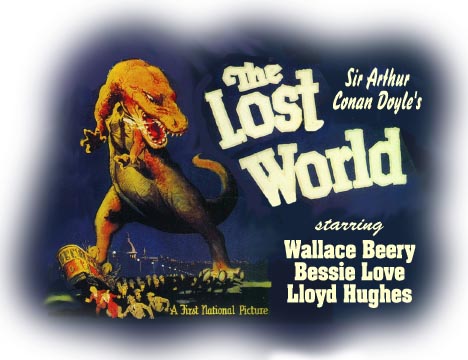
The earliest cinematic depictions of dinosaurs dates back to 1913. That year marked the dawn of the Cinematic Triassic Age of the Most Bestest Dinosaur Movies Ever. Twelve years later, the age reached its first major evolutionary step with the silent film adaptation of Conan Doyle's The Lost World (1925).


The Lost World, in both novel and film form, is the story of an expedition that discovers living dinosaurs on -you guessed it- an isolated plateau in South America. 

The screen adaptation of Conan Doyle's "stupendous story" was directed by Harry O. Hoyt. However, the success of the film is really in the hands of its director of visual effects, Willis O'Brien. 

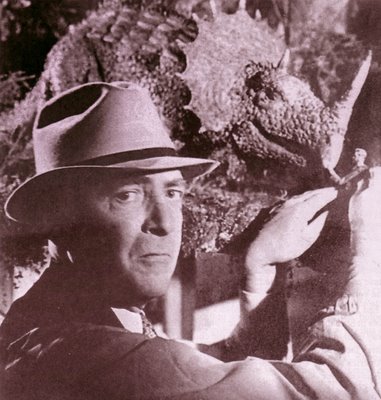
O'Brien, a former newspaper cartoonist, had been making short films featuring dinosaurs since 1915. He was the pioneer of stop motion model animation, a method that remained the predominant means of bringing live action dinosaurs (and other monsters) to the screen for the next 78 years. 

Stop motion animation is a long and tedious process that involves gradually manipulating the movements of miniature models then photographing them one frame at a time. A dinosaur walking across the screen, for instance, can take up to a week to shoot. The method is still employed in current kids TV shows like Lunar Jim and Poko and feature films like the Wallace and Gromit movie and The Nightmare Before Christmas.
 

The dinosaurs in the The Lost World look are as good or better than many of the movie dinosaurs that would appear in films in the years to follow. O'Brien's painstaking attention to detail really paid off. For instance, he inserted small balloons under the skin of the model dinosaurs. With each frame, the balloons would be gradually inflated and deflated along with all of the other movements necessary for the shot. In the final film, the effect creates the impression that the creatures are breathing. It's the kind of detail that usually only registers with viewers on subconscious level. The animated dinosaurs seem somehow "real" to an audience.


Willis O'Brien and unknown acquaintance
O'Brien would go on to the even more challenging stop motion animation for the original King Kong, some eight years later in 1933. He would also do the effects for its sequel, Son of Kong (released, amazingly, in the same year as the original) and the similarly themed Mighty Joe Young (1949). O'Brien  won his first and only Oscar for the latter film. Sadly, the visual effects Oscar category did not even exist at the time of O'Brien's earlier work.


The Lost World utilizes one of the most popular premises of the Most Bestest Dinosaur Movies Ever: an undiscovered isolated ecosystem which has somehow permitted the prehistoric creatures to survive for the last 65 million years or so. According to books and movies, there is a massive preponderance around the world of lost islands, valleys, plateaus and centers of the Earth.  


The lost land premise also allows for an artistic license essential to making a Most Bestest Dinosaur Movies Ever. The vast majority of these stories do away with keeping the dinosaurs in their respective Triassic, Jurassic and Cretaceous ages.  If you followed strict scientific rules, you could never, for instance, see a fight between a Tyrannosaurus Rex and a Stegosaurus. As any seven year old boy will tell you, those two species of dinosaur were, like, 64 million years apart, stupid.

It's a plot device that's basically the same as creating a dinosaur fantasy league.

I finally caught up with The Lost World thanks to an excellent DVD release a couple of years back. It is a DVD restoration that is well worth checking out. Visual effects aside, the movie is quite entertaining and watchable.

The Lost World delivers one of the earliest examples of one of the great cliches of the Most Bestest Dinosaur Movie Ever genre: a giant monster on the loose through a modern city. In this case, a Brontosaurus (not the correct term, I know, but it is the one they use in the movie) loose in 1920's London.
In the years to come, dinosaur movies would ramp that particular action set piece way the heck up.


After the work of the great Willis O'Brien in the 20's and 30's, next most significant Most Bestest Dinosaur Movie Ever appears a little later in the Cinematic Triassic Age: the dinosaur segment in Walt Disney's groundbreaking animated feature film Fantasia (1940).


The dinosaurs have about twelve minutes of screen time in this classic animated film. Those dozen minutes feature some amazing cell animation. The Disney reputation for perfectionism really paid off here.

In an incredible economy of visual storytelling, all 170 million years of the great Terrible Lizards time on Earth is conveyed in a very short period of time. For the sake of scientific accuracy, the segment was produced with consultation from The Museum of Natural History in New York.

It is common practice with animators to study the movements of animals they will be animating. However, in most cases, the animals in question usually exist. The Fantasia animators studied iguanas and baby alligators to create a sense of verisimilitude in the movements of the animated dinosaurs.

The extinction of the dinosaurs scene that ends the segment was based on then current theory that a massive drought was responsible for killing off all the dinosaurs. The now popular theory of a giant meteor hitting the Earth causing an enormous environmental disaster did not turn up until 1980.

Ultimately,  though, has with all things dinosaur, nobody really knows nuthin' fer sure.


Uncle Walt originally wanted the extinction sequence to lead into the rise of mammals, the ice age and then the dawn of man. However, the studio was getting a lot of heat from religious groups (who were and continue to be not so big on the Theory of Evolution) . Disney finally decided to just leave the segment go at the extinction of the dinosaurs.

Contrary to popular belief, creationism did not begin with The Flintstones.

As the Cinematic Triassic Age enters its later stage in the 1950's, the history of the Most Bestest Dinosaur Movies Ever takes an interesting turn.

Japan's greatest contributions to popular culture since World War II have got to be manga, amine, samurai movies and giant monsters. The greatest giant monster of them all is Godzilla: King of Monsters(1954) (or Gojira, to follow the original pronunciation and title more closely and come off as a really super elitist monster geek.)

Godzilla is a dinosaur. Up to this point, however, no one has turned up any fossil records of any such creature. But, hey, the discovery of a new species of dinosaur in Argentina was just announced the past February so just run with that premise, K?


Godzilla is also a mutant. Just don't expect him to enroll in Professor's X School for the Gifted any time soon.

Godzilla is a mutation caused by the great 1950’s anxiety invoking plot device of atomic radiation. Godzilla was a "prehistoric creature" innocently frozen in ice as the onset of the Ice Age (oh, we're back on that theory again, are we?).


Godzilla was just, like, all frozen in ice and, like, minding his own business when -wham-O! -along come those darn Americans with their silly atomic tests in the 1950’s.

Suddenly, Godzilla is brought back to life in the most unpleasant way possible . The mighty dinosaur of the Nobodyknowsassic Age now possesses the extra bonus feature of wicked mutations. He has grown massively in size and has acquired the ability to breathe atomic fire. Godzilla’s atomic breath is so powerful, in fact, that he is able to melt an entire division of Japanese Defense Force tanks as if they were miniature plastic models.

Yes, the main visual effects approach to Godzilla was a stunt man in a rubber suit smashing lots of miniature cities and armies.

Atomic mayhem is very much a major theme of the original Godzilla. Turns out that, for the second time in less than a decade, Japan, in form of Godzilla, must endure atomic mayhem inflicted on their cities at the hands of the Americans.

The first film was made at a time when Hiroshima and Nagasaki were still very fresh in the emotional and cultural memory of Japan (the atomic mutation premise is also based on an incident where a Japanese fishing boat was exposed and contaminated by US Atomic testing in the Bikini Islands in the early 50's). Images of crowed hospitals and radiation burns come across as very real in the film. It's easy to forget about the guy-in-a-rubber-suit monster that supposedly inflicted all of the damage.

After the original, my second fave film of the series is Godzilla: Final Wars. It was released in 2004 for the 50th Anniversary of the release of the original. In the movie, Godzilla faces off against all of the other monsters he’s fought in his long movie career. In a purist tradition, Godzilla is still played by a stunt man in a rubber suit, even if he is surrounded by other monsters that are clearly digital creations. Godzilla even fights and kills the American CGI version of himself from the 1999 flop American attempt to reboot the Big G.

Ah, bliss.

The original version of Godzilla as it played in Japanese theatres in 1954 was only officially released in North America for the fist time in 2007 (and is now available on DVD). Before that, we were always treated to the US version which clumsily cut in hastily added scenes of American Reporter Raymond Burr. His character's name was Steve Martin yet there was not a banjo or an arrow through the head anywhere in sight.

Do I need to point out that the original Japanese version is far superior?


SPOILER ALERT: the Japanese finally destroy Godzilla with a horrific secret invention. It is a device that utterly destroys the flesh off of any living being. The Japanese government uses the device once and only once when they take out Godzilla. After that, they destroy it. It is is too awful a weapon to ever be used on anyone or anything ever again.

Hint, Hint….United States of America….

As we enter the 1960's, The Cinematic Age of the Most Bestest Dinosaur Movies Ever enter its Cretaceous Period  (I know. I know. I'm not following quite the right order of dinosaur ages but you will understand why later).

Creationism is one reason to believe that humans and dinosaurs co-existed. Complete ignorance fueled by inaccurate prehistoric depictions in the media is another. One Million Years BC (1967) falls into the latter category. The movie also created the widespread misconception that the fur bikini is up there with fire and the wheel as one of the greatest inventions of the stone age.


One Million Years BC represents another popular take on the genre of Most Bestest Dinosaur Movies Ever, the prehistoric period piece. In most cases, the prehistoric period films take the artistic license of completely doing away with all scientific evidence concerning prehistory. This movie is no exception. Dinosaurs of different ages, completely fictional creatures and cave dwellers with access to 1960's hairdressing technology all exist together in the seemingly randomly chosen year of One Million BC.

One Million Years BC's main attraction was was one of the most incredible creatures of any era: Raquel Welch in a fur bikini. The preceding line was brought to you courtesy of every dad from the 1960's.

As anyone who has seen The Shawshank Redemption can tell you, the best selling poster of Ms.Welch in the fur bikini from this movie was an iconic image of the 60's. Raquel was also responsible for getting the asses of 14 year old boys (who were previously too cool for such childhood obsessions as dinosaurs) into the cinema seats in record numbers.  Fantastic Voyage made Raquel Welch a star. One Million Years BC made her a superstar and international sex symbol surpassed only by Bridget Bardot.

But enough about the clearly exploitative commercial tactics utilizing Ms.Welch and her groundbreaking state of undress in mainstream commercial cinema.

Let's talk dinosaurs.

One Million Years BC was produced by Hammer films.  Hammer Films is the studio responsible for an endless amount of high grossing 1950's horror movies starring Christopher Lee and/or Peter Cushing in any of the following roles: Dracula, Frankenstein, The Mummy or The Wolfman. Hammer was a very successful British studio with an incredible amount of box office savvy when it came to certain niche audiences. That savvy lead them to do incredibly smart things with One Million Years BC. One was to hire Ms. Welch. The other was to hire legendary stop motion animator Ray Harryhausen.

Ray Harryhausen and known accomplices
Harryhausen worked with the legendary Willis O'Brien on Mighty Joe Young. He picked up the stop motion animation torch after the death of O'Brien in 1960, inventing his own brand of the process known as "Dynamation".

Harryhausen worked on such B-movie classics as Jason and The Argonauts (which is not, contrary to my childhood belief, about Canadian football), The Beast From 20,000 Fathoms, Earth vs. The Flying Saucer and all of the Sinbad The Sailor epics.


In One Million Years BC, Harryhausen brings to life all kinds of dinosaurs and other giant prehistoric animals (like, for some reason, a deadly giant tortoise). All of the prehistoric animals in the film follow a clearly laid out rule of the genre, they are immediately and instinctively hostile towards all humans at first sight.

Years before the much more accurate 1981 cave dweller epic Quest For Fire did it, One Million Years BC had no spoken intelligible dialogue. The cave dwellers communicated only in gibberish grunts and yells. Anthony Burgess could not be reached for comment.

One Million Years BC is , oddly, a rare mainstream 1960's film that is pure cinema from beginning to end. It also completely removes any and all foreign release dubbing or sub-titling expenses, thus making the movie an international distributor's wet dream.

One Million Years BC boasts one of the best tag lines I've ever seen for a movie of its kind: "This is the way it was.".


Harryhausen would continue to dominate the Cinematic Cretaceous Age of the Most Bestest Dinosaur Movie Ever in the 1960's.

His next great contribution was The Valley of Gwangi (1969).


The premise of the movie is super simple: cowboys meet dinosaurs.

If you were a seven year old boy circa 1969, this seemingly once-in-a-lifetime combo of shoot-em-ups and "Rrrarahhh!" was a cinematic experience that, by the end of the movie, would have you uttering the words, "I can die now".

The premise gives us some unique action set pieces. Particularly impressive are the scenes where the cowboys attempt to lasso the titular Allosaurus as if it were stray cattle. The sequence where one of the cowboys attempts to hog tie a Pterodactyl is also a highlight.

The Valley of Gwangi stars James Franscicus. Franciscus also starred in Beneath the Planet of the Apes and Longstreet, the very cool TV show about a blind private investigator. The man was major star on my radar at the time, to be sure. The B-movie/TV actor (the the two mediums were one in the same in that era) pulls off one of  those great " always talk in a deep modulated voice, grimace when dealing with physical challenges and smile when talking to women and children" performances that was considered de riguer in the 1960's action adventure movie.


As you may have guessed Gwangi is part of that lost valley/island,/center of the Earth plot device genre of the Most Bestest Dinosaur Movies Ever.

In late 19th Century Mexico, a bunch of cowboys discover a lost "Forbidden Valley" where dinosaurs still live. The dinos survival in that area is rather an incredible feat when consider that Mexico’s Yucatan Peninsula is the spot largely believed to be ground zero for the impact of the meteor that theoretically destroyed all the dinosaurs on Earth some 65 million years ago. There are some very big rocks around the valley, though, so I guess that's what did the trick.

After the cowboys manage to lasso Gwangi, the Allosaurus, they bring him back to a small Mexican city (in a wooden cage no less!). Their plan is to make a ton of pesos by making the dinosaur the star attraction at the Wild West Show that Fransiscus works for.

As is often the case with movies that feature a prehistoric creature interacting with civilization, it is a perfect plan with which nothing can possibly go wrong.


What Most Bestest Dinosaur Movie Ever is complete without those super cool flying reptiles known as the Pterodactyl?

Technically there was never any such creature as a Pterodactyl. There were flying reptiles known as Pterodactylus and Pteranodon but never ones called Pterodactyls. That name is mostly a product of popular culture. Uh-huh, yeah....try telling that to the screen writers of any one of these movies.

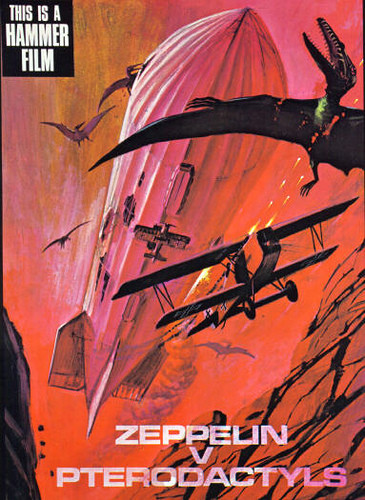
In the Cinematic Cretaceous Age, one species of such a film was extinct before it even evolved. Hammer films, hot of the success of One Million Years BC and their follow-up films When Dinosaurs Ruled The Earth and The Creatures The World Forgot, had a movie planned with the single most promising title ever: Zeppelins vs Pterodactyls.


Alas, the film was never made.

Aside from the Zeppelins vs Pterodactyls poster carbon dated at some time in the early 70's, the only fossil evidence of the project that exists is this oddball Youtube mash-up of a fictional 1930's movie serial:


And, yes, that's the pterodactyl from The Lost World.


As the end of the  Cinematic Cretaceous Age looms, we begin to see stop motion model animation in the Most Bestest Dinosaur Movies Ever start to die out.

Though, the process was never the only way to go when bringing dinosaurs to the screen. Some lower budget films used actual lizards running around over miniature landscapes. The lizards were often filmed in slow motion so as to appear to move like much larger creatures. Sometimes the poor animals would have stuff like a lame looking plastic horn attached to their heads; a practice that organizations  like PETA and the Humane Society would surely never allow today.

There was another approach typified by a one classic movie of the upper Cinematic Cretaceous Age of the Most Bestest Dinosaurs Ever.

I have strong memories of it.


I definitely don't remember the giant prehistoric laser shooting manta ray.
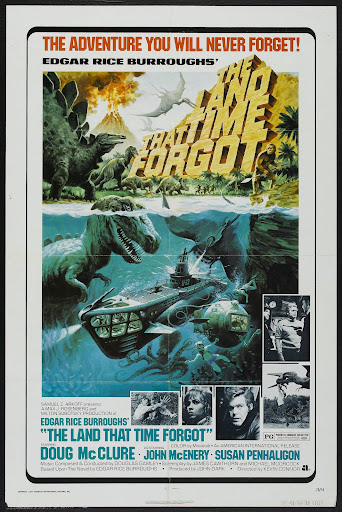
The Fairview Cinema. The suburban West Island of Montreal. A Saturday afternoon. 1975. 400 hundred kids hyped on Twizzlers and popcorn are packed into the only movie theatre for miles around. The movie was The Land That Time Forgot (1975) and it rocked the friggin' room!


I remember not being able to hear the dialogue for moments at a time on account of all the kids screaming or cheering or both at different cool and dramatic points in the movie.  This was before the days of super loud movies with a 19.1 Digital Dolby Surround System that have speakers mounted in every square inch of the cinema and a sub woofer that sounds like it has been surgically implanted on top of your eardrum.  Back then, a movie theatre had one, maybe two speakers in the whole place. A room of 400 kids could easily drown that out.

Back in the day, when there were no PVR's, DVD's, 3D Blu-ray's, Netflicks, Zip.ca's, cable, digital downloads or even VCR's, seeing a movie in the theatre was a big frakkin' deal. You missed it and you'd have to wait years till the movie came on TV. Then you'd have to watch it exactly at the time aired and watch the commercials ( and there was now way to fast forward through them either). That's my generation's version of walking to 10 miles to school without shoes in a blinding snowstorm every single day.

The Land That Time Forgot is based on the novel by Edgar Rice Burroughs. Famous as the creator of Tarzan, Burroughs wrote the book in 1918 inspired by the massive success of Conan Doyle's The Lost World. In arcane literary terms, this process is known as a "ripp-off".

The premise of the book and film is almost as cool as The Valley of Gwangi. Gwangi had dinosaurs and cowboys, The Land That Time Forgot had a submarine and dinosaurs.

The prehistoric creatures (or all eras and cavemen too, natch) live on lost island in the South Atlantic.
Its kind of a long story but the island is discovered by a German U-boat manned by a mixed crew of German, British and Americans. It's a bit of an uneasy alliance, needless to say, it being the middle of World War I and all.

The Land That Time Forgot features a somewhat more unique approach to dinosaur special effects. The creatures in the movie are all puppets or other non-animated models. Most are miniature and a couple are to scale. Pretty much all the effects in the movie are "in camera", a term meaning that they require little or no post production work and usually appear in the final film as they were originally shot.

In the words of a good friend of mine: "Pterodactyls are very hard to train."

In this movie, we get to see Allosaurus, Triceratops, Diplodocus, the seldom featured undersea dinosaur Plesiosaur and, in what is so obviously a scale model suspended from a crane, the highlight of any dinosaur movie, the improperly named Pterodactyl.

The Land That Time Forgot stars Doug McClure, an actor known for his work on such TV shows as the long running Western The Virginian, the underrated 70's spy show S.E.A.R.C.H. and particularly well know to me for co-starring with William Shatner in The Barbary Coast. McClure is that classic just slightly too old and too pudgy to still be playing an action adventure hero type. Unlike today, male leads in those kinds of movies could get away with that shit. 

I remember the consensus about The Land That Time Forgot amongst my friends at time: "Wow! That was amazing! It's so much better than 'The Land of the Lost'!".


The Land That Time Forgot was a sleeper hit in 1975. It was followed a sequel, The People That Time Forgot (1977).

It is a much lesser movie (yikes!) but it does have a scene that's just about as close to Zeppelins vs Pterodactyls as we'll probably ever see.


Stop motion model animation would still see a couple more flourishes before dying out at the end of the Cinematic Cretaceous Age of The Most Bestest Dinosaur Movies Ever.

Well, the effects might have seen flourishes, anyway. It's hard to say the same for some of the movies they were used in.

Case in point is Planet of Dinosaurs (1978).


This uber B-movie features dinosaurs that live on another planet altogether. Planet of Dinosaurs has got the odd combination of a unique premise and a very very low budget.

And, no, Planet of Dinosaurs is not about Charlton Heston crash landing on a planet where dinosaurs are the civilized masters who run their cars with fuel made from fossilized remains of long extinct human beings.

Planet of Dinosaurs, however, is not above totally ripping off the spaceship crash landing scene from Planet of the Apes (and about a dozen other things from different movies).

a group of astronauts' spacceship crash lands on an alien planet. The ship sinks into what looks like a small shallow pond and so the space travelers are stranded (where they were going or what they were doing is never really made clear).

It's not long before they discover they are on a planet that has some kind of parallel evolution thing going on. They enounter dinosaurs that look very much like the ones from Earth's past. These dinosaurs are also somehow able to survive in a very barren looking desert. Clearly, the evolutionary process on this planet has some differences from that of Earth's.

Planet of Dinosaurs is the kind of movie that seems to have been tailor made for shows like Mystery Theater 3000 and its internet counterpart, Rifftrax. It looks like most of the casting director's research consisted of watching porno movies. The dialogue scenes are not unlike watching a 70's era adult movie with all the sex and nudity cut out. I'm pretty sure the costume designer got a great bulk deal on disco track suits too.

The dinosaurs are surprisingly well animated. I guess if you're gonna make a movie called Planet of Dinosaurs with a limited budget, you better spend most of that budget on the dinosaurs. The movie is very entertaining, though probably not for the reasons the people making it intended.

Planet of Dinosaurs has an interesting and unexpected conclusion.

And, once again, no, there's no discovering a half buried Statue of Liberty and a "My God, we've been on Earth the whole time!" kinda twist ending.


The Cinematic Cretaceous Age of the Most Bestest Dinosaur Movies Ever comes to crashing halt by the end of the 80's. In it's place, we see something much much greater evolve.

It is finally the dawn of the Cinematic Jurassic Age of The Most Bestest Dinosaur Movies Ever.

See why I switched up the order of the dinosaur ages now?

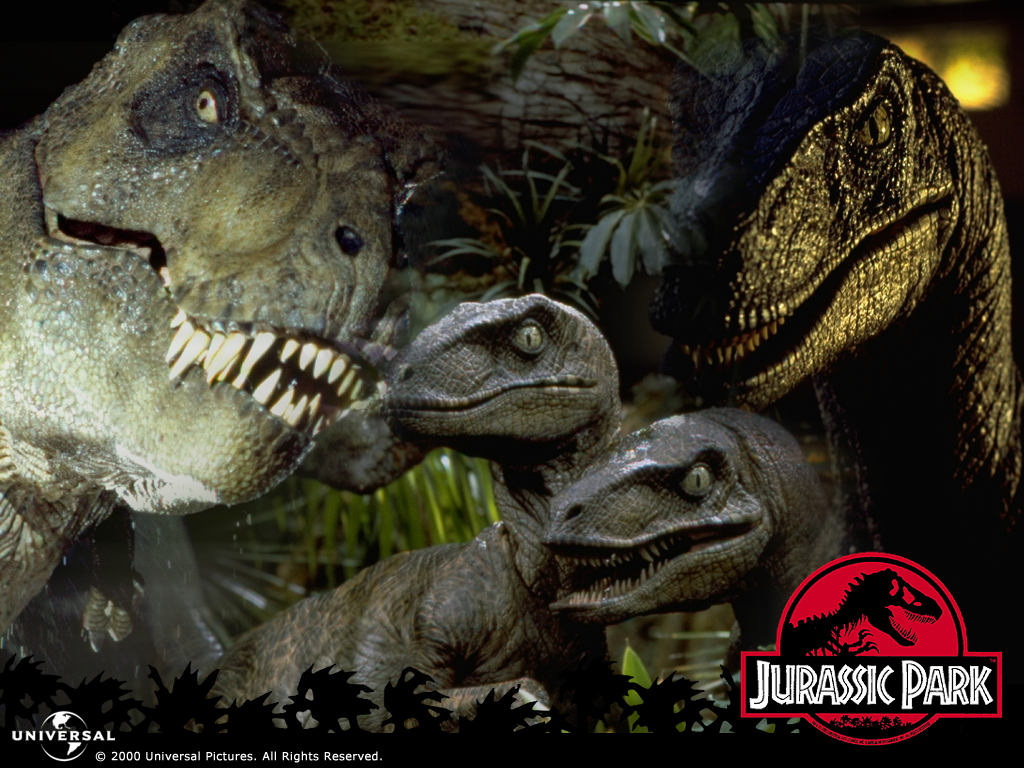
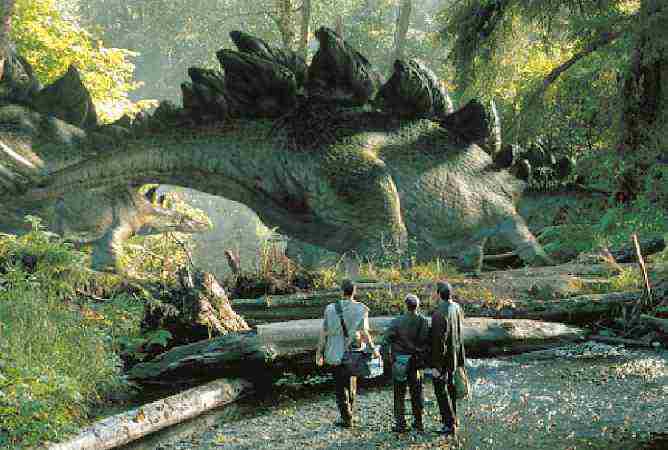
The Jurassic Park Trilogy (1993-2001) was seminal to redefining the entire genre.


The first film, Jurassic Park (1993) pulled off the genre re-invigoration feat particularly well. It should. The movie was directed by that great man who is half a boy/boy who is half man, Steven Spielberg.

Jurassic Park was based on the bestselling novel by Michael Crichton.  Crichton basically recycled the plot of his great 1973 SF film, Westworld (which he both wrote and directed).  Just substitute cloned dinosaurs running amok in a theme park for android cowboys running amok in a theme park and you’ve got the general idea.

Both book and the film present a the clever device of cloning to get dinosaurs into the modern world. No lost worlds, islands or planets here. Well, to be fair, there is an island but it’s not lost, it's intentionally hidden. The dinosaurs on said island are cloned from DNA taken from dinosaur blood found in mosquitoes that have been encased in amber for 65 million years. As any geneticist, biologist or even paleontologist will tell you, this is an extremely plausible, error free scientific hypothesis.

Crichton's was not the first dinosaur cloning story. One of my all time favourite SF writers, Robert Silverberg, wrote a short story back in 1980 entitled Our Lady of the Sauropods .  It was about dinosaurs cloned from fossilized DNA. The dinosaurs in this story are on a space station instead of an island.  The dinosaurs in Silverberg's story are also depicted as having a collective intelligence not unlike the Velociraptors in Jurassic Park.

What Mr.Silverberg's attorney was thinking back in the early 90's, I have no idea.

I remember going into Jurassic Park with reservations and coming out pleasantly surprised. The Raptors in particular involved some of Spielberg’s best suspense work since Jaws. Not a perfect movie, though, by any means.

Jurassic Park has a great concept, excellent direction and visual effects that make the film worth watching just on their own merit. Its narrative, however, is unsatisfying. The main problem being that darn screenplay by one of Hollywood's favourite scribes David Koepp that, like all of the guys’ screenwriting, falls apart in the crucial final third act. Kinda a bad place for your stories to fall apart there, dude.

It is also very clear that Speilberg knows full well who the major audience for Jurassic Park is, namely kids: lots and lots of kids. He plays to that audience a great deal, often the at the expense of credibility and consistent tone.
Scale puppets stood in for CGI in closer shots


The dinosaurs of Jurassic Park (and most all of the dino films from the early 90's onwards) are the most “real” looking prehistoric animals yet. The visual effects that brought the Terrible Lizards of yester-paleontological era to life are truly groundbreaking. Jurassic Park is a milestone for the use of computer generated images (CGI) in movies. Almost of all of the dinosaurs in the movie are entirely digital creations.

It marked the virtual end of the era of stop motion animation that began in 1915. Once a generation got a load of Jurassic Park, movies like Valley of Gwangi and The Land That Time Forgot are, even for young kids, pretty laughable.

Chrichton’s novel ends with (SPOILER ALERT) all of the dinosaurs on the island of Ilsa Nublar dying horrific deaths at the hands of a napalm air strike. It’s the way the movie would have ended if Francis Ford Coppolla had been directing instead of Spielberg. Imagine Doors music playing while a T-Rex goes down in flames while we hear Marlon Brando repeating the words, "The horror. The horror.".

In the final chapter of the book, we learn that a few Velociraptors had managed to stow away in a supply boat that left before the island before its destruction.  The book ends with the world’s only surviving dinosaurs clandestinely escaping into the deep remote jungles of South America.

What a cool set up for a sequel!

Spielberg didn’t touch it.


Oddly, even Crichton did not take advantage of the potential sequel plot line he set up.

In 1995, Chrichtion realeased the sequel to the novel of Jurassic Park, The Lost World (for once, I will give Mr. Crichton the benefit of the doubt and say that the title is an homage to and not a ripp-off of Conan Doyle).

Presumably the book was written in the wake of the phenomenal success of the movie and Crichton was essentially writing a first draft of the potential sequel. In the book, he creates the notion of the previously unknown Jurassic Park Site B on Isla Nublar's sister island of Isla Sorna. On that island many more species of dinosaurs have been cloned along with those of Jurassic Park. The dinosaurs have essentially been roaming free since the end of the last novel.

The Lost World: Jurassic Park (1997), also directed by Steven Spielberg, went with that premise.

Spielberg's version, oddly,  incorporates the destruction of the original dinosaurs from Crichton's first novel has happening some time between the two movies. But it turns out that, unknown to anybody but wily ol's Sir Richard Attenborough, there is a whole other island of dinosaurs right next to the first.

It all kinda brings up a lot of questions. Like how exactly did this guy keep the cloning of dinosaurs and the subsequent existence of huge prehistoric creatures roaming around on two different islands a secret ? Isn't the theory that some of the bigger dinosaurs, like Brachiosaurus, say, could have taken up to 20 years to grow to their full size?  Wouldn't that put the beginnings of this guy’s cloning project back in the early 70’s? Isn't that kinda a long time to successfully hide animals that are up to 95 feet long and 40 feet tall in the age aerial surveillance, radar, sonar, satellites and frequent air travel? And what about that air strike on the first island? How did they not notice an entire second island full of dinosaurs?


The Lost World story is simple: good environmentalists vs bad capitalists
Spielberg's got a really bad real case of “Cool. I get to do all the stuff I couldn’t do in the first one” in The Lost World. It’s one of the film's biggest problems.

The films third and final act features a contrived and really out of place action set piece: the tried and true prehistoric monster wreaking havoc on civilization. Through a series of highly convoluted circumstances,  a T-Rex ends up rampaging through downtown San Diego.

"A Tyrannosaurus Rex rampaging through downtown San Diego": kinda sound like a punchline from a Johnny Carson monologue circa 1980, doesn't it?

On the DVD, Kathleen Kennedy, one of Spielberg’s long time producers, says that she warned Spielberg against the ending.  The original ending had our heroes attempting to fly off of the island while under a pterodactyl attack (Yeah! Zeppelins vs. Pterodactyls at last!).
Spielberg, she says,wanted to change the third act of the film at the 11th hour. He was obsessed with getting the ol’ Godzilla movie shtick in there. Producer Kennedy, however, says that she told him that kind of a sequence really belonged in a different movie.

She was dead right on that one.

The T-Rex rampage scene has a very Speilbergian nod to many another monster on the rampage movie. There is a scene where the T-Rex chases a group of screaming Japanese businessmen down the streets of San Diego. The scene is reminiscent of Godzilla and, oh say, every Japanese monster movie ever made (not to mention the TV series Ultra Man).
I remember when The Lost World came out, I was doing a gig in some small town in upstate New York.  A bunch of us from the show went to see the movie on opening day at a mall megaplex nearby.  All of the local residents in attendance that day must have really appreciated that Godzilla reference.  They couldn’t stop laughing at the running, screaming Japanese businessmen.


We finally got to see some full on Pterodactyl action in Jurassic Park III (2001).

Helicopters vs. Pterodactyls?
Pretty much the only thing I remember from Jurassic Park III are the great flying dinosaurs. They are amazingly well done.  No doubt most of the effects ground work had been laid out for the sadly aborted Pterodactyl climax of the Lost World.

The only other thing I remember about Jurassic Park III is there’s something about a plane crashing on the now quarantined Isla Sorna where the dinosaurs run free...maybe... then there’s the army arriving to save the day or something...then it ends with the Pterodactyls flying off the island...or something like that....at some point...with Pterodactyls.

The Pterodactyls parts of the movie are really exciting and cool and good too and they also have Pterodactyls in them.

I think William H. Macy is in Jurassic Park III. He’s really good, as I recall.

He played a Pterodactyl, right?


The Cinematic Jurassic Age of The Most Bestest Dinosaur Movies ever hits unparalleled heights with Peter Jackson's sublime remake, King Kong (2005).


Naomi Watts in King Kong does an incredible job of playing off of animated monsters that weren't there.

Kong is not, strictly, speaking a dinosaur movie but, just like the immortal 1933 classic, there are plenty of dinosaurs in it.

Really good dinosaurs too.

Not only does Jackson's version have the most impressive CGI dinosaurs up to that time, his version utilizes the Terrible Lizards extremely well.

In King Kong, we get back to that good ol' fashioned lost ecosystem premise. Dinosaurs of all types exist on the wonderfully named Skull Island. These dinosaurs, however, have kept evolving over the last 65 million years. It's a wonderful bit of artistic license on Jackson's part that allows him a wide latitude of only having to follow only the scientific rules that suit the film.

I recently read an interview with a paleontologist on-line. He was asked to rate the scientific accuracy of  the prehistoric creatures represented on screen in various movies.  He praised movies like The Valley of Gwangi for following the paleontological behavioral theories of the day. However, he came down very hard on the 2005 Kong for getting a lot of the physical characteristics of  dinosaurs like Tyrannosaurus Rex and Brachiosaurus wrong. Didn't the guy watch the extras on his DVD?  Dude, what kind of scientific method is that?

Skull Island is also full of any number of fictional giant bugs, worms and penis-like creatures that suck people to death head first in the most Freudian manner possible.

King Kong himself , though, is perhaps the most curious inhabitant of the island.

Kong may have been based on species of a prehistoric gorilla known as Gigantopithecus. Gigantopithecus never would have co-existed with dinosaurs. The prehistoric ape was on Earth much later: from one million years ago to three hundred thousand years. The extinct primate stood approximately 10 feet tall (Kong is 25 feet tall in Jackson's version) and would have been around at the same time as early man. Some think that Gigantopithecus may have inspired legends like those of the the Yeti and Sasquatch (or, if you are really hardcore about it, the giant ape still lives and is the Yeti and Sasquatch).


Yeti, Sasquatch or King Kong?


A more likely scientific hypothesis is that the producers of the original movie thought that a big ape attacking stuff would be cool and that the studio ordered them to make use of all the expensive dinosaur models they made for an earlier movie that was never finished.


Take a look at one of my fave scenes in King Kong. It is a deleted scene that turns up on the extended cut available on DVD and Blu-ray.

I'm pretty sure those sub-titles are actually lyrics to a Bjork song.


Yep. Nothing phases these old school pulp jungle adventure men of the 1930's, does it?

I highly recommend the extended cut version of the Peter Jackson's King Kong. My first reaction to the prospect of a new, three hour version of Kong was "Uh-oh. It was already kinda long as it was".
The theatrical release of King Kong is a great yet flawed movie. The three hour version is a vast improvement. Without getting into any spoiler alerts, putting a lot of the cut scenes back in makes many parts of the film make more sense and helps the movie work better a whole.

At three hours, watching the extended Kong is more like watching Lawrence of Arabia, Ben Hur or any of Jackon's Lord of the Rings movies: a large commitment that is well worth it.

Plus, as you can see above, there are some just plain killer extra action stuff.

The extended cut changes a pretty good movie  it into a thoroughly satisfying epic tour-de-force adventure epic.


The not-Brontosauruses

It is unlikely that the  Cinematic Jurassic Age of the Most Bestest Dinosaur Movies Ever will see extinction. There may well be a couple of box office meteors that will impact the genre for a time. Ultimately, though, the pop culture fascination with the great extinct Terrible Lizards will always lead the creatures to resurrection.

Dinosaurs are still a popular staple in both big blockbuster movies and in the CGI (it is now a low budget effect) direct-to-DVD thrillers. A T-Rex even turned up in a 2008 movie version of one of the dinosaurs movie's remote ancestors, Journey to the Center of the Earth.


One question that comes up a surprising amount of the time in my circle of friends is "If you had a time machine and could only travel back in time to one time period, what would it be".  My answer is always the same:

"Hands down, I would go back in time just to get a look at living dinosaurs. I wanna know if the movies got it right".


Finally, my personal thanks for this post goes out to all the good people at Blogger. They clearly saw that my first draft of the post needed work and so very considerately crashed their entire system just before my usual posting day. They didn't let the fact that I'd actually saved all my work before the crash get in the way either. They made extra certain that almost all of my writing was lost.

Ultimately, I finally had to rewrite 80% of the material all over again.

Thanks guys.

It will not be forgotten...

Thursday, December 23, 2010

10 "It's Ain't Always Such a Wonderful Life" Christmas Movies

10. A Midnight Clear (1992)


A Midnight Clear is one of the most underrated war movies out there (and ditto that on Christmas movies too).

This indie 1992 movie features an all star Brat Pack of The 90's cast: Ethan Hawke, Gary Sinse, Kevin Dillion, Peter Berg and Arye Gross. They play an American Intelligence unit isolated in the Ardennes Forest during The Battle of The Bulge in World War II.

The Battle of the Bulge was a last ditch attempt by the Germans to turn the tide of the war back in their favour. It almost worked. The offensive was launched on December 16, 1944 with much of the bloodiest fighting taking place over Christmas and New Years.

In the midst of the fighting, the American soldiers are approached under a flag of truce by a lost German platoon. The war is pointless for them by now and they just want to surrender. Far removed from the fighting, the "enemies" find themselves celebrating Christmas together.  Then tension mounts when the war once again reaches their doorstep and the two enemies are lead down a path from which there is no coming back.

A Midnight Clear is one of those films that doesn't hit you over the head with messages. The anti-war sentiments are there, to be sure, but they just lie there subtly, allowing the audience to come to their own conclusions.  The same is true of the film's sympathetic and ambiguously heroic deception of these particular men who fought in World War II.

The film was made at a time when WWII was not in vogue in Hollywood. The war movie genre was still under the shadow of the lingering 80's obsession with movies about the Vietnam War. Even the box in the video store compared the movie to Platoon. It would be another six years before Spielberg and Saving Private Ryan would make WWII cool again.

A Midnight Clear is a lost gem, an underdog in the combat film genre, a great alternate Xmas flick and well worth seeking out.

9. The Apartment (1960)


The Apartment won the Oscar for Best Picture in 1960.  It was one of those Best Pictures that actually deserved the honour. It was directed by Billy Wilder, legendary for directing one of the best film comedies of all time, Some Like it Hot. Wilder plays things a bit more dark and real this time around. He once again casts his Some Like it Hot favourite, Jack Lemmon, along with an unrecognizably young Shirley Maclaine and Fred MacMurray in what was probably his last non-family friendly role.

Set in the final week of the 1950's, The Apartment follows the story of a mid-level insurance company drone, played by Lemmon, trying to work his way up in the company. He has a unique strategy to achieving that goal. He lends out his apartment to four different managers so that they can use it as secret hideaway for all of their many extramarital affairs (and you thought Mad Men did it first). Chief among the managers is head honcho Fred MacMurray.

Things get a little complicated when Lemmon starts to hit it off with one MacMurray's main squeezes, played by Maclaine.  Over Christmas and New Years,  there's love, betrayal and attempted suicide. Yet Wilder manages to keep even the darkest moments both appealing and funny.

The Apartment features a performance from MacMurray that is so incredibly creepy you will never watch My Three Sons or Son of Flubber (yep, those stupid Robin Williams Disney things were remakes) the same way again.

The Apartment is a more realistic take on Christmas. Life goes on during the holidays; it's not like all your issues and conflicts just go on an extended Christmas break like the banks do.


8. Eyes Wide Shut (1999)


Stanley Kubrick is quite possibly the greatest film director who ever lived.  His films have a visual language and meaning all their own. Kubrick is many things but he is not a panderer. Either you keep up with his audacious storytelling methods or you don't. It's that simple.

That may explain why Eyes Wide Shut still remains Kubrick's most maligned and misunderstood film. Some critics went so far as to say that Kubrick must not have finished editing it at the time of his death (he never lived to see the film released) or that he caved into studio pressure to tone down the extensive amount of orgy scenes. I don't think those critics understand Kubrick all that well. It's a much more complex film that they are giving the legendary director credit for.

And, oh yeah, it all takes place around Christmas.

Eyes Wide Shut is a story of sex and betrayal, both real and imagined. Kubrick does for Tom Cruise in Eyes Wide Shut what he did for Ryan O'Neal in Barry Lyndon: makes him look like a much better actor than he is. Cruise, after a confession from his wife Nicole Kidman (both real and movie version at the time), heads out into the streets of a backlot in London made to look exactly like New York City. He embarks on a a dream-like journey of sex, surreal experiences and well, more sex, really.  He encounters an elite orgy of anonymous sex that reflects the inner world of his psyche run wild (See Stanley? I'm keepin' up). The orgy scenes are not about being shocking, sexy or caving or not caving into the studio censorship. Those scenes are much more oneiric in nature than any of those things.

And, oh yeah, they take place around Christmas.

One of the things I love about Eyes Wide Shut is how Kurbick (like the candles in Barry Lyndon) lights entire scenes with Chirstmas lights. I have never seen another movie that has used holiday lights as artfully and beautifully as Eyes Wide Shut.

And ya just gotta love any movie that ends (SPOILER ALERT) with Nicole Kidman standing in the middle of a crowded toy store on Christmas Eve saying the words, "We have to fuck."

I suggest that any of the maligners who may be reading this out there take another look at Eyes Wide Shut. I mean, who has ever really liked a Kubrick film on first viewing?

And, besides, Christmas is a time for forgiveness.


7. On Her Majesty's Secret Service (1969)

It was only after seeing this movie three times and reading the book that I realized it's a Christmas movie. It's as close as James Bond ever gets to anything yuletide. Well, aside from Sean Connery calling his attache case with a pop-out knife and exploding gas canisters in it, "A nasty Christmas present" in From Russia With Love. K....um...that was really geeky, wasn't it?

In this Bond outing, George Lazenby fills Sean Connery's shoes (for just one movie, as it would turn out). Lazenby is no Connery. In fact, he's barely even a Moore (and certainly not a Craig or even a Brosnan or a Nelson or Niven or....okay, I'll stop now). Though he does nail the last line of the movie, which in this case, is pretty damn important. Yep, this is the one were Bond gets married. Given that he is definitely not married in any other subsequent Bond movies, well, um, I think that's a spoiler alert.

In Lazenby's inexperienced hands, Bond comes off as a more vulnerable and less confident than any another 007 in cinema history (and I"m including Woody Allen's Bond from the 1967 comedy version of Casino Royale).

Back to the Xmas connection.

Ernest Stavro Blofeld, Bond's only multiple movie arch nemesis (played this time around by Telly Savalas -it wasn't just Bond they kept recasting), threatens to launch a major biological attack on the free world on Christmas Eve 1969, unless his demands are met.

James Bond spends Christmas Eve in a car chase on solid ice and in one of the greatest ski chases ever put on film. Bond launches an all-out assault with a group of mercenaries on Blofeld's remote complex high in the Swiss Alps on Christmas Day (again, you gotta be an eagle-eyed Bond fan to catch the references to the actual days).

At one point, Blofeld  manages to capture Bond on Xmas eve. "Merry Christmas, 007" says Blofeld to Bond as 007 awakens. The first thing that comes into view as Bond's vision de-blurs in a POV shot, is Blofeld's Christmas tree.

Let's just pause on that for a second.

Blofeld is a guy who shoots his own henchmen in cold blood just to make a minor point and kills associates who bother him with lethally electrically wired chairs in the middle of bad guy board meetings. Just a movie before, Blofeld attempted to destroy most of the world with thermonuclear weapons. The man is the CEO and founder of an organization called the Special Executive for Counter-Intelligence, Terrorism, Revenge and Extortion. Yet,  in the middle of planning and executing a massive complex plot to attack the free world with a horrific plague , he still takes time out to go and pick out a Christmas tree, transport it back to his remote complex in the Swiss alps and decorate it.

There is hope for the world after all.


6. Batman Returns (1992)

Outside of some wrapping paper I manage to track down every year, Batman makes a rare connection with the yuletide season in this movie. Batman Returns is the second and last Tim Burton directed Batman film and my personal fave of the 1989-97 caped crusader franchise.

Christmas is a back drop for the action in this story and it is a backdrop Burton takes full macabre advantage of.  There are giant exploding presents, screaming women thrown off roofs into Christmas trees and lethal brightly colored candy cane weapons. In the back story for Danny Devito's wonderful take on The Penguin, the "freakish" baby is both born and abandoned by his wealthy parents at Christmas. Michael Keaton's acceptable Batman and Michelle Pfeiffer's incredible Catwoman (and I am not just talking about the costume) have a twisted mistletoe-inspired rooftop fight.

Few directors can utilize childhood imagery with such twisted juxtaposition to darkness the way Burton can. Yet somehow Burton is, at the same time, always able to somehow create a sense of security amongst the dark visions of evil elves and bat-infested Christmas trees.

That in itself is a Christmas miracle.


5. Kiss Kiss Bang Bang(2005)


Before Robert Downey Jr.'s being fired from Alley McBeal for a heroin bust and his big Iron Man renaissance, he kinda drifted around in a random array of under-the-radar roles. This is one of them.

Kiss Kiss Bang Bang is a great movie.  The story follows Downey's small time NYC crook as he literally runs from the cops into an audition that just happens to be going on at the time. In the heat of the emotional moment of the chase, he actually lands a role in a Hollywood movie. Downey is then sent to LA where he is to prepare for the role of private eye by hanging out with a real private eye played by Val Kilmer (in a wonderful performance).

Downey finds himself in LA cruising around with Kilmer at Christmas time. Downey also manages to stumble across Michelle Monaghan as a struggling actress. Monaghan's role in Kiss Kiss Bang Bang is sure to satisfy anybody's sexy Santa's helper fetish. Kiss Kiss Bang Bang uses the classically surreal setting of Christmas in LA to maximum effect.

Also used to great effect are the legendary hard boiled detective writings of Raymond Chandler. His work is heavily referenced and integrated into the film. The movie is broken up in to chapters that borrow the plot, themes and titles of Chandler's The Lady in the Lake, The Little Sister, Farewell My Lovely, Trouble is My Business and The Simple Art of Murder. Though the movie does not take itself quite as seriously as any of those books. In fact, Kiss Kiss Bang Bang has a great deal of fun with the pulp detective fiction genre.

Kiss Kiss Bang Bang marks the directorial debut of Shane Black, the Hollywood screenwriter who gave us the first two Lethal Weapon movies, The Monster Squad, The Last Boy Scout, The Last Action Hero and The Long Kiss Goodbye. Four of his screenplays use the backdrop of Christmas in LA. 

Xmas in LA is quite a popular setting for the non-Christmas Christmas movies, as our next selection undoubtedly demonstrates.


4. Die Hard (1987)


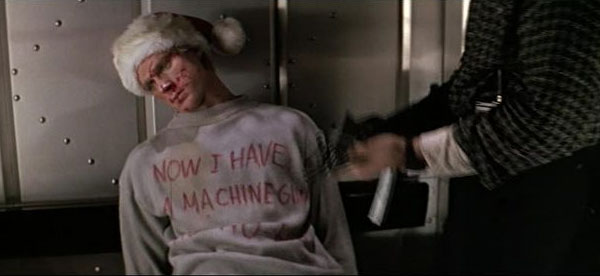
This scene is about as into the Christmas spirit as Die Hard gets

A perennial favourite on just about every alternative Christmas movie list out there, Die Hard is also a movie that forever redefined the action genre.

It's Christmas Eve in LA. New York cop John McClane (Bruce Willis) is town to try and patch things up with his ex-wife.  In the middle of her company's Xmas party, heavily armed men storm the tower and take control of the company's massive skyscraper. McClane, who happens to be out of the room at the time, finds himself  the lone hero who must.....okay, if you've read this far I really don't need to go on.

Die Hard is a massively entertaining piece of escapism. I say even though the screenplay displays some of the laziest writing I have ever seen. Everyone in the movie but the bad guys, Willis, his ex-wife and Urkel's friend's cop dad is unnecessarily stupid, arrogant and just plain unlikeable. It's as if the only way screenwriters Jeb Stuart and Steven E. De Sousa could make Willis a sympathetic character was by making everyone around him an asshole. Nonetheless, Die Hard is (even on the umpteenth viewing) full of great one-liners, exciting and genuinely suspenseful, despite the massive amounts of gratuitous violence.

Also Willis displays the most innovative use of Christmas packing tape I have ever seen. I'm still waiting for that one to turn up on Martha Stewart's show.

Die Hard 2 also takes place on Christmas Eve. Unfortunately, the story is set in Washington DC so there is tons of snow and winter tableau's everywhere.  That automatically makes it too Christmassy for this list.

A screening of Die Hard around the crazily busy holiday season is a great way to unwind. Die Hard also nicely counteracts all the nice and happy yuletide images the media feeds us constantly throughout December.

A wonderful bit of Christmas movie-tie in marketing


3. Black Christmas

When I was a kid, they ran a trailer for Black Christmas during The Flinstones. It scared the hell out of me so much that my father, understandably, wrote a letter to the CRTC regarding the inappropriate airing of horror movie trailers during freakin' cartoons (some of those are his exact words). I think it was that negative memory and my perceived silliness of the premise that kept me away from Black Christmas for many years to come.

Until a few years ago, to be exact. One Christmas, IS, the wonderful love of my life, and I got not only to spend our first Christmas together but also to host all the yuletide festivities in our own home. It was almost midnight Christmas Eve and I was busy putting out and organizing the army of presents generated by two families. IS was watching TV at the time.  Suddenly, the sounds of the Pope's midnight mass from The Vatican was replaced by low budget 70's horror atonal piano horror movie music and screaming with Silent Night echoing in the background. I found it both distracting and mood breaking. I looked up at IS and asked her why she was watching, of all things, Black Christmas now. She calmly responded, "This is my 'It's a Wonderful Life'".

I gained an immediate new-found respect for Black Christmas at that moment.

It has grown on me in the years since.  It's a very well directed and well crafted horror thriller. Black Christmas pre-dates the holiday themed slasher movies trend begun by John Carpenter's Halloween by four years. It's also the first movie to use the much subsequently overused and quoted line, "The call is coming from inside the house!".

Black Christmas was directed by one of Canada's finest directors, the late Bob Clark. Clark also went on to direct the massive hit sex comedy, Porky's. Those two movies alone have made Clark a pariah among Canadian culture elitists who believe that this country's culture begins and ends with Pierre Burton and Farley Mowat. Even Clark's excellent Sherlock Holmes mystery, Murder by Decree, can't turn that perception around. It may also rub a lot of people the wrong way 'cause it has many a horrific murder set to the strains of holiday music (also one of the first horror films to use the ironic music juxtaposition device). That and both movies were made on Canadian Government Tax Credit programs.

Black Christmas is one of those horror movies that is actually a pretty good movie. Clark uses strategically placed silences, slow motion and accompanying slowed down sound effects and aforementioned juxtaposition of murder in the midst of tinsel and colourful blinking lights to create a film that is genuinely creepy, tense and scary. Black Christmas also features a great deal of that 70's "Hey, we can swear in movies now!" dialogue, including one scene in particular where the "C" word is thrown around so much that it would render the film virtually unreleasable in today's market. Oddly, the violence, though, is considered tame by today's standards.

Black Christmas stars a pre-Superman,pre-mental breakdown Margot Kidder, a pre-SCTV Andrea Martin, a post-Zeffereili's Romeo and Juliet Oliva Hussey and a post-2001, pre-2010 Keir Dullea (my guess is that they took advantage of the fact the he was in Toronto shooting the embarrassingly low budget Canadian Sci-Fi series, The Starlost, at the time) . Cementing its classic B-movie status is the appearance of John Saxon as the initially disbelieving cop turned last minute savior.

You can always count on some Canadian cable network running low on their seasonal Cancon to run Black Christmas at least once every December.

The recent "all 70's horror movies must be remade" craze gave us a 2006 version of Black Christmas (with Andrea Martin as the only returning cast member).

Avoid that one at all costs.


2. Joyeux Noel (2005)

One of the brutal realities of war is that war doesn't just stop because it's Christmas.

Or does it?

Joyeux Noel is an amazing trilingual (English, French and German, everybody speaks in their native tongue-none of this Hollywood "the entire world speaks English with an accent" silliness) film that explores just that idea. The story is based on a number of true incidents of unofficial spontaneous cease fires, yuletide and otherwise, that happened during World War I. They were more than just cease-fires. Soldiers from both sides would climb out of their horrible rat infested trenches and actually celebrate the holiday (or just hang out) together.

There is one particularly moving scene in Joyeux Noel. One of the German soldiers hears the Scottish troops over in their trenches playing Christmas Carols on the bagpipes (they often fought in very close quarters in that war) on Christmas Eve.  Silent Night played on the bagpipes might not be most people's idea of easy listening music but it does inspire the German soldier in question. Turns out the guy was an opera signer in civilian life (yeah, it's a bit of a conceit but run with it). He makes the incredibly brave move of climbing out of the trenches singing the "O Come All Ye Faithful" . He stands right in the middle of "no man's land", just belting out the carol. It is this act of pacifistic bravery that inspires the other British, French and German troops to get out of their trenches as well.

In the case of the these impromptu cessation of hostilities, the festivities were often stopped not by the soldiers themselves but but by commanding officers as soon as they got wind of the activity. This is what happens in Joyeux Noel. All of the soldiers are severely punished for acting contrary to their job description.

The punishment the German troops receive is immediate reassignment to the Eastern Front.  Yes, the Eastern Front was infamously awful in both World Wars. The film ends on a chilling line. As the German soldiers are being transported to the Eastern Front by train, one of them says, "I'm Jewish. I don't even care about Christmas". 


1. Meet John Doe (1941)


Meet John Doe is the darker, more realistic version of It's a Wonderful Life. The two films are both directed by Frank Capra. Meet John Doe was released in 1941, five years before It's a Wonderful Life. Meet John Doe was a big hit in its initial release and has now faded into obscurity while the opposite is true of It's a Wonderful Life. The two films contain many of Capra's recurring themes but feature very different treatments of those themes and ideas.

Now let's talk about Meet John Doe on its own terms.

In 1941 before the US entry into WWII, the Great Depression was still dragging on. A newspaper columnist, played by the wonderfully underrated Barbara Stanwyck, is laid off. In response, she writes a letter to the editor under the name John Doe stating that Mr. Doe will jump off the roof of City Hall on Christmas Eve (still several months off) to protest the current state of the country's social and economic ills. The letter causes a sensation and Stanwyck is hired back. In a effort to keep sales up, the paper's editor concocts a plan to create an actual John Doe. They find a former baseball player played by Gary Cooper. Cooper is now homeless (or a "hobo" as was the term then) and agrees to pretend to be John Doe 'cause he needs the money to fix his bum arm that's keeping him out of the major leagues.

It's not long before John Doe creates a massive grass roots movement of common people. The movement is funded by the paper's owner and publisher played by Edward Arnold. Arnold's character is an early 1940's version of a media mogul, owning multiple newspapers and radio stations. Arnold is, of course, putting up the money to back John Doe  in order to serve his own political ambitions. His jackbooted-motorcycle-riding private security force and lines like "What this country needs is an iron hand" betray Arnold's crytpo-fascist leanings. In 1941, fascism was on the march (to put it mildly) in Europe and Asia. The US was still predominantly isolationist and, really,  no one was really sure whether fascism would catch on in America or not.

As soon as Cooper and Stanwcyk (who is both Cooper's speech writer and his love interest) clue in to Arnold's true ambition, they stand against him. Arnold, in turn, reveals to the media that he owns that John Doe is really a "fake". The exposure of the "fraud" is in an incredibly emotionally powerful scene set in a stadium full of Doe supporters.

Now thoroughly publicly discredited, Cooper decides that the only way to save the John Doe Society (as the movement is now called) is to follow through on the message of the original letter and jump off the roof of City Hall on Christmas Eve.

Highly regarded by film academics, directors and screenwriters, Meet John Doe is an otherwise forgotten film. You really gotta look to find a TV airing, even around Christmas. The DVD is put out by small time companies and usually has bad sound and not the greatest picture.  It is still worth seeking out, especially at this time of the year and especially if you're starting to get a little tired of It's a Wonderful Life.

Take a look at this scene.


(and that's big WTF? on all that Dead Zone stuff)

There are no angels in Meet John Doe. God is often referred to there is no evidence of His divine intervention like in that other Capra Christmas classic. Edward Arnold is not Lionel Barrymore.  He does not make speeches and judgments. He is not curmudgeonly. He is quieter, more scheming and a lot more powerful than Barrymore ever was (and I'm even counting when Barrymore is seen running the whole town in an alternate reality).  Much much scarier, in other words.  Gary Cooper is a bit more morally ambiguous than Jimmy Stewart. The bad guy is more powerful, we're not really sure if the good is really good and there is no tangible morally superior force in the universe. It's not the kind of movie you want to watch while wrapping your presents on Christmas Eve.

Meet John Doe ends on note of hope but not one of certainty. That's kind of what Christmas, and life, is really like.


Merry Christmas,
Happy Holidays,
Season's Greetings,
and Happy Whatever Else We're Supposed To Say Now,
All The Best for 2011!

TB