This week's post is my first ever vlog. In this video post, I discuss my own unique perspective on the craft of acting while wearing glasses or sunglasses.
Enjoy.
Hey, He Had on a Hatters, I'm off on vacation.
My post will resume once again the week of September 10, 2012. Until, then have a great rest of August and a fun Labour Day weekend.
See you in September!
The Bowman Blog: trenchantly goofy musings from an actor, writer and all around pop culture geek.
About Me
- Terence Bowman
- Montreal, Quebec, Canada
- I am a Montreal-based actor, writer and comedian. When U.S. President John F. Kennedy was shot, I was three days old. I cried all day. My favourite books of all time are Moby Dick by Herman Melville, The Last Temptation by Nikos Kazantzakis and The Ewoks Fun Time Activity Book by Chirpa and Pamploo. I am a member of The Vestibules, On The Spot Improv and The Best Buy Battery Club. Except for the Battery Club, I've been at all this stuff for over 20 years. Enjoy my blog.
Showing posts with label Terence Bowman. Show all posts
Thursday, August 16, 2012
Friday, February 4, 2011
The Superbowl and The Sum of All My Fears
Not to fear, all my geeky readers of this blog, this post isn't really that much about the Superbowl. Mainly it will involve action movies, Tom Clancy and on set film business anecdotes as they relate to the biggest football game of the year.
The Super Bowl is this Sunday. It will feature That Team There playing against That Other Team There. If that doesn't reassure you of this post's minimal Super Bowl coverage, I don't know what will.
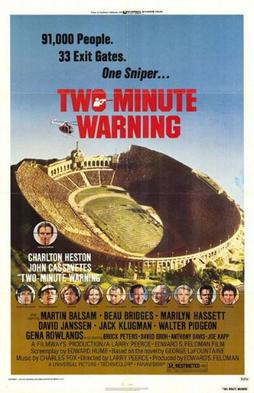
I hope The U.S. Department of Homeland Security watches a lot of movies. If so, they will have operable intelligence that the Super Bowl is quite the popular potential target for terrorists and/or psychos. It's a scenario that very much predates 9-11. Super Bowl attack paranoia goes at least as far back as 1976:
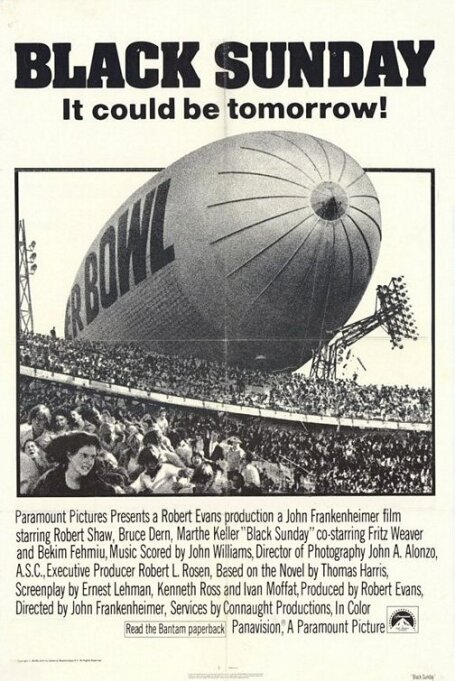
A year later, Hollywood upped the stakes with this classic John Frankenheimer thriller
In Black Sunday, terrorists plan to bomb the Super Bowl (they had the rights to the name this time around) using the Goodyear blimp as the delivery system. And, yes, actual terrorists do figure in the plot. Palestinians in this case. Just to back up the point, the hero of the movie is a tough Mossad agent played by Robert Shaw. Though, really, the Goodyear company should know better than to hire a bitter psycho Vietnam veteran played by Bruce Dern to pilot their blimp.
Back in 1977, such scenarios seemed quaintly far fetched.
Why is it that I'm only interested in football when it involves the threat of mayhem and destruction being reigned down on the sport's biggest game? Oh, yeah, right. High school Gym class.
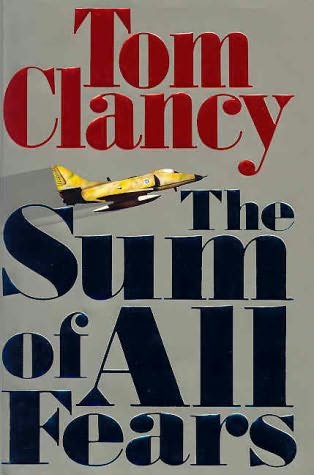
Best selling political thriller author Tom Clancy brought the Super Bowl attack premise to its ultimate logical conclusion with this 1991 entry into his popular Jack Ryan series of books:
Yep. Part of the plot of Clancy's The Sum of All Fears involves terrorists setting off a nuclear bomb at -you guessed it- the Super Bowl.
Hollywood decided to wait until 2001 to announce plans to film The Sum of All Fears. It was kinda odd timing given that three other of Clancy's books about CIA operative Jack Ryan, The Hunt For Red October, Patriot Games and Clear and Present Danger, had already been filmed featuring the 007-like switch-up casting of Alec Baldwin and Harrison Ford as Ryan.
In The Sum of All Fears, the much younger than his predecessors Ben Affleck was cast as Ryan. James Earl Jones suddenly became Morgan Freeman. In fact, there was no real indication if there was or was not supposed to be continuity between this newest Ryan adventure and the previous two. The Sum of All Fear has got to be the most secretive reboot of all time.
At this point, you may be wondering where the acenecdotes about the movie biz that I promised earlier fits in to all this. It's coming, trust me.
The Sum of All Fears was one of the first big Hollywood blockbusters to shoot in Montreal. That meant that a great deal of Montreal actors would probably get quite a lot of smaller speaking roles (with various variations on the term "smaller").
That included yours truly.
The Sum of All Fears was one of the weirder auditions I've been on. I went in for some other movie or TV show entirely. I don't remember the title even. These were the old glory days of the Montreal film and TV production boom. It was not uncommon to lose track of auditions, especially once I was done with them. In recession laden 2011, however, it's hard to forget something you do only two or three times a year. Anyway, while I was auditioning for whatever, I was asked if I'd like to read one line for The Sum of All Fears.
Yes, it's true. Actors audition, sometime multiple times, for roles of one line or sometimes even less. This is especially true for Montreal-based actors.
They put me on tape saying my one line, "Mr.President". I said it while handing a video cassette box over to an unseen presumably off-camera President of the United States. I had no idea of the context of the scene in the story but I'm pretty sure that the prop in question was not actually supposed to be a video cassette case in the actual movie.
Auditions had already been held for The Sum of All Fears and all the parts had been cast some time ago. I even knew some actors who had already worked on the film by then. I had never auditioned in the first place. That I got to read for it at all was a total bonus.
Like many auditions back in the day, I put it out of my mind and went on with my life. A few weeks later, I was in Toronto working on the editing of "The Font Doctor", a short film written, performed and directed by The Vestibules. I picked up a phone message from my agent. The director of the movie, in the words of the casting director, "really loved" the way I said "Mr. President".
I had been offered a part in The Sum of All Fears.
Before the role was a done deal, they wanted to know if I could drive a manual transmission vehicle. If so, the gig was mine. Many years ago, I had an acting teacher whose advice when it came to any question regarding potential work was "always say yes". Can you sing? Yes. Can you dance? Yes. Can you speak German with a Scottish Accent? Yes. Can you drive a manual transmission? Yes. Thinking foremost of that advice and not wanting to lose a role of any size in a major Hollywood movie, I , of course, said "Yes."
As you may have guessed, I could not drive a manual transmission vehicle then (or now even). I decided that I'd take a crash course (no pun intended) and learn how to drive standard before my shoot date. In my experience, roles ivolving driving in movies usually meant going about four feet and then stopping and getting out. I was sure I could master that much in a short period of time.
There was one small problem. From the time when I got back to Montreal to when my shoot day was scheduled was only about one week. So as soon as I got home, I went to the driving school down the street. I told them I had to learn to drive a car with standard transmission in one week. The woman behind the counter asked me why it had to be done in such a short period of time. I said it's because I needed to know how to drive standard so that I could act in a movie with Ben Affleck. She looked at me blankly for a beat then said ,"No one will believe that. I'll tell the instructors you are going to Europe for business in a week.". Then she got on the phone to find any available driving instructors who could fit the lessons into their schedule in the next week.
I ended up landing four different lessons with four different instructors. I also ended up paying a nice and hefty "rush" fee on top of the cost of the lessons (still, though, at Hollywood pay scales, I'd be coming out way ahead).
At the time, I was writing and recording radio sketches with The Vestibules during the day and then doing shows with On The Spot Improv at night. So each evening that week, I'd finish with The 'Bules, shove a sandwich in my face on the bus, do an hour of manual driving lessons (at various weird locations all over the city, beggars can't be choosers) and then go do a show with Spot that night.
I think I wrecked many a clutch during that week. My fourth lesson was canceled by the instructor at the last minute. I would have to make do with just three lessons. I was still a little shaky on my abilities to drive a vehicle with a manual transmission.
My shoot day finally arrived. I was lucky that first day. Production was behind schedule and they didn't get to my scene at all that day. I got paid to sit around in my trailer for twelve hours and then go home. It was a nice way to relax and build up my manual transmission skills confidence. I kept coming back to "Hey, I'm only gonna have to drive for like three feet. I probably won't even have to shift gears." It was a night shoot so I managed to get some sleep in as well. Nice work if you can get it.
On the second day (we still call 'em days even when they're nights), they were ready to shoot my scene right when at the beginning of the day. Normally, that's a rare treat for a bit player in a big movie. This time around, not so much.
At this point, I should point what my role was. I did not get the role of a Pentagon official handing the President a video cassette box. No. Instead I got the role of a National Guard driver.
See, in the movie (SPOILER ALERT), there is this convoluted Chechnyian terrorist plot to set off a nuclear bomb at the Super Bowl (which is again, for legal reasons, referred to as The Big Football Game or something equally lame). Of course, CIA analyst turned super agent Jack Ryan somehow figures out the plot. However, he is not in time to stop the bomb from exploding. Nice going, Ryan. James Bond would never have let that happen. So in my scene, Ryan is rushing to a makeshift aid station set up near the blast site. Destruction and mayhem are everywhere.
I'm the National Guard driver that drives Ryan on to the site. I have one line. I say, "Oh, great. Now it's snowing too." to which Ryan says, "It's not snow. It's ash from the blast" (my guess is that this scene was added last minute over concerns that audiences might misinterpret the ash as snow-it being late January in Maryland in the story and all).
It seems I had, out of nowhere, suddenly landed myself a dialogue scene with Ben Affleck. Score...sort of.
We were shooting out at the Armed Forces base airport in St.Jean Sur Richelieu (about half an hour out of Montreal). I walked on set and saw the whole thing in its entirety for the first time. By set, I mean two airplane hangers and a massive tarmac. There were two huge tents. One was for make-up for the extras so that they could all be made up to have simulated radiation burns and other injuries. The second was the hospital tent in the movie that they were going to shoot in. There was also a bunch of cars and trucks, military and otherwise. There were even actual soldiers from the US Army, presumably playing themselves (hello, typecasting).
Right next to the crane (OMG, a crane shot!), there was this very large truck. It had a great deal of expensive camera and lighting gear attached to it.
That was the truck that I was going to have to drive. Gulp.
Just then, the director, an extremely nice man named Phil Alden Robinson introduced himself to me. He explained that that day was the biggest and most complicated day of the entire shoot. The biggest day of the entire shoot of an action thriller involving a nuclear explosion. Did I mention that it would be best for the shoot and my career that I not fuck anything up and ruin a shot with all this other incredibly expensive stuff going?
I was then introduced to Mr. Affleck. We headed over to truck. I'm was about to do a scene in the middle of a big budget Hollywood blockbuster driving a truck I didn't know how to drive while playing a scene with Ben Affleck.
Piece of cake.
I got into the truck so we could rehearse the scene. I took a look at the gears. My mouth hung open in amazement.
The truck had an automatic transmission.
So when they told me I had to know how to drive standard, they were just kidding I guess. Can I have the last week of my life back now, please?
Immediately, my confidence level shot up about ten fold. However, I still have to drive a huge truck with lots of expensive equipment hanging off it. I ran the scene with Mr. Affleck a couple of times while doing some rehearsal driving. Other than almost running down some extras who were walking where they should not have been walking, everything went fine. Mr. Afflect disappeared back to his trailer. We continued to run the mechanics of the driving and the scene several times with his stand-in.
During that time, I was constantly told by the assistant director to drive much faster. Meanwhile the Steadicam operator, not unpredictably, kept asking me to make it all nice and smooth. I'm not sure where the director was in any of this.
The scene required, as I predicted, a short drive. I do my lines with Mr.Affleck while driving, drive a few more feet then stop. Mr.Affleck gets out of the truck and the Steadicam follows him out, the operator seamlessly walks onto a platform on the crane as it rises up and we see Mr. Affleck continuing to cross the tarmac in, to use Mr. Robinson's words, "the most complicated shot of the picture".
The whole scene is almost second nature to me by the time that we are ready to shoot. As we prepare, the stand-in is suddenly gone and I'm sitting next to Ben Affleck once again. We rehearse the scene once. We now are ready to shoot. There is a long delay. Mr. Affleck goes away someplace again. The assistant director comes over to me. He asks me if I can get out of the truck for a moment. They need to run the scene with one their guys, for some technical reason. So I get out and watch them run the scene with a member of the crew driving the truck. It goes nice and fast.
Suddenly, Mr. Affleck is back. He gets into the truck. The crew member gets out of the truck. I figure they will be calling me back any moment. Then I suddenly notice that the wardrobe and hair people are hovering around the crew member.
They are putting a national guard uniform on the guy and giving him a military style haircut similar to mine.
Years earlier, I played the lead role in a wonderful play by Christoper Durang titled The Actor's Nightmare. It's about an actor who suddenly finds himself in a production of Hamlet but has not rehearsed the part and doesn't know any of the lines. As an improv veteran of many years, that scenario was never my version of The Actor's Nightmare.
That moment on set that night was my Actor's Nightmare. My Sum of All Fears.
Now nobody had said a word to me at that point. So I decided, "Fuck it. I'll play dumb".
As they were getting ready to roll, I walked over to the truck to get in. The assistant director came running over and said, "Um, we're gonna do the shot with one of our guys. It's a big rig and it needs to move fast.". Thanks for the update, pal. Then I asked him what was going on with my lines. He said he didn't know. I was quickly ushered away.
Later Mr. Robinson, the director, came over to me and apologized. He said that with all that equipment on the truck, it was an insurance issue. And they just suddenly realized this before rolling? To this day, I'm still not sure if I buy that explanation.
Though the director did tell me that Mr. Affleck and I would record our lines at the end of the shoot. The shot in the scene is of the back of our heads so they could just dub the lines in later.
I was still not at all happy. As it turned out, the branch president of ACTRA, the actor's union, also had a small part in the film and was shooting that day. "Ha! Little do they realize that the union branch president is on set today. They have not heard the end of this!", I thought.
I marched over to his trailer and explained what had happened. He very calmly and casually said, "Yeah.They can do that. As long as they're paying you.". I walked away singing Billy Bragg's "There is Power in a Union" to myself.
Just then the second assistant director came up to me and told me that they would not be using me in the shot tonight but that I would be recording me with Mr. Affleck at the end of the night. Boy, are those second assistant director's ever in the loop or what?
The end of the night came and me an' Ben (he wasn't Mr.Affleck anymore) recorded our two lines in the truck while it wasn't moving. About a thousand people stood around being completely quiet until we were finished.
I went home thinking that ,well, at least my voice would get to be in a major motion picture. And I did make something like 2500 bucks for two days work.
My date on set was in April of 2001. I think the film wrapped some time in June (they had been shooting since February). I don't think I need not get into the events that followed in September. The original word that I was getting through my agent was that in the aftermath of 9-11, the movie would be shelved permanently and never released. What had once been a far fetched Tom Clancy plot was now hitting way too close to home.
About a month later, Collateral Damage, an Arnold Schwarzenegger movie about a firefighter tracking down a terrorist that had killed his family, was a huge hit. Add to that all those stories of how movies like Independence Day were flying off the video store shelves (which, it was later learned, was based on a report from one New York area Blockbuster -so all those post 9-11 pundits were actually analyzing the behavior of one movie geek).
Early in 2002, I began seeing this in the theatres:
The Sum of All Fear opened in May 2002. I went to see it.
Most of the scenes depicting the attack were cut way down or were right out completely. Gone were the tents full of survivors with radiation burns. Only one short scene about the aftermath of the blast stayed in the movie on account of its importance to the plot. Also gone also was me, the damned truck, the crew member standing in for me and even the dialogue Ben and me recorded. Less than a year after 9-11, not showing the horrific aftermath of a nuclear attack on U.S. soil was understandable. A big drag for me but understandable.
When The Sum of All Fears came out on DVD, my scene was nowhere to be seen even in the deleted scenes. The movie was never a big enough hit to warrant a super duper two disc collector's edition DVD or Blu-ray. I doubt that footage will ever be unearthed. No. It will forever remain one of the great lost scenes of cinema history.
Every year I could care less about the Super Bowl except for one thing. It reminds of that day on the set of The Sum of All Fears. Showbiz is totally and utterly unpredictable.
Much to my surprise, a couple of years ago, I got suddenly $400 royalty cheque for The Sum of All Fears. I started singing "There is Power in a Union" with a different meaning this time.
Those royalty cheques keep coming in every year. And I'm not even in the movie!
Imagine what kind of cheques Ben Affleck must be getting.
The Super Bowl is this Sunday. It will feature That Team There playing against That Other Team There. If that doesn't reassure you of this post's minimal Super Bowl coverage, I don't know what will.
I hope The U.S. Department of Homeland Security watches a lot of movies. If so, they will have operable intelligence that the Super Bowl is quite the popular potential target for terrorists and/or psychos. It's a scenario that very much predates 9-11. Super Bowl attack paranoia goes at least as far back as 1976:
A psycho sniper at the Super Bowl that only Charlton Heston and John Cassavetes can stop? Suddenly I'm a lot more interested in football.
I know. I know. It's actually referred to as Championship Sunday in the movie. More than likely the producers could not afford the rights to the name Super Bowl. That NFL legal licensing team was on the ball even back then. I wouldn't be surprised if this post is pulled for legal reasons because I did not title it The Big Football Game at the Beginning of February and The Sum of All My Fears.
A year later, Hollywood upped the stakes with this classic John Frankenheimer thriller
In Black Sunday, terrorists plan to bomb the Super Bowl (they had the rights to the name this time around) using the Goodyear blimp as the delivery system. And, yes, actual terrorists do figure in the plot. Palestinians in this case. Just to back up the point, the hero of the movie is a tough Mossad agent played by Robert Shaw. Though, really, the Goodyear company should know better than to hire a bitter psycho Vietnam veteran played by Bruce Dern to pilot their blimp.
Back in 1977, such scenarios seemed quaintly far fetched.
Why is it that I'm only interested in football when it involves the threat of mayhem and destruction being reigned down on the sport's biggest game? Oh, yeah, right. High school Gym class.
Best selling political thriller author Tom Clancy brought the Super Bowl attack premise to its ultimate logical conclusion with this 1991 entry into his popular Jack Ryan series of books:
Yep. Part of the plot of Clancy's The Sum of All Fears involves terrorists setting off a nuclear bomb at -you guessed it- the Super Bowl.
Hollywood decided to wait until 2001 to announce plans to film The Sum of All Fears. It was kinda odd timing given that three other of Clancy's books about CIA operative Jack Ryan, The Hunt For Red October, Patriot Games and Clear and Present Danger, had already been filmed featuring the 007-like switch-up casting of Alec Baldwin and Harrison Ford as Ryan.
In The Sum of All Fears, the much younger than his predecessors Ben Affleck was cast as Ryan. James Earl Jones suddenly became Morgan Freeman. In fact, there was no real indication if there was or was not supposed to be continuity between this newest Ryan adventure and the previous two. The Sum of All Fear has got to be the most secretive reboot of all time.
At this point, you may be wondering where the acenecdotes about the movie biz that I promised earlier fits in to all this. It's coming, trust me.
The Sum of All Fears was one of the first big Hollywood blockbusters to shoot in Montreal. That meant that a great deal of Montreal actors would probably get quite a lot of smaller speaking roles (with various variations on the term "smaller").
That included yours truly.
The Sum of All Fears was one of the weirder auditions I've been on. I went in for some other movie or TV show entirely. I don't remember the title even. These were the old glory days of the Montreal film and TV production boom. It was not uncommon to lose track of auditions, especially once I was done with them. In recession laden 2011, however, it's hard to forget something you do only two or three times a year. Anyway, while I was auditioning for whatever, I was asked if I'd like to read one line for The Sum of All Fears.
Yes, it's true. Actors audition, sometime multiple times, for roles of one line or sometimes even less. This is especially true for Montreal-based actors.
They put me on tape saying my one line, "Mr.President". I said it while handing a video cassette box over to an unseen presumably off-camera President of the United States. I had no idea of the context of the scene in the story but I'm pretty sure that the prop in question was not actually supposed to be a video cassette case in the actual movie.
Auditions had already been held for The Sum of All Fears and all the parts had been cast some time ago. I even knew some actors who had already worked on the film by then. I had never auditioned in the first place. That I got to read for it at all was a total bonus.
Like many auditions back in the day, I put it out of my mind and went on with my life. A few weeks later, I was in Toronto working on the editing of "The Font Doctor", a short film written, performed and directed by The Vestibules. I picked up a phone message from my agent. The director of the movie, in the words of the casting director, "really loved" the way I said "Mr. President".
I had been offered a part in The Sum of All Fears.
Before the role was a done deal, they wanted to know if I could drive a manual transmission vehicle. If so, the gig was mine. Many years ago, I had an acting teacher whose advice when it came to any question regarding potential work was "always say yes". Can you sing? Yes. Can you dance? Yes. Can you speak German with a Scottish Accent? Yes. Can you drive a manual transmission? Yes. Thinking foremost of that advice and not wanting to lose a role of any size in a major Hollywood movie, I , of course, said "Yes."
As you may have guessed, I could not drive a manual transmission vehicle then (or now even). I decided that I'd take a crash course (no pun intended) and learn how to drive standard before my shoot date. In my experience, roles ivolving driving in movies usually meant going about four feet and then stopping and getting out. I was sure I could master that much in a short period of time.
There was one small problem. From the time when I got back to Montreal to when my shoot day was scheduled was only about one week. So as soon as I got home, I went to the driving school down the street. I told them I had to learn to drive a car with standard transmission in one week. The woman behind the counter asked me why it had to be done in such a short period of time. I said it's because I needed to know how to drive standard so that I could act in a movie with Ben Affleck. She looked at me blankly for a beat then said ,"No one will believe that. I'll tell the instructors you are going to Europe for business in a week.". Then she got on the phone to find any available driving instructors who could fit the lessons into their schedule in the next week.
I ended up landing four different lessons with four different instructors. I also ended up paying a nice and hefty "rush" fee on top of the cost of the lessons (still, though, at Hollywood pay scales, I'd be coming out way ahead).
At the time, I was writing and recording radio sketches with The Vestibules during the day and then doing shows with On The Spot Improv at night. So each evening that week, I'd finish with The 'Bules, shove a sandwich in my face on the bus, do an hour of manual driving lessons (at various weird locations all over the city, beggars can't be choosers) and then go do a show with Spot that night.
I think I wrecked many a clutch during that week. My fourth lesson was canceled by the instructor at the last minute. I would have to make do with just three lessons. I was still a little shaky on my abilities to drive a vehicle with a manual transmission.
My shoot day finally arrived. I was lucky that first day. Production was behind schedule and they didn't get to my scene at all that day. I got paid to sit around in my trailer for twelve hours and then go home. It was a nice way to relax and build up my manual transmission skills confidence. I kept coming back to "Hey, I'm only gonna have to drive for like three feet. I probably won't even have to shift gears." It was a night shoot so I managed to get some sleep in as well. Nice work if you can get it.
On the second day (we still call 'em days even when they're nights), they were ready to shoot my scene right when at the beginning of the day. Normally, that's a rare treat for a bit player in a big movie. This time around, not so much.
At this point, I should point what my role was. I did not get the role of a Pentagon official handing the President a video cassette box. No. Instead I got the role of a National Guard driver.
See, in the movie (SPOILER ALERT), there is this convoluted Chechnyian terrorist plot to set off a nuclear bomb at the Super Bowl (which is again, for legal reasons, referred to as The Big Football Game or something equally lame). Of course, CIA analyst turned super agent Jack Ryan somehow figures out the plot. However, he is not in time to stop the bomb from exploding. Nice going, Ryan. James Bond would never have let that happen. So in my scene, Ryan is rushing to a makeshift aid station set up near the blast site. Destruction and mayhem are everywhere.
I'm the National Guard driver that drives Ryan on to the site. I have one line. I say, "Oh, great. Now it's snowing too." to which Ryan says, "It's not snow. It's ash from the blast" (my guess is that this scene was added last minute over concerns that audiences might misinterpret the ash as snow-it being late January in Maryland in the story and all).
It seems I had, out of nowhere, suddenly landed myself a dialogue scene with Ben Affleck. Score...sort of.
We were shooting out at the Armed Forces base airport in St.Jean Sur Richelieu (about half an hour out of Montreal). I walked on set and saw the whole thing in its entirety for the first time. By set, I mean two airplane hangers and a massive tarmac. There were two huge tents. One was for make-up for the extras so that they could all be made up to have simulated radiation burns and other injuries. The second was the hospital tent in the movie that they were going to shoot in. There was also a bunch of cars and trucks, military and otherwise. There were even actual soldiers from the US Army, presumably playing themselves (hello, typecasting).
Right next to the crane (OMG, a crane shot!), there was this very large truck. It had a great deal of expensive camera and lighting gear attached to it.
That was the truck that I was going to have to drive. Gulp.
Just then, the director, an extremely nice man named Phil Alden Robinson introduced himself to me. He explained that that day was the biggest and most complicated day of the entire shoot. The biggest day of the entire shoot of an action thriller involving a nuclear explosion. Did I mention that it would be best for the shoot and my career that I not fuck anything up and ruin a shot with all this other incredibly expensive stuff going?
I was then introduced to Mr. Affleck. We headed over to truck. I'm was about to do a scene in the middle of a big budget Hollywood blockbuster driving a truck I didn't know how to drive while playing a scene with Ben Affleck.
Piece of cake.
I got into the truck so we could rehearse the scene. I took a look at the gears. My mouth hung open in amazement.
The truck had an automatic transmission.
So when they told me I had to know how to drive standard, they were just kidding I guess. Can I have the last week of my life back now, please?
Immediately, my confidence level shot up about ten fold. However, I still have to drive a huge truck with lots of expensive equipment hanging off it. I ran the scene with Mr. Affleck a couple of times while doing some rehearsal driving. Other than almost running down some extras who were walking where they should not have been walking, everything went fine. Mr. Afflect disappeared back to his trailer. We continued to run the mechanics of the driving and the scene several times with his stand-in.
During that time, I was constantly told by the assistant director to drive much faster. Meanwhile the Steadicam operator, not unpredictably, kept asking me to make it all nice and smooth. I'm not sure where the director was in any of this.
The scene required, as I predicted, a short drive. I do my lines with Mr.Affleck while driving, drive a few more feet then stop. Mr.Affleck gets out of the truck and the Steadicam follows him out, the operator seamlessly walks onto a platform on the crane as it rises up and we see Mr. Affleck continuing to cross the tarmac in, to use Mr. Robinson's words, "the most complicated shot of the picture".
The whole scene is almost second nature to me by the time that we are ready to shoot. As we prepare, the stand-in is suddenly gone and I'm sitting next to Ben Affleck once again. We rehearse the scene once. We now are ready to shoot. There is a long delay. Mr. Affleck goes away someplace again. The assistant director comes over to me. He asks me if I can get out of the truck for a moment. They need to run the scene with one their guys, for some technical reason. So I get out and watch them run the scene with a member of the crew driving the truck. It goes nice and fast.
Suddenly, Mr. Affleck is back. He gets into the truck. The crew member gets out of the truck. I figure they will be calling me back any moment. Then I suddenly notice that the wardrobe and hair people are hovering around the crew member.
They are putting a national guard uniform on the guy and giving him a military style haircut similar to mine.
Years earlier, I played the lead role in a wonderful play by Christoper Durang titled The Actor's Nightmare. It's about an actor who suddenly finds himself in a production of Hamlet but has not rehearsed the part and doesn't know any of the lines. As an improv veteran of many years, that scenario was never my version of The Actor's Nightmare.
That moment on set that night was my Actor's Nightmare. My Sum of All Fears.
Now nobody had said a word to me at that point. So I decided, "Fuck it. I'll play dumb".
As they were getting ready to roll, I walked over to the truck to get in. The assistant director came running over and said, "Um, we're gonna do the shot with one of our guys. It's a big rig and it needs to move fast.". Thanks for the update, pal. Then I asked him what was going on with my lines. He said he didn't know. I was quickly ushered away.
Later Mr. Robinson, the director, came over to me and apologized. He said that with all that equipment on the truck, it was an insurance issue. And they just suddenly realized this before rolling? To this day, I'm still not sure if I buy that explanation.
Though the director did tell me that Mr. Affleck and I would record our lines at the end of the shoot. The shot in the scene is of the back of our heads so they could just dub the lines in later.
I was still not at all happy. As it turned out, the branch president of ACTRA, the actor's union, also had a small part in the film and was shooting that day. "Ha! Little do they realize that the union branch president is on set today. They have not heard the end of this!", I thought.
I marched over to his trailer and explained what had happened. He very calmly and casually said, "Yeah.They can do that. As long as they're paying you.". I walked away singing Billy Bragg's "There is Power in a Union" to myself.
Just then the second assistant director came up to me and told me that they would not be using me in the shot tonight but that I would be recording me with Mr. Affleck at the end of the night. Boy, are those second assistant director's ever in the loop or what?
The end of the night came and me an' Ben (he wasn't Mr.Affleck anymore) recorded our two lines in the truck while it wasn't moving. About a thousand people stood around being completely quiet until we were finished.
I went home thinking that ,well, at least my voice would get to be in a major motion picture. And I did make something like 2500 bucks for two days work.
My date on set was in April of 2001. I think the film wrapped some time in June (they had been shooting since February). I don't think I need not get into the events that followed in September. The original word that I was getting through my agent was that in the aftermath of 9-11, the movie would be shelved permanently and never released. What had once been a far fetched Tom Clancy plot was now hitting way too close to home.
About a month later, Collateral Damage, an Arnold Schwarzenegger movie about a firefighter tracking down a terrorist that had killed his family, was a huge hit. Add to that all those stories of how movies like Independence Day were flying off the video store shelves (which, it was later learned, was based on a report from one New York area Blockbuster -so all those post 9-11 pundits were actually analyzing the behavior of one movie geek).
Early in 2002, I began seeing this in the theatres:
The Sum of All Fear opened in May 2002. I went to see it.
Most of the scenes depicting the attack were cut way down or were right out completely. Gone were the tents full of survivors with radiation burns. Only one short scene about the aftermath of the blast stayed in the movie on account of its importance to the plot. Also gone also was me, the damned truck, the crew member standing in for me and even the dialogue Ben and me recorded. Less than a year after 9-11, not showing the horrific aftermath of a nuclear attack on U.S. soil was understandable. A big drag for me but understandable.
When The Sum of All Fears came out on DVD, my scene was nowhere to be seen even in the deleted scenes. The movie was never a big enough hit to warrant a super duper two disc collector's edition DVD or Blu-ray. I doubt that footage will ever be unearthed. No. It will forever remain one of the great lost scenes of cinema history.
Every year I could care less about the Super Bowl except for one thing. It reminds of that day on the set of The Sum of All Fears. Showbiz is totally and utterly unpredictable.
Much to my surprise, a couple of years ago, I got suddenly $400 royalty cheque for The Sum of All Fears. I started singing "There is Power in a Union" with a different meaning this time.
Those royalty cheques keep coming in every year. And I'm not even in the movie!
Imagine what kind of cheques Ben Affleck must be getting.
Friday, January 7, 2011
Just Unearthed From The Dark Misty Vaults of Time
This photo of me was recently unearthed. I had never seen it before. In fact, I've never seen a picture of me this young.
Good thing somebody accidentally caught me in the frame while they were trying to get a good shot of that lamp.
Just for the record the moniker on written on top never caught on. My brother's name is Kerry. Too much confusion ensued (though it was a great way of getting out of trouble) so it was dropped when I was very young. I have never thought of "Terry" as my name. I have had many a battle of wills with teachers over the years who insisted on calling me this thing that was not my name.
"Ter" was often used by my family but never really caught with the general public.
For the curious, this was written on the back of the photo.
No one is really sure how old the lamp was.
That would put the picture circa February of 1964. Pretty sure that's my mom's handwriting. I suspect that the note was written some years later unless she suffering from some kind of postpartum amnesia.
Research at the Terence Bowman Historical Institute continues....
Good thing somebody accidentally caught me in the frame while they were trying to get a good shot of that lamp.
Just for the record the moniker on written on top never caught on. My brother's name is Kerry. Too much confusion ensued (though it was a great way of getting out of trouble) so it was dropped when I was very young. I have never thought of "Terry" as my name. I have had many a battle of wills with teachers over the years who insisted on calling me this thing that was not my name.
"Ter" was often used by my family but never really caught with the general public.
For the curious, this was written on the back of the photo.
No one is really sure how old the lamp was.
That would put the picture circa February of 1964. Pretty sure that's my mom's handwriting. I suspect that the note was written some years later unless she suffering from some kind of postpartum amnesia.
Research at the Terence Bowman Historical Institute continues....
Friday, November 19, 2010
The Ten Best Things About The Year I Was Born
In addition to my entry into the world there were -believe it or not- many other wonderful things going on in 1963. I have compiled a list of the Ten Best Things About The Year I Was Born and how they relate to me and my life (Birthday Self Indulgence Alert! Birthday Self Indulgence Alert!). This list is undoubtedly going to stir up a storm of controversy and heated discussions amongst the massive Internet fanbase for both me and the year 1963.
I stand by my choices.
10. The Great Escape
9. Monkey Planet by Pierre Boulle
Apes and monkeys are both primates and both members of the simian suborder. However, the two are very different animals. In current casual English usage the words ape and monkey are often used interchangeably. The french language cuts right to the chase and has just one word for both apes and monkeys: singes.
In 1963, critically acclaimed author of Bridge on the River Kwai, Pierre Boule, published his first science fiction novel, La Planete des Singes. The title could be translated into English as either Monkey Planet, Planet of the Monkeys, Ape Planet, or as the much more familiar title, Planet of the Apes.
The early English language editions of Boulle's unique novel about a French journalist embedded on a space mission who ends up stranded on a planet where apes are the the masters and humans the beasts went with the title Monkey Planet. Fortunately, for the biggest pre-Star Wars SF movie franchise of all time, when Hollywood adapted Boulle's novel to the big screen, they decided not to forgo Monkey Planet and go with the translation of the title that would actually appeal to audiences over the age of five.
I wouldn't be the first person to point out that Boulle's Monkey Planet bears more similarities to Jonathan Swift's Gulliver's Travels than it does to Franklin J. Shaffner's trippy yet moralizing ground breaking science fiction film. Monkey Planet is rife with arch absurdest social and political satire. Planet of the Apes is rife with "Take your damn paws of me you damn dirty apes!".
Given the political situation of France and it's colonies in the early 60's (they were in the process of losing Algeria and had already lost Vietnam), Boulle's story of a planet where the simians have taken over comes off as something of a cautionary tale with just a tinge of implied underlying racism.
The character of Zira in the book is absolutely incredible. No film has matched Boulle's characterization of the incredibly emotionally grounded and powerful female ape. And did I mention that in the book Charlton Heston is French?
If you're not into reading, just watch the third Apes film, Escape From The Planet of the Apes. Substitute the lone French journalist on an ape planet for the talking apes on a human planet and you get the idea.
Other than an unused treatment for the second Apes film, Beneath The Planet of the Apes, Boulle's only contribution to the Apes franchise was cashing some General Ursus sized royalty cheques.
8. The Final Mercury Space Mission
On May 19, 1963, a rocket lifted off from Cape Canaveral. It was piloted by astronaut Gordon Cooper. 22 Earth orbits and one splash down later, the Mercury Space program was over. The significance of this final mission of NASA's first manned space program is not so much what it accomplished but what it lead to. The Mercury program was followed by NASA's Apollo program.
Hopefully, you don't need Tom Hanks and an HBO miniseries to tell you what incredible things the Apollo space program achieved.
Gordon Cooper, Alan Shepard, John Glenn and their fellow American astronauts were such an incredible part of the mythos of the early 60's. Nothing defined the uniqueness of the era better than those crew-cutted fearless men with their cool helmets who got to go into space.
One night my dad (an aerospace engineer) let us leave the all lights in the house on overnight so that the astronauts could see us and the rest of our city from space. Normally, we would be in serious trouble if we so much as left a room without the lights turning off. All night was unthinkable. These astronauts must have been a big deal indeed.
My father's extraordinary deviation from the Official Always Turn Off Every Light Policy was, in my opinion, Nasa's greatest achievement.
7. Leonard Cohen Emerges
In 1963, The Favourite Game, Leonard Cohen's second novel was published.
It would be another five years before the young struggling anglo Montreal writer would shift his career focus from the publishing world to the much more stable and secure prospects of the music industry.
Admittedly I am more familiar with Cohen's music over his early literary aspirations. Nonetheless, it's fair to say that the career of an artist who would later have a profound impact on my life was well underway.
Cohen's words and music always had a way of nurturing the black emptiness of the soul without creating a bottomless abyss of hopelessness and despair from which there is no escape. There was always a light at the end of Cohen's emotional tunnels of pain. For every razor blade there was always faint music outside in the streets, for every deeply scarring relationship there was always some woman's beautiful golden hair and for every betrayal there was always a famous blue raincoat.
There's a few significant Cohen albums that got me through some pretty rough times in my turbulent thirties as well as more break-ups than I'd care to recall.
My different musician friends alternately tell me that Cohen is either one of the most innovative song writers that ever lived or that, c'mon, he's just writing the same song over and over again. Whatever. All I know is that there are very few artists out there that have moved me as much as Leonard Cohen has.
6.Ring of Fire-Johnny Cash
Johnny Cash is the coolest guy ever. Period.
He dressed in all in black. He had this amazingly unique deep voice. He has this really cool way of slinging his guitar across his back when taking to the stage.
I've followed the late great Mr.Cash through every step of his career from the whimsical A Boy Named Sue right through to Cash's swan song single, his incredible cover of Trent Reznor's Hurt.
Johnny Cash could be both spiritual and existential simultaneously yet still somehow remaining folksy. The Man in Black certainly knew a thing or two about pain, depression and loneliness too. It mighta had something to do with the reported 100 pills a day he was popping by the mid-60's.
Musically Cash often walked his own line between folk, country, gospel and rock n'roll. He came out the legendary Sun Records studios of Memphis in the 1950's. His graduating class included Elvis Presley, Roy Orbison and Jerry Lee Lewis. Yet Cash stood apart from those legendary artists. His was a music all his own.
Ring of Fire spent 17 weeks at the number one spot on the country music charts in 1963. Coincidentally, it rose to number 17 on the Billboard Top 100. It was not originally recorded by Cash nor did he write it (the song writing credits go to Merle Kilgore and the love of Johnny's wife, June Carter). Nevertheless, once Cash touched Ring of Fire, it was forever his.
Over the years, Ring of Fire has been covered by such diverse artists as Eric Burdon and The Animals, Blondie, Stan Ridgway and Social Distortion. Though the ultimate accolade for Ring of Fire and Johnny Cash's amazing musical legacy is the inclusion of the song on Guitar Hero 5.
5. Akira Kurosawa's High and Low
Japanese director Akira Kurosawa is almost as legendary as the samurai he often portrays in his films. Seven Samurai, in particular is mandatory viewing in most film schools. Kurosawa was also known for occasionally venturing into the contemporary noir thriller genre. His 1948 film, Stray Dog, is a standout in that department. For me, though, Kurosawa's best film is another such venture into the genre, 1963's High and Low.
Toshiro Mifune, long time Kurosawa collaborator and one of Japan's biggest stars at the time, plays a wealthy executive whose chauffeurs' son is kidnapped in botched attempt to abduct Mifune's son. That does not stop the kidnappers from still demanding their ransom.
What follows is an incredibly riveting combination of intrigue, suspense and some classic Kurosawan moral and emotional dilemmas. The story takes many amazing twists and turns portraying both intense character development and an in depth police procedural drama. Kurosawa finally leads us (in some unforgettably noir scenes) into to the seamy underbelly of 1963 Tokyo.
At the risk of over-simplifying its title, the film seamlessly takes us from the High of the world of corporate executives and board rooms to the Low of the world of junkies and pushers.
Above all, High and Low is very entertaining film. It's one more masterpiece that helps cement Akira Kurosawa's place in history as Japan's greatest motion picture export.
Well, except maybe for Godzilla...
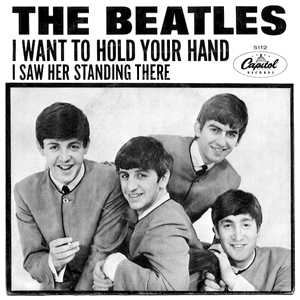
4. The Beatles- I Want to Hold Your Hand
The Beatles hit I Want to Hold Your Hand was recorded in the month before I was born. It was released in the UK 10 days after I was born. About a month after that, it was released in the US, just narrowly squeaking into 1963. In early 1964, the rookie Lennon-McCartney songwriting collaboration became the anthem of Beatlemania.
It's hard to believe today but back then The Beatles were strictly in the domain of kids mostly under 15. There is a wonderful trailer on the Help! DVD that says, "Hey, adults! You can go see Help! too". In early 60's mainstream media, The Beatles were seen the same way Justin Bieber is today (freakin' hell, that was a scary sentence to write).
My older siblings were all big Beatles fans. So like many kids in the generations to follow me, I grew up with The Beatles. As a preschooler I was more familiar with I Want to Hold Your Hand than I was with Old McDonald Had a Farm.
Like my brothers and my sister I saw the band evolve from the little cuties who sang I Want to Hold Your Hand to the long haired bearded "freaks" performing their final live appearance together on a rooftop in London.
I had a plastic army guy I named Sgt. Pepper. I sang Octopus' Garden in the elementary school variety show (not having had a single singing lesson at the time, it was most likely awful). I actually paid money to see the movie Caveman just because Ringo Starr was in it. I was at the memorial for John Lennon in Central Park on December 14, 1980.
I have lived through all the remixes, remasters, lost tapes, rarities, anthologies, circus shows, re-releases, compilations, rare live recordings, documentaries, photos and whatever the hell else they've come up with to keep repackaging the Fab Four over the years.
The Beatles are more than just band whose music I know and love. They are part of the landscape of my life.
3. Mad Men
Mad Men is, of course, not actually from 1963 but it is very much about 1963. Season 3, in particular, takes place entirely in 1963. Nothing really captures the look and feel of the early 1960's the way Mad Men does. The period detail and fashions are incredible.
Focusing on the professional and personal lives on Madison avenue advertising executives (Mad Men, get it?), the period series depicts a world where everything seems beautiful and perfect on the surface . Not far beneath that beautiful perfect surface of nice clothes, swank offices and smiling families lurks the darker worlds of alcoholism, serial infidelity, undiagnosed depression, paranoia, repressed homosexuality and socially sanctioned sexism, racism, and prejudice. The very different attitudes and social mores of 1963 are skewed through a subtle modern day prism.
Mad Men is often thin on dialogue but thick on subtext. It's a show that says more in its silences than most dramatic TV shows can say in 60 minutes of dialogue. Quite simply, Mad Men is the best show currently on TV.
Among other things, the Season 3 of Mad Men sees deals with the November 22, 1963 assassination of President John F. Kennedy. The tragic event has a massive indirect impact on the various character's inner emotional lives. It is quite possibly the best episode of the series thus far.
Incidentally, Don and Betty Draper's third child, Gene, would be the same age I am today where he not a fictional character.
2. From Russia With Love
1963 saw the release of the second and, in my opinion, best James Bond movie of the entire franchise (though the 2006 Casino Royale does give it a run for its money). From Russia With Love is also the only Bond film that is actually an improvement on the original Ian Fleming novel.
From Russia With Love is one of the rare Bond movie outings that does involve some kind of an arch villain in a secret lair filled with cutting edge technology, intent on taking over and/or destroying the world. No, the second Bond is your simple Cold War-era spy thriller. It is a basic suspense chase story revolving around Bond, evil agents from SPECTRE and beautiful Russian intelligence operative in way over her head.
Connery is in fine form in From Russia With Love. He is as close to Fleming's Bond as he would ever get. By the next installment, Goldfinger, Connery's smirks and sense of self-parody would already begin to kick in. There would be no going back once Connery and the franchise caught the silly bug.
From Russia With Love features one of the greatest fight scenes ever filmed. Sean Connery and Robert Shaw (in a amazingly cold-blooded performance) take each other on in a tiny train compartment. The fight reportedly took two weeks to film. Director Terence Young (no relation) had the good sense to let the rickety rocking sounds of the interior of a speeding train score the scene. The end result is, even by today's standards, exciting and stunning.
The train fight is a scene that defines the essence of Bond. Beneath the nice suits with the thin ties, the first class meals, the gambling in exclusive men's clubs, the gorgeous women,t he fast cars, and the right wine with the right meal, it all comes down two guys in an enclosed space beating the shit out of each other in a kill or be killed bare-knuckled struggle to the death.
It would be another 43 years before a James Bond movie would ever take itself that seriously again.
1.The Birth of JFK Assassination Conspiracy Theories
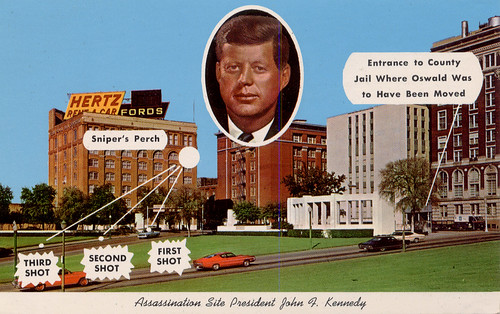
The assassination of President Kennedy in Dallas on November 22, 1963 is a dark moment in history. It really does not belong on any ten best list. That's why it's not on this one. It's the conspiracy theories borne out the fatal shooting that really fascinate me.
The Kennedy assassination was three days after my birth. For better or worse, it's a moment in time that has always and will always be linked to my arrival. The Official History of the World as it was handed down to me by parents went like this: Great Depression, World War II, JFK is shot, you are born (technically, yes, I was born first but I was too young to grasp such subtleties).
If Oliver Stone is to be believed (and when it comes to conspiracies, why not?), the Kennedy assassination theories began on the actual day the President was shot. Though, it was really not until Jack Ruby assassinated Lee Harvey Oswald, the alleged JFK assassin, on the way to a Dallas courtroom two days later that the conspiracy theories really took off.
Let's get one thing straight, I'm not going to use this blog to get into the whole conspiracy riff, okay?
I'm not going to talk about all the suspicious unanswered questions surrounding the shooting of the President. Questions like just why exactly why did Ruby shoot Oswald? Could Oswald really have made those three shots at that angle from the Texas School Book Depository? Why did the description of the murder weapon change while in the hands of the Dallas Police? Why was there witness intimidation going on during the investigation? What's with that guy with the umbrella in Zapruder film? Was he signaling somebody? Who did Oswald have contact with while he was living in the Soviet Union?
See? It's kinda addictive, isn't it?
Over the years I think I've heard 'em all. The major more legitimate theories have the conspiracy engineered by either the CIA, the KGB, the mafia, the Secret Service, Fidel Castro, the Israeli government, a secret multi-generational cabal that goes back to the assassination of President Lincoln, UFO's, the teamsters, or, according to a theory put forward by my sketch comedy troupe The Vestibules, British pop star Kiki Dee.
In a really odd way the Kennedy Assassination conspiracy theories are my own twisted connection to the world I was born into.
Or are they?
I stand by my choices.
10. The Great Escape
9. Monkey Planet by Pierre Boulle
Apes and monkeys are both primates and both members of the simian suborder. However, the two are very different animals. In current casual English usage the words ape and monkey are often used interchangeably. The french language cuts right to the chase and has just one word for both apes and monkeys: singes.
In 1963, critically acclaimed author of Bridge on the River Kwai, Pierre Boule, published his first science fiction novel, La Planete des Singes. The title could be translated into English as either Monkey Planet, Planet of the Monkeys, Ape Planet, or as the much more familiar title, Planet of the Apes.
The early English language editions of Boulle's unique novel about a French journalist embedded on a space mission who ends up stranded on a planet where apes are the the masters and humans the beasts went with the title Monkey Planet. Fortunately, for the biggest pre-Star Wars SF movie franchise of all time, when Hollywood adapted Boulle's novel to the big screen, they decided not to forgo Monkey Planet and go with the translation of the title that would actually appeal to audiences over the age of five.
I wouldn't be the first person to point out that Boulle's Monkey Planet bears more similarities to Jonathan Swift's Gulliver's Travels than it does to Franklin J. Shaffner's trippy yet moralizing ground breaking science fiction film. Monkey Planet is rife with arch absurdest social and political satire. Planet of the Apes is rife with "Take your damn paws of me you damn dirty apes!".
Given the political situation of France and it's colonies in the early 60's (they were in the process of losing Algeria and had already lost Vietnam), Boulle's story of a planet where the simians have taken over comes off as something of a cautionary tale with just a tinge of implied underlying racism.
The character of Zira in the book is absolutely incredible. No film has matched Boulle's characterization of the incredibly emotionally grounded and powerful female ape. And did I mention that in the book Charlton Heston is French?
If you're not into reading, just watch the third Apes film, Escape From The Planet of the Apes. Substitute the lone French journalist on an ape planet for the talking apes on a human planet and you get the idea.
Other than an unused treatment for the second Apes film, Beneath The Planet of the Apes, Boulle's only contribution to the Apes franchise was cashing some General Ursus sized royalty cheques.
![]() |
| The cover of this early edition of Pierre Boulle's original novel reflects the satirical spirit of the book. |
8. The Final Mercury Space Mission
On May 19, 1963, a rocket lifted off from Cape Canaveral. It was piloted by astronaut Gordon Cooper. 22 Earth orbits and one splash down later, the Mercury Space program was over. The significance of this final mission of NASA's first manned space program is not so much what it accomplished but what it lead to. The Mercury program was followed by NASA's Apollo program.
Hopefully, you don't need Tom Hanks and an HBO miniseries to tell you what incredible things the Apollo space program achieved.
Gordon Cooper, Alan Shepard, John Glenn and their fellow American astronauts were such an incredible part of the mythos of the early 60's. Nothing defined the uniqueness of the era better than those crew-cutted fearless men with their cool helmets who got to go into space.
One night my dad (an aerospace engineer) let us leave the all lights in the house on overnight so that the astronauts could see us and the rest of our city from space. Normally, we would be in serious trouble if we so much as left a room without the lights turning off. All night was unthinkable. These astronauts must have been a big deal indeed.
My father's extraordinary deviation from the Official Always Turn Off Every Light Policy was, in my opinion, Nasa's greatest achievement.
![]() | |||||
| Gordon Cooper or GI Joe Astronaut? |
7. Leonard Cohen Emerges
In 1963, The Favourite Game, Leonard Cohen's second novel was published.
It would be another five years before the young struggling anglo Montreal writer would shift his career focus from the publishing world to the much more stable and secure prospects of the music industry.
Admittedly I am more familiar with Cohen's music over his early literary aspirations. Nonetheless, it's fair to say that the career of an artist who would later have a profound impact on my life was well underway.
Cohen's words and music always had a way of nurturing the black emptiness of the soul without creating a bottomless abyss of hopelessness and despair from which there is no escape. There was always a light at the end of Cohen's emotional tunnels of pain. For every razor blade there was always faint music outside in the streets, for every deeply scarring relationship there was always some woman's beautiful golden hair and for every betrayal there was always a famous blue raincoat.
There's a few significant Cohen albums that got me through some pretty rough times in my turbulent thirties as well as more break-ups than I'd care to recall.
| Leonard Cohen touches your perfect body with his mind |
My different musician friends alternately tell me that Cohen is either one of the most innovative song writers that ever lived or that, c'mon, he's just writing the same song over and over again. Whatever. All I know is that there are very few artists out there that have moved me as much as Leonard Cohen has.
6.Ring of Fire-Johnny Cash
Johnny Cash is the coolest guy ever. Period.
He dressed in all in black. He had this amazingly unique deep voice. He has this really cool way of slinging his guitar across his back when taking to the stage.
I've followed the late great Mr.Cash through every step of his career from the whimsical A Boy Named Sue right through to Cash's swan song single, his incredible cover of Trent Reznor's Hurt.
Johnny Cash could be both spiritual and existential simultaneously yet still somehow remaining folksy. The Man in Black certainly knew a thing or two about pain, depression and loneliness too. It mighta had something to do with the reported 100 pills a day he was popping by the mid-60's.
Musically Cash often walked his own line between folk, country, gospel and rock n'roll. He came out the legendary Sun Records studios of Memphis in the 1950's. His graduating class included Elvis Presley, Roy Orbison and Jerry Lee Lewis. Yet Cash stood apart from those legendary artists. His was a music all his own.
Ring of Fire spent 17 weeks at the number one spot on the country music charts in 1963. Coincidentally, it rose to number 17 on the Billboard Top 100. It was not originally recorded by Cash nor did he write it (the song writing credits go to Merle Kilgore and the love of Johnny's wife, June Carter). Nevertheless, once Cash touched Ring of Fire, it was forever his.
Over the years, Ring of Fire has been covered by such diverse artists as Eric Burdon and The Animals, Blondie, Stan Ridgway and Social Distortion. Though the ultimate accolade for Ring of Fire and Johnny Cash's amazing musical legacy is the inclusion of the song on Guitar Hero 5.
5. Akira Kurosawa's High and Low
Japanese director Akira Kurosawa is almost as legendary as the samurai he often portrays in his films. Seven Samurai, in particular is mandatory viewing in most film schools. Kurosawa was also known for occasionally venturing into the contemporary noir thriller genre. His 1948 film, Stray Dog, is a standout in that department. For me, though, Kurosawa's best film is another such venture into the genre, 1963's High and Low.
Toshiro Mifune, long time Kurosawa collaborator and one of Japan's biggest stars at the time, plays a wealthy executive whose chauffeurs' son is kidnapped in botched attempt to abduct Mifune's son. That does not stop the kidnappers from still demanding their ransom.
What follows is an incredibly riveting combination of intrigue, suspense and some classic Kurosawan moral and emotional dilemmas. The story takes many amazing twists and turns portraying both intense character development and an in depth police procedural drama. Kurosawa finally leads us (in some unforgettably noir scenes) into to the seamy underbelly of 1963 Tokyo.
At the risk of over-simplifying its title, the film seamlessly takes us from the High of the world of corporate executives and board rooms to the Low of the world of junkies and pushers.
Above all, High and Low is very entertaining film. It's one more masterpiece that helps cement Akira Kurosawa's place in history as Japan's greatest motion picture export.
Well, except maybe for Godzilla...
4. The Beatles- I Want to Hold Your Hand
The Beatles hit I Want to Hold Your Hand was recorded in the month before I was born. It was released in the UK 10 days after I was born. About a month after that, it was released in the US, just narrowly squeaking into 1963. In early 1964, the rookie Lennon-McCartney songwriting collaboration became the anthem of Beatlemania.
It's hard to believe today but back then The Beatles were strictly in the domain of kids mostly under 15. There is a wonderful trailer on the Help! DVD that says, "Hey, adults! You can go see Help! too". In early 60's mainstream media, The Beatles were seen the same way Justin Bieber is today (freakin' hell, that was a scary sentence to write).
My older siblings were all big Beatles fans. So like many kids in the generations to follow me, I grew up with The Beatles. As a preschooler I was more familiar with I Want to Hold Your Hand than I was with Old McDonald Had a Farm.
Like my brothers and my sister I saw the band evolve from the little cuties who sang I Want to Hold Your Hand to the long haired bearded "freaks" performing their final live appearance together on a rooftop in London.
I had a plastic army guy I named Sgt. Pepper. I sang Octopus' Garden in the elementary school variety show (not having had a single singing lesson at the time, it was most likely awful). I actually paid money to see the movie Caveman just because Ringo Starr was in it. I was at the memorial for John Lennon in Central Park on December 14, 1980.
I have lived through all the remixes, remasters, lost tapes, rarities, anthologies, circus shows, re-releases, compilations, rare live recordings, documentaries, photos and whatever the hell else they've come up with to keep repackaging the Fab Four over the years.
The Beatles are more than just band whose music I know and love. They are part of the landscape of my life.
3. Mad Men
Mad Men is, of course, not actually from 1963 but it is very much about 1963. Season 3, in particular, takes place entirely in 1963. Nothing really captures the look and feel of the early 1960's the way Mad Men does. The period detail and fashions are incredible.
Focusing on the professional and personal lives on Madison avenue advertising executives (Mad Men, get it?), the period series depicts a world where everything seems beautiful and perfect on the surface . Not far beneath that beautiful perfect surface of nice clothes, swank offices and smiling families lurks the darker worlds of alcoholism, serial infidelity, undiagnosed depression, paranoia, repressed homosexuality and socially sanctioned sexism, racism, and prejudice. The very different attitudes and social mores of 1963 are skewed through a subtle modern day prism.
Mad Men is often thin on dialogue but thick on subtext. It's a show that says more in its silences than most dramatic TV shows can say in 60 minutes of dialogue. Quite simply, Mad Men is the best show currently on TV.
Among other things, the Season 3 of Mad Men sees deals with the November 22, 1963 assassination of President John F. Kennedy. The tragic event has a massive indirect impact on the various character's inner emotional lives. It is quite possibly the best episode of the series thus far.
Incidentally, Don and Betty Draper's third child, Gene, would be the same age I am today where he not a fictional character.
2. From Russia With Love
1963 saw the release of the second and, in my opinion, best James Bond movie of the entire franchise (though the 2006 Casino Royale does give it a run for its money). From Russia With Love is also the only Bond film that is actually an improvement on the original Ian Fleming novel.
From Russia With Love is one of the rare Bond movie outings that does involve some kind of an arch villain in a secret lair filled with cutting edge technology, intent on taking over and/or destroying the world. No, the second Bond is your simple Cold War-era spy thriller. It is a basic suspense chase story revolving around Bond, evil agents from SPECTRE and beautiful Russian intelligence operative in way over her head.
Connery is in fine form in From Russia With Love. He is as close to Fleming's Bond as he would ever get. By the next installment, Goldfinger, Connery's smirks and sense of self-parody would already begin to kick in. There would be no going back once Connery and the franchise caught the silly bug.
From Russia With Love features one of the greatest fight scenes ever filmed. Sean Connery and Robert Shaw (in a amazingly cold-blooded performance) take each other on in a tiny train compartment. The fight reportedly took two weeks to film. Director Terence Young (no relation) had the good sense to let the rickety rocking sounds of the interior of a speeding train score the scene. The end result is, even by today's standards, exciting and stunning.
The train fight is a scene that defines the essence of Bond. Beneath the nice suits with the thin ties, the first class meals, the gambling in exclusive men's clubs, the gorgeous women,t he fast cars, and the right wine with the right meal, it all comes down two guys in an enclosed space beating the shit out of each other in a kill or be killed bare-knuckled struggle to the death.
It would be another 43 years before a James Bond movie would ever take itself that seriously again.
1.The Birth of JFK Assassination Conspiracy Theories
The assassination of President Kennedy in Dallas on November 22, 1963 is a dark moment in history. It really does not belong on any ten best list. That's why it's not on this one. It's the conspiracy theories borne out the fatal shooting that really fascinate me.
The Kennedy assassination was three days after my birth. For better or worse, it's a moment in time that has always and will always be linked to my arrival. The Official History of the World as it was handed down to me by parents went like this: Great Depression, World War II, JFK is shot, you are born (technically, yes, I was born first but I was too young to grasp such subtleties).
If Oliver Stone is to be believed (and when it comes to conspiracies, why not?), the Kennedy assassination theories began on the actual day the President was shot. Though, it was really not until Jack Ruby assassinated Lee Harvey Oswald, the alleged JFK assassin, on the way to a Dallas courtroom two days later that the conspiracy theories really took off.
Let's get one thing straight, I'm not going to use this blog to get into the whole conspiracy riff, okay?
I'm not going to talk about all the suspicious unanswered questions surrounding the shooting of the President. Questions like just why exactly why did Ruby shoot Oswald? Could Oswald really have made those three shots at that angle from the Texas School Book Depository? Why did the description of the murder weapon change while in the hands of the Dallas Police? Why was there witness intimidation going on during the investigation? What's with that guy with the umbrella in Zapruder film? Was he signaling somebody? Who did Oswald have contact with while he was living in the Soviet Union?
See? It's kinda addictive, isn't it?
Over the years I think I've heard 'em all. The major more legitimate theories have the conspiracy engineered by either the CIA, the KGB, the mafia, the Secret Service, Fidel Castro, the Israeli government, a secret multi-generational cabal that goes back to the assassination of President Lincoln, UFO's, the teamsters, or, according to a theory put forward by my sketch comedy troupe The Vestibules, British pop star Kiki Dee.
In a really odd way the Kennedy Assassination conspiracy theories are my own twisted connection to the world I was born into.
Or are they?
Thursday, November 11, 2010
Remembering My Grandfather: Veteran of The Great War
My grandfather was a veteran of the The Great War.
The Great War is also known as Word War I. And, yes, you read that right and, no, it's not a typo. World War I, not II. Perhaps the greatest tragedy of the The Great War was that it had to be renamed because of the bigger, more horrific war that broke out just 21 years later. Whatever the name, my grandfather was there.
I dwell on this point because it still amazes me that a 46 year-old guy living in the year 2010 has a grandfather who participated in a war that ended in 1918 ( some 92 years ago to the day, in fact).
I have, of course, long been familiar with my dad's WWII service in the Royal Canadian Air Force, my uncle who survived both Dieppe and D-Day and of another uncle who was not so fortunate and was killed circa 1943 during the Italian Campaign . However, I'd heard comparatively little about my maternal grandfather and his time in uniform during what was often naively referred to as "The War to End All Wars".
I never knew the man. He died when I was three. There is picture of me with him when I was a baby but I have no idea of its whereabouts now. Luckily, though, a lost of photo of my grandfather and his Canadian Expeditionary Force Discharge Certificate were both recently unearthed.
Take a look:
You now know about as much as I do.
Richard Edward Rist enlisted in Ottawa on April 13, 1915. He served in Canada, England and France with The Canadian Expeditionary Force. He was discharged in Hamilton Ontario on May 19, 1919. What happened in those four years no one really knows. My mom tells me he spoke very little about his time in the army.
The certificate tells us that Richard Rist served with The First Field Company of Canadian Engineers. A quick Google search reveals that there were some 14, 000 troops of the aforementioned company in Europe between 1914 and 1918. It also states that these particular Canadian engineers dug tunnels and laid mines during The Battle of Vimy Ridge. Vimy Ridge, of course, being one of Canadian military history's most significant and bloodiest battles. Who knows if he was actually there or not.
His rank and date of birth are both smudged out on this certificate and so lost to the ages. My guess is that he was about 35 when he signed up.
We do know one very important detail. Whatever the soldier named Richard Rist's experiences, whatever horrific things he may or may not have witnessed or lived through, he came back alive and in one piece.
Shortly after the war, my grandfather worked in some capacity as an iron worker in Toronto. We can see him with his co-workers in this photo. He was nice enough to be the only guy in the shot wearing a white fedora. That's him in the second row. Most likely, this photo was taken sometime in the early 20's, about three to five years before my mother was born. He would have been close to the same age I am today.
For those of you who may not know, my full name is Terence Richard Bowman. I was named for Richard Edward Rist, veteran of The Great War.
Many of the details may be missing but, nonetheless, we do still remember Richard Edward Rist and that he lived through what was one of the most brutal conflicts Canada has ever been involved with.
And isn't that the whole point of of a day like today?
The Great War is also known as Word War I. And, yes, you read that right and, no, it's not a typo. World War I, not II. Perhaps the greatest tragedy of the The Great War was that it had to be renamed because of the bigger, more horrific war that broke out just 21 years later. Whatever the name, my grandfather was there.
I dwell on this point because it still amazes me that a 46 year-old guy living in the year 2010 has a grandfather who participated in a war that ended in 1918 ( some 92 years ago to the day, in fact).
I have, of course, long been familiar with my dad's WWII service in the Royal Canadian Air Force, my uncle who survived both Dieppe and D-Day and of another uncle who was not so fortunate and was killed circa 1943 during the Italian Campaign . However, I'd heard comparatively little about my maternal grandfather and his time in uniform during what was often naively referred to as "The War to End All Wars".
I never knew the man. He died when I was three. There is picture of me with him when I was a baby but I have no idea of its whereabouts now. Luckily, though, a lost of photo of my grandfather and his Canadian Expeditionary Force Discharge Certificate were both recently unearthed.
Take a look:
You now know about as much as I do.
Richard Edward Rist enlisted in Ottawa on April 13, 1915. He served in Canada, England and France with The Canadian Expeditionary Force. He was discharged in Hamilton Ontario on May 19, 1919. What happened in those four years no one really knows. My mom tells me he spoke very little about his time in the army.
The certificate tells us that Richard Rist served with The First Field Company of Canadian Engineers. A quick Google search reveals that there were some 14, 000 troops of the aforementioned company in Europe between 1914 and 1918. It also states that these particular Canadian engineers dug tunnels and laid mines during The Battle of Vimy Ridge. Vimy Ridge, of course, being one of Canadian military history's most significant and bloodiest battles. Who knows if he was actually there or not.
His rank and date of birth are both smudged out on this certificate and so lost to the ages. My guess is that he was about 35 when he signed up.
We do know one very important detail. Whatever the soldier named Richard Rist's experiences, whatever horrific things he may or may not have witnessed or lived through, he came back alive and in one piece.
Shortly after the war, my grandfather worked in some capacity as an iron worker in Toronto. We can see him with his co-workers in this photo. He was nice enough to be the only guy in the shot wearing a white fedora. That's him in the second row. Most likely, this photo was taken sometime in the early 20's, about three to five years before my mother was born. He would have been close to the same age I am today.
For those of you who may not know, my full name is Terence Richard Bowman. I was named for Richard Edward Rist, veteran of The Great War.
Many of the details may be missing but, nonetheless, we do still remember Richard Edward Rist and that he lived through what was one of the most brutal conflicts Canada has ever been involved with.
And isn't that the whole point of of a day like today?
Subscribe to:
Posts (Atom)