
*that aren't from movies about Jesus
 |
| The first still from Mel Gibson's upcoming Robocop reboot |
After bunnies and chocolate eggs, the most prominent image of Easter is that of Jesus Christ crucified on the cross. It's an image that permeates more than just Easter. There are few other images in our Judeo Christian-based culture that are quite as resonantly iconic (well, if you leave out the Judeo part, anyway). The image of the 11th and 12th Stations of The Cross have been revisited by artists in many different mediums over the last twenty or so centuries.
Film makers are no exception. In the history of cinema, many directors have gone there and in many different ways. A good deal have gone to the literal representation of the crucifixion in biblical films like William Wyler with Ben Hur and George Stevens with The Greatest Story Ever Told while others have taken more controversial routes like Norman Jewison with Jesus Christ Superstar, Martin Scorsese with The Last Temptation of Christ and, more recently, Mel Gibson with The Passion of the Christ. Far more prevalent, though, are the allegorical Christ figures of movie history. Peruse through enough academic articles and serious-minded fan websites and you will find alleged Christ parallels in every cinematic icon from Rhett Butler to Luke Skywalker. Many times the perceived savior allusion is more than just literary in nature; they are visual and cinematic in nature and they usually key thematic and dramatic scenes in film. The image most commonly cinematically referred to is that of the crucifixion of Christ. These scenes borrow not just the thematic concepts of the crucifixion but much of the classic iconography of the crucifixion as well: outstretched arms, nails through the hands or wrists, the crown of thorns and the spear in the side, to name a few.
For some, these visual crucifixion cues are more apparent and meaningful than others. For someone raised Catholic as I was (though I'm most definitely in the "fallen" category now) and who was later taught film criticism by a Jesuit priest, such images leap off the screen. For those with more secular upbringings who were taught film criticism (if at all) by, say, an avowed Marxist, probably not so much. However, as Marshal McLuhan was fond of saying, "The medium is the message". If those images are up there on that movie screen and a viewer notices it, consciously or not, then they do have some kind of meaning.
I could spend a blog post each week pointing out each and every visual Christ allegory that has ever appeared in a movie at one time or another. I've narrowed it down to five of my favourite examples. Here are five examples of films that have borrowed, used for their own purposes and some might say twisted and even ridiculed the imagery that, next to bunnies, is most strongly associated with this time of the year.
WARNING: Big time SPOILER ALERT, if you have not seen any of these movies.
Conan The Barbarian
1982
Directed by John Milius
1982
Directed by John Milius

Who's Standing in for Jesus?
Future Governor of California and champion body builder turned action movie star, Arnold Schwarzenegger. In this case, Mr. Schwarzenegger is playing legendary fantasy writer Robert E. Howard's most famous creation Conan The Cimmerian, an ancient and, I might add, pagan barbarian.
What's the context?
While seeking revenge for the murder of his father, Conan tracks down the evil, mystical and snake-themed warlord Thursla Doom, (James Earl Jones, who was then still trying to break away from that Darth Vader typecasting thing). After tracking down Doom, Conan attempts to infiltrate Doom's temple but is captured. Doom then sentences the barbarian to death by crucifixion. While tied to a tree (not nailed to a cross), Conan endures his torment in the most pro-active way possible. At one point, a vulture attempts to peck out Conan's eyes. Before the bird can do so, Conan bites the thing right in the neck and kills it. The barbarian is later rescued by one of his comrades in arms and is brought back to health with the help of the magic of an old wizard.
What makes it a crucifixion?
The religious allegories of the scene, while present as a stylistic motif, are a bit tenuous, to say the least. Conan almost, but doesn't quite, die while tied to a tree and is then brought back to "life" via supernatural means. Yeah, that's sorta kinda a crucifixion and resurrection metaphor, but, really, the only allegory that really holds up to scrutiny is Conan's incredible ability to survive hardship, torment and almost certain death.
The scene is often described a quintessential moment in defining the character of Conan, both in cinema and in literature. The scene itself is taken directly from a similar yet much more powerful description of Conan's similar crucifixion in Howard's original short story, A Witch Shall Be Born.
 |
| Artist Boris Valego's rendering of A Witch Shall Be Born |
"By the side of the caravan road a heavy cross had been planted, and on this grim tree a man hung, nailed there by iron spikes through his hands and feet. Naked but for a loin-cloth, the man was almost a giant in stature, and his muscles stood out in thick corded ridges on limbs and body, which the sun had long ago burned brown..."
-Robert E. Howard, A Witch Shall Be Born, 1934
That section of the original Conan story is some of the best writing of Howard's career and, in my opinion, the most powerful passage ever written for his signature character. In the story, Conan ends up on the wrong side of a bloody coup d'etat in ancient city state. He is literally crucified for defying Constantius, the new conqueror. Conan is nailed, not tied, to a cross, not a tree. The vulture scene is basically the same. Conan's only rescue comes in the form of a passerby, one of Constantius' rivals, who merely cuts down the cross and lets Conan fend for himself from there. Conan, of course, manages to survive to fight another day. In an effort to retain some believability, Howard has Conan spend several months recovering. Conan finally exacts his revenge when, after conquering his army, he finally captures and then crucifies Constantius, the very man that had Conan nailed to the cross in the first place. Not only does Conan overcome suffering at the hands of his enemies but he does quite aggressively.
"You are more fit to inflict torture than endure it.", says Conan to his former tormentor as he leaves the man hanging on the cross.
Not exactly "turn the other cheek" stuff, is it?
No, Conan is not a messianic figure of salvation and resurrection ; he survives crucifixion not because of his virtue or because of divine providence but because Conan The Barbarian (in both movies and books) is, quite simply a tough, determined and unkillable badass.
The Omega Man
1971
Directed by Boris Sagal
Directed by Boris Sagal

Who's standing in For Jesus?:
Charlton Heston, as U.S. Air Force Colonel Robert Neville, M.D..
What's the context?:
The Omega Man is the second of three film adapatations of Richard Matheson's short story I Am Legend (the first is The Last Man on Earth in 1964 with Vincent Price and the third is I Am Legend with Will Smith in 2007).
In 1975 (which would have been four years into the Not-Too-Distant Future when the film was made) the Cold War has become one of biological warfare. Heston, an Air Force research physician, injects himself with an experimental vaccine, but it is too late. Most, if not all, of the world population has already succumbed to the plague created by the war. Heston believes he's the last man on Earth. He goes on to spend his days roaming the deserted streets of Los Angeles and his nights fighting off a cult of plague infected nocturnal albino vampires. The cult is determined to destroy all remaining technology and Heston along with it. However, Heston and his large cachet of automatic weapons and greenades have something to say about that plan.
Heston is rescued from the albino vampires one night by a group young hippie survivors. The young "kids of today" are immune to the plague because of their age. Can you tell this movie was made in the early 70's?
With the help of one of the young hippies, a former medical student, Heston is able manufacture a new vaccine from his own blood as he, of course, is immune to the plague.
Before he can get out of the city with the new vaccine, however, one of the albino vamps manages to impale Heston with a large spear. Heston dies slowly, posed in a Christ on the cross style crucifixion pose. The young hippies retrieve the serum he made, get out of the city and get the closing credits rolling.
What makes it a crucifixion scene?
K, this allegory is pretty ham-handed but, as the aforementioned Jesuit Priest who taught me film criticism used to say, "It's all there.". First, there's the outstretched arms and the slightly bent knees: you know, you basic Christ on a the cross position. Then Heston bleeds profusely from the wound inflicted by a large spear (yes, yes, he was not stabbed exactly in the side but let's not too holier than thou about every little detail, okay?). Not to mention the fact that the man has just effectively saved all of humanity from its own, you might say "sins", with a serum that was literally made from Heston's own blood.
Once it's all laid out like that, the symbolism is pretty forced and, frankly, even as these kinds of things go, kind of silly in how seriously it takes itself.
On the bright side, though, perhaps the grateful survivors of this future world will someday drink wine at communion each week, as a way of symbolizing the sacrifice of the Blood of Heston...
Blade Runner
1982
Directed by Ridley Scott
 |
| This image is closer to that of a Resurrection that it is to that of a Crucifixion but more on that later. |
Who is standing in for Jesus?
Rutgar Hauer, as the powerful, menacing yet somehow spiritual and sympathetic biorobotic android, Roy Batty.
What's the context?
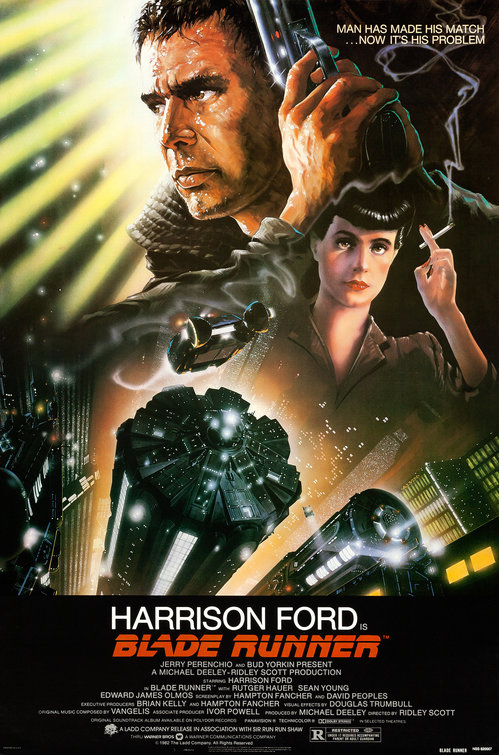
Blade Runner is the bleak dystopian future to end all the bleak dystopian futures.
Futuristic cop/bounty hunter or, if you prefer, Blade Runner, Rick Deckard (Harrison Ford) is assigned to track down and "retire" (ie: kill) a group of rogue biorobotic androids known as replicants. The replicants, lead by the creepily charismatic Roy Batty (Hauer) have escaped from what basically amounts to slavery to seek out Dr. Eldon Tyrell. Tyrell is head of the eponymous Tyrell Corporation, creators and manufacturers of the Replicants. That makes Tyrell something of a God figure, at least as far as the replicants are concerned, anyway. As Deckard hunts the replicants, he seems to become increasingly cold and inhuman, even as he becomes romantically involved with a replicant. Meanwhile, the fugitive replicants appear to be gaining more humanity as they come closer and closer to the end of their genetically programmed two year life span.
In the film's climax, Deckard has a dramatic show down with the surviving replicants on a rooftop in the rain. He is tormented physically and psychologically by the increasingly powerful and menacing Batty. As Batty realizes his time is coming to and end and that he is starting to lose control of his physical body, he drives a nail through each of the palms of his hands, in attempt to stop them from shaking. Moments later, after rescuing Ford from falling off the roof and saving his life, Hauer sits down in the rain on the rooftop and declares that it's "time to die.". He droops down into a still position and releases a white dove that he had (for some reason) grabbed a hold of earlier. The dove flies directly up into the air in slow motion as the camera follows it from below.
What makes it a crucifixion scene?
The religious allusions in Blade Runner are a bit more subtle and nuanced than in the other films mentioned in this post. They are one element in a wonderfully multifaceted palate that deals with many themes and concepts, both visual and thematic. They are stylistic, cultural, philosophical and, yes, even theological in nature.
Let's stick to the theological stuff.
Let's stick to the theological stuff.
Among other things, biblical allusions and references abound in Blade Runner. Ford in one scene deals with street vendors in outdoor markets that have a strong visual and aural middle eastern biblical vibe to them. He interrogates an exotic dancer who performs with a snake, a biblical symbol of Satan, that in the words of the host of her show, "once corrupted the soul of man".Tyrell is portrayed as a powerful, and, yes, an almost God-like figure who lives in a temple-like skyscraper, the top of which can only be ascended to in a glass elevator that overlooks the city, the sky and the stars.
At the end of the film, Batty performs his own self-crucifixion, then saves Deckard's life and then dies. As he dies, he releases the white dove that flies upwards. A white dove often symbolizes the Holy Spirit, which, coincidentally, also left Christ as he died on the cross (the dove could also be interpreted as symbolic of Batty's soul). The Christ allusions end there ,though. There is no resurrection for Batty. Yet the end of the film suggest that there may be a resurrection, at least thematically, for Deckard.
At the end of the film, Batty performs his own self-crucifixion, then saves Deckard's life and then dies. As he dies, he releases the white dove that flies upwards. A white dove often symbolizes the Holy Spirit, which, coincidentally, also left Christ as he died on the cross (the dove could also be interpreted as symbolic of Batty's soul). The Christ allusions end there ,though. There is no resurrection for Batty. Yet the end of the film suggest that there may be a resurrection, at least thematically, for Deckard.
Of course, director Ridley Scott is not drawing perfect direct lines between Batty and Jesus. Rather, he is playing with these archetypal cultural images to create an impression. By drawing these religious allusions, even they are only perceived subconsciously, Scott is playing with the issue of existentialism vs spirituality. Batty, an artificial being created by humans and the supposed evil villain of the piece becomes a figure of great humanity and redemption as he clings to his final moments of life. The white doves suggests not only possible savior overtones but, on a more basic level, it suggests that this non-human being perhaps did, in fact, have a soul. The world of Blade Runner is one in which humans can create life via their own technology, both human and animal. It's life that, as it turns out, could have more potential for humanity and spiritualism than its creators. The humans of Blade Runner live in a world dominated and even partly destroyed by that same technology that created artificial life.
Is there a God in the midst of all of this bleak, technologically dominated world of the future? Or, in a world where its technology is so powerful, is humanity God?
Is there a God in the midst of all of this bleak, technologically dominated world of the future? Or, in a world where its technology is so powerful, is humanity God?
Like many great films (and even art in general), Blade Runner raises more questions than it answers.
Robocop
1987
Directed by Paul Verhoven
Directed by Paul Verhoven

Who's Standing in For Jesus?
Peter Weller as Officer Alex Murphy, soon to become a super cyborg cop, Robocop.
What is the context?
Another dystopian not-too-distant future outing, only this one is just a tad more bleak than The Omega Man and at least as bleak as Blade Runner.
In the crime ridden no man's land that is Detroit of the near future, the police force has -in the ultimate satire of Reagan era politics - been privatized. The Omni Consumer Products Corporation is now in charge of the cops and, boy, have they got some cool ideas for technological upgrades to the force. One of their new innovations involves building unstoppable cyborg super cops. Their first guinea pig for the new law enforcement product line is Officer Alex Murphy. Murphy is selected for the job after he is killed in the line of duty. Killed, I might add, in one of the most brutal killing scenes in cinema history.
Once "legally dead", Murphy is fused with mechanical robot parts and becomes the ultimate law enforcement machine, known simply as Robocop. Or as the movie poster puts it: "Part Machine. Part Man. All cop." The film is never clear as to whether Murphy was killed and actually brought back from the dead via technology or is just almost killed and given a new lease on life via technology.

Whatever the case, Murphy's death at the hands of some of the most sadomasochistically twisted villains this side of Deliverance, is akin to a crucifixion. In the hands of audacious Dutch director Paul Verhoeven, in his first mainstream Hollywood feature, Murphy's death scene is actually a tad more than just akin to Christ on the cross.
All of Verhoeven's films, from his early art-house European films like The 4th Man to his big mainstream Hollywood movies like Starship Troopers, Basic Instinct and even the much maligned Showgirls, feature some from of thematic crucifixion and/or resurrection, usually centered around the film's central character.
Why makes it a crucifixion scene?
The crucifixion allegories in this movie are bit more subtle than those of Conan The Barbarian or even those of The Omega Man (similar to Blade Runner, though). The imagery may not be immediately consciously obvious to the casual viewer. I've found that calling Murphy's death scene a crucifision allegory is often met with the classic "you're reading to much into it" rebuttal that film symbolism interpretations are often met with. Yet, at the same time, I often also hear people who have just seen Robocop for the first time, bring up the crucifixion angle without prompting.
Take a look at the scene below and you'll see what I mean (warning for the uninitiated, it's pretty violent and disturbing).
In particular, Murphy's hand being blown off with a shot gun at close range is a nail through the palm of the hand taken to the next level. He is "killed" in an outstretched arm position. That crucifixion image is a little less on the nose on account of the fact that the man is missing an arm at the time. Murphy's final bloody head wound is a more brutal version of a crown of thorns. The visual allusions are indirect and subtle, yet still there.
The crucifixion imagery works on an almost subconscious level. It is an excellent example of Verhoevan's unique ability to create audaciously over-the-tip visuals yet still maintain an air of subtlety at the same time.
I actually agree with the "don't read too much into it" argument but not so much in terms of the imagery but more in terms of the conclusions one might make from that imagery.
Sure, Murphy/Robocop goes through his own version of crucifixion and he sees his own version of a resurrection when he is transformed into the savior hero of Robocop. However, even within the film's own terms, Robocop is not Jesus, nor is he meant to be. Verhoeven uses the Christ parallels as a means of creating a deeper and more emotional connection with a larger than life hero (literally, in this case). He does this through the use of deeply rooted, powerful, culturally based iconography. At the same time, he is also using the Jesus allegories as an ironic juxtaposition with a bleak world of violence, social disorder and immorality.
Is Robocop really a savior? Or just a promulgation of more violence, death and disorder? Is a world so mired in crime and corruption even capable of redeeming itself? Is such a world's salvation even within the reach of a savior like Robocop?
Discuss.
Life of Brian
1979
Directed by Terry Jones
1979
Directed by Terry Jones

Who's Standing in For Jesus?
Graham Chapman as Brian, but he's more standing near than standing in.
What's the Context?
And now for something completely different....
Brian is this guy, see, who just happened to be born in Bethlehem in the stable next door to the one that Jesus Christ was born in on the same night. He spends most of the rest of his life either being mistaken for or living in the shadow of, the true Messiah.
The premise of Brian gives the legendary British comedy troupe, Monty Python, an opportunity to do some of the best and most irreverent biblical comedy ever.
Many have taken the film to be critical and insulting to Jesus, his teachings and to religon in general. However, really, the film is full of comedy that goes something like this:
Brian (addressing a large crowd, hanging on his every word): "You are all individuals!"
Crowd: (in unison) "We are all individuals."
Pause
Lone voice in the crowd: "I'm not.".
Or the scene in which an organization known as the Judean People's Front talk about they despise their bitter rivals, The People's Front of Judea.
It's quite clear that Python's objects of satire are the institutions, culture and subsequent misinterpretations of Christianity. It's no wonder that much of the clergy spoke out so strongly against the film.
Life of Brian ends with Brian, as seems to be his lot in life, following in Christ's footsteps and being, you got it, crucified (along with, I might add, all of the rest of the Python troupe in various other roles).
What makes it a crucifixion scene?
Duh.
This being a comedy and all, there is certainly none of the violent imagery of the crucifixion seen in other films on the subject, both allegorical and literal. No hands are nailed to crosses, there is no crown of thorns and no large spears are poked into Brian's side. Still, though, the image of the film's lead character stuck up there on a cross to (unlike the real savior) die for no good reason is just a tad of a heavy note with which to end a comedy.
Python handles it brilliantly.
Eric Idle, hanging there on a cross just next to Brian, breaks out into song. The song, "Always Look on the Bright Side of Life" is so inanely happy and optimistic that it puts the final musical numbers of most Disney musicals to shame. The end of Life of Brian is one of the greatest strokes of comedic genius in all of Pythondom (but let's not overstate it).
On the one hand, there is the obvious comedic contrast of a happy musical comedy song (with just a touch of Python's infamous cynical irony) sung be a group of people about to die the horrific death of crucifixion. It's easy to see how some may consider the scene to be a complete mockery of the crucifixion of Christ and the value and beliefs that all of Christianity stands for, thus making it utterly blasphemous.
It isn't really, though, if you think about it.
Even with all of its ironic cynical satire, "Always Look on the Bright Side of Life" is an incredibly catchy song that ultimately exudes happiness and optimism in almost every note. Listen to Canadian folk singer Bruce Cockburn's live cover version of the song and notice the enthusiasm with which the audience sings along. Then try and tell yourself that is not so. Still not convinced? Try singing "Always Look on the Bright Side of Life" to yourself and see if you're not feeling better after a verse or two.
Happiness, optimism and the belief that much better things are coming, even in the face of the bleak and horrific present; I'm sorry, but, isn't that what Christianity is all about?
Happy Easter,
Passover,
Greek Orthodox Easter
Greek Orthodox Easter
and
Spring
Everybody!
 |
| Thought I'd leave you on a pop culture Christ allegory image that really didn't go down so well, though it was not religious groups who objected, but comic book fans! |







 ’s classic pulp fantasy adventure hero
  will be arriving in cinemas soon. The new movie,
  , stars
  ’s and
  '
'  as Conan and is directed by Marcus Nipsel who has previously successfully revived both
  and
and  franchises.
  movie rather than more faithful adaptation of Howard’s
  yarns.
  or
or  , the vast majority of a potential movie audience has little or no familiarity with any given character's literary exploits. And movies and books are very different mediums. In order for one to effectively translate from one to the other, liberties must often be taken. Most fans probably understand those challenges, what is especially frustrating is when the movies do away with the spirit and intentions of the books.
  vs the writings of
  is nothing new. Movies and literary adventure heroes, along with their fans, have been duking it out decades.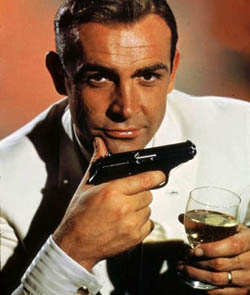
 ,
,  once referred to Bond movie actor
 as "a Glaswegian lorry driver who mangles my character". Many Fleming fans might be inclined to agree that sentiment.
 , opens with Bond sitting in a bar in the Miami Airport. He’s flying back from Central America where he has just carried out his assignment to kill a drug dealer who was working with the communists (the book was published in 1959). Bond reflects on the moment that he killed the man; how the man had life in him one moment and suddenly no longer had that life the minute Bond snapped his neck. His internal musings on his the nature of his dark and deadly occupation depict a man questioning his own morality and place in the world. Fleming's writing in that instance is almost existential in its poignancy.
  sees Sean Connery as James Bond, on a similar mission, emerge from a pond with a plastic duck on his head.
 veteran, wrote the first Bond novel,
  , in 1952. Described by Fleming as being a “blunt instrument” rather than a hero, the literary Bond bore only a passing resemblance to most of the film portrayals that audiences would come to know and love over the years.
 . Hence the term "
 ".
".  only played the role once in
 ,in 1969, almost immediately following Connery's departure. Lazenby was not an experienced enough actor to bring any kind of distinctive interpretation of the character to the table.
  took the part over from
  in 1973 through to
 in 1985. Moore played a highly campy character that happened to have the same name as Ian Fleming’s Bond.
  , took over the role in 1987's
  and is often denigrated by critics even to this day.
  It was a direction that ultimately left Dalton with nowhere to go.
  took over the role in
  in 1995. Brosnan's interpretation was something of a compromise between the lighter Bond of Connery/Lazenby/Moore and the darker Bond of Fleming/Dalton. His performance and the movies themselves often walked a blurred line between action and camp.
  , the Bond reboot of 2006 starring
  as 007, brought back a darker Bond. Though Craig's Bond wasn’t entirely based on Fleming. Some of the characteristics of Fleming’s Bond were there, to be sure, and the movie does follow much of the plot of Fleming’s novel, but, ultimately, Craig and the franchise both used Fleming and at the same time did their own thing with the character.
 spy novel’s film adaptations are a case of extreme mangling. Between 1960 and 1993, American author
  wrote 27 novels centering on the exploits of the tough, hard-hitting, and very deadly secret agent named Matt Helm.
  or
or  . He also describes the violence and death around him in chillingly dispassionate tones.
 were made between 1966-69. That was the height of the 60’s spy movie craze. It was also the height of spy movie silliness. The movies are outright comedies that redefine the parameters of wacky.
  legend
 plays Helm. Martin does not exactly stretch himself as an actor in the role. Not only does Martin maintain his classic recreational drinking, smoking and skirt chasing personality but he even ramps up that which was already a pretty steep ramp to begin with. The sexual innuendo one-liners never stop in the Helm movies, whether they are funny or not (most of the time, not). Nor does the parade of babes for Martin to smugly leer at.
 and
and  from launching a stolen Russian missile from Mexico into the United States. In the movie version of
 , Matt Helm must stop a cartoony South American revolutionary with an army of young women in khaki miniskirts from launching a flying saucer armed with a super duper laser beam.
  has cited Martin’s (and not Hamilton’s) Matt Helm as a major influence on the creation of his of his 60's spy movie parody character,
  . Both, for instance, have the cover profession of fashion photographer. A number of the lines and scenes in the Powers movies are lifted directly out of Matt Helm. Myers, fortunately, manages to make most of the Helm inspired humour much funnier.
  and his company Dreamworks has taken an interest in making a Matt Helm film closer in spirit to the Donald Hamilton novels.
  , the guys who wrote the well received 2009
  reboot are reportedly writing the script.
 is one of the most popular fictional characters of the 20th century. The character first appeared in print in 1912. The
  animated movie adaptation of the character was a box office hit in 1999. That pretty much spans the century. During that time (and even since), there have been some Eighty plus Tarzan movies. The character is known all over the world and has multi-generational appeal and recognition.
  written by his creator,
  . Very few of the
 come close to portraying the Tarzan of Burroughs’ novels.
  officer in
  , discovers a valley of lost
  , is given an immortality potion by a witch doctor, fights the
  , shrinks down to seven inches in height, discovers the still living missing
  between man and ape and is a pilot for the
  during

 as Tarzan, dominated the popular consciousness of the character. That series of movies began with
  in 1932 and continuing for decades, both with and without Weissmuller.
  sidekick named Cheetah. Getting through Cheetah’s “comic relief” segments in these movies requires a great deal of patience.
 and
and  (1960), starring Gordon Scott are two of the better Tarzan movies out there. The 1960’s saw a Tarzan TV series featuring a well spoken intelligent Tarzan in the person of
  . However, it still never really captured the spirit of Burroughs.
 starring
 in the title role, follows some of the Burroughs story line from the original novel. The scenes of Tarzan growing up amongst the apes in the jungle are pretty close to the book. However, the story veers off significantly once Tarzan is brought back to civilization.
 also follows the early parts of the book quite closely. Tarzan is depicted as teaching himself to read, for instance. However, once Tarzan meets Jane, it takes off on its own path. As most Burroughs aficionados will tell you, however, there are no
 songs in the original novel.
 -era
-era  or perhaps a
  type would be a step in the right direction.
 , certainly raises the specter of a possible authentic to Burroughs Tarzan movie.
 in the 1930’s. While published in other forms after Howard’s tragic suicide in 1936, the stories did not really take off until the paperback editions of the 1960’s featuring the character defining cover art of
  . A series of extremely popular
  followed in the 1970’s. By the 80’s, Conan was ready for the big screen.
 . Milius has very particular right leaning libertarian viewpoints that to, one degree or another, colour all of his films (particularly
  ,
,  and the first draft of his screenplay for
  ’s
’s  .) This is true of
  : Emperor of all Men by
  . Clearly, this a line that Milius connected with.
 followed in 1984. The Conan sequel was much lighter in tone than its predecessor. It also had the rather campy presence of people like
 and
and It is a very old school fantasy adventure movie at heart. Director
  (
(

 ) was one of the first directors to discover Schwarzenegger’s sense of humour. It is played up to the hilt and often to great effect. Conan The Destroyer marks the birth of the Schwarzenegger charisma that would lead Arnie through most of his movie work for the next 20 years but would not at all help the man in his subsequent
 than it is to anything Howard ever wrote.