About Me

My photo
Montreal, Quebec, Canada
I am a Montreal-based actor, writer and comedian. When U.S. President John F. Kennedy was shot, I was three days old. I cried all day. My favourite books of all time are Moby Dick by Herman Melville, The Last Temptation by Nikos Kazantzakis and The Ewoks Fun Time Activity Book by Chirpa and Pamploo. I am a member of The Vestibules, On The Spot Improv and The Best Buy Battery Club. Except for the Battery Club, I've been at all this stuff for over 20 years. Enjoy my blog.

Friday, June 3, 2011

RIP The Video Store 1977-2012


May 29, 2011. A crappy rainy Sunday.

I show up at my local Blockbuster to return a couple of Blu-rays I had rented last week. The rain and the wind are drizzling in my face so I keep my head down until I am well into the store.

As I walk in, I'm debating whether I should look around for something else to rent or just take a quick look at the sales in the "previously enjoyed"  section.

Just as I drop my movies into the return slot, I realize something is up. I have not heard the mandatory happy "Bonjour! Hi!" greeting from even one Blockbuster employee. 

I look around the store. Holy crap. There's lots of people here. 

I think about that for a second. Well, it is raining and often the video stores do get busy when it rains. No. No. Wait a sec. What is this? 1983?

As I look at the multitude of unusually empty shelves, the situation becomes glaringly obvious. The rumors of imminent Blockbuster store closings have come to pass. The giant that had stumbled and fallen some time ago is now breathing his last breathe.

Suddenly, the obsessive compulsive movie collector part of my brain takes control. I immediately head to the Blu-ray section. 

How long has this liquidation sale been going on? Will any decent movies still be left?

At the same time, in the back of my mind, the historical significance of the moment is not lost on me. The video store, as we know it, is facing its Armageddon (oh, I got plenty more metaphors like that coming, my friends).

We're not just talking the dying Blockbuster giant either. Another smaller independent video store near my home has not stocked a new release in like three months. Another one nearby simply does not stock Blu-ray discs. Another is continually liquidating a large part of their inventory.

The video store will soon join vinyl records, Steinberg's, a divided Germany, the slide ruler, Miracle Mart and the Soviet Union as established institutions that I have seen disappear in my lifetime. However, unlike all those other things, I have also witnessed the birth of the video store.
Check out the channel dials on this baby

First hand.

My first job ever  was in a video store (well, if you don't count delivering papers for The Montreal Star for a week before they shut down forever). I worked in the very first video store on the suburban West Island of Montreal, in fact. 

I started working there in 1981. The place could not have been open more than a year. The entire concept of the video store was not even five years old at the time.

The first commercially available video recorders dated back as far as 1963. However, the first truly commercially viable VCR's and accompanying tapes, first appeared around 1976. I remember there was this big article in Playboy magazine (see? even back then I was reading it for the articles) with a picture of one those big clunky 70's VCR's in front of the 70's version of King Kong with the banner title of "Johnny Carson Watch Your Ass". The article predicted that these new cool video machines were going to put an irreversible dent into conventional TV viewing.

Uh-huh. Yeah. Right. Got any other brilliant predictions there, guys?

The original idea of the VCR was that it would be used pretty much exclusively for what we now in the PVR age call "timeshifting". You'd be able to record TV shows that you weren't actually able to watch on TV  when they aired. Speaking as a kid who, on account of his bed time, was only able to watch the first half of every James Bond movie, believe me, this was a truly revolutionary concept.

The idea of watching prerecorded tapes of previously theatrically released movies was not on anybody's radar. What a ridiculous waste of state of the art tech that would be! Besides the concept had already been tried and failed, miserably, back in 1972 (along with an equally unsuccessful early VCR).


This a Sony VCR commercial from 1977. Note the only feature they're pushing is recording.


I remember seeing this ad on TV when it first aired. The reaction of those cab drivers is really not that out there.


Circa 1976, there was this small company known as Magnetic Video who had been in business-doing something or other- since 1968. These guys went to 20th Century Fox studios and asked for a licensing deal to put one or more of the studio's films on a videocassette and sell it. The reported response from Fox was "Um, yeah. whatever. Here we'll give you...um...I dunno...umm...how about the movie version of M*A*S*H...for...ah...I dunno...just give us...like...$10,000 for the rights, okay?".

By 1977, Magnetic Video had 50 different movie titles available for sale on Betamax cassette as well as on the much lesser upstart video format known as VHS. A Los Angeles based entrepreneur named George Atkinson opened up the first store front video rental outlet in December of that year. Having blown all his capital buying 100 movies on video (reportedly about 25 bucks a pop in 1977), Atkinson hit on the idea of an annual "membership fee" of $50 in addition to the cassette rental fee of $10 a day. This video stuff was still just for the rich folk.

In a response not unlike the industry's response to the recent issue of video downloads, Atkinson was threatened with a major lawsuit for renting the videos. The lawsuit lasted until one of the high priced lawyers working for the big Hollywood studios discovered that, yes, in fact, actually, renting the tapes is completely legal under US copyright laws.

Thus the way was paved for my first job.

So 4 years later I'm working at one of the first video rental stores in the city, possibly the country. Videologue is the name of the store. It was the the one and only store of its kind for for miles and miles around.

The place was tiny. The store's first location did not even have a proper store front. We were located in rented office space in and amongst a bunch of actual business offices upstairs from an itsy bitsy mall. That did not slow down business in any way.

The news of the store spread far and wide. Early technology adapters came from all over. Such luminaries as the host of the CTV game show, The Mad Dash, Pierre Lalonde, and the lead singer of Canadian 70's arena rock back, April Wine, Miles Goodwyn, frequented the store. It was the video store to see and be seen in.

We were in on the ground floor of the 80's video boom. By 1982, there were any number of other video stores in the neighborhood. Some of them even had store fronts.

Once Videologue did finally moved to a store front location, it was not uncommon to have people (especially older folk), walk in off the street and ask, "What kind of a store is this?".

And, yes, back then, the store would get very busy every time it rained.

In my time working at Videologue, I experienced many of the significant milestones in the history of the video rental industry. For instance, I remember listening to all our techno geek customers complaining endlessly about how the crappy VHS cassettes completely took over the video market from the clearly far superior Betamax system.


We also sold VCR's. The place went nuts when we started stocking the first ever VCR to fall below $800...in 1982 dollars.

Walmart now sells a DVD player for $20
In 1983, Paramount Home Video sent us an endless amount of promotional posters for the upcoming home video release of Star Trek II: The Wrath of Khan. The studio was using one of their hottest properties to take the "massive gamble" (as all the fairly new home video trades at the time called it) of marketing movies on VHS at the consumer friendly price of just $19.95. Up till then movies on video cassette were priced primarily for video rental stores and not for general retail sale. Some movies cost as much as $110 a tape. Only the super rich uber movie geeks actually bought movies in those days. We sold more big screen projection TV's than we did movies.

So Paramount Home Video was banking on the fact that, in addition of rental revenues, even more money could be made off of movie sales, as long as the the price was right. Anyone who buys videos today, knows which way their "massive gamble" went (come to think of it, given the nature of Trek fandom, it wasn't really that big a gamble at all).


The big VHS marketing experiment as it appeared in 1983

Industry milestone, yes. Good movie,not really.
Another seminal 80's movie was Conan the Barbarian. Sorry, Arnie fans (those of you that are still left) I'm only talkin' industry terms here. I remember the trades being all a buzz about how this Conan movie had the unique virtue of being the first film to make more money on video than in its intial theatrical release. It was not long till there was suddenly movies like The Sword and the Sorcerer, The Beastmaster, Barbarian Queen and other low budget muscles, babes and bad dialogue epics filled our shelves.


Then there were the movies.

Just like today in video stores, movies play on TV's in the store. They play, ostensibly to promote the store's product, but, in practice those movies are more to keep the employees from getting bored when things are slow.

Bingo for me too!

I got to see so many movies while working at Videologue. Well, when it wasn't raining, anyway.

At the time of the initial home video release of the original Star Wars, for instance, the movie played in our store on a seemingly constant endless loop for the entire summer of '82. Almost all of the Star Wars lines and references I know today were picked up during those screenings (BTW, it did say "Episode IV: A New Hope" on the screen even then....but Han Solo still fired first).

In addition to Star Wars, I got to catch up with many other movies. I'd watch films that I liked the first time around in the theatre, had not seen yet, missed, didn't get around to or just wasn't all that interested in to begin with. The ones that stick out in my mind are are Flashdance, Forbidden Planet, An Officer and a Gentleman, Fantastic Voyage, Ragtime, Flash Gordon, Fast Times at Ridgemont High, Body Heat, The Longest Day, Annie Hall, The Great Muppet Caper, Alien,The African Queen, Airplane!, The Thing [Blu-ray] and (my boss's fave,sadly) Porky's .

Most importantly, though, I finally saw the final half of all those James Bond movies.

It was year before I got to see how Bond took this guy out.

I worked at Videologue until 1984. I was laid off when business started getting just a little bit too slow. By then, chain video stores were muscling out most of the small mom and pop outfits like ours (though, the chains then were still mostly regional then). Videologue was struggling. A license to print money transformed into a tough and highly competitive business in just three years. The store was just not able to keep up with the growing competition from chains with much more resources at their disposal. Videologue went out of business not long after I left.

Fgiggin' amazing job while it lasted, though.

After that, I moved off the West Island and into the Montreal borough known as NDG (my hood ever since).

My first week in the 'DG, I landed a job at Avenue Video on Monkland ave. That store is still there. If there is anyone from Avenue Video reading this, I would just like to point out that your sign is wrong. It reads "Avenue Video. Since 1986". I worked there in 1984.

That job did not last long. Turns out they didn't actually need to hire another employee when they hired me (huh?) so I was let go after three weeks.

From there on in, I was a purely a spectator and customer of the video industry.

The industry continued to boom. The gap between video release and theatrical release and video release got shorter. It went from what was often years to matter of months. That was largely thanks to these guys....


The giant US and Canadian corporate Blockbuster video chain moved in the 90's.  Many of the smaller stores and chains still held in there, nonetheless.


Around the year 2000, the first nail hit the coffin of the video rental industry.  The home video digital format had been a long time coming. The public immediately embraced the medium of the DVD.  So much so that many DVD sales of catalog films (as they say in the biz) would often out-gross the theatrical box office revenues of current movies.

Video stores had to keep up. In the space of just five years, almost all their inventory had to repurchased in the DVD format. Some of those stores had thousands of titles. Even with the popularity of the format, that still must have meant some serious financial demands on the stores. Then the whole process started happening again a few years later with the Blu-ray format.


Then the good ol' Internet mucked everything up. Just as the VCR put an irreversible dent in conventional TV watching 25 years earlier, the Internet put an irreversible dent in conventional video viewing in the first decade of the 21st century. Zip.ca, Netflix, both legal and illegal digital downloads presented competition that the video rental store could just not match. Blockbuster attempted their own version of Zip and Netflix but, alas, it was far too late.

The video store industry is now on life support. It just lost a major organ with the demise of Blockbuster. Some higher brain functions may still stay in place for some time to come. For instance, stores like Montreal's own Boit Noire, that cater to a clientele of niche cinephiles, could still last a few years longer.

Overall, though, I predict the video rental store will last until next year, 2012. I only say that so that the industry's dates, 1977-2012, make a nice even 35 years.

In these days of slow work in my chosen field, I often find myself toying with the idea of getting a job in a video store once again. It would be fascinating to be in on the death of the industry just as I was in on its birth.

And, oh, yeah, for those of you still keeping track, last Sunday I picked up the Blu-ray disc editions of Casino Royale , I Am Legend , The Terminator and Indiana Jones and the Kingdom of the Crystal Skull  for a combined total of about 21 bucks.

The death of the video store industry is bittersweet indeed.


I got this disc home and watched the first half of the movie before going to bed, just for old time's sake

Thursday, June 2, 2011

Weekly Goofy Movie Clip "An Oh-So-Young Chris Walken"


Here's a clip of a very young Christopher Walken.

Walken is, of course, best known for his roles in such seminal films as A View to a Kill, Heaven's Gate and Joe Dirt.

This is a scene from an episode of the original Hawaii Five-O TV series. The episode, entitled "Run Johnny Run", first aired January 14, 1970 during the series' second season.


Walken would have been about 27 years old when this episode was shot.

It is clear that Walken's talent and definitive acting style were already firmly in place even then. He is so good that, like many good actors, he raises the game of everyone around him. Case in point is series star Jack Lord. Lord, an actor whose performances could sometimes be as stiff as his hairpiece, is just a little better when he is on screen with the young Walken.

And, yes, I know, this is not technically a "movie" clip. Talk to my Internet branding advisers about it.

Check back here next week for another Weekly Goofy Movie Clip.

Same Bat Time...ish

Same Bat Blog.


Wednesday, May 25, 2011

Weekly Goofy Movie Clip "Ricardo Montalban and Herve Villechaize's Big Musical Number"

This is a little something I put together....


Okay, then....

Montalban's reactions are from the interrogation scene in Conquest of the Planet of the Apes.

The musical number is, yes, from the 70's TV series, Fantasy Island.

I can only imagine how the idea for a musical number with Mr. Roarke and Tatoo ever came about.
Possibly it went something like this:

(The Producer of Fantasy Island stands outside of Herve Villechaize's trailer. Herve has locked the door and won't come out.) 
Producer: Herve, you have to come out of your trailer now. We've been ready to shoot for the last two hours.
Herve: No!
Procucer: Look, we've been through this before. We're trying to give you more lines in every episode.
Herve: That's not good enough.
Producer: (sighs) What do you want now?
Herve: I want to be in a musical number.
Producer: What?
Herve: You heard me. A big musical number. With Ricardo. And it has to be part of an episode. I want it to be just like those musicals from the 30's and 40's that Ricardo was in.
Producer: Huh-uh. Do have any experience with that kind of thing?
Herve: Hmmm....I think I might stay in here another two hours...
Producer: (exasperated) Okay. Fine.

Given Ricardo Montalban's experience in those old MGM musicals, pacing the number for Mr.
Villechaize's talents must of been kinda like asking Lance Armstrong to ride a tricycle with training wheels.


Watch for The Weekly Goofy Movie Clip.

Same Bat Time...ish.

Same Bat Blog.

Tuesday, May 24, 2011

So I Finally Watched The Rambo Movies...


You know, I gotta admit that the 80's was not exactly my favourite decade. I know saying that goes against the current ironclad Pop Culture 80's Retro Mandate but I'll take my chances.

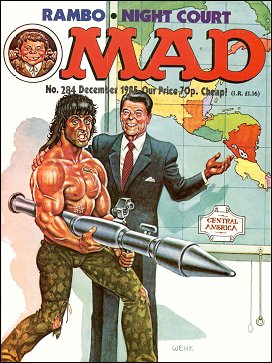
As a kid who was weaned on Mad Magazine jokes about Watergate and Vietnam, the sudden political shift towards the likes of Canada's very own Brian Mulroney, the U.K's Margaret Thatcher and The Greatest Single American That Ever Lived, Ronald Reagan, came as something of a shock to my system.

It wasn't just the politics either. The trickle-down cultural repercussions of the Reagan Era had a definite impact on the pop culture zeitgeist of the decade.

Being an even bigger Leftist Commie Pinko Canuck back then than I am now, I went and wrote a paper for my propaganda course at Concordia on propaganda in current popular culture. It focused on many pop culture phenomena that today are remembered as beloved icons of many people's childhoods. I'm not going to get all curmudgeonly and name names but the paper focused on what I, at the time felt, was a disturbing trend toward increasingly violent, simplistic and militaristic TV shows and movies, often aimed at kids.

One of the greatest examples of this trend, the Rambo movies, however, did not figure in my paper. The reason for that omission was simple. People who discuss and comment on movies that they have not seen were then, and are still, one of the banes of my existence. And I simply could not bring myself to watch any of those movies. 

I have not seen a single one of the Rambo movies in all the years that have passed since.


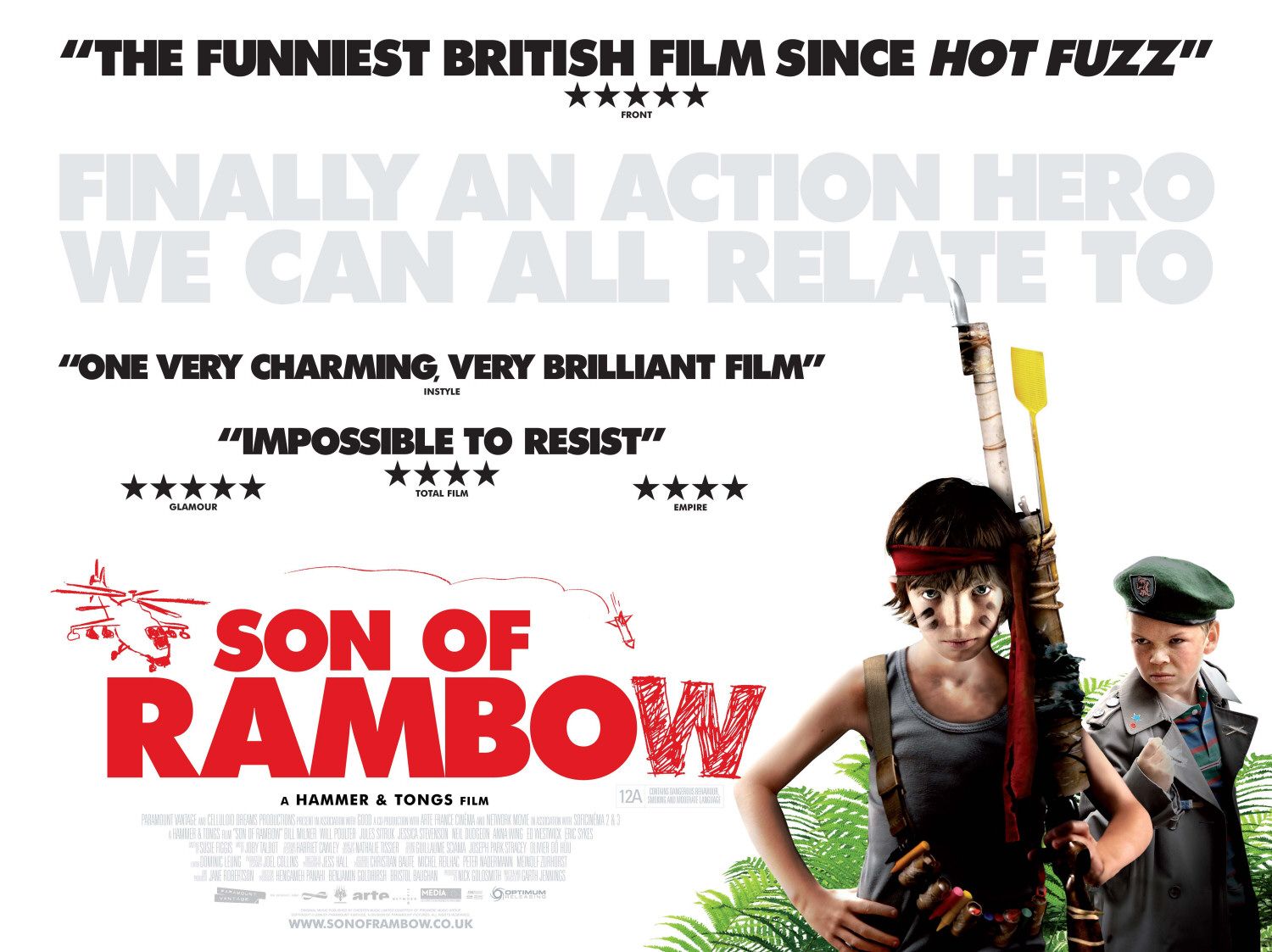
However, not too long ago, I saw an interesting little independent British movie called Son of Rambow (2007). 

Son of Rambow is the story of Will, a kid growing up in the UK circa 1982. Will is being brought up in an environment so religiously conservative that he is forbidden to watch TV or movies.  Nonetheless, the young boy of about 8 manages to see a bootleg copy of the First Blood (1982), the first film of the Rambo series. He instantly idolizes the character of John Rambo.

As is the case with many kids experiences with TV and movies, he personalizes the character in order to face the challenges and struggles in his own life, particularly the death of his father. 

The ideology of the movie is not on the boy's radar, nor does it really make an impact in his life. 

Will decides to write, direct and star in his own sequel to First Blood that mirrors, from a very juvenile perspective, issues he is dealing with during a particularly rough part of his childhood. 

My Concordia propaganda paper aside, the film nicely makes the case that kids personalities and behavior are not changed by TV and movies . Like everyone else, they react to movies based on their personal experiences and feelings. 


Son of Rambow was such an interesting little film that it made me reconsider the Rambo movies. I thought that maybe it's time I experienced what they were all about. Thanks to a marathon on the movie channel, Mpix, and a weekend to myself,  I was able to do just that. 

So in the spirit of the young hero of Son of Rambow, here then are my own personal thoughts and feelings on those quintessentially 80's pop culture zeitgeist action movies...


This poster kept me company while working in a video store in the 80's
First Blood is by far the most subtle movie of the series...and that's not really saying that much. It is a very basic story told on a relatively small scale. Decorated Vietnam War vet John Rambo is harassed by small town cops. He fights back, escapes to the woods and then proceeds to re-enact his own version of the Vietnam War.  In this conflict, however, the Vietnam vet, ironically, is cast as his former enemy,  the Viet Cong. The hapless cops are the Americans forces, attempting to fight an elusive, incredibly resourceful and determined enemy in an unfamiliar and inhospitable natural environment.  

Even from the first film, it is clear that the story of John Rambo is an American story told from a very American perspective. 

Or is it? 

The novel was first published in 1972.
I was amazed to learn that First Blood is based on a novel written by a Canadian, David Morell, and that the director of the movie, Ted Kotchef, is also Canadian.  Kotchef was, among other things, responsible for bringing two of Mordecai Richler's novels to the screen: The Apprenticeship of Duddy Kravitz and Joshua: Then and Now (both shot in Montreal). 

First Blood, in its initial stages of development, was a very different movie than the one that was realeased in 1982.

Stallone was far from the first choice for the role of Rambo. Al Pacino, Robert Deniro, Clint Eastwood and even Dustin Hoffman had all been approached for the role. They all turned it down.


The movie that inspired the original casting and choice of director
After that, the movie was to star country musician turned actor Kris Kristofferson as Rambo. That's not as weird a casting choice at it may sound. Kristofferson was a United States Army Ranger captain before getting into show biz. The rest of the cast was going to be Gene Hackman as the corrupt small town sheriff and Lee Marvin as Rambo's former commanding officer. The movie in that incarnation was reportedly going to be directed by Sam Peckinpah, director of such incredible Hollywood tomes on the nature of violence and masculine aggression as The Wild Bunch and Straw Dogs. Also, the original script followed the novel more closely in which (SPOILER ALERT) Rambo commits suicide at the end of the story.


I only dwell on these "mighta been" scenarios to make a point. First Blood represents a point of transition in the blockbuster Hollywood action movie. 

As I began watching the film and taking in its low key deliberately paced opening scenes, I was expecting one of those smaller scale 70's style action movies. Something like the original Walking Tall, for instance (not the silly Rock remake), which also follows the story of one man fighting corruption in a small town. Even 70's action movies like Death Wish and Dirty Harry, by today's standards, come off as subtle and thoughtful films that examine the issue of the use of violence to maintain law and order.


So as I watched the opening scenes following Stallone's quiet and reserved John Rambo and Brian Dennehy's unassuming yet stern small town sheriff, I started thinking that the film would go on to show how the conflict between the two characters intricately evolves, step by step, in an increasingly brutal and violent confrontation.


Silly me.


No more than 10 minutes into the movie, Stallone starts skillfully kicking the shit of out the one dimensionally corrupt and evil cops. Seemingly seconds after that, he has ran out of the police station and into the woods. Suddenly, we are into fast paced editing and action. The quiet Jerry Goldsmith score has quickly shifted to become one of Mr. Goldsmith's standard "Tunn-Tun-Ta-Ta-Tun-Tun-Tunnnn" action movie scores.  The movie proceeds to follow an A to B plot line from there on in. It's watchable and engagingly paced but certainly not a low key or subtle film.


That, in essence, is what First Blood represents: a shift from the mainstream Hollywood movies of the 70's to the mainstream Hollywood movies of the 80's.  One is quiet, deliberately paced and more nuanced with its themes while the other is faced paced, loud and generally pretty simplistic in its themes. 

It is not all surprising, then, that the script was rewritten so that at end of the movie, Rambo does not commit suicide.  And, of course, I'm not just talking about the commercial considerations of sequels here. One version of the story is a portrayal of the Vietnam Vet as a tragic symbol of all of the lives of young Americans that were both literally and figuratively destroyed by the war. The other version turns the Vietnam vet into the heroic underdog persecuted by an unjust society (in real life, BTW, there are equally valid arguments for both sides, IMO). 

Rambo certainly does not come off as a tragic figure, in true sense of the word. Instead, Rambo, the undisputed hero of the movie, runs around taking out cops (though never once killing anyone), driving trucks over blockades and blowing tons of stuff up, leaving a trail of unwarranted destruction in his path. 

No wonder that little British kid loved him so much.


Rambo's survival in the end of First Blood, for better or worse, opened some big time blockbuster floodgates...


“Boy, I saw RAMBO last night.  I know what to do the next time this happens.”  
Former US President Ronald Reagan, on US hostages in Lebanon
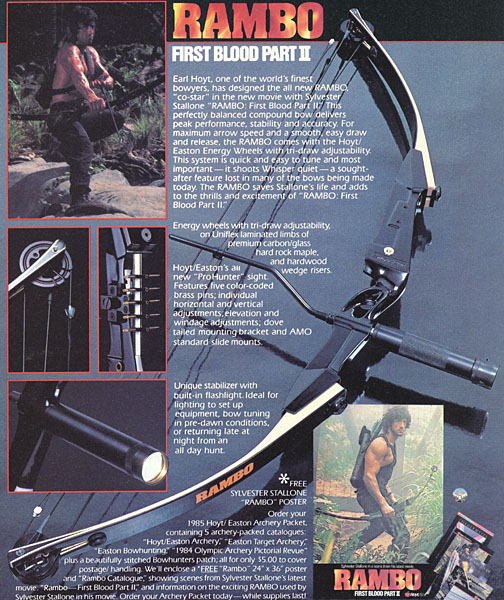
To borrow a phrase from Monty Python, Rambo: First Blood Part II (1985) is where things "started getting a bit silly".

Once again, we get a classic archetype of an American movie that is actually written and directed by Canadians. The director of the the second Rambo film, George P. Cosmatos was born in Italy and emigrated to  Canada later in life. The screenplay was co-written by some Canuck named or other named James Cameron. 


The original Rambo First Blood Part II

The film was an even bigger hit than First Blood. 


So much so, that I remember comedians doing bits about what Rambo II and Rambo III might be like (none of it funny, trust me). I remember thinking "Um...wouldn't that be Rambo III and IV? Does anyone even realize this movie is a sequel?". Nor did it seem to matter that the movie's plot of a Vietnam veteran returning to the 'Nam to rescue POW's allegedly still held captive in the country, had already been done. Two years earlier there was a film called Uncommon Valor (directed, interestingly, by First Blood director, Ted Kotcheff) that told pretty much the same story.


All of that is fitting, actually. Rambo First Blood Part II is movie does not hold up to much scrutiny. 

Nonetheless, here goes.


John Rambo is pulled off of the chain gang he was sentenced to after the events of First Blood. He is sent on a mission to rescue POW's reportedly still being held in Vietnam. In reality, whether or not this was ever actually true remains the subject of great debate and controversy in the US. 

The ill advised Rambo Saturday morning cartoon
Whatever. 

Doesn't matter in Rambo's world. 

Not only are the POW's still there but a weak US government, despite enlisting the help of Rambo, doesn't really want to rescue them. To top it off, the POW's are being held by Vietnamese soldiers who still wear the exact same uniforms they wore during the conflict 20 years earlier. More importantly, good ol' Charlie, it turns out, is in league with those darn Russkies just like everyone always knew they were.


I remember seeing these posters in the Sporting Goods section of Canadian Tire

In this movie, Rambo has been upgraded from a highly skilled yet down-beaten underdog to a one man army superhero. The action is quick and violent. Rambo kills in this movie. A lot. He kills every which way he can. At one point, he blows an evil Vietnamese soldier literally to pieces with an exploding arrow.

Watching this film gave me a flashback to the Westerns I used to watch on TV as a very young kid. I don't remember much about the titles or actors or even plots of those Westerns. All I remember is that the cowboys were continually shooting and escaping from a bunch of Indians (that's what they called Native Americans in movies in those days). Whatever the odds may have been against them, the cowboys always got them injuns, no matter what.

Both those old Westerns and Rambo First Blood Part II are pretty much the same movie. Both take complex gray historical incidents and gloss them over into an overly simplistic shoot 'em up.


Freudian much?

The action in Rambo First Blood Part II is so big and over the top, that at times, it might almost come off as a comedy, or at the very least, tongue in cheek escapism. However, Stallone is determined to not let anything like that happen. The movie is very clearly a fantasy reboot of the Vietnam War, where in Rambo's words, "...we get to win this time". There is a great deal of heavy handed dialogue like "I just want this country to love us and much as we love it." . Stallone plays those lines with every bit of maudlin pathos he can muster. 

Then there's the ludicrous closing credits ballad by Frank Stallone (Sly's bro) featuring lyrics about a "time for healing". 

I'm not sure why the song never charted. 


Rambo First Blood Part II is a juxtaposition of escapist action and obvious messages that ultimately does the movie no favours.


This time around the All American Rambo III (1988) is directed by a Brit, Peter MacDonald.


In this movie, Rambo helps freedom fighters in their struggle against the Soviet occupation of Afghanistan. 

Man, that is so 23 years ago, isn't it?

This installment of the Rambo saga reminded a great deal of films like Mission To Moscow and Action in the North Atlantic. Both were Hollywood movies made during World War II that were, in order to promote war time alliances, very pro-Russian.  They were also movies that got the people who made them into a lot of trouble during the Cold War.


Rambo III's granddad
The approach in Rambo III is quite similar. Rambo arrives in Afghanistan (ostensibly to rescue his former commanding officer but, really, we all know it's just so that he can kill a bunch of Russians).  He is greeted by Afghan freedom fighters. These guys are portrayed in the classic Hollywood tradition of benevolent racial stereotyping. 

There is plenty of clunky expository dialogue explaining how the Afghans are a simple people who are not that different from Americans. They just want their freedom and they are willing to fight for it. 

Just like in the WWII propaganda movies promoting "our Russian friends", the Afghans even get a classically American colloquial endorsement from the hero of the movie. Rambo's Afghan guide tells Rambo that the Russians will never conquer his country. He says that many armies, going as far back as Alexander The Great and as recently as the British in the 1919, have tried but have never been successful. The guide asks Rambo if he knows what that means. Rambo replies, "It means you don't take any shit".


"Hello. Historical Irony Department. Can I help you?"


The movies were also known as Sylvester Stallone's Muscle Ego Project.


Rambo III is even more violent than Rambo First Blood Part 2.  However, watching the Rambo formula unfold for the third time, all the details of whose head got shot off by what kind of automatic weapon when kinda just blend into each other. 


The film ends with a title reading "Dedicated to all the people of Afghanistan".  There is a similar message about the Russians at the end Mission to Moscow. 


James Bond also fought the Russians in Afghanistan
The Afghan freedom fighters, historically know as the Mujaheddin, but never refereed to as such in the film,  later evolved into Al Quaeda and the Taliban. I'm sure there's a conspiracy theory out there somewhere that blames 9-11 on Rambo. Thankfully, there are no scenes featuring Rambo fighting side by side with a young and up-and-coming Mujaheddin named Osama bin Laden. That woulda been kinda hard to live down.

Ultimately, the Russians did finally manage to exact their revenge on Rambo. Shortly before the film's release, the Soviet Union announced that it would be  withdrawing all of its forces from Afghanistan.  The news was enough to cost Rambo III the number one spot in the box office grosses on opening weekend.


Darn Russkies...


Flash forward 20 years....


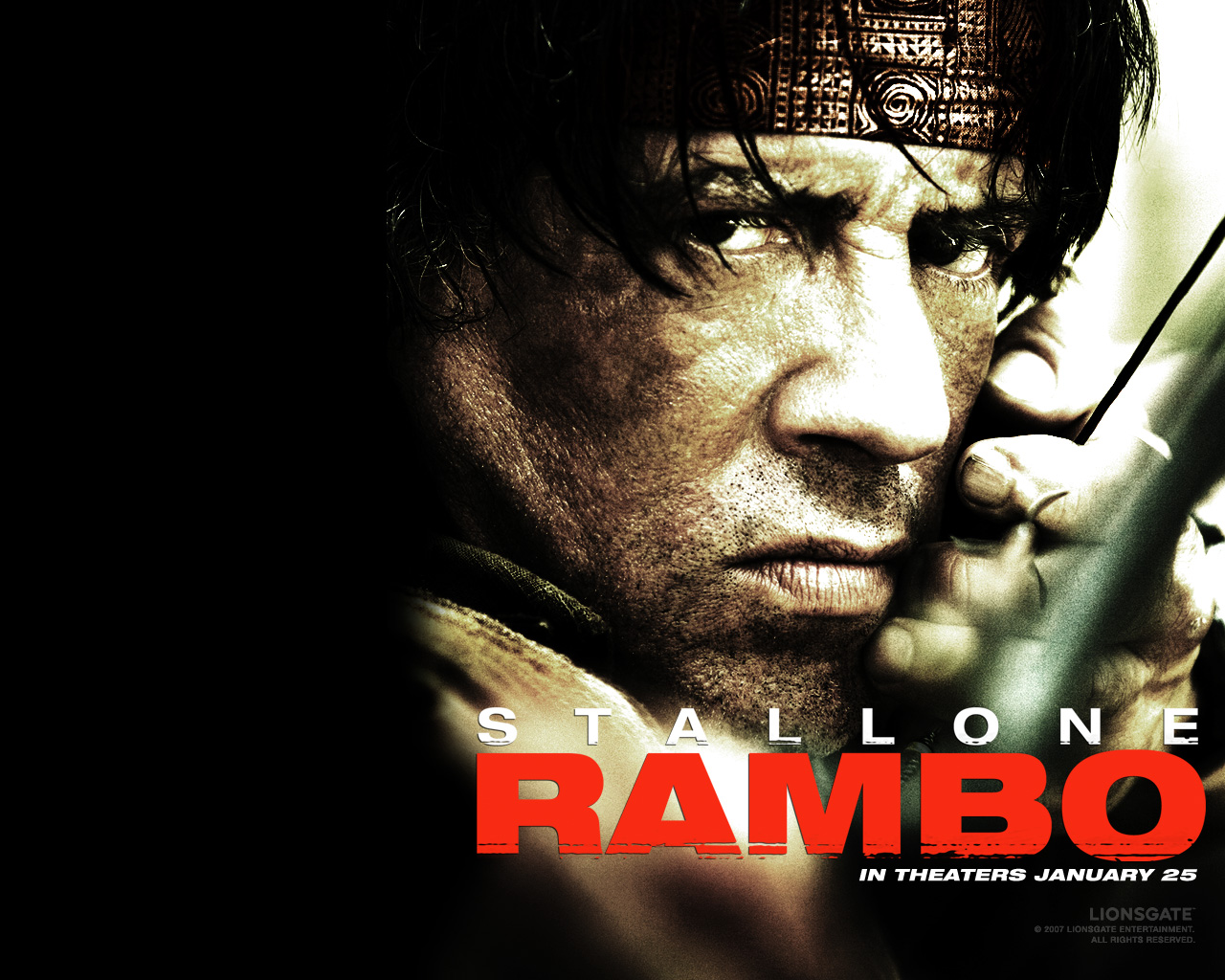
I remember seeing this poster next to the poster for the 2008 Indiana Jones movie and checking my calendar.

Sylvester Stallone, now 62 years old, feels a sudden need to reboot his career. He had done well two years earlier resurrecting Rocky after a sixteen year hiatus. So he decides to revisit the other big franchise of his career, Rambo.


Titled simply Rambo (known in some areas as John Rambo or Rambo IV or, my personal fave variation on the title, Rambo First Blood Part IV), this is the only movie in the franchise actually directed by Stallone himself.  No Canucks or Brits pretending to understand Yanks this time around.


This is by far the grittiest and most violent film of the bunch. The film has a very grainy look. The violence is much more plentiful and graphic. Stallone seems intent on steering away from the exaggerated hyper reality silliness of the first three movies.  For instance, flashback scenes from the previous films are quickly edited and shown in washed out sepia tones.


Julie Benz, Stallone's co-star in Rambo, was 10 when the first movie came out
Much to my surprise, Rambo's one man army does not in any way get involved in the War on Terror. I mean, really, what a great opportunity for John Rambo to return to Afghanistan and redeem himself for his inadvertent role in the founding of Al Quaeda. He could have single-handedly taken out the Taliban, Al Quaeda and Bin Laden himself (and beat Obama to it to boot).


However, Stallone wisely avoids such too close to home issues. He uses the opportunity of a Rambo revival, instead, to bring attention to the on going human rights violations in Burma. These violations have gotten little or no press ever. The situation is quite graphically depicted in the film.  When Rambo literally blows the Burmese bad guys away with a great big machine gun, it was the only time in the series where I found myself actually sort of on board with Rambo's actions.


Political activists have, believe it or not, praised Rambo for bringing awareness to the situation in Burma. I can't help but wonder how the activists really feel about such awareness being raised by such an incredibly violent film. Especially one that ends with a life long avowed pacifist pounding a dying Burmese soldier repeatedly in the head with a rock. 


Reportedly owning a copy of a DVD of Rambo in Burma is a crime for which you can be immediately imprisoned. Get caught selling a copy and you could be put to death.


You know, I'm not the biggest fan of these movies either, but, dude, c'mon...


Until the next sequel....or next blog post, whichever comes first....

Friday, May 20, 2011

Weekly Goofy Movie Clip "Acting Cliches 101"

his is a short scene from The Lost World: Jurassic Park (1997), It comes early on in the film. Jeff Goldblum gets recognized on the subway as "that dinosaur guy". The rest speaks for itself.


It seems that Steven Spielberg's attorneys will not allow me to embed into my blog the video that they just allowed me to upload to Youtube.

Anyway, you can watch the scene by clicking here. Mr.Spielberg's lawyers apologize for the inconvenience.


I have no idea who the other actor in the scene is but, in about 50 seconds of screen time, the guy manages to nail almost every acting cliche in the book.

Actors are often trained to "find the moments" in a scene. It seems like this actor is trying to find one about once every ten seconds. One of the lines that is commonly heard in acting classes is, "Chewing gum is not a character". This actor has not been to any of those classes. Oh, and did you catch that little subtle display of his mime training in that little dinosaur bit he does?

And on top of everything else, I really could not tell what his intention in the scene is supposed to be.
The IMDB entry for this film does not even list the role. Sadly, this brief appearance in a Steven Spielberg blockbuster was not quite the big career break this actor seems to have thought it might be.

On the other, sir, if you are reading this: here we are discussing 49 seconds of your screen time some 14 years later so I guess that's something.


Watch for The Weekly Goofy Movie Clip post of "He Had on a Hat".

Same Bat Time...ish

Same Bat Blog.