"I have wrought my simple plan If I give one hour of joy
To the boy who's half a man
Or to the man who's half a boy"
Sir Arthur Conan Doyle,
author The Lost World, 1912
The first dinosaur was scientifically designated in 1824. The term "dinosaur" (Greek for "terrible lizards"-more or less) was coined in 1841. The first novel featuring dinosaurs that avoided extinction, Journey to the Center of the Earth by Jules Verne, came out in 1864.
I'm surprised it took that long.
The public's fascination with these previously unknown prehistoric creatures was almost immediate. As early as the 1850's, museums that displayed the first complete dinosaurs skeletons were experiencing record attendance.
Monsters of one kind or another have always been part of our culture. Mythology is full of creatures like sea servants and dragons (the inspiration for the dragon myths may well have been based on different discoveries of mysterious as-of-yet-unexplained giant bones going back as far as 2000 BC). With dinosaurs, the monsters no longer had to be exclusively mythological.
Speaking for myself, the most intriguing thing about these great big extraordinarily unique prehistoric creatures is the fact they were once real live animals that lived on the same planet I live on now. This half a man/half a boy is a big fan of dinosaurs movies in general. In particular, I am a fan of movies that I sometimes like to refer to as the Most Besest Dinosaur Movies Ever.
Like the dinosaurs themselves, dinosaur cinema has seen, in my opinion, three different cinematic versions of the geological ages that marked the dinosaurs' time on Earth: Triassic, Jurassic and Cretaceous. Each of these ages marks the cinematic evolution of the dinosaur genre. Through the Cinematic Ages of the Most Bestest Dinosaur Movies Ever, the dinosaurs achieved the one thing that evolution had denied them: survival.
The emergence of the Cinematic Dinosaur Ages is rooted firmly in literature. In 1912, Sherlock Holmes creator Sir Arthur Conan Doyle wrote The Lost World. His novel sealed the deal on the popularity of speculative fiction concerning dinosaurs. Conan Doyle was reportedly inspired by the discovery of prehistoric plants, thought to be extinct, still living on a plateau in South America. He took that premise and ran with it. The book was quite possibly Conan Doyle's best selling non-Sherlock Holmes novel.
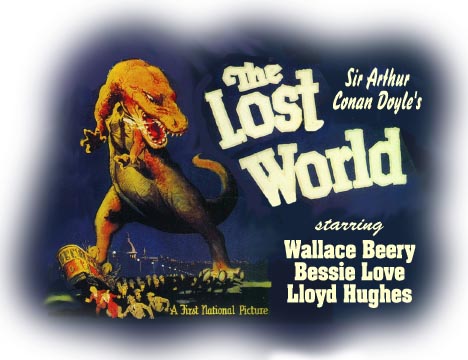
The earliest cinematic depictions of dinosaurs dates back to 1913. That year marked the dawn of the Cinematic Triassic Age of the Most Bestest Dinosaur Movies Ever. Twelve years later, the age reached its first major evolutionary step with the silent film adaptation of Conan Doyle's
The Lost World (1925).
The Lost World, in both novel and film form, is the story of an expedition that discovers living dinosaurs on -you guessed it- an isolated plateau in South America.
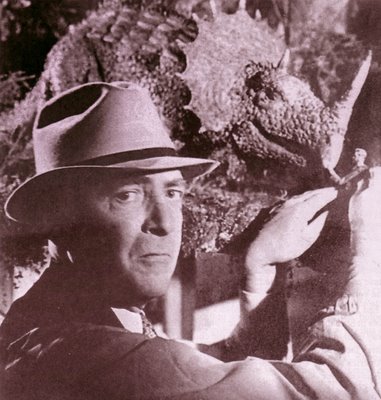
The screen adaptation of Conan Doyle's "stupendous story" was directed by Harry O. Hoyt. However, the success of the film is really in the hands of its director of visual effects, Willis O'Brien.
O'Brien, a former newspaper cartoonist, had been making short films featuring dinosaurs since 1915. He was the pioneer of stop motion model animation, a method that remained the predominant means of bringing live action dinosaurs (and other monsters) to the screen for the next 78 years.
Stop motion animation is a long and tedious process that involves gradually manipulating the movements of miniature models then photographing them one frame at a time. A dinosaur walking across the screen, for instance, can take up to a week to shoot. The method is still employed in current kids TV shows like Lunar Jim and Poko and feature films like the Wallace and Gromit movie and The Nightmare Before Christmas.
The dinosaurs in the The Lost World look are as good or better than many of the movie dinosaurs that would appear in films in the years to follow. O'Brien's painstaking attention to detail really paid off. For instance, he inserted small balloons under the skin of the model dinosaurs. With each frame, the balloons would be gradually inflated and deflated along with all of the other movements necessary for the shot. In the final film, the effect creates the impression that the creatures are breathing. It's the kind of detail that usually only registers with viewers on subconscious level. The animated dinosaurs seem somehow "real" to an audience.
 |
| Willis O'Brien and unknown acquaintance |
O'Brien would go on to the even more challenging stop motion animation for the original King Kong, some eight years later in 1933. He would also do the effects for its sequel, Son of Kong (released, amazingly, in the same year as the original) and the similarly themed Mighty Joe Young (1949). O'Brien won his first and only Oscar for the latter film. Sadly, the visual effects Oscar category did not even exist at the time of O'Brien's earlier work.
The Lost World utilizes one of the most popular premises of the Most Bestest Dinosaur Movies Ever: an undiscovered isolated ecosystem which has somehow permitted the prehistoric creatures to survive for the last 65 million years or so. According to books and movies, there is a massive preponderance around the world of lost islands, valleys, plateaus and centers of the Earth.
The lost land premise also allows for an artistic license essential to making a Most Bestest Dinosaur Movies Ever. The vast majority of these stories do away with keeping the dinosaurs in their respective Triassic, Jurassic and Cretaceous ages. If you followed strict scientific rules, you could never, for instance, see a fight between a Tyrannosaurus Rex and a Stegosaurus. As any seven year old boy will tell you, those two species of dinosaur were, like, 64 million years apart, stupid.
It's a plot device that's basically the same as creating a dinosaur fantasy league.
I finally caught up with The Lost World thanks to an excellent DVD release a couple of years back. It is a DVD restoration that is well worth checking out. Visual effects aside, the movie is quite entertaining and watchable.
The Lost World delivers one of the earliest examples of one of the great cliches of the Most Bestest Dinosaur Movie Ever genre: a giant monster on the loose through a modern city. In this case, a Brontosaurus (not the correct term, I know, but it is the one they use in the movie) loose in 1920's London.
In the years to come, dinosaur movies would ramp that particular action set piece way the heck up.
After the work of the great Willis O'Brien in the 20's and 30's, next most significant Most Bestest Dinosaur Movie Ever appears a little later in the Cinematic Triassic Age: the dinosaur segment in Walt Disney's groundbreaking animated feature film
Fantasia (1940).
The dinosaurs have about twelve minutes of screen time in this classic animated film. Those dozen minutes feature some amazing cell animation. The Disney reputation for perfectionism really paid off here.
In an incredible economy of visual storytelling, all 170 million years of the great Terrible Lizards time on Earth is conveyed in a very short period of time. For the sake of scientific accuracy, the segment was produced with consultation from The Museum of Natural History in New York.
It is common practice with animators to study the movements of animals they will be animating. However, in most cases, the animals in question usually exist. The Fantasia animators studied iguanas and baby alligators to create a sense of verisimilitude in the movements of the animated dinosaurs.
The extinction of the dinosaurs scene that ends the segment was based on then current theory that a massive drought was responsible for killing off all the dinosaurs. The now popular theory of a giant meteor hitting the Earth causing an enormous environmental disaster did not turn up until 1980.
Ultimately, though, has with all things dinosaur, nobody really knows nuthin' fer sure.
Uncle Walt originally wanted the extinction sequence to lead into the rise of mammals, the ice age and then the dawn of man. However, the studio was getting a lot of heat from religious groups (who were and continue to be not so big on the Theory of Evolution) . Disney finally decided to just leave the segment go at the extinction of the dinosaurs.
Contrary to popular belief, creationism did not begin with The Flintstones.
As the Cinematic Triassic Age enters its later stage in the 1950's, the history of the Most Bestest Dinosaur Movies Ever takes an interesting turn.
Japan's greatest contributions to popular culture since World War II have got to be manga, amine, samurai movies and giant monsters. The greatest giant monster of them all is
Godzilla: King of Monsters(1954) (or Gojira, to follow the original pronunciation and title more closely and come off as a really super elitist monster geek.)
Godzilla is a dinosaur. Up to this point, however, no one has turned up any fossil records of any such creature. But, hey, the discovery of a new species of dinosaur in Argentina was just announced the past February so just run with that premise, K?
Godzilla is also a mutant. Just don't expect him to enroll in Professor's X School for the Gifted any time soon.
Godzilla is a mutation caused by the great 1950’s anxiety invoking plot device of atomic radiation. Godzilla was a "prehistoric creature" innocently frozen in ice as the onset of the Ice Age (oh, we're back on that theory again, are we?).
Godzilla was just, like, all frozen in ice and, like, minding his own business when -wham-O! -along come those darn Americans with their silly atomic tests in the 1950’s.
Suddenly, Godzilla is brought back to life in the most unpleasant way possible . The mighty dinosaur of the Nobodyknowsassic Age now possesses the extra bonus feature of wicked mutations. He has grown massively in size and has acquired the ability to breathe atomic fire. Godzilla’s atomic breath is so powerful, in fact, that he is able to melt an entire division of Japanese Defense Force tanks as if they were miniature plastic models.
Yes, the main visual effects approach to Godzilla was a stunt man in a rubber suit smashing lots of miniature cities and armies.
Atomic mayhem is very much a major theme of the original Godzilla. Turns out that, for the second time in less than a decade, Japan, in form of Godzilla, must endure atomic mayhem inflicted on their cities at the hands of the Americans.
The first film was made at a time when Hiroshima and Nagasaki were still very fresh in the emotional and cultural memory of Japan (the atomic mutation premise is also based on an incident where a Japanese fishing boat was exposed and contaminated by US Atomic testing in the Bikini Islands in the early 50's). Images of crowed hospitals and radiation burns come across as very real in the film. It's easy to forget about the guy-in-a-rubber-suit monster that supposedly inflicted all of the damage.
After the original, my second fave film of the series is Godzilla: Final Wars. It was released in 2004 for the 50th Anniversary of the release of the original. In the movie, Godzilla faces off against all of the other monsters he’s fought in his long movie career. In a purist tradition, Godzilla is still played by a stunt man in a rubber suit, even if he is surrounded by other monsters that are clearly digital creations. Godzilla even fights and kills the American CGI version of himself from the 1999 flop American attempt to reboot the Big G.
Ah, bliss.
The original version of Godzilla as it played in Japanese theatres in 1954 was only officially released in North America for the fist time in 2007 (and is now available on DVD). Before that, we were always treated to the US version which clumsily cut in hastily added scenes of American Reporter Raymond Burr. His character's name was Steve Martin yet there was not a banjo or an arrow through the head anywhere in sight.
Do I need to point out that the original Japanese version is far superior?
SPOILER ALERT: the Japanese finally destroy Godzilla with a horrific secret invention. It is a device that utterly destroys the flesh off of any living being. The Japanese government uses the device once and only once when they take out Godzilla. After that, they destroy it. It is is too awful a weapon to ever be used on anyone or anything ever again.
Hint, Hint….United States of America….
As we enter the 1960's, The Cinematic Age of the Most Bestest Dinosaur Movies Ever enter its Cretaceous Period (I know. I know. I'm not following quite the right order of dinosaur ages but you will understand why later).
Creationism is one reason to believe that humans and dinosaurs co-existed. Complete ignorance fueled by inaccurate prehistoric depictions in the media is another.
One Million Years BC (1967) falls into the latter category. The movie also created the widespread misconception that the fur bikini is up there with fire and the wheel as one of the greatest inventions of the stone age.
One Million Years BC represents another popular take on the genre of Most Bestest Dinosaur Movies Ever, the prehistoric period piece. In most cases, the prehistoric period films take the artistic license of completely doing away with all scientific evidence concerning prehistory. This movie is no exception. Dinosaurs of different ages, completely fictional creatures and cave dwellers with access to 1960's hairdressing technology all exist together in the seemingly randomly chosen year of One Million BC.
One Million Years BC's main attraction was was one of the most incredible creatures of any era: Raquel Welch in a fur bikini.
The preceding line was brought to you courtesy of every dad from the 1960's.
As anyone who has seen The Shawshank Redemption can tell you, the best selling poster of Ms.Welch in the fur bikini from this movie was an iconic image of the 60's. Raquel was also responsible for getting the asses of 14 year old boys (who were previously too cool for such childhood obsessions as dinosaurs) into the cinema seats in record numbers. Fantastic Voyage made Raquel Welch a star. One Million Years BC made her a superstar and international sex symbol surpassed only by Bridget Bardot.
But enough about the clearly exploitative commercial tactics utilizing Ms.Welch and her groundbreaking state of undress in mainstream commercial cinema.
Let's talk dinosaurs.
One Million Years BC was produced by Hammer films. Hammer Films is the studio responsible for an endless amount of high grossing 1950's horror movies starring Christopher Lee and/or Peter Cushing in any of the following roles: Dracula, Frankenstein, The Mummy or The Wolfman. Hammer was a very successful British studio with an incredible amount of box office savvy when it came to certain niche audiences. That savvy lead them to do incredibly smart things with One Million Years BC. One was to hire Ms. Welch. The other was to hire legendary stop motion animator Ray Harryhausen.
 |
| Ray Harryhausen and known accomplices |
Harryhausen worked with the legendary Willis O'Brien on Mighty Joe Young. He picked up the stop motion animation torch after the death of O'Brien in 1960, inventing his own brand of the process known as "Dynamation".
Harryhausen worked on such B-movie classics as Jason and The Argonauts (which is not, contrary to my childhood belief, about Canadian football), The Beast From 20,000 Fathoms, Earth vs. The Flying Saucer and all of the Sinbad The Sailor epics.
In One Million Years BC, Harryhausen brings to life all kinds of dinosaurs and other giant prehistoric animals (like, for some reason, a deadly giant tortoise). All of the prehistoric animals in the film follow a clearly laid out rule of the genre, they are immediately and instinctively hostile towards all humans at first sight.
Years before the much more accurate 1981 cave dweller epic Quest For Fire did it, One Million Years BC had no spoken intelligible dialogue. The cave dwellers communicated only in gibberish grunts and yells. Anthony Burgess could not be reached for comment.
One Million Years BC is , oddly, a rare mainstream 1960's film that is pure cinema from beginning to end. It also completely removes any and all foreign release dubbing or sub-titling expenses, thus making the movie an international distributor's wet dream.
One Million Years BC boasts one of the best tag lines I've ever seen for a movie of its kind:
"This is the way it was.".
Harryhausen would continue to dominate the Cinematic Cretaceous Age of the Most Bestest Dinosaur Movie Ever in the 1960's.
His next great contribution was The Valley of Gwangi (1969).
The premise of the movie is super simple: cowboys meet dinosaurs.
If you were a seven year old boy circa 1969, this seemingly once-in-a-lifetime combo of shoot-em-ups and "Rrrarahhh!" was a cinematic experience that, by the end of the movie, would have you uttering the words, "I can die now".
The premise gives us some unique action set pieces. Particularly impressive are the scenes where the cowboys attempt to lasso the titular Allosaurus as if it were stray cattle. The sequence where one of the cowboys attempts to hog tie a Pterodactyl is also a highlight.
The Valley of Gwangi stars James Franscicus. Franciscus also starred in Beneath the Planet of the Apes and Longstreet, the very cool TV show about a blind private investigator. The man was major star on my radar at the time, to be sure. The B-movie/TV actor (the the two mediums were one in the same in that era) pulls off one of those great " always talk in a deep modulated voice, grimace when dealing with physical challenges and smile when talking to women and children" performances that was considered de riguer in the 1960's action adventure movie.
As you may have guessed Gwangi is part of that lost valley/island,/center of the Earth plot device genre of the Most Bestest Dinosaur Movies Ever.

In late 19
th Century
Mexico, a bunch of cowboys discover a lost "Forbidden Valley" where dinosaurs still live. The dinos survival in that area is rather an incredible feat when consider that Mexico’s Yucatan Peninsula is the spot largely believed to be ground zero for the impact of the meteor that theoretically destroyed all the dinosaurs on Earth some 65 million years ago. There are some very big rocks around the valley, though, so I guess that's what did the trick.
After the cowboys manage to lasso Gwangi, the Allosaurus, they bring him back to a small Mexican city (in a wooden cage no less!). Their plan is to make a ton of pesos by making the dinosaur the star attraction at the Wild West Show that Fransiscus works for.
As is often the case with movies that feature a prehistoric creature interacting with civilization, it is a perfect plan with which nothing can possibly go wrong.
What Most Bestest Dinosaur Movie Ever is complete without those super cool flying reptiles known as the Pterodactyl?
Technically there was never any such creature as a Pterodactyl. There were flying reptiles known as Pterodactylus and Pteranodon but never ones called Pterodactyls. That name is mostly a product of popular culture. Uh-huh, yeah....try telling that to the screen writers of any one of these movies.
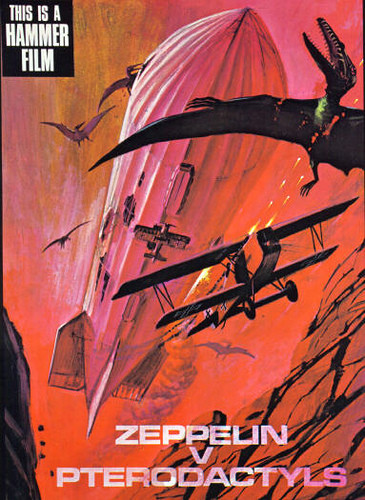
In the Cinematic Cretaceous Age, one species of such a film was extinct before it even evolved. Hammer films, hot of the success of One Million Years BC and their follow-up films When Dinosaurs Ruled The Earth and The Creatures The World Forgot, had a movie planned with the single most promising title ever:
Zeppelins vs Pterodactyls.
Alas, the film was never made.
Aside from the Zeppelins vs Pterodactyls poster carbon dated at some time in the early 70's, the only fossil evidence of the project that exists is this oddball Youtube mash-up of a fictional 1930's movie serial:
And, yes, that's the pterodactyl from The Lost World.
As the end of the Cinematic Cretaceous Age looms, we begin to see stop motion model animation in the Most Bestest Dinosaur Movies Ever start to die out.
Though, the process was never the only way to go when bringing dinosaurs to the screen. Some lower budget films used actual lizards running around over miniature landscapes. The lizards were often filmed in slow motion so as to appear to move like much larger creatures. Sometimes the poor animals would have stuff like a lame looking plastic horn attached to their heads; a practice that organizations like PETA and the Humane Society would surely never allow today.
There was another approach typified by a one classic movie of the upper Cinematic Cretaceous Age of the Most Bestest Dinosaurs Ever.
I have strong memories of it.
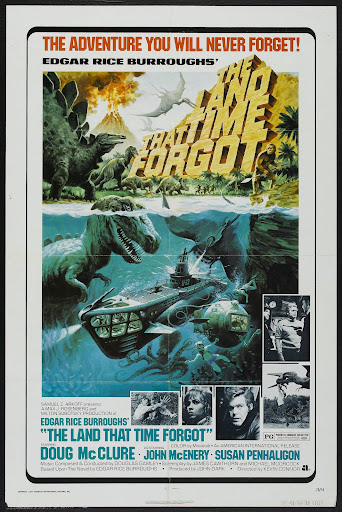 |
| I definitely don't remember the giant prehistoric laser shooting manta ray. |
The Fairview Cinema. The suburban West Island of Montreal. A Saturday afternoon. 1975. 400 hundred kids hyped on Twizzlers and popcorn are packed into the only movie theatre for miles around. The movie was
The Land That Time Forgot (1975) and it
rocked the friggin' room!
I remember not being able to hear the dialogue for moments at a time on account of all the kids screaming or cheering or both at different cool and dramatic points in the movie. This was before the days of super loud movies with a 19.1 Digital Dolby Surround System that have speakers mounted in every square inch of the cinema and a sub woofer that sounds like it has been surgically implanted on top of your eardrum. Back then, a movie theatre had one, maybe two speakers in the whole place. A room of 400 kids could easily drown that out.
Back in the day, when there were no PVR's, DVD's, 3D Blu-ray's, Netflicks, Zip.ca's, cable, digital downloads or even VCR's, seeing a movie in the theatre was a big frakkin' deal. You missed it and you'd have to wait years till the movie came on TV. Then you'd have to watch it exactly at the time aired and watch the commercials ( and there was now way to fast forward through them either). That's my generation's version of walking to 10 miles to school without shoes in a blinding snowstorm every single day.
The Land That Time Forgot is based on the novel by Edgar Rice Burroughs. Famous as the creator of Tarzan, Burroughs wrote the book in 1918 inspired by the massive success of Conan Doyle's The Lost World. In arcane literary terms, this process is known as a "ripp-off".
The premise of the book and film is almost as cool as The Valley of Gwangi. Gwangi had dinosaurs and cowboys, The Land That Time Forgot had a submarine and dinosaurs.
The prehistoric creatures (or all eras and cavemen too, natch) live on lost island in the South Atlantic.
Its kind of a long story but the island is discovered by a German U-boat manned by a mixed crew of German, British and Americans. It's a bit of an uneasy alliance, needless to say, it being the middle of World War I and all.
The Land That Time Forgot features a somewhat more unique approach to dinosaur special effects. The creatures in the movie are all puppets or other non-animated models. Most are miniature and a couple are to scale. Pretty much all the effects in the movie are "in camera", a term meaning that they require little or no post production work and usually appear in the final film as they were originally shot.
 |
| In the words of a good friend of mine: "Pterodactyls are very hard to train." |
In this movie, we get to see Allosaurus, Triceratops,
Diplodocus, the seldom featured undersea dinosaur Plesiosaur and, in what is so obviously a scale model suspended from a crane, the highlight of any dinosaur movie, the improperly named Pterodactyl.
The Land That Time Forgot stars Doug McClure, an actor known for his work on such TV shows as the long running Western The Virginian, the underrated 70's spy show S.E.A.R.C.H. and particularly well know to me for co-starring with William Shatner in The Barbary Coast. McClure is that classic just slightly too old and too pudgy to still be playing an action adventure hero type. Unlike today, male leads in those kinds of movies could get away with that shit.
I remember the consensus about The Land That Time Forgot amongst my friends at time: "Wow! That was amazing! It's so much better than 'The Land of the Lost'!".
The Land That Time Forgot was a sleeper hit in 1975. It was followed a sequel,
The People That Time Forgot (1977).
It is a much lesser movie (yikes!) but it does have a scene that's just about as close to Zeppelins vs Pterodactyls as we'll probably ever see.
Stop motion model animation would still see a couple more flourishes before dying out at the end of the Cinematic Cretaceous Age of The Most Bestest Dinosaur Movies Ever.
Well, the effects might have seen flourishes, anyway. It's hard to say the same for some of the movies they were used in.
Case in point is
Planet of Dinosaurs (1978).
This uber B-movie features dinosaurs that live on another planet altogether. Planet of Dinosaurs has got the odd combination of a unique premise and a very very low budget.
And, no, Planet of Dinosaurs is not about Charlton Heston crash landing on a planet where dinosaurs are the civilized masters who run their cars with fuel made from fossilized remains of long extinct human beings.
Planet of Dinosaurs, however, is not above totally ripping off the spaceship crash landing scene from Planet of the Apes (and about a dozen other things from different movies).
a group of astronauts' spacceship crash lands on an alien planet. The ship sinks into what looks like a small shallow pond and so the space travelers are stranded (where they were going or what they were doing is never really made clear).
It's not long before they discover they are on a planet that has some kind of parallel evolution thing going on. They enounter dinosaurs that look very much like the ones from Earth's past. These dinosaurs are also somehow able to survive in a very barren looking desert. Clearly, the evolutionary process on this planet has some differences from that of Earth's.
Planet of Dinosaurs is the kind of movie that seems to have been tailor made for shows like Mystery Theater 3000 and its internet counterpart, Rifftrax. It looks like most of the casting director's research consisted of watching porno movies. The dialogue scenes are not unlike watching a 70's era adult movie with all the sex and nudity cut out. I'm pretty sure the costume designer got a great bulk deal on disco track suits too.
The dinosaurs are surprisingly well animated. I guess if you're gonna make a movie called Planet of Dinosaurs with a limited budget, you better spend most of that budget on the dinosaurs. The movie is very entertaining, though probably not for the reasons the people making it intended.
Planet of Dinosaurs has an interesting and unexpected conclusion.
And, once again, no, there's no discovering a half buried Statue of Liberty and a "My God, we've been on Earth the whole time!" kinda twist ending.
The Cinematic Cretaceous Age of the Most Bestest Dinosaur Movies Ever comes to crashing halt by the end of the 80's. In it's place, we see something much much greater evolve.
It is finally the dawn of the Cinematic Jurassic Age of The Most Bestest Dinosaur Movies Ever.
See why I switched up the order of the dinosaur ages now?
The Jurassic Park Trilogy (1993-2001) was seminal to redefining the entire genre.
The first film,
Jurassic Park (1993) pulled off the genre re-invigoration feat particularly well. It should. The movie was directed by that great man who is half a boy/boy who is half man, Steven Spielberg.
Jurassic Park was based on the bestselling novel by Michael Crichton. Crichton basically recycled the plot of his great 1973 SF film, Westworld (which he both wrote and directed). Just substitute cloned dinosaurs running amok in a theme park for android cowboys running amok in a theme park and you’ve got the general idea.
Both book and the film present a the clever device of cloning to get dinosaurs into the modern world. No lost worlds, islands or planets here. Well, to be fair, there is an island but it’s not lost, it's intentionally hidden. The dinosaurs on said island are cloned from DNA taken from dinosaur blood found in mosquitoes that have been encased in amber for 65 million years. As any geneticist, biologist or even paleontologist will tell you, this is an extremely plausible, error free scientific hypothesis.
Crichton's was not the first dinosaur cloning story. One of my all time favourite SF writers, Robert Silverberg, wrote a short story back in 1980 entitled Our Lady of the Sauropods . It was about dinosaurs cloned from fossilized DNA. The dinosaurs in this story are on a space station instead of an island. The dinosaurs in Silverberg's story are also depicted as having a collective intelligence not unlike the
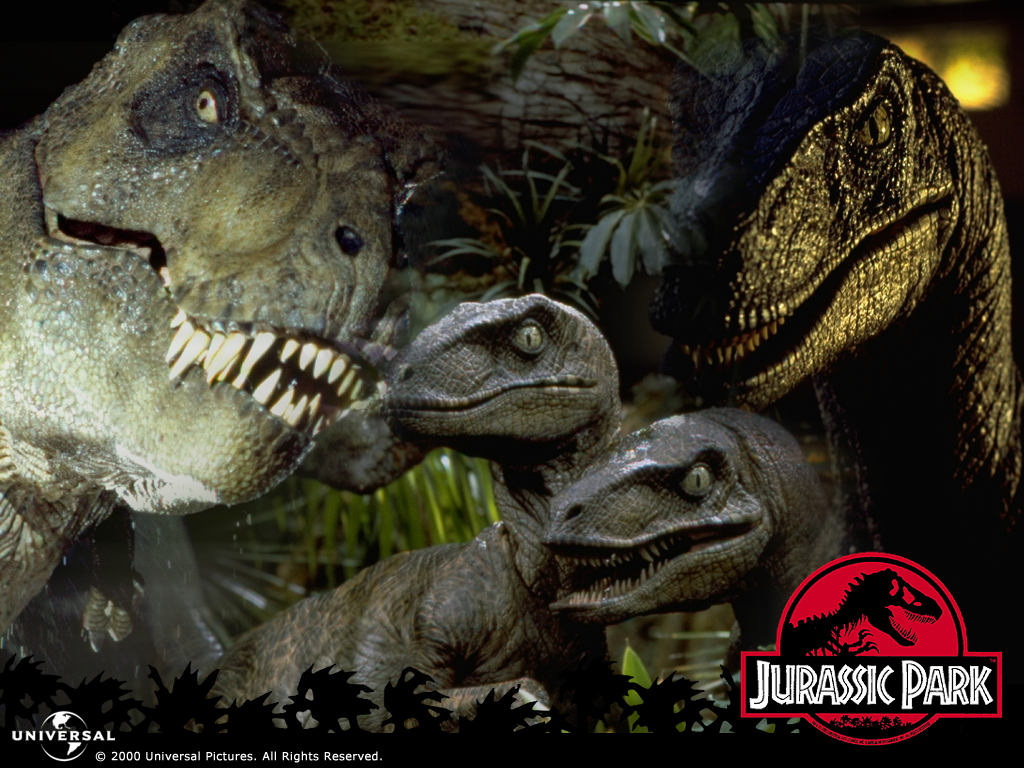
Velociraptors
in Jurassic Park.
What Mr.Silverberg's attorney was thinking back in the early 90's, I have no idea.
I remember going into Jurassic Park with reservations and coming out pleasantly surprised. The Raptors in particular involved some of Spielberg’s best suspense work since Jaws. Not a perfect movie, though, by any means.
Jurassic Park has a great concept, excellent direction and visual effects that make the film worth watching just on their own merit. Its narrative, however, is unsatisfying. The main problem being that darn screenplay by one of Hollywood's favourite scribes David Koepp that, like all of the guys’ screenwriting, falls apart in the crucial final third act. Kinda a bad place for your stories to fall apart there, dude.
It is also very clear that Speilberg knows full well who the major audience for Jurassic Park is, namely kids: lots and lots of kids. He plays to that audience a great deal, often the at the expense of credibility and consistent tone.
 |
| Scale puppets stood in for CGI in closer shots |
The dinosaurs of Jurassic Park (and most all of the dino films from the early 90's onwards) are the most “real” looking prehistoric animals yet. The visual effects that brought the Terrible Lizards of yester-paleontological era to life are truly groundbreaking. Jurassic Park is a milestone for the use of computer generated images (CGI) in movies. Almost of all of the dinosaurs in the movie are entirely digital creations.
It marked the virtual end of the era of stop motion animation that began in 1915. Once a generation got a load of Jurassic Park, movies like Valley of Gwangi and The Land That Time Forgot are, even for young kids, pretty laughable.
Chrichton’s novel ends with (SPOILER ALERT) all of the dinosaurs on the island of Ilsa Nublar dying horrific deaths at the hands of a napalm air strike. It’s the way the movie would have ended if Francis Ford Coppolla had been directing instead of Spielberg. Imagine Doors music playing while a T-Rex goes down in flames while we hear Marlon Brando repeating the words, "The horror. The horror.".
In the final chapter of the book, we learn that a few Velociraptors
had managed to stow away in a supply boat that left before the island before its destruction. The book ends with the world’s only surviving dinosaurs clandestinely escaping into the deep remote jungles of South America.
What a cool set up for a sequel!
Spielberg didn’t touch it.
Oddly, even Crichton did not take advantage of the potential sequel plot line he set up.
In 1995, Chrichtion realeased the sequel to the novel of Jurassic Park, The Lost World (for once, I will give Mr. Crichton the benefit of the doubt and say that the title is an homage to and not a ripp-off of Conan Doyle).
Presumably the book was written in the wake of the phenomenal success of the movie and Crichton was essentially writing a first draft of the potential sequel. In the book, he creates the notion of the previously unknown Jurassic Park Site B on Isla Nublar's sister island of Isla Sorna. On that island many more species of dinosaurs have been cloned along with those of Jurassic Park. The dinosaurs have essentially been roaming free since the end of the last novel.
The Lost World: Jurassic Park (1997), also directed by Steven Spielberg, went with that premise.
Spielberg's version, oddly, incorporates the destruction of the original dinosaurs from Crichton's first novel has happening some time between the two movies. But it turns out that, unknown to anybody but wily ol's Sir Richard Attenborough, there is a whole other island of dinosaurs right next to the first.
It all kinda brings up a lot of questions. Like how exactly did this guy keep the cloning of dinosaurs and the subsequent existence of huge prehistoric creatures roaming around on two different islands a secret ? Isn't the theory that some of the bigger dinosaurs, like Brachiosaurus, say, could have taken up to 20 years to grow to their full size? Wouldn't that put the beginnings of this guy’s cloning project back in the early 70’s? Isn't that kinda a long time to successfully hide animals that are up to 95 feet long and 40 feet tall in the age aerial surveillance, radar, sonar, satellites and frequent air travel? And what about that air strike on the first island? How did they not notice an entire second island full of dinosaurs?
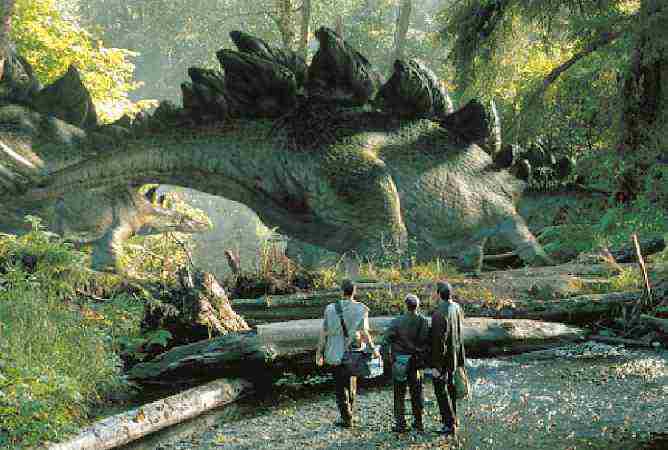
 |
| The Lost World story is simple: good environmentalists vs bad capitalists |
Spielberg's got a really bad real case of “Cool. I get to do all the stuff I couldn’t do in the first one” in The Lost World. It’s one of the film's biggest problems.
The films third and final act features a contrived and really out of place action set piece: the tried and true prehistoric monster wreaking havoc on civilization. Through a series of highly convoluted circumstances, a T-Rex ends up rampaging through downtown San Diego.
"A Tyrannosaurus Rex rampaging through downtown San Diego": kinda sound like a punchline from a Johnny Carson monologue circa 1980, doesn't it?
On the DVD, Kathleen Kennedy, one of Spielberg’s long time producers, says that she warned Spielberg against the ending. The original ending had our heroes attempting to fly off of the island while under a pterodactyl attack (Yeah! Zeppelins vs. Pterodactyls at last!).
Spielberg, she says,wanted to change the third act of the film at the 11
th hour. He was obsessed with getting the ol’ Godzilla movie shtick in there. Producer Kennedy, however, says that she told him that kind of a sequence really belonged in a different movie.
She was dead right on that one.
The T-Rex rampage scene has a very Speilbergian nod to many another monster on the rampage movie. There is a scene where the T-Rex chases a group of screaming Japanese businessmen down the streets of San Diego. The scene is reminiscent of Godzilla and, oh say, every Japanese monster movie ever made (not to mention the TV series Ultra Man).
I remember when The Lost World came out, I was doing a gig in some small town in upstate New York. A bunch of us from the show went to see the movie on opening day at a mall megaplex nearby. All of the local residents in attendance that day must have really appreciated that Godzilla reference. They couldn’t stop laughing at the running, screaming Japanese businessmen.
We finally got to see some full on Pterodactyl action in
Jurassic Park III (2001).
 |
| Helicopters vs. Pterodactyls? |
Pretty much the only thing I remember from Jurassic Park III are the great flying dinosaurs. They are amazingly well done. No doubt most of the effects ground work had been laid out for the sadly aborted Pterodactyl climax of the Lost World.
The only other thing I remember about Jurassic Park III is there’s something about a plane crashing on the now quarantined Isla Sorna where the dinosaurs run free...maybe... then there’s the army arriving to save the day or something...then it ends with the Pterodactyls flying off the island...or something like that....at some point...with Pterodactyls.
The Pterodactyls parts of the movie are really exciting and cool and good too and they also have Pterodactyls in them.
I think William H. Macy is in Jurassic Park III. He’s really good, as I recall.
He played a Pterodactyl, right?
The Cinematic Jurassic Age of The Most Bestest Dinosaur Movies ever hits unparalleled heights with Peter Jackson's sublime remake,
King Kong (2005).
 |
| Naomi Watts in King Kong does an incredible job of playing off of animated monsters that weren't there. |
Kong is not, strictly, speaking a dinosaur movie but, just like the immortal 1933 classic, there are plenty of dinosaurs in it.
Really good dinosaurs too.
Not only does Jackson's version have the most impressive CGI dinosaurs up to that time, his version utilizes the Terrible Lizards extremely well.
In King Kong, we get back to that good ol' fashioned lost ecosystem premise. Dinosaurs of all types exist on the wonderfully named Skull Island. These dinosaurs, however, have kept evolving over the last 65 million years. It's a wonderful bit of artistic license on Jackson's part that allows him a wide latitude of only having to follow only the scientific rules that suit the film.
I recently read an interview with a paleontologist on-line. He was asked to rate the scientific accuracy of the prehistoric creatures represented on screen in various movies. He praised movies like The Valley of Gwangi for following the paleontological behavioral theories of the day. However, he came down very hard on the 2005 Kong for getting a lot of the physical characteristics of dinosaurs like Tyrannosaurus Rex and Brachiosaurus
wrong. Didn't the guy watch the extras on his DVD? Dude, what kind of scientific method is that?
Skull Island is also full of any number of fictional giant bugs, worms and penis-like creatures that suck people to death head first in the most Freudian manner possible.
King Kong himself , though, is perhaps the most curious inhabitant of the island.
Kong may have been based on species of a prehistoric gorilla known as Gigantopithecus. Gigantopithecus never would have co-existed with dinosaurs. The prehistoric ape was on Earth much later: from one million years ago to three hundred thousand years. The extinct primate stood approximately 10 feet tall (Kong is 25 feet tall in Jackson's version) and would have been around at the same time as early man. Some think that Gigantopithecus may have inspired legends like those of the the Yeti and Sasquatch (or, if you are really hardcore about it, the giant ape still lives and
is the Yeti and Sasquatch).
 |
| Yeti, Sasquatch or King Kong? |
A more likely scientific hypothesis is that the producers of the original movie thought that a big ape attacking stuff would be cool and that the studio ordered them to make use of all the expensive dinosaur models they made for an earlier movie that was never finished.
Take a look at one of my fave scenes in King Kong. It is a deleted scene that turns up on the extended cut available on DVD and Blu-ray.
I'm pretty sure those sub-titles are actually lyrics to a Bjork song.
Yep. Nothing phases these old school pulp jungle adventure men of the 1930's, does it?
I highly recommend the extended cut version of the Peter Jackson's King Kong. My first reaction to the prospect of a new, three hour version of Kong was "Uh-oh. It was already kinda long as it was".
The theatrical release of King Kong is a great yet flawed movie. The three hour version is a vast improvement. Without getting into any spoiler alerts, putting a lot of the cut scenes back in makes many parts of the film make more sense and helps the movie work better a whole.
At three hours, watching the extended Kong is more like watching Lawrence of Arabia, Ben Hur or any of Jackon's Lord of the Rings movies: a large commitment that is well worth it.
Plus, as you can see above, there are some just plain killer extra action stuff.
The extended cut changes a pretty good movie it into a thoroughly satisfying epic tour-de-force adventure epic.
 |
| The not-Brontosauruses |
It is unlikely that the Cinematic Jurassic Age of the Most Bestest Dinosaur Movies Ever will see extinction. There may well be a couple of box office meteors that will impact the genre for a time. Ultimately, though, the pop culture fascination with the great extinct Terrible Lizards will always lead the creatures to resurrection.
Dinosaurs are still a popular staple in both big blockbuster movies and in the CGI (it is now a low budget effect) direct-to-DVD thrillers. A T-Rex even turned up in a 2008 movie version of one of the dinosaurs movie's remote ancestors, Journey to the Center of the Earth.
One question that comes up a surprising amount of the time in my circle of friends is "If you had a time machine and could only travel back in time to one time period, what would it be". My answer is always the same:
"Hands down, I would go back in time just to get a look at living dinosaurs. I wanna know if the movies got it right".
Finally, my personal thanks for this post goes out to all the good people at Blogger. They clearly saw that my first draft of the post needed work and so very considerately crashed their entire system just before my usual posting day. They didn't let the fact that I'd actually saved all my work before the crash get in the way either. They made extra certain that almost all of my writing was lost.
Ultimately, I finally had to rewrite 80% of the material all over again.
Thanks guys.
It will not be forgotten...