About Me

My photo
Montreal, Quebec, Canada
I am a Montreal-based actor, writer and comedian. When U.S. President John F. Kennedy was shot, I was three days old. I cried all day. My favourite books of all time are Moby Dick by Herman Melville, The Last Temptation by Nikos Kazantzakis and The Ewoks Fun Time Activity Book by Chirpa and Pamploo. I am a member of The Vestibules, On The Spot Improv and The Best Buy Battery Club. Except for the Battery Club, I've been at all this stuff for over 20 years. Enjoy my blog.
Showing posts with label The Avengers. Show all posts

Tuesday, June 26, 2012

Act of Valor, Hollywood and The Pentagon


Watching Act of Valor, the recent film in which active duty US Navy SEALs portray themselves in a Hollywood war movie gave me some very mixed feelings.

For one thing, the casting of real life warriors in a war movie further blurs the already heavily blurred line between escapism and war in Hollywood movies. Let's face it, every Hollywood war movie from Rambo to Abbott and Costello's Buck Privates has some kind of an agenda behind it. Entertainment and escapism are usually only half of the picture when it comes to Hollywood's military themed movies.

Hollywood, especially in recent years, is often categorized as a left leaning, liberal industry that predominately pushes a "radical" leftist viewpoint. When it comes to Hollywood and the military, though, that assessment of the American film industry comes off as, well, ill informed at best.


On Wilshire Boulevard in Los Angeles, in and amongst the production companies, talent agencies, entertainment lawyers and other ancillary show biz industries, there is a building that houses the entertainment liaison branch of the Office of Public Affairs of the US Army, Air Force, Navy and Marines. The function of these offices is to help provide "U.S. military assistance in producing feature motion pictures, television shows, documentaries, music videos, commercial advertisements, CD-ROM games, and other audiovisual programs...".

Act of Valor represents what some might categorize as the ultimate culmination of  said "U.S. military assistance". It is also part of a long standing symbiotic relationship between Hollywood and the Pentagon, sometimes referred to as the "Military Entertainment Complex".

The US Department of Defense has been offering help and assistance to Hollywood in the making of war and other military themed movies at least as far back as the 1915 feature film The Battle Cry of Peace:  A Call to Arms against War. This very early silent film tells the story of how foreign powers manipulate the pacifist movement in the US in order to leave American unprepared for a (fictional) invasion of New York and Washington. The movie featured actual US troops along with real generals and even an appearance by the current Secretary of War (as the title was known then) at the time. It doesn't take a great deal of political analysis to understand why the military might want to support such a movie.


Wings, a 1927 movie about World War I fighter aces that was the first film to ever win the Best Picture Oscar, also received US military assistance. This assistance was especially useful when it came to recreating aerial battle scenes. These scenes featured real planes shot from wing mounted cameras. To this day, it is considered some the greatest biplane dogfight footage ever shot.


Yep, the Hollywood Pentagon relationship is a pretty simple formula, really. Want to get shots of tanks, planes and an army of thousands in your movie? Don't want to incur a massive production and/or special effects budget? 


Simple. Get Pentagon cooperation. They'll let you use their personnel and equipment for next to nothing.


The catch? The Pentagon gets script approval. 


That's right, you want their hardware, they get to tell you what can and can not go into your movie. 


As you might guess, The Pentagon usually has got a quite specific agenda of their own. And that will be most certainly represented in their script notes. The history of The Pentagon's involvement with Hollywood has impacted many military themed and war movies in significant ways. Many such films have seen changes that intrinsically alter their meaning and substance. 


WWII veteran and celebrated American novelist James Jones wrote an epic length novel in 1951 titled From Here to Eternity.  In the book, Jones tells the story (based largely on his own experiences) of a group of soldiers stationed in Hawaii during the time leading up to the Japanese attack on Pearl Harbor in December 1941. The book is an unflinchingly frank account of military life from Jones' personal perspective. It depicts a system where, for instance, a corrupt Captain is not punished or reprimanded by the Army for his actions. Rather, he ends up getting promoted.

The Pentagon made it clear from the outset that they would not lend their support to any movie based on Jones' book. Unfortunately, making a film adaptation of From Here to Eternity without Pentagon support was cost prohibitive due to the amount of men, equipment and locations required to do justice to Jones' novel. The studio, Columbia Pictures, and the Pentagon were gridlocked on the issue.

Finally, the studio made the move of showing the Pentagon a shooting script before pursuing the issue of assistance any further. The script in question already contained changes to many of the more "undesirable" elements in Jones' novel. The corrupt Captain, for example, does not get promoted but instead is caught and dealt with appropriately. The director of the 1953 film adaption of From Here to Eternity, Fred Zinneman, once said that the scene where the Captain receives his comeuppance from his superior officers is "the worst moment in the film, resembling a recruiting short."

Which brings up another interesting point.


Maintaining a squeaky clean positive image of the military is one part of The Pentagon's agenda in Hollywood movies. It does not stop there, though. Beyond just providing a positive public image for the military, Hollywood movies can also be great recruiting tools. This can be especially true of movies aimed younger audiences, particularly teenage boys.

The 1982 Bill Murray comedy Stripes was, believe it or not, approved of and supported by the US Department of Defense. One of the first things that the Pentagon had changed was to eliminate all drugs and drinking scenes from the script (and there were plenty in the first draft, apparently).  They also had a hand in the "losers become heroes" action comedy sequence that dominates the second half of the film. During that part of Stripes, the character of Sgt Hulka, the career Army Drill Sergeant played by Warren Oates, comes off as a resourceful, heroic and ultimately likable character. The portrayal of the character in the latter part of the movie is a total about face from the unlikable depiction of Sgt Hulka earlier on in which the Sergeant steadfastly plays the role of Murray's uptight authoritarian antagonist.

The film ends with Murray, and his band of supposed military non-conformists, defeating the Russians and being celebrated as heroes, all the while surrounded by a bevy of cute young girls. 

Seriously. Watch Stripes again and look at how pro-Army that movie actually is.

An even more obvious example of the  "Hollywood movie as recruiting poster"  is the 1986 movie that made Tom Cruise a major star, Top Gun. The US Navy gave the filmmakers an unprecedented amount of support and access to their facilitates for the making of the movie. The result is a veritable love letter to aircraft carriers, fighter jets and the cool guys like "Maverick", "Ice Man" and "Viper" that fly them. 


For those of you who may have been in coma  back in 1986, Top Gun was a massive hit, grossing $176 million in the domestic market alone. The success of Top Gun also boosted recruitment in the late 80's. The year after the movie's release, the US military saw an increase in personnel of 20,000 over the previous year. It is a movie that is seen by many as part of a force that gave the image of the military in the US a 180 degree turn around from their much more negative image during the Vietnam era.


The Pentagon has also refused not to support a number of films for very telling reasons.  They turned down a 1963 film called Seven Days in May. The film starred Kirk Douglas and Burt Lancaster and was directed by John Frankenheimer (The Manchurian Candidate) from a screenplay by Rod Serling (host and creator of TV's The Twilight Zone). It was about military led coup against the US government.  


The Pentagon also retroactively withdrew support from Clint Eastwood's 1985 war movie, Heartbreak Ridge. It seems that Eastwood refused to cut a scene in which his character shot an unarmed Cuban soldier during the 1983 US invasion of Grenada. Not surprisingly, The Pentagon objected to the depiction of a US Marine committing an act that would be seen as a war crime. They had supported the film during shooting but any onscreen acknowledgement of their cooperation was withdrawn from the movie. The contentious scene did stay in the picture, though.

In the case of two classic Vietnam War movies, Francis Ford Coppola with Apocalypse Now and Oliver Stone with Platoon, both side stepped the Pentagon support issue entirely by shooting in the Philippines. They enlisted the help of that country's military to play the role of the US military whenever major amounts of men and equipment were called for. Though both of those filmmakers also ran into plenty of trouble contending with some highly unstable Filipino politics during filming.

The 1996 alien invasion blockbuster Independence Day is a movie that you'd think the Pentagon would have been all over. However, they objected to the part of the movie where it is revealed that the US military has been secretly experimenting with alien spaceships on a US Air Force base in Nevada known as Area 51 since the 1950's.

More recently, the Pentagon refused to provide support to this summer's Marvel studios blockbuster, The Avengers. They reportedly objected to scenes where Colonel Nick Fury, played Samuel L. Jackson, was seen taking orders from a nebulous international committee.

The Avengers plowed on without the Pentagon's support. One of the advantages of a big CGI budget, I guess. Too bad, though. Imagine if they'd have been able to shoot on a real life SHIELD Hellicarrier.


Not all blockbusters followed the same path as Independence Day and The Avengers. Recent Pentagon supported blockbusters include Battleship, Battle Los Angeles, X Men First Class and all three of the Transformers movies. Transformers director Michael Bay describes himself as "world class ass kisser" when it comes to his attitude toward this kind of support.


Even more recently, Act of Valor has taken the Hollywood Pentagon partnership to a whole new level. 


Back in 2007, directors Mike McCoy and Scott Waugh were making a training film for the United States Navy's Sea, Air, and Land teams, or as they are better known, SEALs. The project eventually led to the idea of making a feature film about the SEALs with members of that elite commando team serving as advisers. In addition, of course, the film makers would also have the full cooperation of the US Navy.  As the planning of the film progressed, it was felt that only the SEALs could effectively duplicate their tactics on screen. The idea of casting actual active duty SEALs to play themselves was born.


While Act of Valor was not directly funded by the US Navy or the Department of Defense, the movie is still very much their baby. To cinch that point, the US Navy had final cut approval of the film.

In the movie business, BTW, that's huge.

Getting final cut of a movie is usually an honour reserved for the likes of studio heads and big money making Hollywood auteurs like Steven Spielberg and James Cameron.

More than anything else, Act of Valor was viewed as a potentially very effective recruiting tool.  It seems that nobody in the Pentagon had forgotten about Top Gun. As far as the Pentagon in Hollywood is concerned, box office numbers are not nearly as important as recruiting numbers.

The resulting film is an odd mixture of a old school Hollywood war movie tropes, standard contemporary action movie explosions and chase scenes, impressive cinematography and some of the the most audacious "stunt" casting in Hollywood history.

Many of the reviews I have seen of Act of Valor focus on the performances of real life SEALs (whose real names never appear on screen).  Many of the critics state that the SEALs are not actors and that, unfortunately, it really shows on screen. Some critics even go so far as to say that the nonprofessional performances distract from the film's ability to entertain. Other reviews from online commentators counteract these arguments stating that the acting is not what's important about the movie or make the case that no one was expecting the SEALs to be great actors anyway or even point out that they've seen worse performances by "so-called professional actors" in other movies ( I, for one, would love to know what movies they are referring to).

See? It's all fake.
The implication of both arguments is that there isn't really anything any one can do when there are nonprofessionals with no acting training or experience in the lead roles. The underlying assumption is that it is simply a given that there is no way they could have been able to pull off convincing performances. 

On that point, I totally disagree.

Act of Valor is not the first movie in history of cinema to use nonprofessional or inexperienced actors.  Victorio de Sica's 1948 Italian Neo-Realist classic, The Bicycle Thieves, featured some incredibly real performances by non-actors. When George A. Romero created the modern day zombie movie with The Night of the Living Dead in 1968, much of his cast was nonprofessional. If anything, that casting worked for the film and not against it. British faux documentary director Peter Watkins has gotten some stunning results from nonprofessionals in films like The Battle of Culloden (1964), The War Game (1968) and Punishment Park (1970). In the hit indie film, Once, director John Carney got memorable performances out of two professional musicians with little or no acting training or background in the lead roles .  Closer to the war movie genre, World War II veteran and inexperienced actor Harold Russell won an Oscar for his portrayal of a disabled war hero in William Wyler's 1946 film, The Best Years of Our Lives. Stanley Kubrick worked wonders with former US Marine Corps Drill Sergeant R. Lee Ermey (and other less experienced actors) in his Vietnam War movie, Full Metal Jacket (1986).

If the SEALs performances in Act of Valor didn't work then, really, the responsibility for that failure falls on directors McCoy and Waugh. There are many techniques you can use to get good performances out of non-actors. McCoy and Waugh, however, seemed to have instead decided to direct the SEAL's as if they were experienced actors. The SEALs seem to have been given artificial bits of physical business, fake smiles, forced scenes that supposedly depict a sense of camaraderie, and it also seems like they may have received that dreaded direction for all actors everywhere, line readings (that's when the director tells you exactly how to say any given line of dialogue). These guys are not able to pull off any of those things. The dialogue they are given even contains a few typical action movie one-liners. Dude, seasoned actors have trouble with that shit, what were you expecting?
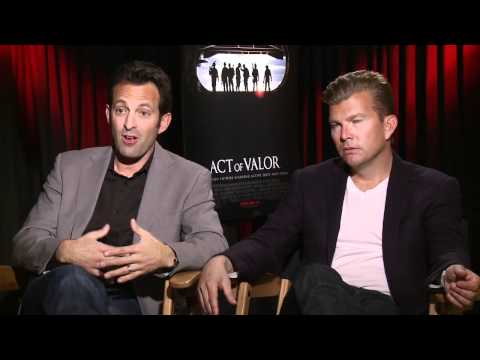


Directors McCoy and Waugh
Getting something real and natural out the SEALs should not have been that much of a stretch. They are playing themselves doing something that live every day.  I mean, c'mon, it's not like they were cast as 57 year old Hindu women. 

Fortunately, The SEALs do have some very real moments, though they are few and far between. When they are in the field on a mission, relaying orders and information to each other in the midst of battle, their calm matter of fact delivery is stunningly real. Act of Valor could have benefited from more of that kind of thing.

There is one scene, in which a SEAL interrogates a captured bad guy, that has incredible life to it. Much of the scene appears to be improvised. I suspect that actor Alex Veadov, (one of a few professional actors in supporting roles, in this case playing the bad guy) has some improvisational training in his background. He and the real life SEAL interrogator provide what is easily the best acted scene in the film. Let actors improvise (professional or otherwise) in a situation where they don't necessarily know what's coming next and eventually real stuff will start happening.

However, directors McCoy and Waugh may well have been on a tight schedule and budget and thus were not allowed the luxury of exploring scenes through improvisation. Or, as first time feature film directors with primarily documentary films on their resumes, they may simply have been too inexperienced in the craft of directing actors. Or perhaps the Navy wanted those kinds of performances, for whatever reason that may have suited their agenda. I've certainly been in enough commercials to know that, as the Mad Men guys like to say, "The client is always right, even when they're wrong." It is probably yet another example of how the Pentagon's influence on Hollywood has once again impacted the content of one more movie.

As an action movie, Act of Valor is okay. The action and the story are well executed. The combat scenes, due perhaps to their verisimilitude, stand out from your more typical fare.  However, Act of Valor is neither just an action movie nor typical fare. In fact, the movie is not nearly as escapist in nature as it attempts to appear to be.


As a recruiting film, going after the target audience of teenage boys approaching enlistment age, Act of Valor is, well, outstanding. As if to cement the goal of reaching their intended audience, some combat scenes are shot from the SEALs' POV, which unmistakably intimates the look of the Call of Duty video games and just about every other first person shooter game out there.

The SEALs at one point launch a rescue mission to retrieve a captured CIA operative (and apparently capturing a CIA agent in the field takes little more than impersonating the guy from room service, but I digress). The agent in question is a woman. While she is depicted as tough and capable, she is still very much portrayed as the vulnerable female captured by crazed and evil men. To hammer the point home, the evil men both symbolically rape and crucify their captor. The SEALs arrive almost literally in the nick of time. It's all standard patriarchal rescue scenario stuff, to be sure.

The SEALs are seen mounting military operations with some extremely heavy duty equipment in the Philippines, Somalia and Mexico. There does not appear to be even a second thought given to the fact that are launching military incursions into foreign countries without any apparent permission or even knowledge of their activities on the part of said countries.

Honestly, at times, Act of Valor fells like Team America minus the puppets and the jokes. Though it is foolish to dismiss this movie so flippantly. One thing I can tell you from my personal experience with the World War  II veterans in my family is that I remember that they always held great disdain for Hollywood's romanticism of war. The cast may be real warriors using real tactics and equipment but Act of Valor is not real war any more that it is merely Hollywood escapism.

As far as I'm concerned the issue of Act of Valor is not whether or not you love it or hate it or whether or you agree or disagree with its ideology. Bigger even then how the viewer feels about it is that the viewer understands what the movie is. Just being able to ask the question of why Act of Valor was made is more important than the answer. Knowledge is power.

Don't kid yourself; no matter what the motivation behind it, there is no truth to the phrase "it's just a movie".


Friday, May 4, 2012

The Avengers and The Movie Crossovers That Never Happened


The Avengers have arrived.

The long awaited big screen adaptation of the legendary Marvel Comics superhero team in is finally playing in theaters. There has never been a crossover movie quite like The Avengers; characters established in their own original movies, made with the express intention of later putting those characters together in one big movie. The hype surrounding the release of Iron Man, Iron Man 2, The Incredible Hulk, Thor and Captain America was not just about the opening of a big blockbuster movie in and of itself.  As much as anything else,  the hype was also about how each movie brought the world one set up closer to The Avengers.

Movie crossovers are nothing new: Frankenstein Meets The Wolf Man, King Kong vs Godzilla, Alien vs. Predator...the list goes on. Granted, putting Frankenstein and the Wolf Man in the same movie was as an after thought and not the reason why they made a Frankenstein and a Wolf Man movie in the first place but, still, you get the general idea.

It's all been done.

Or has it?

What about those crossover movies, some potential dreams comes true, some potential nightmares come true, that never quite made it into movies theaters?

 In the world of Hollywood Development Hell that is the movie business, many ideas, crossover and otherwise, are talked about. Few come to fruition.


Some of those ideas can run anywhere from the bizarre to the unfeasible or, in some cases, both.

Take, for instance, these examples...


The Beatles in The Lord of the Rings as Directed by Stanley Kubrick
Speaking as a huge fan of all three of the above, I am so glad this project never came to be.


Back in the day when Beatlemania was all the rage, The Beatles original old school show biz manager, Brian Epstein, signed a three picture deal for the The Fab Four with United Artists. A Hard Day's Night and Help! were the first two films of these deals.

By 1966, things had changed a bit since those two cinematic moptop romps were filmed. The Beatles had performed their last live show.  They started smoking those funny cigarettes Bob Dylan gave them. They were among the first people on the UK to drop acid. And, perhaps most significantly, the lads from Liverpool were replacing lyrics like "She loves you, yeah, yeah, yeah. She loves you, yeah, yeah, yeah" with lyrics like "No one I think is in my tree, I mean it must be high or low". 

The Era of Beatlemania had officially bitten the dust.

The boys themselves, now Zuckebergesque millionaires in their mid-20's, decided that they wanted to run their career a little differently from here on in. And they had the power to do pretty much whatever the hell they wanted. As anyone who has sat through the Star Wars prequels can tell you, that kind of creative control in not necessarily a good thing.

The Beatles were now, in part, defined by their own reactions against the earlier part of their career. They no longer had any taste for the incredible amount of handling they had undergone during their Beatlemania phase, for instance. Huge stadium shows were out. Rather than making live TV appearances, they made short films of their songs (early rock videos, really) to show on the Ed Sullivan Show and American Bandstand. And they sure weren't into making silly off-the-wall movies designed to sell soundtrack albums. Nonetheless, there was still a small matter of the contractual obligation they had for that pesky third Beatles movie. Well, if the lads were gonna do a film, they were gonna do it their way. Their, it turns out, lead to some -shall we say?- interesting ideas.

In the mid 60's, Italian film maker Sergio Leone had just created the genre that became known as the Spaghetti Western. The genre was typified by films of his like A Fistful of Dollars and The Good, The Bad and The Ugly. Yep, one of The Beatles movie ideas was that they would be the stars of a western; quite possibly a Leone-like Spaghetti Western. The movie may well have featured John, Paul, George and the aptly named Ringo sporting Clint Eastwood-like hair and beards while slinging their genre deconstructing six guns to the tune of an Ennio Morricone soundtrack perhaps peppered with a few psychedelic sounding Fab Four Country and Western songs.

The movie, oddly tittled A Talent For Loving, was actually scheduled to shoot in Spain. The reason for aborting the production was ostensibly on account of weather problems in that country. Though some might say it was the Hands of the Good Movie Gods intervening. If so, The Beatles would continue to keep those Hands pretty busy for some time to come.

The other idea the Beatles had was to do a film adaptation of JRR Tolkein's classic Fantasy  trilogy, The Lord of the Rings.  Back in the Sixties, The Lord of the Rings was seen as more of a mind blowing trippy hippie kinda book and not as much as the celebrated epitome of all geekdom that it is today. The lads were serious enough about the idea to approach the director of the SF classic 2001: A Space Odyssey, Stanley Kubrick. This made perfect sense because, aside from Kubrick being an accomplished A-list director at the time, 2001 was a movie that was very popular with the hippie crowd in 1968.

The Beatles. Tolkien. Kubrick. 1968. Did I mention the part about those funny Dylan cigarettes and being some of the first people in the UK to drop acid?

Stanley Kubrick's Lord of the Rings, Beatles-style, had already been cast too: George Harrison as Gandalf, Paul  McCartney as Frodo Baggins, Ringo Starr as Sam Wisegamgee and John Lennon as Gollum.

Hey, man, don't shoot the messenger.

According to most reliable Kubrick biographies, the legendary director did actually consider taking the job. Kubrick finally passed on the film, though, on the grounds that the books, even with his 2001 visual effects team on the job, were unfilmable. In the pre-Industrial Light and Magic and CGI era, Kubrick was right.

While a Kubrick LOTR would have been fascinating, God knows how much of Tolkien would have actually made it to the final cut. Just ask Antony Burgess, Stephen King and Vladimir Nabokov how Kubrick film adaptations worked out for them.

Not to mention that The Beatles are not actors. They would have been plugging their own personalities into pre-established Tolkien characters. So the movie would have ended up with a Maharishi-like Gandalf, a over-the-top cutesy Frodo, an angry anti-authoritarian Golum and a goofily downbeat Sam.

It's also rumoured that, after Kubrick turned the project down, British film maker John Boorman was approached. Boorman too would have been an "interesting" fit, having gone on to direct films like Deliverance, Excalibur and one of the trippiest SF exercises of all time, Zardoz.

According to Peter Jackson, it was Tolkien himself, by virtue of the fact that he was still alive at the time, who put the ultimate kibosh on the whole bizarre mash-up of a project.

The Beatles finally ended up getting their long desired hippy dippy adventure movie and got to honour their United Artists contract at the same time. The solution to both problems was the animated film, Yellow Submarine. The animated movie was appropriately psychedelic to the era. It also demanded very little of The Beatles, outside of writing some new songs and appearing in a short live action epilogue at the end of the film.

Another crossover that never happened...


Zeppelins, Dinosaurs, Vikings and Nazis
With a line up like that, how could you go wrong? 
Well, let's start with never making it...


While none of the above elements were established movie franchises per se, they were, and still are, elements that, even by themselves in just one film, can make for awesome movies.

Hot on the heels of the success of the original 1933 King Kong, producers and directors Ernest B. Schoedsack and Merian C. Cooper were approached by MGM studios to make a fantasy adventure movie so big that it would make King Kong look like a spider monkey. The movie in question was to have been titled War Eagles.

The basic elements of the movie would have gone something like this: explorers discover a lost valley. In this remote valley, descendants of Vikings lost centuries before continue to thrive. Also still existing in this valley: dinosaurs. Vikings and dinosaurs. Of course. De rigeur for any great adventure epic, really.

In addition to dinosaurs, there are also giant prehistoric eagles (the fossil records for which have yet to be discovered, I guess). Naturally, the Vikings ride these giant eagles majestically through the skies. Somewhere along the way, it being the eve of World War II and all, the Nazis attempt to invade the US of A. Their attack fleet is made up, naturally, of Zeppelins. Oh, yes, indeed, my friends, the climatic battle of War Eagles would have featured Vikings riding a top giant prehistoric eagles fighting off Nazi Zeppelins over the skyscrapers of Manhattan.

Total Geekasm.

For the 1930's, War Eagles have been positively Michael Bay in its scope (though probably better directed). The movie would have been in Technicolor, the same process for making colour movies (a rarity back then) used in The Wizard of OZ and Gone With The Wind. Willis O'Brien, the effects legend behind King Kong, was set to do the visual effects. The screenplay was written by Cyril Hume, who wrote many of the hit MGM Tarzan movies as well as the now classic 50's SF film, Forbidden Planet.

With a premise so rich and a team like that, it begs the question: how did this movie not get made?  Well, the answer had something to do with the real life version of World War II.

Producer Cooper was also very much the adventurer. He was a flier and subsequent POW during World War I.  Not unlike the Carl Denham character in King Kong, Cooper shot wildlife documentary footage in exotic locales like Africa and South America during the 20's. On the brink of  the US entry into World War II, Cooper left Hollywood to join the US Air Force, despite the fact he was already old enough to have been exempt from military service. When he left, War Eagles was put on hold. It was never picked up again. At the time of Cooper's departure, the film was pretty far into production too, as this excellent book tells us.

A novel , supposedly based on the unfilmed screenplay for War Eagles, came out many years later, though, I'm told, given War Eagles' history and pedigree, it is something of a let down. IMDB lists a 2012 version of War Eagles, with a similar plot to the original, as being "in development" but it cites no stars, director, writer, producer or studio attached to it.

Hey, Peter Jackson, you showed a great amount of admiration for King Kong in your 2005 remake. Maybe you could get to War Eagles after that Hobbit thing, k?


Star Trek Meets Eddie Murphy
The best idea in blockbuster movie crossovers since Richard Pryor met Superman.


Back in the mid 80's, riding high on the phenomenal success of the first Beverly Hills Cop movie, former Saturday Night Live star Eddie Murphy was just about the biggest comic on the planet. It seems that somebody got the idea of expanding Murphy's comedic range beyond that of just the planet.

Also not doing too badly in the mid 80's was the Star Trek franchise. The feature film series based the seminal SF TV series was hot off the one two punch of the hit movies, Star Trek II and III.  Leonard Nimoy, director and star of the upcoming Star Trek IV,  felt that, after all the emotionally wrenching death, destruction and resurrection in II and III, it was time for the Trek franchise to lighten up a bit. After all, where was the Star Trek movies answer to the show's classic comic relief episode, The Trouble With Tribbles?

Well, the answer certainly wasn't in the idea that came next.

Apparently some of the suits at Paramount Pictures got wind of the lighter direction idea for Trek. I guess they looked at some Beverly Hills Cop box office receipts and suddenly came up with a brilliant idea. Why not put Eddie Murphy in the next Star Trek movie? Unfortunately, their question was a rhetorical one.

Nimoy played the studio's little game and considered the idea. Murphy, reportedly a huge fan, leaped at even the very idea of appearing in a Star Trek movie. The wacky alien concept was bounced around but, in the end, it was decided that Murphy would be funniest if he were allowed to stay squarely in his mid 80's urban context. Thus the idea of a time travel story line was born.

According to Nimoy's book, I Am Spock, Nimoy met with Murphy in the ascending superstar's new sparsely furnished Hollywood Hills mansion. Nimoy writes that both parties,while remaining enthusiastic, expressed reservations over such a crossover and that both were well aware of its potential for failure.

The story goes that someone at the studio suddenly became aware of Superman III, which featured ground-breaking comedian turned movie star Richard Pryor in a central role. The combo of the very funny Pryor and the very established franchise of Superman was, well, poorly received by critics and fans alike. Superman III did okay at the box office yet still sent the franchise into a slump. Somebody at Paramount got appropriately scared of the idea of mixing franchises and of potentially killing both Murphy's and Trek's reputation simultaneously. Keep the two apart, though, and there was almost guaranteed success for each.

That ended up being the right call. Star Trek IV went on to become one the highest grossing Star Trek movies ever. Murphy's next two movies, The Golden Child and Coming to America, are still among the star's top ten highest money makers ever.

The time travel scenario did stay in the picture, though. The part Murphy was supposed to have played in Star Trek IV eventually morphed in the role of  20th century marine biologist Dr.Gillian Taylor, Kirk's love interest.

Imagine if Murphy had stuck with the part that far ; now that woulda been a crossover.


Which brings us to....


Batman vs. Superman
Wolfgang Petersen's Super Perfect Das Bat Force One starring Jude Law and Colin Ferell. 


Cast your mind back the time just after Joel Schmuacher and George Clooney "killed" the Batman franchise; the time when it was painfully obvious that Christopher Reeve would never play Superman again. Around that time, superhero movies were seeing something of a box office renaissance with the success of X-Men and the first Spider-Man movie. Hulk, Daredevil and Fantastic Four movies were also on the way. Not surprisingly, the idea of of reviving both the Superman and Batman franchises was very much one the minds of the people at DC Comics and Warner Studios. Reportedly, the predominant feeling was that bringing life back to Warner/DC's dormant flagship characters would best done sooner than later. Many different options on how to go about reviving Supes and Bats were explored.

What they settled on was Batman vs Superman.

Batman vs Superman...hmmm....well, the idea of getting those two guys together in a movie is a good one and one that is long overdue at that. However, the "vs" angle can be a bit problematic. Anyone who read World's Finest Comics (which regularly featured Superman-Batman team ups) when they were a kid knows that the two superheroes' alliance was generally an amiable one. Sure, in later Justice League and other comics, there was plenty of tension between The Gothamite and the Metropolitan. However, with the exception of Frank Miller's extremely gritty The Dark Knight Returns, relations between the two rarely broke down the "vs" level.

The battling superhero scenario has certainly been done in the comics. Plenty of times, in fact. It's a premise that can work, within certain limits. You can have The Thing vs The Hulk or The Hulk vs Wolverine and even the monumental Marvel-DC crossover of Superman vs Spider-Man seemed to make sense, but when comes to Superman and Batman, the whole "vs" concept just doesn't quite mesh.

Wolfgang doin' the directan' thang
Nonetheless, Batman vs Superman moved ahead. The studio got Wolfgang Petersen, director of such films as Das Boot, The Perfect Storm, Enemy Mine, The Neverending Story, Troy and Air Force One, on board to direct. Petersen stated publicly that he was very into the idea and loved the film versions of both characters that had appeared thus far. In fact, he still claims that he is interested in directing a Batman vs Superman movie some day.

Possible casting choices that hit the rumour mill at the time included Jude Law or Josh Hartnett as Superman and Colin Ferrell or actual eventual Batman, Christian Bale, as The Dark Knight himself. Apparently, Bale was also at one point considered for the role of Superman.

Wow. Imagine. Bale vs Bale. That, I woulda paid good money to see.

Like the Eddie Murphy meets Star Trek idea, however, Warner/DC got cold feet on the idea mixing franchises. Lighter heads prevailed. They decided that it would be better to revive each character separately. If Batman vs Superman bombed, both characters were screwed at box office. If only one or the other bombed, well, they always had Batman vs Superman in their back pocket to help boost the hypothetically less successful franchise.

In time, Warner/DC finally went with Christopher Nolan's Batman Begins. For the Kryptonian's resurrection, there was Bryan Singer's ostensible follow up to the Christopher Reeve Superman movies, Superman Returns. Batman Begins was a huge hit, as was its sequel, The Dark Night (and most likely that will also be the case for the upcoming The Dark Knight Rises). Superman Returns, on the other hand, did well financially but not so well with critics and fans. Whatever the case, there was never any talk of Bale's Batman duking it out with Brandon Routh's Superman.

In fact, now with The Avengers finally here, the DC superhero movie crossover project may well come full circle. Marvel Comics has just made a huge, bold and more than likely very successful move with a feature film version of their superhero team. Warner/DC have apparently been thinking about a potential movie featuring that company's biggest superhero group, The Justice League (also known for years on Saturday morning TV as the Super Friends) for some time. Now, it may well happen.

All Warner/DC needs to do now, is, after the 2013 Superman movie, Man of Steel, reboot Batman yet again (neither Nolan nor Bale are interested in seeing the Dark Knight join the league). Then they just need to tackle the small matter of making a Wonder Woman, Flash and Aquaman movie. And, well, popular or not, they've already established a movie Green Lantern, who could be ready to join the Justice League any time.


But, you know, after looking at the Development Hell process in detail in this post, it's possible that just about every project on this list may well come into being before we will ever see anything like a Justice League or a similarly ambitious crossover movie happen.

Saturday, January 28, 2012

Captian America, The Great American Iconoclast


When the blockbuster Captain America movie first hit theatres throughout the world in the summer of 2011, some countries released the movie not under its original title of Captain America: First Avenger but under the truncated title, First Avenger.

The underlying concern was that the name “Captain America” might negatively impact international box office numbers in some countries due to Anti-Americanism and a general distrust of American foreign policy- notwithstanding the potential brand recognition attached to an over 70 year old comic book hero.  

Paramount Pictures reportedly gave international distributors a choice: Call it Captain America: The First Avenger or truncate it to The First Avenger - but no other variations. In the end, only Russia, Ukraine and South Korea opted to shorten the movie's title.

Given the true history and nature of Captain America's character, however, no country should have had to change the movie's name: Far from being an icon of American jingoism, this superhero often has been one of his nation's most trenchant critics.

On the surface, the reasons for concern are understandable. Outside of comic-book fandom, all that most people think of when they hear the name "Captain America" (or even just look at the guy) is an over-the-top American propaganda figure. Let's face it: Cap's costume is heavily dominated by stars and stripes. It's like Betsy Ross and Edna Mode teamed up to design the outfit. Many observers simply assume that he is a creature of the Pentagon spin machine. Indeed, an informal survey of media coverage of the upcoming Captain America movie found news outlets from CNN to Fox News to the BBC stating that the superhero with the star-spangled shield was created as a propaganda tool for the U.S. war effort during the Second World War.

That is a major misconception: The first issue of Captain America was published by Timely Comics (later Marvel Comics) in December 1940, a full year before America's entry into World War II.


At that time, the American mood towards the war in Europe was largely isolationist: There were still many Americans who wanted the United States to stay out of what was then seen as a European war and none of America's business.

Of course, there were also a number of Americans who took the opposite view. One of them was FDR. Others were hawkish media figures who led a subtle push toward military involvement through movies, radio, newspapers and, yes, even comics.

In the latter case, the push was not always so subtle: The cover of the first issue of Captain America featured a splashy full-colour rendering of the red, white and blue clad superhero punching Adolf Hitler right in the face. Believe it or not, it was a controversial image back in the day.

For Captain America's creators, the legendary Jack Kirby and Joe Simon, both the character and the punch were no accident. Like many Jews in America at the time, Kirby and Simon were concerned with the news coming out of Nazi Germany. The political message behind an American superhero who was ready, willing and able to take on the Nazis was intentional. Simon said in an interview years later that, "the opponents to the war were all quite well organized. We wanted to have our say, too."

After its initial publication, the now-famous Hitler-bashing cover resulted in threats and hate mail for the authors. The underlying patriotic wartime themes of Captain America were embraced by official government propaganda only much later - after the attack on Pearl Harbor.

Sales of Captain America comic books trailed off significantly after the end of the Second World War, and it eventually ceased publication. But 20 years later, the character was revived by another comic-book legend, Stan Lee, who concocted a story about Cap being frozen in suspended animation since 1945, and revived by a newly formed superhero group, The Avengers, in 1964.


In the February 1970 issue, Cap is seen wandering the streets of New York, contemplating the then-current social revolution. Thinks Cap in a classic Marvel comics thought bubble: "And in a world rife with injustice and endless war . Who is to say the rebels are wrong? But, I've never learned to play by today's new rules! I've spent a lifetime defending the flag, and the law! Perhaps I should have battled less, and questioned more!"

Later, Cap bolts out of bed and says of the establishment: "It was the same establishment that gave them a Martin Luther King, a Tolkien, a McLuhan, and a couple of brothers named Kennedy! We don't claim to be perfect . no generation is! All we can do is learn to live with each other - learn to love one another."
Not exactly gung-ho American conservatism, that. It was the kind of nuanced reflection that was a rarity in the anti-establishment era.


A little later in the 1970s, when Watergate rocked America, the Marvel Uni-verse produced its own fictional version of the scandal - and Captain America was front and center.

A subversive terrorist organization known as The Secret Empire attempted a coup d'état against the United States. The group was stopped by Captain America. Later, Cap learns that the leader of the Secret Empire was none other than the president of the United States (who, at that time, of course, was Richard Nixon). The actions of The Secret Empire and their connections with the commander-in-chief were covered up. Like Joe Simon and Jack Kirby many years before him, writer Steve Englehart openly admitted the political intentions of the story; it was definitely meant to be an allegory to Watergate.


Captain America, disillusioned by the whole affair, dumps his American red, white and blue costume, and takes on the identity of Nomad (the man without a country - get it?). It was around the same time that Cap took on The Falcon, one of the very first African American superheroes in mainstream comics, as a sidekick. Captain America was no Archie Bunker in tights.

Fast forward to the George W, Bush era, and you find that the Marvel Universe in general, and Captain America in particular, were still commenting on the times. In a story-line that mirrored the real-life Patriot Act, the fictional U.S. Government passed the "Superhuman Registration Act," requiring all persons with super powers to register with the government as "a human weapon of mass destruction." The superhumans also were required to reveal their true identities and submit to government training. The creed of the post-9/11 era was: "You are either with us or against us." Captain America was most decidedly on the "against us" side: He opposed the Act and refused to register, arguing that such legislation was an infringement of American civil liberties.

Actually, he didn't just argue. He fought. Hard. And a lot. And against his former friends and allies such as Iron Man. Captain America, the onetime "sentinel of liberty," finally went into hiding as a mall cop.
Finally, and begrudgingly, Cap did "the right thing" and surrendered, preferring instead to fight the rest of his political battles in court. But while Cap was being brought into the court house, he was shot by a sniper. Then, Sharon Carter, a SHIELD agent and Cap's former lover, also known as Agent 13, finished the job and killed Captain America.


She was, of course, under the influence of the bad guys at the time. Nonetheless, the circumstances are telling: Captain America was killed by a federal agent while defying the actions of his government in a time of war. The story behind the death of Captain America certainly did not reflect the mainstream jingoism of the post-9/11 Bush Era.

All of which to say: Anyone who understands Captain America's story should understand that the title of the movie should not have been changed - because he is the farthest thing from an icon of unthinking American sabre-rattling. Doing so serves only to fortify misconceptions surrounding a character who has wrestled, more than most real-life thinkers, with the question of what it means to be "American."


Reprinted courtesy of the The National Post
www.national post.ca